
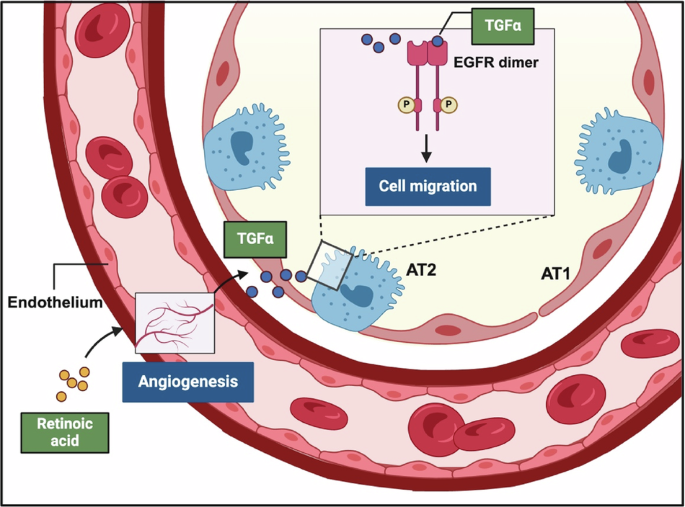
Lung repair involves coordination of multicellular processes, including endothelial angiogenesis and epithelial repopulation. Retinoic acid (RA) signalling is crucial for lung development, homeostasis, and repair; however, the mechanisms through which RA drives repair are still unknown. It has previously been shown that RA has no direct effects on the repair of alveolar epithelium, yet in animal studies, RA induces alveolar regeneration. Here we show that RA induces endothelial angiogenesis, which is associated with enhanced paracrine signalling to alveolar epithelial cells. Transcriptomic profiling of RA-treated HPMECs undergoing angiogenesis revealed enrichment of wound healing pathways, and subsequent in silico analysis identified several candidate mediators of endothelial-epithelium crosstalk. Scratch assays demonstrated that of these candidates, only TGFα promoted wound healing in alveolar epithelial A549 and primary human alveolar type 2 (hAT2) cells. Mechanistically, TGFα was associated with increased epithelial cell migration and activation of EGFR signalling, without detectable effects on proliferation or apoptosis. Our findings indicate that RA-induced endothelial angiogenesis promotes epithelial EGFR signalling through paracrine mediators, including TGFα. This study highlights the importance of endothelial–epithelial interactions in lung repair and provides insight into pathways that may be targeted to enhance alveolar regeneration.
Trending
- Chemo hair loss doesn't define me
- As assisted dying bill returns to Commons, families recall loved ones’ battle to ‘go out on own terms’ | Assisted dying
- Maryam Moshiri: BBC News presenter reveals she has blood cancer
- Cancer survivors living with chemo hair loss celebrate resilience
- Scientists find breast cancer cells hiding behind protective “shields”
- Why Investigate Implant Upsizing in a Mastectomy Skin Flap Necrosis Study?
- Real-World Data Reveals Underdiagnosis of SCLC-Associated LEMS
- In vivo photoacoustic breast imaging and the interactive effects of skin tone, wavelength, beamformer, and depth on target detectability


Monday, September 7
