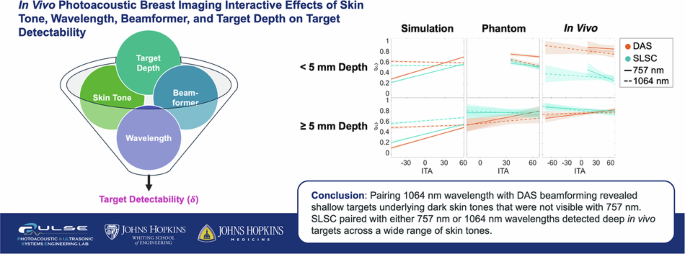
Photoacoustic imaging is promising for breast cancer diagnosis. However, image quality diminishes with greater melanin content with delay-and-sum (DAS) beamforming, which can be resolved with short-lag spatial coherence (SLSC) beamforming. We investigated the applicability of SLSC beamforming to photoacoustic breast data acquired from 29 patients with skin tone individual typology angles (ITAs) ranging −78° (dark) to 71° (very light), acquired with 757 nm and 1064 nm wavelengths. In shallow targets (<5 mm), with 1064 nm wavelength, target detectability (defined as a scaled average of generalized contrast-to-noise and signal-to-noise ratios) decreased from a mean of 0.80 with DAS beamforming to a mean of 0.33 with SLSC beamforming (p < 0.05). Shallow targets were not visible with 757 nm wavelength when ITA < 14°. In deeper targets, when ITA ≤ 0°, the mean target detectability aggregated across both wavelengths was 0.74 and 0.85 with DAS and SLSC beamforming, respectively. Results were validated with simulated and/or phantom data, and statistical significance was demonstrated with a linear mixed-effects model (p < 0.05), providing the first known tripartite analysis to assess competing interactions among beamformers, wavelengths, and target depths in clinical photoacoustic imaging.
Trending
- In vivo photoacoustic breast imaging and the interactive effects of skin tone, wavelength, beamformer, and depth on target detectability
- Characterisation of TP53 mutational features and outcomes of acute myeloid leukaemia after allogeneic haematopoietic cell transplantation
- Neoadjuvant triplet chemotherapy enables radiotherapy avoidance in human papillomavirus–associated oropharyngeal cancer: a multicentre Phase II trial
- Translational modelling challenges receptor‑occupancy‑based dosing of PD‑1 inhibitors like pembrolizumab
- A pancreatic cancer organoid-macrophage co-culture using starPEG-heparin hydrogel deciphers tumor-immune cell interactions
- How Might WCLC 2026 Clarify the Evolving Role of APPs in Lung Cancer?
- How Is AI Advancing Tumor Boards, Care Coordination, and Treatment Planning?
- ITGA5 promotes homologous recombination mediated radioresistance in esophageal squamous cell carcinoma by upregulating RAD51AP1 expression


Sunday, September 6
In vivo photoacoustic breast imaging and the interactive effects of skin tone, wavelength, beamformer, and depth on target detectability
 By NewsCancer