


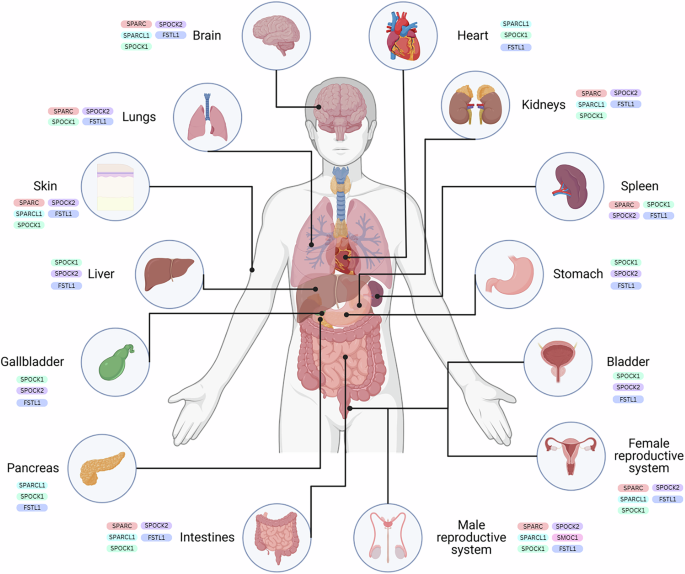
Viloria K, Munasinghe A, Asher S, Bogyere R, Jones L, Hill NJ. A holistic approach to dissecting SPARC family protein complexity reveals FSTL-1 as an inhibitor of pancreatic cancer cell growth. Sci Rep. 2016;6:37839.
Google Scholar
Wang B, Chen K, Xu W, Chen D, Tang W, Xia TS. Integrative genomic analyses of secreted protein acidic and rich in cysteine and its role in cancer prediction. Mol Med Rep. 2014;10:1461–8.
Google Scholar
Ling H, Li Y, Peng C, Yang S, Seto E. HDAC10 inhibition represses melanoma cell growth and BRAF inhibitor resistance via upregulating SPARC expression. NAR Cancer. 2024;6:18.
Google Scholar
Kaleağasıoğlu F, Berger MR. SIBLINGs and SPARC families: their emerging roles in pancreatic cancer. World J Gastroenterol WJG. 2014;20:14747.
Google Scholar
Li T, Liu X, Yang A, Fu W, Yin F, Zeng X. Associations of tumor suppressor SPARCL1 with cancer progression and prognosis (review). Oncol Lett. 2017;14:2603–10.
Google Scholar
Xiang Y, Qiu Q, Jiang M, Jin R, Lehmann BD, Strand DW, et al. SPARCL1 suppresses metastasis in prostate cancer. Mol Oncol. 2013;7:1019–30.
Google Scholar
Luo HL, Chiang PH, Huang CC, Su YL, Sung MT, Tsai EM, et al. Methylation of SPARCL1 Is associated with oncologic outcome of advanced upper urinary tract urothelial carcinoma. Int J Mol Sci. 2019;20:1653.
Google Scholar
Guo X, Tai H, Li X, Liu P, Liu J, Yu S SPARC is a novel prognostic biomarker for ovarian cancer and associated with immune signatures and drug response. Clin Exp Obstet Gynecol. 2024;51:5103061. https://doi.org/10.31083/j.ceog5103061.
Lane TF, Sage EH. The biology of SPARC, a protein that modulates cell-matrix interactions. FASEB J. 1994;8:163–73.
Google Scholar
Patthy L, Nikolics K. Functions of agrin and agrin-related proteins. Trends Neurosci. 1993;16:76–81.
Google Scholar
Wang C, Xu Y, Xu M, Sun C, Zhang X, Tao X, et al. SPOCK2 modulates neuropathic pain by interacting with MT1-MMP to regulate astrocytic MMP-2 activation in rats with chronic constriction injury. J Neuroinflamm. 2024;21:57.
Google Scholar
Hohenester E, Maurer P, Timpl R. Crystal structure of a pair of follistatin-like and EF-hand calcium-binding domains in BM-40. EMBO J. 1997;16:3778–86.
Google Scholar
Klingler A, Regensburger D, Tenkerian C, Britzen-Laurent N, Hartmann A, Stürzl M, et al. Species-, organ- and cell-type-dependent expression of SPARCL1 in human and mouse tissues. PLoS One. 2020;15:e0233422.
Google Scholar
Claeskens A, Ongenae N, Neefs JM, Cheyns P, Kaijen P, Cools M, et al. Hevin is down-regulated in many cancers and is a negative regulator of cell growth and proliferation. Br J Cancer. 2000;82:1123–30.
Google Scholar
Ye Z, Chen J, Hu X, Yang S, Xuan Z, Lu X, et al. SPOCK1: a multi-domain proteoglycan at the crossroads of extracellular matrix remodeling and cancer development. Am J Cancer Res. 2020;10:3127–37.
Google Scholar
Meh P, Pavsic M, Turk V, Baici A, Lenarcic B. Dual concentration-dependent activity of thyroglobulin type-1 domain of testican: specific inhibitor and substrate of cathepsin L. Biol Chem. 2005;386:75–83.
Google Scholar
Babaei-Jadidi R, Kashfi H, Alelwani W, Karimi Bakhtiari A, Kattan SW, Mansouri OA, et al. Anti-miR-135/SPOCK1 axis antagonizes the influence of metabolism on drug response in intestinal/colon tumour organoids. Oncogenesis. 2022;11:4.
Google Scholar
Ahn N, Kim W-J, Kim N, Park HW, Lee S-W, Yoo J-Y The Interferon-Inducible Proteoglycan Testican-2/SPOCK2 functions as a protective barrier against virus infection of lung epithelial cells. J Virol. 2019;93:0662–19. https://doi.org/10.1128/JVI.00662-19.
DeGroot MS, Williams B, Chang TY, Maas Gamboa ML, Larus IM, Hong G, et al. SMOC-1 interacts with both BMP and glypican to regulate BMP signaling in C. elegans. PLoS Biol. 2023;21:3002272.
Rocnik EF, Liu P, Sato K, Walsh K, Vaziri C. The novel SPARC family member SMOC-2 potentiates angiogenic growth factor activity. J Biol Chem. 2006;281:22855–64.
Google Scholar
Gao Q, Mok H-P, Zhuang J. Secreted modular calcium-binding proteins in pathophysiological processes and embryonic development. Chin Med J. 2019;132:2476–84.
Google Scholar
Zhang Y, Wang Y, Zheng G, Liu Y, Li J, Huang H, et al. Follistatin-like 1 (FSTL1) interacts with Wnt ligands and Frizzled receptors to enhance Wnt/β-catenin signaling in obstructed kidneys in vivo. J Biol Chem 2022;298:102010. https://doi.org/10.1016/j.jbc.2022.102010.
Geng Y, Dong Y, Yu M, Zhang L, Yan X, Sun J, et al. Follistatin-like 1 (FSTL1) is a bone morphogenetic protein (BMP) 4 signaling antagonist in controlling mouse lung development. Proc Natl Acad Sci USA. 2011;108:7058–63.
Google Scholar
Hambrock HO, Kaufmann B, Müller S, Hanisch FG, Nose K, Paulsson M, et al. Structural characterization of TSC-36/Flik: analysis of two charge isoforms. J Biol Chem. 2004;279:11727–35.
Google Scholar
Chen L, Liu Z Downregulation of FSTL-1 attenuates the inflammation injury during Streptococcus pneumoniae infection by inhibiting the NLRP3 and TLR4/NF-κB signaling pathway. Mol Med Rep. 2019;20:5345–52.
Magadum A, Singh N, Kurian AA, Sharkar MTK, Chepurko E, Zangi L. Ablation of a single N-glycosylation site in human FSTL 1 induces cardiomyocyte proliferation and cardiac regeneration. Mol Ther Nucleic Acids. 2018;13:133–43.
Google Scholar
Bradshaw AD, Puolakkainen P, Dasgupta J, Davidson JM, Wight TN, Helene Sage E. SPARC-null mice display abnormalities in the dermis characterized by decreased collagen fibril diameter and reduced tensile strength. J Invest Dermatol. 2003;120:949–55.
Google Scholar
Tremble PM, Lane TF, Sage EH, Werb Z. SPARC, a secreted protein associated with morphogenesis and tissue remodeling, induces expression of metalloproteinases in fibroblasts through a novel extracellular matrix-dependent pathway. J Cell Biol. 1993;121:1433–44.
Google Scholar
Nuñez-delMoral A, Brocos-Mosquera I, Vialou V, Callado LF, Erdozain AM. Characterization of hevin (SPARCL1) immunoreactivity in postmortem human brain homogenates. Neuroscience. 2021;467:91–109.
Google Scholar
Sullivan MM, Puolakkainen PA, Barker TH, Funk SE, Sage EH. Altered tissue repair in hevin-null mice: inhibition of fibroblast migration by a matricellular SPARC homolog. Wound Repair Regen. 2008;16:310–9.
Google Scholar
Li C, Yuan H, Chen J, Shang K, He H. The oncogenic functions of SPARCL1 in bladder cancer. J Cell Mol Med. 2024;28:e70196.
Google Scholar
O’Brown NM, Patel NB, Hartmann U, Klein AM, Gu C, Megason SG. The secreted neuronal signal Spock1 promotes blood-brain barrier development. Dev Cell. 2023;58:1534–1547.e6.
Google Scholar
Ham SM, Song MJ, Yoon H-S, Lee DH, Chung JH, Lee S-T. SPARC is highly expressed in young skin and promotes extracellular matrix integrity in fibroblasts via the TGF-β signaling pathway. Int J Mol Sci. 2023;24:12179.
Google Scholar
Tanaka HY, Kitahara K, Sasaki N, Nakao N, Sato K, Narita H, et al. Pancreatic stellate cells derived from human pancreatic cancer demonstrate aberrant SPARC-dependent ECM remodeling in 3D engineered fibrotic tissue of clinically relevant thickness. Biomaterials. 2019;192:355–67.
Google Scholar
Hewitt RJ, Puttur F, Gaboriau DCA, Fercoq F, Fresquet M, Traves WJ, et al. Lung extracellular matrix modulates KRT5+ basal cell activity in pulmonary fibrosis. Nat Commun. 2023;14:41621. https://doi.org/10.1038/s41467-023-41621-y.
Gagliardi F, Narayanan A, Gallotti AL, Pieri V, Mazzoleni S, Cominelli M, et al. Enhanced SPARCL1 expression in cancer stem cells improves preclinical modeling of glioblastoma by promoting both tumor infiltration and angiogenesis. Neurobiol Dis. 2020;134:104705. https://doi.org/10.1016/j.nbd.2019.104705.
Váncza L, Horváth A, Seungyeon L, Rókusz A, Dezső K, Reszegi A, et al. SPOCK1 overexpression suggests poor prognosis of ovarian cancer. Cancers 2023;15:072037. https://doi.org/10.3390/CANCERS15072037/S1.
Váncza L, Karászi K, Péterfia B, Turiák L, Dezső K, Sebestyén A, et al. SPOCK1 promotes the development of hepatocellular carcinoma. Front Oncol. 2022;12:819883.
Google Scholar
Wang Y, Wang W, Qiu E. SPOCK1 promotes the growth of osteosarcoma cells through mTOR-S6K signaling pathway. Biomed Pharmacother. 2017;95:564–70.
Google Scholar
Xu Y, Zhao P, Xu X, Zhang S, Xia B, Zhu L. T790M mutation sensitizes non-small cell lung cancer cells to radiation via suppressing SPOCK1. Biochem Biophys Rep. 2024;38:101729.
Google Scholar
Yu F, Li G, Gao J, Sun Y, Liu P, Gao H, et al. SPOCK1 is upregulated in recurrent glioblastoma and contributes to metastasis and Temozolomide resistance. Cell Prolif. 2016;49:195–206.
Google Scholar
Ren F, Wang Y, Chen P, Guo C. Downregulation of SPOCK2 promotes the proliferation, adhesion, and invasion of endometrial epithelial cells. Gynecol Endocrinol. 2021;37:273–7.
Google Scholar
Luo J, Lai C, Xu X, Shi J, Hu J, Guo K, et al. Mechanism of prognostic marker SPOCK3 affecting malignant progression of prostate cancer and construction of prognostic model. BMC Cancer 2023;23:11151. https://doi.org/10.1186/S12885-023-11151-3.
Aoki H, Takasawa A, Yamamoto E, Niinuma T, Yamano HOO, Harada T, et al. Downregulation of SMOC1 is associated with progression of colorectal traditional serrated adenomas. BMC Gastroenterol. 2024;24:03175. https://doi.org/10.1186/s12876-024-03175-1.
Loh JJ, Li TW, Zhou L, Wong TL, Liu X, Ma VWS, et al. FSTL1 secreted by activated fibroblasts promotes hepatocellular carcinoma metastasis and stemness. Cancer Res. 2021;81:5692–705.
Google Scholar
Chiou J, Chang YC, Tsai HF, Lin YF, Huang MS, Yang CJ, et al. Follistatin-like protein 1 inhibits lung cancer metastasis by preventing proteolytic activation of osteopontin. Cancer Res. 2019;79:6113–25.
Google Scholar
McGovern KE, Nance JP, David CN, Harrison RES, Noor S, Worth D, et al. SPARC coordinates extracellular matrix remodeling and efficient recruitment to and migration of antigen-specific T cells in the brain following infection. Sci Rep. 2021;11:4549.
Google Scholar
Zhong C, Cheng Z, Shu Y, Yang X, Hu J, He L, et al. FSTL1 is a prognostic marker and promotes invasion and metastasis of colon cancer. Discov Oncol. 2025;16:03989. https://doi.org/10.1007/s12672-025-03989-9.
Eun K, Kim AY, Ryu S. Matricellular proteins in immunometabolism and tissue homeostasis. BMB Rep. 2024;57:400–16.
Google Scholar
Hu Q, Zhu Y, Mei J, Liu Y, Zhou G. Extracellular matrix dynamics in tumor immunoregulation: from tumor microenvironment to immunotherapy. J Hematol Oncol. 2025;18:65.
Google Scholar
Fenouille N, Tichet M, Dufies M, Pottier A, Mogha A, Soo JK, et al. The epithelial-mesenchymal transition (EMT) regulatory factor SLUG (SNAI2) is a downstream target of SPARC and AKT in promoting melanoma cell invasion. PLoS One. 2012;7:e40378.
Google Scholar
Weaver MS, Workman G, Sage EH. The copper binding domain of SPARC mediates cell survival in vitro via interaction with integrin β1 and activation of integrin-linked kinase. J Biol Chem. 2008;283:22826.
Google Scholar
Li L, Zhao J, Zhang H, Li D, Wu S, Xu W, et al. HIGD1A inactivated by DNA hypermethylation promotes invasion of kidney renal clear cell carcinoma. Pathol Res Pr. 2023;245:154463.
Google Scholar
López-Moncada F, Torres MJ, Lavanderos B, Cerda O, Castellón EA, Contreras HR SPARC induces e-cadherin repression and enhances cell migration through integrin αvβ3 and the transcription factor ZEB1 in prostate cancer cells. Int J Mol Sci. 2022;23:23115874. https://doi.org/10.3390/ijms23115874.
Xia Q, Du Z, Chen M, Zhou X, Bai W, Zheng X, et al. A protein complex of LCN2, LOXL2 and MMP9 facilitates tumour metastasis in oesophageal cancer. Mol Oncol. 2023;17:2451–71.
Google Scholar
Alshargabi R, Sano T, Yamashita A, Takano A, Sanada T, Iwashita M, et al. SPOCK1 is a novel inducer of epithelial to mesenchymal transition in drug-induced gingival overgrowth. Sci Rep. 2020;10:9785.
Google Scholar
Lu Y, Ying D, Tian Y, Ruan Y, Cheng G, Lv K, et al. LncRNA LINC01857 drives pancreatic adenocarcinoma progression via modulating miR-19a-3p/SMOC2. Clinics 2022;77:100047. https://doi.org/10.1016/j.clinsp.2022.100047.
Matsuura Y, Onuma K, Coppo R, Uematsu H, Kondo J, Miyagawa-Hayashino A, et al. Dynamic change of polarity in spread through air spaces of pulmonary malignancies. J. Pathol. 2025;10:6382. https://doi.org/10.1002/path.6382.
Lathia JD, Liu H. Overview of cancer stem cells and stemness for community oncologists. Target Oncol. 2017;12:387–99.
Google Scholar
Mateo F, Meca-Cortés Ó, Celià-Terrassa T, Fernández Y, Abasolo I, Sánchez-Cid L, et al. SPARC mediates metastatic cooperation between CSC and non-CSC prostate cancer cell subpopulations. Mol Cancer. 2014;13:237.
Google Scholar
Zhu J, Wang LY, Li CY, Wu JY, Zhang YT, Pang KP, et al. SPARC promotes self-renewal of limbal epithelial stem cells and ocular surface restoration through JNK and p38-MAPK signaling pathways. Stem Cells. 2020;38:134–45.
Google Scholar
Wang LY, Zhang YT, Du LQ, Wu XY, Zhu J. The effect of SPARC on the proliferation and migration of limbal epithelial stem cells during the corneal epithelial wound healing. Stem Cells Dev. 2021;30:301–8.
Google Scholar
Singh M, Venugopal C, Tokar T, Brown KR, McFarlane N, Bakhshinyan D, et al. RNAi screen identifies essential regulators of human brain metastasis-initiating cells. Acta Neuropathol. 2017;134:923–40.
Google Scholar
Lu H, Ju DD, Yang GD, Zhu LY, Yang XM, Li J, et al. Targeting cancer stem cell signature gene SMOC-2 Overcomes chemoresistance and inhibits cell proliferation of endometrial carcinoma. EBioMedicine. 2019;40:276–89.
Google Scholar
Feng J, Zheng X Histone Deacetylase 2 Stabilizes SPARC-related modular calcium binding 2 to promote metastasis and stemness in gallbladder cancer. Curr Mol Med. 2024;24. https://doi.org/10.2174/0115665240257970231013094101.
Zhou F, Tao J, Gou H, Liu S, Yu D, Zhang J, et al. FSTL1 sustains glioma stem cell stemness and promotes immunosuppressive macrophage polarization in glioblastoma. Cancer Lett. 2025;611:217400.
Google Scholar
Zhao Y, Li H, Zhang Y, Yang Z, Chen X, Yang Y Inhibiting immune escape in lung adenocarcinoma: the role of SPARC in suppressing CD276 function. Biotechnol Biotechnol Equip 2024;38:2338432. https://doi.org/10.1080/13102818.2024.2338432.
He K, Li C, Yuan H, Jiang K, Deng G. Immunological role and prognostic value of SPARCL1 in pan-cancer analysis. Pathol Oncol Res. 2022;28:1610687.
Google Scholar
Liu Y, Feng L, Yang Y, Lin Z, Jiang W. SPOCK1 is a prognostic-related biomarker and correlated with immune infiltrates in head and neck squamous cell carcinoma. J Biomater Tissue Eng. 2023;13:309–18.
Google Scholar
Gan C, Li M, Lu Y, Peng G, Li W, Wang H, et al. SPOCK1 and POSTN are valuable prognostic biomarkers and correlate with tumor immune infiltrates in colorectal cancer. BMC Gastroenterol. 2023;23:4.
Google Scholar
Lu Q, Zhang Y, Chen X, Gu W, Ji X, Chen Z. Prognostic significance and immune infiltration of microenvironment-related signatures in pancreatic cancer. Medicine. 2021;100:e24957.
Google Scholar
Wang J, Xia S, Zhao J, Gong C, Xi Q, Sun W. Prognostic potential of secreted modular calcium-binding protein 1 in low-grade glioma. Front Mol Biosci. 2021;8:666623.
Google Scholar
Ogiwara Y, Nakagawa M, Nakatani F, Uemura Y, Zhang R, Kudo-Saito C. Blocking FSTL1 boosts NK immunity in treatment of osteosarcoma. Cancer Lett. 2022;537:215690.
Google Scholar
Kudo-Saito C, Ogiwara Y, Imazeki H, Boku N, Uemura Y, Zhang R, et al. CD11b + DIP2A + LAG3+ cells facilitate immune dysfunction in colorectal cancer. Am J Cancer Res. 2021;11:5428.
Google Scholar
Qin C, Zhao B, Wang Y, Li Z, Li T, Zhao Y, et al. Extracellular vesicles miR-31-5p promotes pancreatic cancer chemoresistance via regulating LATS2-Hippo pathway and promoting SPARC secretion from pancreatic stellate cells. J Extracell Vesicles 2024; 13. https://doi.org/10.1002/jev2.12488.
Ma J, Ma Y, Chen S, Guo S, Hu J, Yue T, et al. SPARC enhances 5-FU chemosensitivity in gastric cancer by modulating epithelial-mesenchymal transition and apoptosis. Biochem Biophys Res Commun. 2021;558:134–40.
Google Scholar
Quek C, Pratapa A, Bai X, Al-Eryani G, Pires da Silva I, Mayer A, et al. Single-cell spatial multiomics reveals tumor microenvironment vulnerabilities in cancer resistance to immunotherapy. Cell Rep. 2024;43:114392.
Google Scholar
Gao Y, Yu M, Ma M, Zhuang Y, Qiu X, Zhao Q, et al. SPOCK1 contributes to the third-generation EGFR tyrosine kinase inhibitors resistance in lung cancer. J Cell Biochem. 2019;120:12566–73.
Google Scholar
Hong C, Lishan W, Peng X, Zhengqing L, Yang Y, Fangfang H, et al. Hsa_circ_0074298 promotes pancreatic cancer progression and resistance to gemcitabine by sponging miR-519 to target SMOC. J Cancer. 2022;13:34–50.
Google Scholar
Zhao X, Zhang H, Gu L, Zhang H, Cao H DDP induced cytotoxicity through miR-215-5p/COL5A1/FSTL1 axis to regulate autophagy in lung adenocarcinoma cells. Curr Pharm Biotechnol. 2024;26. https://doi.org/10.2174/0113892010303045240903053257.
Cheng S, Huang Y, Lou C, He Y, Zhang Y, Zhang Q. FSTL1 enhances chemoresistance and maintains stemness in breast cancer cells via integrin β3/Wnt signaling under miR-137 regulation. Cancer Biol Ther. 2019;20:328–37.
Google Scholar
Jia Q, Li M, Ma Y, Liu J, Jia Q, Zhang Q, et al. SPARC promotes malignant progression and predicts poor prognosis in cervical squamous cell carcinoma. Pathol Res Pr. 2025;272:156096.
Google Scholar
Gao ZW, Liu C, Yang L, He T, Wu XN, Zhang HZ, et al. SPARC overexpression promotes liver cancer cell proliferation and tumor growth. Front Mol Biosci. 2021;8:775743. https://doi.org/10.3389/fmolb.2021.775743.
Li W, Chi Y, Xiao X, Li J, Sun M, Sun S, et al. Plasma FSTL-1 as a non-invasive diagnostic biomarker for patients with advanced liver fibrosis. Hepatology. 2024;10:1167. https://doi.org/10.1097/HEP.0000000000001167.
Li Z, Zheng C, Liu H, Lv J, Wang Y, Zhang K, et al. A novel oxidative stress-related gene signature as an indicator of prognosis and immunotherapy responses in HNSCC. Aging. 2023;15:14957–84.
Google Scholar
Liu Y, Han T, Wu J, Zhou J, Guo J, Miao R, et al. SPOCK1, as a potential prognostic and therapeutic biomarker for lung adenocarcinoma, is associated with epithelial-mesenchymal transition and immune evasion. J Transl Med. 2023;21:909.
Google Scholar
Zhao J, Cheng M, Gai J, Zhang R, Du T, Li Q SPOCK2 serves as a potential prognostic marker and correlates with immune infiltration in lung adenocarcinoma. Front Genet. 2020;11:588499. https://doi.org/10.3389/FGENE.2020.588499/PDF.
Hidalgo M, Plaza C, Musteanu M, Illei P, Brachmann CB, Heise C, et al. SPARC expression did not predict efficacy of nab-paclitaxel plus gemcitabine or gemcitabine alone for metastatic pancreatic cancer in an exploratory analysis of the phase III MPACT trial. Clin Cancer Res. 2015;21:4811–8.
Google Scholar
Ding X, Jin Y, Shi X, Wang Y, Jin Z, Yin L, et al. TDO2 promotes bladder cancer progression via AhR-mediated SPARC/FILIP1L signaling. Biochem Pharm. 2024;223:116172.
Google Scholar
Kudo-Saito C, Fuwa T, Murakami K, Kawakami Y. Targeting FSTL1 prevents tumor bone metastasis and consequent immune dysfunction. Cancer Res. 2013;73:6185–93.
Google Scholar
Desai N, Trieu V, Damascelli B, Soon-Shiong P. SPARC expression correlates with tumor response to albumin-bound paclitaxel in head and neck cancer patients. Transl Oncol. 2009;2:59.
Google Scholar
Zheng B, Chen Y, Niu L, Zhang X, Yang Y, Wang S, et al. Modulating the tumoral SPARC content to enhance albumin-based drug delivery for cancer therapy. J Controlled Release. 2024;366:596–610.
Google Scholar
Li H, Li Y, Zheng X, Chen F, Zhang S, Xu S, et al. RBM15 facilitates osimertinib resistance of lung adenocarcinoma through m6A-dependent epigenetic silencing of SPOCK1. Oncogene. 2024;44:307.
Google Scholar
Zhao P, Guan H-T, Dai Z-J, Ma Y-G, Liu X-X, Wang X-J. Knockdown of SPOCK1 inhibits the proliferation and invasion in colorectal cancer cells by suppressing the PI3K/Akt pathway. Oncol Res Featuring Preclin Clin Cancer Therapeutics. 2016;24:437–45.
Lu H, Zhou Q, He J, Jiang Z, Peng C, Tong R, et al. Recent advances in the development of protein–protein interactions modulators: mechanisms and clinical trials. Signal Transduct Target Ther. 2020;5:213.
Google Scholar
Rahman M, Chan APK, Tai IT. A peptide of SPARC interferes with the interaction between Caspase8 and Bcl2 to resensitize chemoresistant tumors and enhance their regression in vivo. PLoS One. 2011;6:e26390.
Google Scholar
Arnold SA, Rivera LB, Miller AF, Carbon JG, Dineen SP, Xie Y, et al. Lack of host SPARC enhances vascular function and tumor spread in an orthotopic murine model of pancreatic carcinoma. Dis Model Mech. 2010;3:57–72.
Google Scholar
Aly NAR, Rizk S, Aboul Enein A, El Desoukey N, Zawam H, Ahmed M, et al. The role of lymphoid tissue SPARC in the pathogenesis and response to treatment of multiple myeloma. Front Oncol. 2022;12:1009993. https://doi.org/10.3389/fonc.2022.1009993.
Zhao S-J, Jiang Y-Q, Xu N-W, Li Q, Zhang Q, Wang S-Y, et al. SPARCL1 suppresses osteosarcoma metastasis and recruits macrophages by activation of canonical WNT/β-catenin signaling through stabilization of the WNT-receptor complex. Oncogene. 2018;37:1049–61.
Google Scholar
Han J, Rong Y, Gao X Multiomic analysis of the function of SPOCK1 across cancers: an integrated bioinformatics approach. J Int Med Res. 2021;49. https://doi.org/10.1177/0300060520962659.
Zheng H, Liu H, Li H, Dou W, Wang X. Weighted gene co-expression network analysis identifies a cancer-associated fibroblast signature for predicting prognosis and therapeutic responses in gastric cancer. Front Mol Biosci. 2021;8:1–17.
Google Scholar
Chen J, Ye Z, Liu L, Xuan B. Assessment of the prognostic value of SPOCK1 in clear cell renal cell carcinoma: a bioinformatics analysis. Transl Androl Urol. 2022;11:509–18.
Google Scholar
Karaman E, Yay F, Ayan D, Bayram E, Erturk S. The clinopathological and prognostic significance of SPOCK1 in gynecological cancers: a bioinformatics based analysis. Biol. 2025;14:209.
Google Scholar
Jiao M, Sun W, Li L, Li C, Zhou J, Li Q, et al. Clinical significance of SPOCK2 expression signature for high-grade serous ovarian cancer patients. Front Genet. 2022;13:878123. https://doi.org/10.3389/FGENE.2022.878123.
Bateman A, Martin MJ, Orchard S, Magrane M, Adesina A, Ahmad S, et al. UniProt: the universal protein knowledgebase in 2025. Nucleic Acids Res. 2025;53:D609–D617.
Google Scholar
