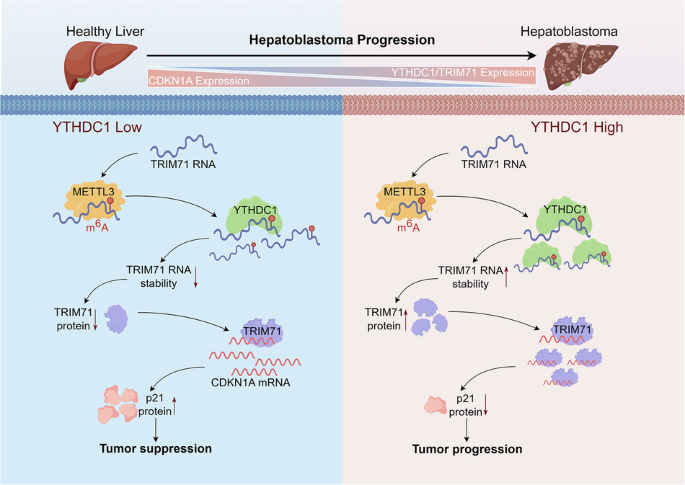
Hepatoblastoma (HB) is the most common primary malignant liver cancer in children. Although complete surgical resection and standardized chemotherapy remain the most effective treatments for HB, they are not curative for all patients. Therefore, a deeper understanding of HB progression and its underlying mechanisms is essential for overcoming these therapeutic limitations. We demonstrate that TRIM71, a key member of the tripartite motif (TRIM)–containing protein family, is highly expressed in HB specimens compared with normal liver tissues, and that its elevated expression is significantly associated with poor prognosis in HB patients. We further show that TRIM71 is required for HB cell growth by counteracting p21-mediated G1/S cell-cycle arrest. Critically, TRIM71 mRNA is stabilized by METTL3-mediated m⁶A methylation and recognized by the reader YTHDC1, establishing a METTL3-YTHDC1-TRIM71 axis essential for HB proliferation. Collectively, our findings uncover a specific role of TRIM71 in HB cell growth and reveal a novel mechanism regulating TRIM71, highlighting TRIM71 as a potential intrinsic biomarker and a promising therapeutic target in hepatoblastoma.
Trending
- Women in England with incurable breast cancer to get life-extending drug on NHS | Breast cancer
- m⁶A-dependent TRIM71 stabilization by YTHDC1 promotes hepatoblastoma progression
- Psychosocial Support for Treatment-Related Challenges in Relapsed/Refractory Multiple Myeloma
- Immunogenic cell death and tertiary lymphoid structures: bridging tumour cell death and immune organization
- SOHO 2026: Key Updates Across the Multiple Myeloma Continuum
- White House Chief of Staff Susie Wiles Says She No Longer Shows Evidence of Cancer After Treatment
- Sequencing Therapy in Follicular Lymphoma: Making Goal-Oriented Conversations Routine
- Secondary T-Cell Malignancies: Identifying and Counseling After CAR T-Cell Therapy


Thursday, September 17
m⁶A-dependent TRIM71 stabilization by YTHDC1 promotes hepatoblastoma progression
 By NewsCancer