


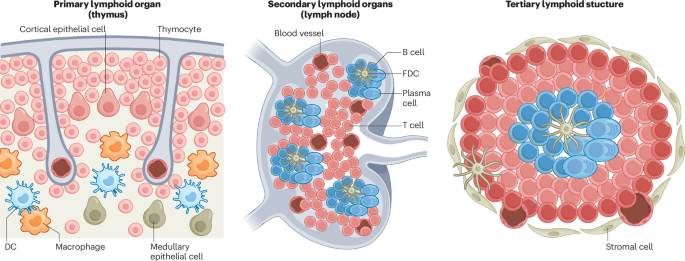
Pabst, R. Plasticity and heterogeneity of lymphoid organs. What are the criteria to call a lymphoid organ primary, secondary or tertiary? Immunol. Lett. 112, 1–8 (2007).
Google Scholar
Cui, X. et al. Tertiary lymphoid structures as a biomarker in immunotherapy and beyond: advancing towards clinical application. Cancer Lett. 613, 217491 (2025).
Google Scholar
Esparcia-Pinedo, L., Romero-Laorden, N. & Alfranca, A. Tertiary lymphoid structures and B lymphocytes: a promising therapeutic strategy to fight cancer. Front. Immunol. 14, 1231315 (2023).
Google Scholar
Cui, C., Craft, J. & Joshi, N. S. T follicular helper cells in cancer, tertiary lymphoid structures, and beyond. Semin. Immunol. 69, 101797 (2023).
Google Scholar
Hennequin, A. et al. Tumor infiltration by Tbet+ effector T cells and CD20+ B cells is associated with survival in gastric cancer patients. OncoImmunology 5, e1054598 (2016).
Google Scholar
Kroeger, D. R., Milne, K. & Nelson, B. H. Tumor-infiltrating plasma cells are associated with tertiary lymphoid structures, cytolytic T-cell responses, and superior prognosis in ovarian cancer. Clin. Cancer Res. 22, 3005–3015 (2016).
Google Scholar
Goc, J. et al. Dendritic cells in tumor-associated tertiary lymphoid structures signal a Th1 cytotoxic immune contexture and license the positive prognostic value of infiltrating CD8+ T cells. Cancer Res. 74, 705–715 (2014).
Google Scholar
Garaud, S., Dieu-Nosjean, M.-C. & Willard-Gallo, K. T follicular helper and B cell crosstalk in tertiary lymphoid structures and cancer immunotherapy. Nat. Commun. 13, 2259 (2022).
Google Scholar
Guillaume, S. M., Beccaria, C. G., Iannacone, M. & Linterman, M. A. Tertiary lymphoid structures across organs: context, composition, and clinical levers. Immunol. Rev. 335, e70063 (2025).
Google Scholar
Ruddle, N. H. Lymphatic vessels and tertiary lymphoid organs. J. Clin. Invest. 124, 953–959 (2014).
Google Scholar
Drayton, D. L., Liao, S., Mounzer, R. H. & Ruddle, N. H. Lymphoid organ development: from ontogeny to neogenesis. Nat. Immunol. 7, 344–353 (2006).
Google Scholar
Martinet, L. et al. Human solid tumors contain high endothelial venules: association with T- and B-lymphocyte infiltration and favorable prognosis in breast cancer. Cancer Res. 71, 5678–5687 (2011).
Google Scholar
Fridman, W. H. et al. B cells and tertiary lymphoid structures as determinants of tumour immune contexture and clinical outcome. Nat. Rev. Clin. Oncol. 19, 441–457 (2022).
Google Scholar
Han, B., Deng, J. & Fan, R. Tertiary lymphoid structure signatures are associated with survival and immunotherapy response in lung adenocarcinoma. Immunol. Res. 73, 40 (2025).
Google Scholar
Cabrita, R. et al. Tertiary lymphoid structures improve immunotherapy and survival in melanoma. Nature 577, 561–565 (2020).
Google Scholar
Rodriguez, A. B. et al. Immune mechanisms orchestrate tertiary lymphoid structures in tumors via cancer-associated fibroblasts. Cell Rep. 36, 109422 (2021).
Google Scholar
Wu, D. et al. Proline uptake promotes activation of lymphoid tissue inducer cells to maintain gut homeostasis. Nat. Metab. 5, 1953–1968 (2023).
Google Scholar
Amisaki, M. et al. IL-33-activated ILC2s induce tertiary lymphoid structures in pancreatic cancer. Nature 638, 1076–1084 (2025).
Google Scholar
Gutiérrez-Melo, N. & Baumjohann, D. T follicular helper cells in cancer. Trends Cancer 9, 309–325 (2023).
Google Scholar
Mueller, C. G., Nayar, S., Campos, J. & Barone, F. Molecular and cellular requirements for the assembly of tertiary lymphoid structures. Adv. Exp. Med. Biol. 1060, 55–72 (2018).
Google Scholar
Baggiolini, M. Chemokines and leukocyte traffic. Nature 392, 565–568 (1998).
Google Scholar
Sato, Y. et al. Heterogeneous fibroblasts underlie age-dependent tertiary lymphoid tissues in the kidney. JCI Insight 1, e87680 (2016).
Google Scholar
Anders, H.-J., Romagnani, P. & Mantovani, A. Pathomechanisms: homeostatic chemokines in health, tissue regeneration, and progressive diseases. Trends Mol. Med. 20, 154–165 (2014).
Google Scholar
Ansel, K. M. et al. A chemokine-driven positive feedback loop organizes lymphoid follicles. Nature 406, 309–314 (2000).
Google Scholar
Rabbany, S. Y. et al. Continuous delivery of stromal cell-derived factor-1 from alginate scaffolds accelerates wound healing. Cell Transpl. 19, 399–408 (2010).
Google Scholar
Broxmeyer, H. E. et al. Effects of CC, CXC, C, and CX3C chemokines on proliferation of myeloid progenitor cells, and insights into SDF-1-induced chemotaxis of progenitors. Ann. N. Y. Acad. Sci. 872, 142–163 (1999).
Google Scholar
Shields, J. D., Kourtis, I. C., Tomei, A. A., Roberts, J. M. & Swartz, M. A. Induction of lymphoidlike stroma and immune escape by tumors that express the chemokine CCL21. Science 328, 749–752 (2010).
Google Scholar
Schumacher, T. N. & Thommen, D. S. Tertiary lymphoid structures in cancer. Science 375, eabf9419 (2022).
Google Scholar
Hofmeister, R. et al. Interleukin-7: physiological roles and mechanisms of action. Cytokine Growth Factor. Rev. 10, 41–60 (1999).
Google Scholar
Deteix, C. et al. Intragraft Th17 infiltrate promotes lymphoid neogenesis and hastens clinical chronic rejection. J. Immunol. 184, 5344–5351 (2010).
Google Scholar
Kroemer, G., Galassi, C., Zitvogel, L. & Galluzzi, L. Immunogenic cell stress and death. Nat. Immunol. 23, 487–500 (2022).
Google Scholar
Galluzzi, L. et al. Consensus guidelines for the definition, detection and interpretation of immunogenic cell death. J. Immunother. Cancer 8, e000337 (2020).
Google Scholar
Cao, G., Ding, C., Dai, J. & Qiu, X. Oncolytic virus and immunogenic cell death in cancer therapy. Tumour Virus Res. 20, 200333 (2025).
Google Scholar
Kepp, O. et al. Crosstalk between ER stress and immunogenic cell death. Cytokine Growth Factor. Rev. 24, 311–318 (2013).
Google Scholar
Wang, Q., Yu, Y., Zhuang, J., Liu, R. & Sun, C. Demystifying the cGAS-STING pathway: precision regulation in the tumor immune microenvironment. Mol. Cancer 24, 178 (2025).
Google Scholar
Decout, A., Katz, J. D., Venkatraman, S. & Ablasser, A. The cGAS–STING pathway as a therapeutic target in inflammatory diseases. Nat. Rev. Immunol. 21, 548–569 (2021).
Google Scholar
Samson, N. & Ablasser, A. The cGAS–STING pathway and cancer. Nat. Cancer 3, 1452–1463 (2022).
Google Scholar
Kwon, J. & Bakhoum, S. F. The cytosolic DNA-sensing cGAS–STING pathway in cancer. Cancer Discov. 10, 26–39 (2020).
Google Scholar
Alipour-Khezri, E., Moqadami, A., Zununi Vahed, S. & Barzegari, A. Cytosolic DNA sensing pathway in senescence and aging: underlying mechanisms and targeted interventions. Biomed. Pharmacother. 193, 118790 (2025).
Google Scholar
Garland, K. M., Sheehy, T. L. & Wilson, J. T. Chemical and biomolecular strategies for STING pathway activation in cancer immunotherapy. Chem. Rev. 122, 5977–6039 (2022).
Google Scholar
Li, Q. et al. The cGAS–STING pathway in cancer: friend or foe. Cell Death Dis. https://doi.org/10.1038/s41419-026-08607-2 (2026).
Google Scholar
Ma, Z. et al. Interferon-dependent SLC14A1+ cancer-associated fibroblasts promote cancer stemness via WNT5A in bladder cancer. Cancer Cell 40, 1550–1565.e7 (2022).
Google Scholar
Demaria, O. et al. STING activation of tumor endothelial cells initiates spontaneous and therapeutic antitumor immunity. Proc. Natl Acad. Sci. USA 112, 15408–15413 (2015).
Google Scholar
Wang, L. et al. Cell-type specific activation of the cGAS–STING pathway in tumor immunotherapy: mechanisms and therapeutic implications. J. Transl. Med. 24, 43 (2026).
Google Scholar
Wu, Q., Leng, X. & Xu, P. Intercellular transmission of cGAS–STING signaling in cancer. Cancer Biol. Med. 20, 93–97 (2023).
Google Scholar
Calvanese, A. L. et al. Sustained innate interferon is an essential inducer of tertiary lymphoid structures. Eur. J. Immunol. 54, 2451207 (2024).
Google Scholar
Chelvanambi, M., Fecek, R. J., Taylor, J. L. & Storkus, W. J. STING agonist-based treatment promotes vascular normalization and tertiary lymphoid structure formation in the therapeutic melanoma microenvironment. J. Immunother. Cancer 9, e001906 (2021).
Google Scholar
Iannuzzo, A. et al. Autoinflammatory patients with Golgi-trapped CDC42 exhibit intracellular trafficking defects leading to STING hyperactivation and ER stress. Nat. Commun. 15, 9940 (2024).
Google Scholar
Carman, C. V. & Martinelli, R. T lymphocyte–endothelial interactions: emerging understanding of trafficking and antigen-specific immunity. Front. Immunol. 6, 603 (2015).
Google Scholar
Hua, Y. et al. Cancer immunotherapies transition endothelial cells into HEVs that generate TCF1+ T lymphocyte niches through a feed-forward loop. Cancer Cell 40, 1600–1618 (2022).
Google Scholar
Blanchard, L. & Girard, J.-P. High endothelial venules (HEVs) in immunity, inflammation and cancer. Angiogenesis 24, 719–753 (2021).
Google Scholar
Hussain, B. et al. High endothelial venules as potential gateways for therapeutics. Trends Immunol. 43, 728–740 (2022).
Google Scholar
Sawada, J. et al. Molecular signature of tumor-associated high endothelial venules that can predict breast cancer survival. Cancer Immunol. Res. 10, 468–481 (2022).
Google Scholar
Kuwabara, S. et al. Prognostic relevance of tertiary lymphoid organs following neoadjuvant chemoradiotherapy in pancreatic ductal adenocarcinoma. Cancer Sci. 110, 1853–1862 (2019).
Google Scholar
Vella, G., Hua, Y. & Bergers, G. High endothelial venules in cancer: regulation, function, and therapeutic implication. Cancer Cell 41, 527–545 (2023).
Google Scholar
Zhao, H. et al. Effects of immunogenic cell death-inducing chemotherapeutics on the immune cell activation and tertiary lymphoid structure formation in melanoma. Front. Immunol. 15, 1302751 (2024).
Google Scholar
Shih, V. F.-S., Tsui, R., Caldwell, A. & Hoffmann, A. A single NFκB system for both canonical and non-canonical signaling. Cell Res. 21, 86–102 (2011).
Google Scholar
Sawada, J. et al. Simultaneous STING and lymphotoxin-β receptor activation induces B cell responses in tertiary lymphoid structures to potentiate antitumor immunity. Nat. Immunol. 26, 1766–1780 (2025).
Google Scholar
Peske, J. D. et al. Effector lymphocyte-induced lymph node-like vasculature enables naive T-cell entry into tumours and enhanced anti-tumour immunity. Nat. Commun. 6, 7114 (2015).
Google Scholar
Zhao, L. et al. Tertiary lymphoid structures in diseases: immune mechanisms and therapeutic advances. Signal. Transduct. Target. Ther. 9, 225 (2024).
Google Scholar
Barone, F. et al. Stromal fibroblasts in tertiary lymphoid structures: a novel target in chronic inflammation. Front. Immunol. 7, 477 (2016).
Google Scholar
Anshu, Shantikumar V., N. & Sreeja, R. Pleiotropic and multicellular roles of lymphotoxin beta receptor in solid tumor immunity and therapeutic targeting. Front. Immunol. 17, 1693507 (2026).
Tan, C. et al. Dynamic remodeling of tertiary lymphoid structures in response to cancer therapy: a recent review. Cancer Immunol. Immunother. CII 74, 313 (2025).
Google Scholar
Nayar, S. et al. Immunofibroblasts are pivotal drivers of tertiary lymphoid structure formation and local pathology. Proc. Natl Acad. Sci. USA 116, 13490–13497 (2019).
Google Scholar
Chen, F. et al. DAMPs in immunosenescence and cancer. Semin. Cancer Biol. 106–107, 123–142 (2024).
Google Scholar
Zhao, R. et al. cGAS-activated endothelial cell–T cell cross-talk initiates tertiary lymphoid structure formation. Sci. Immunol. 9, eadk2612 (2024).
Google Scholar
Sautès-Fridman, C., Petitprez, F., Calderaro, J. & Fridman, W. H. Tertiary lymphoid structures in the era of cancer immunotherapy. Nat. Rev. Cancer 19, 307–325 (2019).
Google Scholar
Lee, Y. et al. Recruitment and activation of naive T cells in the islets by lymphotoxin β receptor-dependent tertiary lymphoid structure. Immunity 25, 499–509 (2006).
Google Scholar
Qu, D. et al. Biodegradable nano-regulator reprograms glioblastoma immunosuppression: pyroptosis–metabolism–immunity crosstalk for cascading immune activation. Angew. Chem. Int. Ed. Engl. 65, e16348 https://doi.org/10.1002/anie.202516348 (2025).
Google Scholar
Porciello, N. et al. Spatial transcriptomics highlights B cells as key contributors to a complete and durable response to chemo-immunotherapy in a patient with resectable NSCLC. J. Immunother. Cancer 13, e011563 (2025).
Google Scholar
O’Connor, R. A., Martinez, B. R., Koppensteiner, L., Mathieson, L. & Akram, A. R. Cancer-associated fibroblasts drive CXCL13 production in activated T cells via TGF-beta. Front. Immunol. 14, 1221532 (2023).
Google Scholar
Liu, Y. et al. Single-cell and spatial transcriptome analyses reveal tertiary lymphoid structures linked to tumour progression and immunotherapy response in nasopharyngeal carcinoma. Nat. Commun. 15, 7713 (2024).
Google Scholar
Zhai, K., Xie, R., Ru, K. & Zhao, M. Tertiary lymphoid structures correlate with the therapeutic efficacy and prognosis of resectable esophageal squamous cell carcinoma undergoing neoadjuvant chemoradiotherapy plus immunotherapy. Front. Immunol. 16, 1616247 (2025).
Google Scholar
Zhang, L. et al. Trigger inducible tertiary lymphoid structure formation using covalent organic frameworks for cancer immunotherapy. Nat. Commun. 16, 44 (2025).
Google Scholar
Roscigno, G. et al. The potential application of stroma modulation in targeting tumor cells: focus on pancreatic cancer and breast cancer models. Semin. Cancer Biol. 113, 151–175 (2025).
Google Scholar
Hu, L. et al. Prognostic impact of tertiary lymphoid structures and cancer-associated fibroblasts in hepatocellular carcinoma with portal vein tumor thrombus. Sci. Rep. 15, 45161 (2025).
Google Scholar
Perucca, A. et al. Micro immune response on-chip (MIRO) models the tumour-stroma interface for immunotherapy testing. Nat. Commun. 16, 1279 (2025).
Google Scholar
Peyraud, F. et al. Tertiary lymphoid structures and cancer immunotherapy: from bench to bedside. Med. 6, 100546 (2025).
Google Scholar
Yu, C. et al. Research trends, hotspots and future directions of tertiary lymphoid structures in cancer: a comprehensive informatics analysis and visualization study. Discov. Oncol. 15, 665 (2024).
Google Scholar
Xu, W. et al. Heterogeneity in tertiary lymphoid structures predicts distinct prognosis and immune microenvironment characterizations of clear cell renal cell carcinoma. J. Immunother. Cancer 11, e006667 (2023).
Google Scholar
Noort, A. R. et al. Tertiary lymphoid structures in rheumatoid arthritis: NF-κB–inducing kinase–positive endothelial cells as central players. Am. J. Pathol. 185, 1935–1943 (2015).
Google Scholar
Yang, C., Cai, Y.-X., Wang, Z.-F., Tian, S.-F. & Li, Z.-Q. Tertiary lymphoid structures in the central nervous system. Trends Mol. Med. 31, 509–521 (2025).
Google Scholar
Lane, P. J. L. et al. Lymphoid tissue inducer cells: bridges between the ancient innate and the modern adaptive immune systems. Mucosal Immunol. 2, 472–477 (2009).
Google Scholar
Lane, P. J. L., Gaspal, F. M., McConnell, F. M., Withers, D. R. & Anderson, G. Lymphoid tissue inducer cells: pivotal cells in the evolution of cd4 immunity and tolerance? Front. Immunol. 3, 24 (2012).
Google Scholar
van de Pavert, S. A. Lymphoid tissue inducer (LTi) cell ontogeny and functioning in embryo and adult. Biomed. J. 44, 123–132 (2021).
Google Scholar
Lochner, M. et al. Microbiota-induced tertiary lymphoid tissues aggravate inflammatory disease in the absence of RORgamma T and LTi cells. J. Exp. Med. 208, 125–134 (2011).
Google Scholar
Zhang, Y. et al. CCL19-producing fibroblasts promote tertiary lymphoid structure formation enhancing anti-tumor IgG response in colorectal cancer liver metastasis. Cancer Cell 42, 1370–1385.e9 (2024).
Google Scholar
Galluzzi, L., Kepp, O., Hett, E., Kroemer, G. & Marincola, F. M. Immunogenic cell death in cancer: concept and therapeutic implications. J. Transl. Med. 21, 162 (2023).
Google Scholar
Naessens, F. et al. CX3CL1 release during immunogenic apoptosis is associated with enhanced anti-tumour immunity. Front. Immunol. 15, 1396349 (2024).
Google Scholar
Krysko, D. V. et al. Immunogenic cell death and DAMPs in cancer therapy. Nat. Rev. Cancer 12, 860–875 (2012).
Google Scholar
Galassi, C., Klapp, V., Yamazaki, T. & Galluzzi, L. Molecular determinants of immunogenic cell death elicited by radiation therapy. Immunol. Rev. 321, 20–32 (2024).
Google Scholar
Demuynck, R., Efimova, I., Naessens, F. & Krysko, D. V. Immunogenic ferroptosis and where to find it? J. Immunother. Cancer 9, e003430 (2021).
Google Scholar
Obeid, M. et al. Calreticulin exposure dictates the immunogenicity of cancer cell death. Nat. Med. 13, 54–61 (2007).
Google Scholar
