


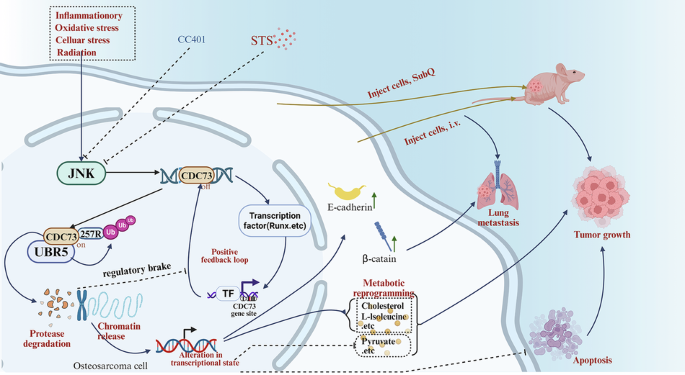
Zheng HC, Xue H, Zhang CY. The roles of the tumor suppressor parafibromin in cancer. Front Cell Dev Biol. 2022;10:1006400.
Google Scholar
Elena C, Andrea C, Di Giovanni F, Alessandra L, Mirella F, Antonella M. Hyperparathyroidism-Jaw Tumor Syndrome Associated to a CDC73 Gene Pathogenic VARIANT and a Nonossifying Desmoplastic Fibroma of the Mandible. Case Rep Endocrinol. 2025;2025:4340464.
Google Scholar
Haronikova L, Olivares-Illana V, Wang L, Karakostis K, Chen S, Fåhraeus R. The p53 mRNA: an integral part of the cellular stress response. Nucleic Acids Res. 2019;47:3257–71.
Google Scholar
Melnick AF, Mullin C, Lin K, McCarter AC, Liang S, Liu YE, et al. Cdc73 protects Notch-induced T-cell leukemia cells from DNA damage and mitochondrial stress. Blood. 2023;142:2159–74.
Google Scholar
Yart A, Gstaiger M, Wirbelauer C, Pecnik M, Anastasiou D, Hess D, et al. The HRPT2 tumor suppressor gene product parafibromin associates with human PAF1 and RNA polymerase II. Mol Cell Biol. 2005;25:5052–60.
Google Scholar
van den Heuvel D, Spruijt CG, González-Prieto R, Kragten A, Paulsen MT, Zhou D, et al. A CSB-PAF1C axis restores processive transcription elongation after DNA damage repair. Nat Commun. 2021;12:1342.
Google Scholar
Li C, Guo Y, Wang L, Yan S. The SMC5/6 complex recruits the PAF1 complex to facilitate DNA double-strand break repair in Arabidopsis. Embo J. 2023;42:e112756.
Google Scholar
Yu FQ, Wang Z, Wang XW, Wang SL, Li XD, Huang QS, et al. MicroRNA-885-5p promotes osteosarcoma proliferation and migration by downregulation of cell division cycle protein 73 homolog expression. Oncol Lett. 2019;17:1565–72.
Google Scholar
Kim SY, Lee JY, Cho YJ, Jo KH, Kim ES, Han JH, et al. USP37 Deubiquitinates CDC73 in HPT-JT Syndrome. Int J Mol Sci. 2022;23,6364.
Lin L, Zhang JH, Panicker LM, Simonds WF. The parafibromin tumor suppressor protein inhibits cell proliferation by repression of the c-myc proto-oncogene. Proc Natl Acad Sci USA 2008;105:17420–5.
Google Scholar
Gaballa A, Gebhardt-Wolf A, Krenz B, Mattavelli G, John M, Cossa G, et al. PAF1c links S-phase progression to immune evasion and MYC function in pancreatic carcinoma. Nat Commun. 2024;15:1446.
Google Scholar
Takahashi A, Tsutsumi R, Kikuchi I, Obuse C, Saito Y, Seidi A, et al. SHP2 tyrosine phosphatase converts parafibromin/Cdc73 from a tumor suppressor to an oncogenic driver. Mol Cell. 2011;43:45–56.
Google Scholar
Rozenblatt-Rosen O, Nagaike T, Francis JM, Kaneko S, Glatt KA, Hughes CM, et al. The tumor suppressor Cdc73 functionally associates with CPSF and CstF 3’ mRNA processing factors. Proc Natl Acad Sci USA 2009;106:755–60.
Google Scholar
Hu B, Chen S. The role of UBR5 in tumor proliferation and oncotherapy. Gene. 2024;906:148258.
Google Scholar
Wang X, Wang X, Gu J, Wei Y, Wang Y. circUBR5 promotes ribosome biogenesis and induces docetaxel resistance in triple-negative breast cancer cell lines via the miR-340-5p/CMTM6/c-MYC axis. Neoplasia. 2025;59:101062.
Google Scholar
Lin H, Zhang L, Liu B, Cui G. UBR5 Significantly correlates with osteosarcomas prognosis and immune exhaustion characteristic in the tumor microenvironment. Curr Cancer Drug Targets. 2023;24,69-79.
Yu Z, Dong X, Song M, Xu A, He Q, Li H, et al. Targeting UBR5 inhibits postsurgical breast cancer lung metastases by inducing CDC73 and p53 mediated apoptosis. Int J Cancer. 2024;154:723–37.
Google Scholar
Zarghooni K, Bratke G, Landgraf P, Simon T, Maintz D, Eysel P. The Diagnosis and Treatment of Osteosarcoma and Ewing’s Sarcoma in Children and Adolescents. Dtsch Arztebl Int. 2023;120:405–12.
Google Scholar
Rosen G, Marcove RC, Caparros B, Nirenberg A, Kosloff C, Huvos AG. Primary osteogenic sarcoma: the rationale for preoperative chemotherapy and delayed surgery. Cancer. 1979;43:2163–77.
Google Scholar
He H, Ni J, Huang J. Molecular mechanisms of chemoresistance in osteosarcoma (Review). Oncol Lett. 2014;7:1352–62.
Google Scholar
Fan GT, Ling ZH, He ZW, Wu SJ, Zhou GX. Suppressing CHD1L reduces the proliferation and chemoresistance in osteosarcoma. Biochem Biophys Res Commun. 2021;554:214–21.
Google Scholar
Yu Q, Geng M, Lu Y, Zhang X, Tong S, Wang Y, et al. Spermidine Secreted by Apoptotic Cells Enhances Chemotherapy Resistance by Modulating β-Catenin Activity in Osteosarcoma. Clin Cancer Res. 2026;32:390–404.
Google Scholar
Sayles LC, Breese MR, Koehne AL, Leung SG, Lee AG, Liu HY, et al. Genome-Informed Targeted Therapy for Osteosarcoma. Cancer Discov. 2019;9:46–63.
Google Scholar
Choo YS, Zhang Z. Detection of protein ubiquitination. J Vis Exp. 2009;1293.
Xiang G, Wang S, Chen L, Song M, Song X, Wang H, et al. UBR5 targets tumor suppressor CDC73 proteolytically to promote aggressive breast cancer. Cell Death Dis. 2022;13:451.
Google Scholar
Rozenblatt-Rosen O, Hughes CM, Nannepaga SJ, Shanmugam KS, Copeland TD, Guszczynski T, et al. The parafibromin tumor suppressor protein is part of a human Paf1 complex. Mol Cell Biol. 2005;25:612–20.
Google Scholar
Liao L, Song M, Li X, Tang L, Zhang T, Zhang L, et al. E3 Ubiquitin Ligase UBR5 Drives the Growth and Metastasis of Triple-Negative Breast Cancer. Cancer Res. 2017;77:2090–101.
Google Scholar
Song M, Yeku OO, Rafiq S, Purdon T, Dong X, Zhu L, et al. Tumor derived UBR5 promotes ovarian cancer growth and metastasis through inducing immunosuppressive macrophages. Nat Commun. 2020;11:6298.
Google Scholar
Odhiambo DA, Fan S, Hirbe AC UBR5 in tumor biology: exploring mechanisms of immune regulation and possible therapeutic implications in MPNST. Cancers. 2025;14,283.
Duan C-Y, Li Y, Zhi H-Y, Tian Y, Huang Z-Y, Chen S-P, et al. E3 ubiquitin ligase UBR5 modulates circadian rhythm by facilitating the ubiquitination and degradation of the key clock transcription factor BMAL1. Acta Pharmacologica Sinica. 2024;45:1793–808.
Google Scholar
Hehl LA, Horn-Ghetko D, Prabu JR, Vollrath R, Vu DT, Pérez Berrocal DA, et al. Structural snapshots along K48-linked ubiquitin chain formation by the HECT E3 UBR5. Nat Chem Biol. 2024;20:190–200.
Google Scholar
Cui H, Fan X. Targeting the NR4A3-RNF139-ATF6 pathway as a therapeutic and diagnostic strategy in bladder cancer. Pathol Res Pract. 2026;278:156301.
Google Scholar
Gupta N, Hanley MJ, Xia C, Labotka R, Harvey RD, Venkatakrishnan K. Clinical Pharmacology of Ixazomib: The First Oral Proteasome Inhibitor. Clin Pharmacokinet. 2019;58:431–49.
Google Scholar
Habelhah H, Shah K, Huang L, Burlingame AL, Shokat KM, Ronai Z. Identification of new JNK substrate using ATP pocket mutant JNK and a corresponding ATP analogue. J Biol Chem. 2001;276:18090–5.
Google Scholar
Bogoyevitch MA, Arthur PG. Inhibitors of c-Jun N-terminal kinases: JuNK no more? Biochim Biophys Acta. 2008;1784:76–93.
Google Scholar
Shearer RF, Iconomou M, Watts CK, Saunders DN. Functional Roles of the E3 Ubiquitin Ligase UBR5 in Cancer. Mol Cancer Res. 2015;13:1523–32.
Google Scholar
Wang Y, Niu K, Shi Y, Zhou F, Li X, Li Y, et al. A review: targeting UBR5 domains to mediate emerging roles and mechanisms – chance or necessity? Int J Surg. 2024;110:4947–64.
Google Scholar
Gao M, Labuda T, Xia Y, Gallagher E, Fang D, Liu YC, et al. Jun turnover is controlled through JNK-dependent phosphorylation of the E3 ligase Itch. Science. 2004;306:271–5.
Google Scholar
Bethard JR, Zheng H, Roberts L, Eblen ST. Identification of phosphorylation sites on the E3 ubiquitin ligase UBR5/EDD. J Proteomics. 2011;75:603–9.
Google Scholar
