


Ethics statements
The studies were performed in compliance with the guidelines approved by the Institutional Animal Care and Use Committee (IACUC) of University of Miami (ethical approval nos. 22-142 and 23-057). Human blood was obtained from Suncoast Community Blood Bank. GABA levels in tumors were determined by reanalyzing a published dataset from an institutional review board-approved study conducted at the University of Michigan59.
Materials
Baclofen, CGP 35348, uric acid and MCI-186 were purchased from Cayman Chemicals. Aminoguanidine, GABA and Ficoll were purchased from Sigma-Aldrich. Isofluorane, buprenorphine, ketamine and xylazine were obtained from the Division of Veterinary Resources (DVR) at the University of Miami. RPMI 1640 with L-glutamine, Glutagro supplement and heat-inactivated FBS were obtained from Corning. DMEM F/12 medium, B-27 supplement 50×, antibiotic–antimycotic 100× and penicillin/streptomycin 100× were purchased from Thermo Fisher Scientific. Recombinant EGF, FGF, GM-CSF and IL-4 were obtained from Biolegend.
Mouse FcR blocking reagent, human FcR blocking reagent and CD8a microbeads mouse (130-117-044) were purchased from Miltenyi Biotec. CFSE, Zombie violet and Zombie aqua fixable viability kit and True Nuclear transcription factor buffer set were purchased from Biolegend.
In vitro mouse flow cytometry antibodies CD11b (M1/70), Ly6C (HK1.4), Ly6G (1A8), NOS2 (W16030C), Arg1 (W210471), CD80 (16-10A1), CD86 (GL-1), CD163 (S150491), CD204 (1F8C33) and IA/IE (M5/114.15.2) were obtained from Biolegend.
In vivo immune profiling mouse flow antibodies CD11b (M1/70), Ly6C (HK1.4 9), Ly6G (1A8), CD68 (FA-11), F4/80 (BM8), CD45 (I3/2.3), CD11c (N418), P2Ry12 (S16007D), IA/IE (M5/114.15.2), PDL1 (10F.9G2), CD204 (1F8C33), CD3 (17A2), CD4 (GK1.5), CD8a (53-6.7), B220 (RA3-6B2), CD69 (H1.2F3), CD152 (UC10-4B9), PD1 (29f.1A12), NK1.1 (S17016D), TIGIT (1G9), NOS2 (W16030C), Ki67 (11Fb), CD45 (30-F11), CD4 (GK1.5), CD8 (6206.7), granzyme B (QA18A28) and TNF MP6-XT22 (506329) were purchased from Biolegend. Brilliant stain buffer and CD3 (145-2C11) were obtained from BD Biosciences.
Human flow antibodies CD45 (HI30), CD3 (OKT3), CD19 (HIB19), CD56 (5.1H11), CD11c (3.9), CD123 (6H6), CD11b (ICRF44), Lox1 (15C4), CD14 (M5E2), CD33 (WM53), HLA/DR (L243), CD66b (G10F5), CD68 (Y1/82A), Arg1 (14D2C43), CD4 (SK3), CD8 (SK1), CD45RA (HI100), CD62L (DREG-56), CD69 (FN50) and CD95 (DX2) were purchased from Biolegend. Lightning-Link Pe Cy7 antibody labeling kit and human/mouse/rat iNOS (2D2-B2) antibody were purchased from Biotechne.
Cell lines
SB28 (H. Okada, University of California, San Francisco), KR158 (K. Reilly, National Cancer Institute (NCI)), L1 cells (L. Deleyrolle, University of Florida), DI318 (J. Lathia, Cleveland Clinic) and GL261 (NCI Division of Cancer Treatment and Diagnosis) cells were acquired through material transfer agreements. Mouse cells were maintained in RPMI 1640 supplemented with 10% FBS and 1% penicillin/streptomycin. Human cell lines were maintained in DMEM F/12 medium containing 10× B-27, 20 ng ml−1 EGF, 20 ng ml−1 FGF, 1% Glutagro and 0.5% penicillin/streptomycin. All cell lines were treated with 1:100 MycoRemoval agent (MP Biomedicals) upon thawing and routinely tested for Mycoplasma species (Lonza). Cells were not used beyond passage 20.
Animal studies
C57BL/6 male and female mice (4 weeks old; JAX, 000664) were purchased from the Jackson Laboratory as needed and housed in the DVR facility at the University of Miami. NOD-Prkdcem26Cd52Il2rgem26Cd22/NjuCrl (NCG) male and female mice (4 weeks old; Charles River, 572NCG) were purchased from Charles River Laboratories. CAT2-KO mice were obtained from D. Dean (Vanderbilt University)29.
C57BL/6 or CAT2-KO male and female mice were intracranially injected at 4–8 weeks old with 20,000–40,000 SB28 or 25,000 GL261 cells, while NCG mice were injected with 10,000 SB28 cells in 5–10 μl of RPMI null medium into the left cerebral hemisphere, 2 mm caudal to the coronal suture and 3 mm lateral to the sagittal suture at a 90° angle with the murine skull to a depth of 2.5 mm, using a stereotaxis apparatus (Kopf). Concomitantly, mice were subcutaneously injected with 3.5 mg kg−1 buprenorphine.
Mice implanted with SB28 and GL261 were intraperitoneally injected with 2 mg kg−1 baclofen, 4 mg kg−1 CGP 35348 or PBS (vehicle) for up to 2 weeks. The first dose was administered 7 days after tumor implantation following a cycle of 5 days on, 2 days off. For combinatorial studies, 100 mg kg−1 aminoguanidine was administered intraperitoneally 7 days after tumor implantation for 5 days. For depletion of gMDSCs, mice were injected with 10 mg kg−1 InVivoMAb antimouse anti-Ly6G (BE0075-1, BioXCell) or InVivoMAb rat IgG2a isotype control (antitrinitrophenol; BE0089, BioXCell) three times per week as described previously5. As approved by the IACUC, we used the following criteria as a surrogate of tumor burden: 1, behavioral changes (aggression, guarding, hiding); 2, hair/coat (ruffled fur, lack of grooming); 3, neurological symptoms (head-tilt, seizure); 4, posture or ambulatory changes (tense, stiff gait, ataxia); 5, activity level changes (restlessness, pacing, lethargy); 6, difficulty in breathing or other sign of distress. Surrogate measures were not exceeded.
Drug prediction
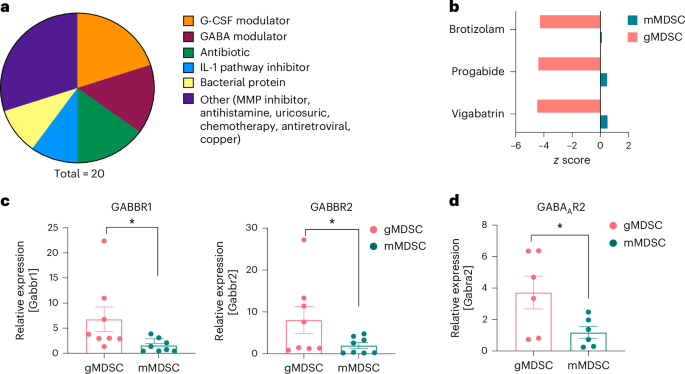
MDSC gene expression and network medicine analyses were previously performed and published5. Candidates were sorted on the basis of z score from low to high. The top 20 clinically approved drugs predicted to selectively target gMDSCs were manually annotated and classified into subgroups on the basis of their molecular targets.
Metabolomic analysis of myeloid cells
Bone marrows were flushed from the femur and tibia of 4–8-week-old male and female C57BL/6 mice with 10 ml of PBS and strained through a 40-μm strainer (Corning). Bone-marrow-derived cells were incubated with 1:50 diluted mouse FcR blocking reagent in FACS buffer (2% PBS–BSA) on ice for 5 min and stained with a cocktail anti-CD11b/Ly6G/Ly6C antibodies (1:100) for 15 min at 4 °C to sort for mMDSCs (CD11b+Ly6C+Ly6G−) and gMDSCs (CD11b+Ly6C−Ly6G+) with the BD FACS SORP Aria Fusion (BD Biosciences). Sorted cells were reconstituted in RPMI medium (RPMI 1640 + 10% FBS + 1% antibiotic–antimycotic) containing 50 ng ml−1 GM-CSF and IL-4. A total of 1 million cells were treated with 100 μM GABA or an equal volume of vehicle (PBS) for 18 h in six-well plates. The cells were harvested as pellets and snap-frozen until further processing. Snap-frozen cell pellets were lysed in methanol and water (80:20) at dry-ice temperature. The quantity of the metabolite fraction analyzed was adjusted to the cell count. Extracts were clarified by centrifugation, dried by nitrogen blower and then reconstituted in 50:50 methanol and water. Metabolite fractions were processed and analyzed by targeted liquid chromatography–tandem mass spectrometry (LC–MS/MS) with dynamic multiple reaction monitoring (MRM). LC–MS/MS experiments were performed on an Agilent Technologies Triple Quad 6470 LC–MS/MS system with a 1290 Infinity II LC flexible pump (quaternary pump), 1290 Infinity II multisampler, 1290 Infinity II multicolumn thermostat with six-port valve and 6470 triple-quadrupole MS instruments. Agilent MassHunter Workstation software LC–MS data acquisition for 6400 Series triple-quadrupole MS with version B.08.02 was used for compound optimization and sample data acquisition. Studies were performed in negative-ion acquisition mode with ion-pairing chromatography, using an Agilent ZORBAX RRHD Extend-C18 column (2.1 × 150 mm, 1.8 µm) and ZORBAX Extend fast guards for ultrahigh-performance LC separation. Agilent MassHunter Workstation quantitative analysis for QQQ version 10.1, build 10.1.733.0 was used to integrate and quantitate metabolite peak areas. LC–MS peaks corresponding to metabolites with coefficients of variation greater than 0.5 underwent manual inspection and integration. The data were normalized to the average sum of metabolites from all the samples and analyzed using Morpheus to generate the heat map. Metaboanalyst was used for pathway enrichment analysis, using the most upregulated metabolites (up to P = 0.1) in female gMDSCs following GABA treatment.
Immunophenotyping of mouse myeloid cells
A total of 250,000 bone-marrow-derived cells were seeded in a round-bottom 96-well U-bottom plate (3788, Corning) and treated with 100 μM GABA, 100 μM baclofen or vehicle (PBS) for 18 h as above. Cells were stained with Zombie violet (1:500) in PBS for 15 min at room temperature, washed with FCS buffer and incubated with 1:50 mouse FcR blocking reagent for 5 min on ice. Cells were stained with anti-CD11b, anti-Ly6G and anti-Ly6C (1:100) for 15 min at 4 °C, fixed using True Nuclear fixation buffer and stained with anti-NOS2 or anti-ARG1 (1:100) in permeabilization buffer for 20 min at room temperature. Samples were acquired using Beckman Coulter CytoFlex LX and analyzed using FlowJo.
Immunophenotyping of human myeloid cells
Leukoreduction system (LRS) chambers from male and female donors, who provided written consent to Suncoast Community Blood Bank, were used entirely for the analysis. First, 30 ml of PBS was flushed through LRS chambers using an 18½ gauge blunt needle (BD Biosciences, 305180). Blood was diluted with PBS to a total volume of 45 ml and was then layered over Ficoll (1:1 ratio). PBMCs collected following centrifugation at 975g without brake for 20 min were resuspended in 50 ml of PBS and centrifuged at 450g for 7 min. Pellets were resuspended in 5 ml of 1× red blood cell lysis buffer (Biolegend) for 5 min at room temperature. Cells were the resuspended in 10 ml of RPMI medium and filtered through a 40-μm nylon mesh filter.
A total of 3–5 million PBMCs were seeded in a six-well plate in 2 ml of medium and treated with 100 μM baclofen or PBS for 18 h. Cells were stained with live/dead viability dye, incubated with 1:50 human FcR blocking reagent and stained with a 1:100 diluted human myeloid panel antibody cocktail for 15 min at 4 °C. Cells were fixed using True Nuclear fixation transcription factor buffer and stained with anti-CD68, anti-NOS2 and anti-ARG1 antibodies (1:100). Samples were acquired using a Beckman Coulter CytoFlex LX and analyzed using FlowJo.
In vivo immune profiling
SB28-bearing mice were euthanized when the first animal exhibited endpoint symptoms. Blood was collected by cardiac puncture into EDTA-coated mini blood collection tubes (Greiner Bio-one, 450470) and centrifuged at 2,000g at 4 °C for 10 min. Single-cell suspensions from spleens were prepared by mechanical dissociation over a 40-μm strainer. Cells were centrifuged at 340g for 5 min and treated with red blood cell lysis buffer. Tumors were collected and minced into small pieces with a razor blade and incubated with collagenase IV (7900, Stem Cell Technologies) containing DNase I (1:1,000; 18047019, Thermo Fisher Scientific) at 37 °C for 15 min. Cells were passed through a 40-μm strainer and centrifuged at 340g for 5 min.
Samples were stained with 1:500 diluted Zombie aqua, treated with Fc blocking reagent and stained with fluorophore-conjugated antibodies as above. Samples were fixed overnight in true nuclear transcription factor buffer and stained with anti-NOS2 antibody as described above. Samples were acquired with Beckman Coulter CytoFlex LX and analyzed using FlowJo.
For the assessment of T cells from tumors, density gradient centrifugation was performed following enzymatic digestion11. Briefly, cells were resuspended in 30% isotonic (P1644, Sigma-Aldrich) and centrifuged at 300g for 20 min at room temperature without brake. Following centrifugation, the supernatant was aspirated and the cell pellet was frozen in serum-free cell freezing medium (30–2600, American Type Culture Collection) and stored in liquid nitrogen until use. For flow cytometry analysis, frozen cells were thawed in a water bath and washed twice with prewarmed complete RPMI. Cells were then incubated with the cell stimulation cocktail (eBioscience) for 4 h at 37 °C before proceeding with staining. Samples were acquired with Cytek Aurora and analyzed using FlowJo.
T cell proliferation assay
T cells were isolated from splenocytes using CD8a microbeads following the manufacturer’s instructions. CD8+ T cells were stained with 5 μmol l−1 CFSE for 5 min at 37 °C and washed with ice-cold 10% RPMI twice. A total of 200,000 T cells were cocultured with MDSCs sorted from WT or CAT2-KO mice at ratios of 1:1 (mMDSCs), 2:1–8:1 (gMDSCs) and 1:1 (nonMDSCs) in the presence of 100 IU of recombinant IL-2 (Peprotech) with mouse anti-CD3/CD28 Dynabeads (Thermo Fisher Scientific) for 4 days in a 96-well round-bottom plate. Then, 100 μM baclofen was added daily to cocultures. For NOS2 inhibition or peroxynitrite scavenging, 0.1 mg ml−1 aminoguanidine, 0.01 mg ml−1 uric acid or 0.1 mg ml−1 MCI-186 were added. On day 4, samples were stained with anti-CD3 antibody and CFSE dilution was analyzed using Beckman Coulter CytoFlex LX and FlowJo.
Analysis of peroxynitrite production
A total of 200,000 sorted MDSCs were stimulated overnight with 100 μM baclofen. Cells were then transferred to a 96-well black-walled plate and incubated with freshly prepared 10 μmol l−1 HPF (Thermo Fisher Scientific, H36004) or DMF as the unstained control for 30 min at 37 °C. The cells were spun down, washed once in 1× HBSS and resuspended in 200 μl of 1× HBSS to acquire fluorescent signal values on the Promega GloMax (Promega, GM3500) Explorer multimode microplate reader.
GABA quantification from mouse and human tumors
Human tissue data analyzed in this study were generated as part of a prior investigation, which involved written consent59. Total abundance values (sum of all isotopologs) of GABA from LC–MS analyses were compared between men and women using both enhancing and nonenhancing regions of tumors. Male tumors included five GBMs and one diffuse hemispheric glioma and female tumors were classified as one GBM and one oligodendroglioma.
GABA levels in mouse brain tumors were quantified using ultrahigh-performance LC coupled to a triple-quadrupole MS instrument (Agilent 1290 Infinity II/6495C). Briefly, snap-frozen tissues were transferred into 2-ml reinforced polypropylene tubes containing a 6-mm stainless-steel grinding ball and prechilled (−20 °C) 80% methanol supplemented with 13C3 sodium L-lactate (Cambridge Isotype Laboratories, MSPP-CLM1579N0) as an internal standard. Extraction solvent (80% methanol) was added at a ratio of 1 ml per 10 mg of tissue. Samples were placed in a MiniG Homogenizer Cryo-Block on dry ice and homogenized using an HG-400 MiniG (Cole-Parmer) for 1 min at 1,500 strokes per min, followed by centrifugation at 15,000g for 15 min at 4 °C. The resulting supernatant, containing polar metabolites, was transferred to Eppendorf Safe-Lock tubes and dried in a CentriVap SpeedVac (Labconco) maintained at 4 °C. Dried extracts were resuspended in water. Chromatographic separation was achieved on an Agilent Zorbax Extend-C18 column (759700902), maintained at 35.0 °C. The injection volume was 2 µl and the mobile phases consisted of solvent A (LC––MS-grade water with 3% methanol, 10 mM tributylamine and 15 mM acetic acid) and solvent C (LC–MS-grade methanol with 10 mM tributylamine and 15 mM acetic acid). A wash step with 100% LC–MS-grade acetonitrile (solvent D) was incorporated after the run. The following gradient was used: 100% A with 0.250 ml min−1 flow at 0–2.5 min, 80% A and 20% C with 0.250 ml min−1 flow at 7.5 min, 55% A and 45% C with 0.250 ml min−1 flow at 13 min, 1% A and 99% C with 0.250 ml min−1 flow at 20 min, 1% A and 99% C with 0.250 ml min−1 flow at 24 min, 1% A and 99% D with 0.250 ml min−1 flow at 24.05 min, 1% A and 99% D with 0.250 ml min−1 flow at 27 min, 1% A and 99% D with 0.800 ml min−1 flow at 27.5 min, 1% A and 99% D with 0.800 ml min−1 flow at 31.35 min, 1% A and 99% D with 0.600 ml min−1 flow at 31.5 min,100% A with 0.400 ml min−1 flow at 32.25 min, 100% A with 0.400 ml min−1 flow at 39.9 min and 100% A with 0.250 ml min−1 flow at 40 min. MS detection was performed in MRM mode using negative electrospray ionization, 25 ms of dwell time, 150 °C gas temperature with 13 l min−1 flow, nebulizer at 45 psi, 325 °C of sheath gas temperature with 12 l min−1 flow, 2,000 V of capillary and 500 V of nozzle voltage. Agilent Masshunter acquisition software 12.1 was used to acquire data. The relative abundance in each sample was quantified using Agilent Quantitative software 12.1.
qPCR
A total of 1 million sorted mMDSCs and gMDSCs were treated with 100 μM GABA or PBS for 18 h in RPMI 1640 medium supplemented with 10% FBS, 1% antibiotic–antimycotic, 50 ng ml−1 GM-CSF and 50 ng ml−1 IL-4. RNA was isolated using the Qiagen RNeasy mini kit, the concentration was measured with a NanoDrop One (Thermo Scientific) and cDNA was synthesized using qScript cDNA Supermix (Quanta Biosciences) in a thermal cycler (Eppendorf). qPCR reactions were performed using QuantStudio 7 Pro Applied Biosystems and Fast SYBR green mastermix (Thermo Fisher Scientific). Threshold cycle values were normalized to Actin expression. The primer sequences (Integrated DNA Technologies) are provided in Supplementary Table 1.
Cancer cell proliferation assay
A total of 100 SB28, KR158, L1 and DI318 cells were plated into 96-well plates coated with Geltrex (Thermo Fisher Scientific, for PDCs). Cells were treated with 100 μM GABA, 100 μM baclofen or vehicle daily. CellTiter-Glo (Promega) values were measured with GloMax Discover plate reader (Promega) on day 5.
Reanalysis of single-cell RNA-sequencing data
GABA-related gene expression from eight men and 13 women with both low-grade and high-grade gliomas were analyzed using a previous dataset (GSE117891)35 across all immune populations. Consent information was not available in the original manuscript. Raw data were downloaded from the Gene Expression Omnibus and processed as previously described60. The average expression of genes encoding GABA-related molecules (GABAAR (GABRA1–GABRA6, GABRB1–GABRB3, GABRD, GABRE, GABRG1–GABRG3, GABRP, GABRQ and GABRR1–GABRR3), GABBR (GABBR1 and GABBR2), GABA transaminase (ABAT and ALDH5A1) and GABA transporter (SLC6A1 and SLC6A11–SLC6A13)) were evaluated. Differences in GABBR1 and GABBR2 in immune cell populations between male and female were compared using the Wilcoxon rank-sum test. The analyses were performed using R (version 4.2.1).
Statistics and reproducibility
No statistical method was used to predetermine sample size but our sample sizes are similar to those reported in previous publications5,29. For in vivo studies, mice were randomized into drug-treated versus vehicle-treated groups and cohoused to limit the cage effect. The investigators were not blinded to allocation during experiments and outcome assessment. Data were analyzed and presented using GraphPad Prism (version 9.5.1, GraphPad Software). Grubbs’ test was used to determine significant outliers and these data points were included in the source data. Data distribution was assumed to be normal but this was not formally tested. An unpaired t-test, paired t-test or two-way analysis of variance (ANOVA) was used for the comparison of differences among sample groups as indicated in the figure legends. The Gehan–Breslow–Wilcoxon test was used to analyze survival data. The specific statistical method used for individual datasets is listed in the figure legends.
Reporting summary
Further information on research design is available in the Nature Portfolio Reporting Summary linked to this article.
