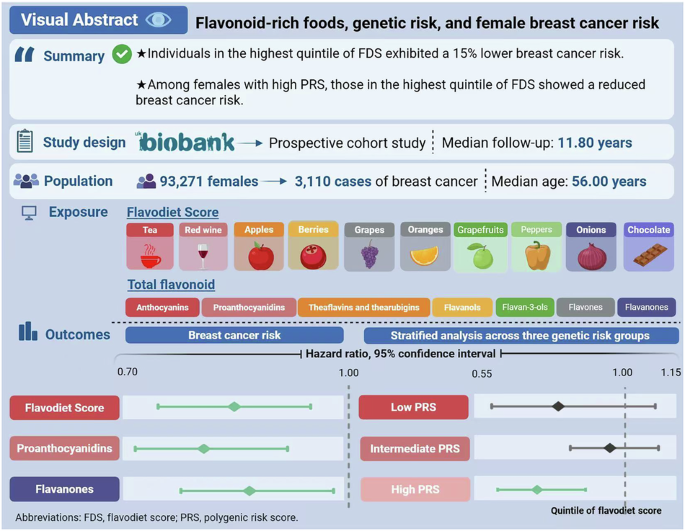
The Flavodiet Score (FDS) represents flavonoid-rich food intake, but its association with breast cancer risk and whether genetic risk modifies this association remain unclear. We analyzed data from 93,271 females in the UK Biobank with a median follow-up of 11.8 years. Associations were examined using delayed-entry Cox proportional hazards regression models. The polygenic risk score (PRS) for breast cancer was constructed based on 168 single nucleotide polymorphisms. Results showed that females in the highest FDS quintile had a 15% reduced risk compared with those in the lowest quintile. Higher intakes of specific flavonoid subclasses (such as flavanones and proanthocyanidins) and of flavonoid-rich foods (including oranges and apples) were also associated with reduced breast cancer risk. Furthermore, the association between FDS and breast cancer risk did not vary significantly according to menopausal status. Notably, among females with high PRS, those in the highest quintile of FDS showed a significantly reduced breast cancer risk. In conclusion, adherence to a flavonoid-rich diet may reduce breast cancer risk, providing valuable guidance for future intervention studies and public health strategies.
Trending
- Guernsey boy, 13, takes on 30-day triathlon in stepdad’s memory
- How Will Successfully Targeting KRAS Change Pancreatic Cancer Treatment?
- Quality of Life, Subgroup Consistency, and the KEYNOTE-966 Study Design
- How Much Of A Cancer Drug Is Too Much? Patients, Researchers Challenge FDA-Approved Dosages
- Rectal cancer trial offers non-surgical treatment hope
- Multimodal spatial profiling reveals distinct myeloid-defined ENKTL subgroups and tumor-myeloid cooperativity within prognostic inflammatory niche
- The inside story of Moderna and Merck’s cancer vaccine triumph
- New treatment helps patients with rectal cancer avoid major surgery and side effects – Cancer Research UK


Monday, August 24
Flavonoid-rich foods, genetic risk, and female breast cancer risk: a prospective cohort study
 By NewsCancer