


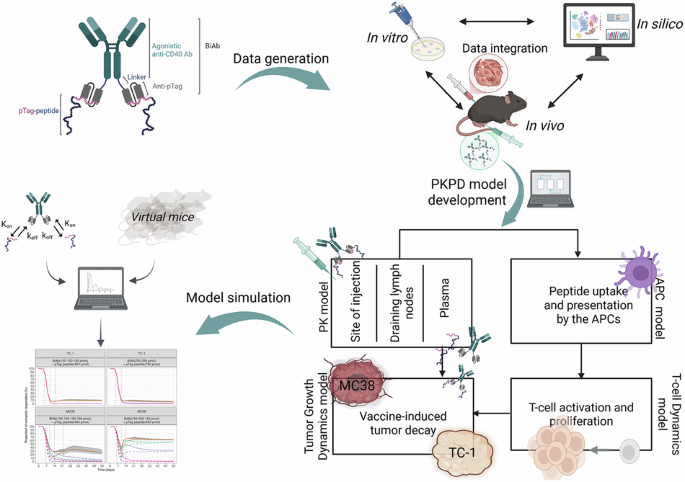
A multiscale semi-mechanistic PKPD modeling framework was built through the sequential development of sub-models, capturing the key PK and PD processes, along with critical biological interactions required for a vaccine-induced T-cell response and tumor regression, and the temporal interplay between product components (Fig. 2). A data-driven approach was applied, with the model informed by in silico, in vitro, and in vivo data while remaining grounded in knowledge from the literature. Parameter estimates for the framework’s sub-models are provided in Table 1 and Suppl. Tables S1–S4.
Table 1 Parameter estimates and their uncertainty (relative standard error, RSE) for the tumor growth dynamic model
Pharmacokinetic model
Given the mechanism of action of the BiTag drug (Fig. 1A) via delivering its peptide cargo to induce local peptide-specific T-cell activation in the draining lymph nodes following s.c. administration (Fig. 1B), a PK model successfully characterized the lymphatic and systemic disposition of the BiAb and pTag-peptide. This model included five anatomical locations: (1) site of s.c. injection in the hock, (2) hock injection draining popliteal lymph node, (3) hock injection draining inguinal lymph node, (4) site of s.c. injection in the flank, and (5) plasma (i.e., central compartment) (Fig. 2A and S1). The binding kinetics between the BiAb and pTag-peptide were applied in all five locations.
Fig. 2: Schematic representation of the multiscale semi-mechanistic pharmacokinetic-pharmacodynamic modeling framework.
Schematic representation of the multiscale semi-mechanistic data-driven pharmacokinetic (A) -pharmacodynamic (B) modeling framework. \({BiAb}\) bispecific antibody, \({Ag}\) peptide, \({APC}\) antigen presenting cell, pMHCx,y major histocompatibility complex -peptide complexes, TEM transition effector memory T-cells; CM, central memory T-cells; kdeg,BiAb:Ag, first-order degradation rate constant of BiAb conjugate from injection site, \({{\rm{k}}}_{{\rm{aff}},{\rm{BiAb}}}\) and \({{\rm{k}}}_{{\rm{aff}},{\rm{Ag}}}\) first-order absorption rate constants of BiAb and \({Ag}\) into the lymph nodes, respectively; \({k}_{{eff}}\) first-order rate constant of transition from lymph nodes to plasma, \({k}_{{el},{BiAb}}\) and \({k}_{{el},{Ag}}\) first-order elimination rate constants of \({Bi}{Ab}\) and \({Ag}\) from plasma, respectively; \({V}_{\max }\) maximum elimination capacity of total \({Bi}{Ab}\), \({K}_{m\,}\) concentration at which the elimination rate is half-maximal, \({k}_{{up}}\) first-order rate constant of peptide uptake by APC, \({k}_{{tr},{BiAb}:{Ag}}\) first-order rate constant of delayed release of peptide within APC, \({k}_{{APC}}\) first-order turn-over rate constant of APC, \({k}_{{off},{pMHCI}}\) and \({k}_{{off},{pMHCII}}\) the dissociation rate constant of the peptide from MHC I and II molecules, respectively ;\(\,{\sigma }_{{NT}}\), \({\sigma }_{{TEM}}\) and \({\sigma }_{{CM}}\) first-order turnover rate constants of naïve, TEM and CM T-cells, \({k}_{{act},{CDi}}\), \({k}_{p,{CDi}}\) and \({k}_{{diff},{CDi}}\) maximum activation, proliferation and differentiation first-order rate constants of T-cells, \({{frc}}_{{TEM}}\) fraction of TEM T-cells differentiating into CM T-cells, \({k}_{G0}\) first-order growth rate constant, \({K}_{G1}\) zero-order growth rate constant, \({{SHR}}_{{Tcell},{TC}1}\) and \({{SHR}}_{{Tcell},{MC}38}\) the vaccine-induced shrinkage effect in TC-1 and MC38 tumor models, respectively; \({{\rm{SHR}}}_{{\rm{trans}},{\rm{BiAb}}}\) and \({{SHR}}_{{per},{BiAb}}\), the transient and persistent BiAb-induced shrinkage effect, respectively, in MC38 tumor model only; \({k}_{d,{nat}}\) first-order natural death rate constant of MC38 tumor, \({k}_{e0,{Tcell}}\) and \({k}_{e0,{Ag}}\) first-order delay rate constants of T-cell and peptide, respectively; \({K}_{{in},{BiAb}}\) zero-order input rate constant. Created in https://BioRender.com.
The injection site was initialized with fully saturated BiAb with pTag-peptides (i.e., 1:2) and excess free pTag-peptide in 1:3 preparations. Following the s.c. injection in the hock, an estimated 57% of the absorbed dose entered the popliteal lymph node, while the remaining drained to the inguinal lymph node. The transition kinetics were assumed to be the same for free BiAb and its pTag-peptide conjugate, with an estimated mean transit time of 6.1 h to both lymph nodes. Thereafter, the different forms drained through the efferent lymphatics to rapidly enter the systemic circulation. Upon s.c. administration into the flank, the free BiAb and its pTag-peptide conjugate were absorbed into the central compartment via a nonlinear process. Additionally, free BiAb underwent a parallel first-order absorption process, with a mean absorption time of 34 h. The free pTag-peptide had a fast mean absorption time (0.25 h) from both injection sites. The estimated half-life of conjugate degradation at the injection site was 31 h.
Total STRIKE2001 BiAb exhibited significant non-linear elimination from the central compartment, along with linear elimination with an estimated half-life of 29 h. Free pTag-peptide had a short half-life of 23 seconds on average. Clearance and volume of distribution were allometrically scaled by body weight using fixed exponents of 0.75 and 1, respectively, relative to a 20 g reference weight. Across all three PK experiments included in the model analysis, the observed median concentrations were included within the 90% confidence interval around the predicted median (Fig. 3), supporting adequate predictive performance of this sub-model. See Supplementary Material, section 1, for further details.
Fig. 3: Simulation-based evaluations of the pharmacokinetics model.
Simulation-based evaluations of the pharmacokinetics model using 1000 simulations, (A) displays time on a linear scale, while (B) shows time on a logarithmic scale. Dots illustrate the observed experimental concentrations. The solid and dashed black lines are the median of the observed and simulated concentration-time profiles, respectively. The blue-shaded regions illustrate the 90% confidence interval for the predicted medians based on the simulated data. SC subcutaneous, HC hock, IV intravenous, RF right flank.
Model for the peptide uptake by antigen-presenting cells
Upon reaching the hock injection draining lymph nodes, the BiTag drug binds to CD40 on APCs (e.g., dendritic cells (DCs)) and is internalized via receptor-mediated uptake for peptide delivery (Fig. 1B). The peptide uptake model was applied to describe the two states required for APC-mediated peptide presentation (Eq. 1–4) after the exposure to either the BiAb:pTag-peptide conjugate or its separate components; 1) extracellular peptides, either free or conjugated, attached to APCs, and 2) intracellular released peptides within APCs, where peptide-major histocompatibility complex (MHC) complexes (\(p{{MHC}}_{x,y}\), with \(x\) indicating class I or II and \(y\) denoting popliteal or inguinal lymph nodes) are formed (Fig. 2B). The transition kinetics between the states were informed by a multistate model (Fig. S2), which was developed to characterize the dynamic states of DCs; further details are in Supplementary Material, section 2. There was a close agreement between the in vitro data and model simulations, with the observed median falling inside the 90% confidence interval of the predicted median (Suppl. Fig. S3).
The extracellular attachment of free peptides (\({{Ag}}_{{free},y}\)) and pTag-peptide conjugated with BiAb (\({{Ag}}_{{conj},y}\)) to APCs was described by the first-order rate constant (\({k}_{{up}}\)). Free peptides were internalized directly via a first-order rate constant (\({k}_{{tr},{Ag}}\)), while conjugated peptides underwent a 6-hour mean delay time through six transit compartments (\({{MTT}}_{{tr},{BiAb}:{Ag}}=\frac{6}{{k}_{{tr},{BiAb}:{Ag}}}\)), describing a delay, before being released from the conjugate (\({{Ag}}_{{conj},{tr},y,n}\)) and presented on MHC molecules (\({{Ag}}_{{MHC},y}\)). The presented peptide decay was influenced not only by APCs’ death rate (\({k}_{{APC}}\)) but also by the dissociation rate constant of the peptide (\({k}_{{off},{pMHCx}}\)) from MHC molecules. This dissociation rate depended on epitope sequence and MHC molecule type (Table 2).
$$\frac{d({{Ag}}_{{free},{ex},y})}{{dt}}={k}_{{up}}\cdot A{g}_{{free},y}-({k}_{{tr},{Ag}}+{k}_{{APC}})\cdot {{Ag}}_{{free},{ex},y}$$
(1)
$$\frac{d\left({{Ag}}_{{conj},{ex},y}\right)}{{dt}}={k}_{{up}}\cdot {{Ag}}_{{conj},y}-({k}_{{tr},{BiAb}:{Ag}}+{k}_{{APC}})\cdot {{Ag}}_{{conj},{ex},y}$$
(2)
$$\frac{d\left({{Ag}}_{{conj},{tr},y,n}\right)}{{dt}}={k}_{{tr},{BiAb}:{Ag}}\cdot {{Ag}}_{{conj},{ex},y}-({k}_{{tr},{BiAb}:{Ag}}+{k}_{{APC}})\cdot {{Ag}}_{{conj},{tr},y,n}$$
(3)
$$\frac{d({{Ag}}_{{MHC},y})}{{dt}}={k}_{{tr},{Ag}}\cdot {{Ag}}_{{free},{ex},y}+{k}_{{tr},{BiAb}:{Ag}}\cdot {{Ag}}_{{conj},{tr},y,{NN}}-({k}_{{off},{pMHCx}}+{k}_{{APC}})\cdot {{Ag}}_{{MHC},y}$$
(4)
Table 2 Summary of binding affinities
T-cell dynamics model
Depending on the peptide, it is presented on MHC-I or MHC-II to activate CD8+ or CD4+ T-cells, respectively (Fig. 2B). The T-cell dynamics model evaluated the T-cell expansion, following the BiAb:pTag-peptide conjugate or its separate entities administration, in the hock injection draining lymph nodes (Figs. 1B, 2B). Naïve T-cell (\({{NT}}_{y}\)) followed a homeostasis assumption (Eq. 5), with turnover rate (\({\rho }_{{NT}})\). Its activation rate (\({{\rm{\sigma }}}_{{NT},{CDi}}\), with \(i\) indicating CD8+ or CD4+ T-cells) to transition effector memory T-cells (\({{TEM}}_{{CDi},y}\)) was triggered by interacting with \(p{{MHC}}_{x,y}\), calculated as \({{Ag}}_{{MHC},y}\) multiplied by \({Avogadr}{o}^{{\prime} }{snumber}\).
$$\frac{d\left({{NT}}_{y}\right)}{{dt}}={\rho }_{{NT}}\cdot \left({{NT}}_{y,0}-{{NT}}_{y}\right)-{{\rm{\sigma }}}_{{NT},{CDi}}\cdot f\left(p{{MHC}}_{{xy}}\right)\cdot {{NT}}_{y}$$
(5)
\({{TEM}}_{{CDi},y}\) were eliminated at a first-order death rate constant \({\rho }_{{TEM},{CDi}}\). Upon interacting with \(p{{MHC}}_{x,y}\), they expanded with the proliferation rate constant \({k}_{p,{CDi}}\) and converted into central memory T-cells (CMCDi,y) via the differentiation rate constant \({k}_{{diff},{CDi}}\). Their differentiation was related to the peptide-MHC complex saturation function \(f\left(p{{MHC}}_{x,y}\right)\) with σ50 representing the number of \({\rm{p}}{{\rm{MHC}}}_{{\rm{x}},{\rm{y}}}\) required for half-maximal effect. When \(f\left(p{{MHC}}_{x,y}\right)\) approached 0, a fraction of effector cells (\({fr}{c}_{{TEM}}\)=0.1) differentiated into \({{CM}}_{{CDi},y}\) (Eq. 6).
$$\frac{d\left({{TEM}}_{{CDi},y}\right)}{{dt}}=\left({\sigma }_{{NT},{CDi}}\cdot {{NT}}_{y}+{k}_{p,{CDi}}\cdot {{TEM}}_{{CDi},y}+{k}_{{diff},{CDi}}\cdot {{CM}}_{{CDi},y}\right)\cdot f\left(p{{MHC}}_{{xy}}\right)-\left({k}_{{diff},{CDi}}\cdot \left(1-f\left(p{{MHC}}_{x,y}\right)\right)\cdot {fr}{c}_{{TEM}}+{\rho }_{{TEM},{CDi}}\right)\cdot {{TEM}}_{{CDi},y}$$
(6)
Similarly, \({{CM}}_{{CDi},y}\), with a death rate constant \({\rho }_{{CM},{CDi}}\), proliferate and differentiate into \({{TEM}}_{{CDi},y}\) (Eq. 7). \({\sigma }_{{NT},{CDi}}\), \({k}_{p,{CDi}}\), and \({k}_{{diff},{CDi}}\) were assumed equal, estimated at 0.63 and 0.98 day−1 for CD8+ and CD4+ T-cells, respectively. The simulation-based 90% confidence interval for the predicted median encompasses the observed median of the four in-vivo T-cell expansion involved in the analysis, indicating satisfactory model predictive ability (Fig. 4). See Supplementary Material, section 3, for details.
$$\frac{d\left({{CM}}_{{CDi},y}\right)}{{dt}}={k}_{{diff},{CDi}}\cdot \left(1-f\left(p{{MHC}}_{x,y}\right)\right)\cdot {fr}{c}_{{TEM}}\cdot {{TEM}}_{{CDi},y}+{k}_{p,{CDi}}\cdot f\left(p{{MHC}}_{x,y}\right)\cdot {{CM}}_{{CDi},y}-\left({k}_{{diff},{CDi}}\cdot f\left(p{{MHC}}_{x,y}\right)+{\rho }_{{CM},{CDi}}\right)\cdot {{CM}}_{{CDi},y}$$
(7)
Fig. 4: Simulation-based evaluations of the T-cell dynamics model.
Simulation-based evaluations of the T-cell dynamics model using 1000 simulations. The black open dots are the observed experimental T-cell measurements across the sample collection sites. The black solid dots are the median of the observed data. The blue solid dots are the medians of the simulated data. The blue-standard errors are the 90% confidence interval of the predicted medians based on the simulated data.
Tumor growth dynamics model
Natural tumor growth was best captured by exponential-linear and Gompertz models for the TC-1 and MC38 tumor models, respectively (Fig. 2B). In the TC-1 model, \({{\rm{k}}}_{G0,{TC}1}\) and \({{\rm{K}}}_{G1,{TC}1}\) represented the first-order and zero-order growth rate constants, with \({{\rm{TS}}}_{{thr}}\) governing the tumor volume threshold for exponential-to-linear growth switch. The MC38 model included the first-order growth rate constant (\({{\rm{k}}}_{G,{MC}38}\)), with a maximum carrying capacity (\(T{S}_{{MC}38,{ss}}\)), and a natural death rate (\({k}_{d,{nat},{MC}38}\)), with females exhibiting a 1.2-fold higher death rate than males. However, the natural death in females decayed exponentially over time (\({{\rm{\lambda }}}_{\sup ,{MC}38}\)) with a half-life of 149 days and inter-animal variability (IAV) of 127%.
To achieve the tumor regression, \({{TEM}}_{{CD}8}\) enter the circulation and infiltrate into the tumor microenvironment (Fig. 2B). The vaccine peptide-induced tumor shrinkage was mediated by \({{TEM}}_{{CD}8}\) dynamics, where an effect delay (\({{TEM}}_{{del},{CD}8,z}\), where \(z\) represents a specific mouse model) was incorporated to best capture the data. This delay reflected both the latency before \({{TEM}}_{{CD}8}\) exerting their antitumor effect and the persistence of this effect, with estimated delay half-lives \((\frac{\mathrm{ln}(2)}{{{\rm{k}}}_{e0,{Tcell},z}})\) of 2.3 and 1.1 days for TC-1 and MC38, respectively (Eq. 8). In the TC-1 model, \({{TEM}}_{{del},{CD}8}\) decay rate increased with larger tumor size, whereas in MC38, it decreased. Additionally, in MC38, free peptides in plasma (\(A{g}_{{free},p,z}\)) increased \({{TEM}}_{{del},{CD}8}\), following an estimated effect delay half-life of 2.4 days (Eqs. 8 – 9).
$$\frac{d\left({{TEM}}_{{del},{CD}8,z}\right)}{{dt}}={{\rm{k}}}_{e0,{Tcell},z}\cdot \left({{TEM}}_{{CD}8,z}\cdot \left(1+{{slp}}_{{Agfree},z}\cdot A{g}_{{del},{free},p,z}\right)-{{TEM}}_{{del},{CD}8,z}\cdot {\left(\frac{T{S}_{z}}{{\mathrm{TS}}_{0,z}}\right)}^{{{coeff}}_{z}}\right)$$
(8)
$$\frac{d\left(A{g}_{{del},{free},p,z}\right)}{{dt}}={{\rm{k}}}_{e0,{Ag},z}\cdot \left(A{g}_{{free},p,z}-A{g}_{{del},{free},p,z}\right)$$
(9)
Where \({{TS}}_{0,z}\) and \({{TS}}_{z}\) are tumor sizes at time=0 and time=t, respectively, \({{\rm{coeff}}}_{z}\) the tumor size effect exponent, and \({{slp}}_{{Agfree},z}\) is the slope of the stimulatory effect of \(A{g}_{{del},{free},p,z}\).
For the TC-1 model, the maximum shrinkage rate constant \({k}_{d,{TC}1}\) was 0.084 day−1, with a half-maximal effect estimated at an \({{TEM}}_{50,{TC}1}\) of 1093 cells (Eq. 10). In the MC38 model, \({k}_{d,{MC}38}\) defined the slope of the shrinkage rate as a function of \({{TEM}}_{{del},{CD}8,{MC}38}\) (Eq. 11) (Figs. 1B and 2B).
In the MC38 model, two distinct BiAb-induced tumor shrinkage effects were identified: transient and persistent. For the transient effect, \({k}_{d,{trans},{BiAb}}\) represents the slope of the shrinkage rate as a function of the total BiAb plasma concentration (\({BiA}{b}_{{total},p}\)) (Eq. 11). The persistent effect, observed only after high BiAb dose administration (i.e., 450 pmol), was described by Eqs. 11 – 12, where \({K}_{{in},{per},{BiAb}}\) denotes the maximum T-cell production at tumor site, \({{BiAb}}_{{per},50}\) denotes the concentration at which half-maximal production is achieved, \({k}_{d,{per},{BiAb}}\) represents the maximum shrinkage rate and \({{TEM}}_{50,{tum}}\) represents the in-situ produced T-cell number required to achieve half-maximal rate. \({{TEM}}_{50,{tum}}\) was >50-fold higher for the BiAb/truncated p-Tag-peptide mixture, compared to BiAb alone or in a conjugate. Additionally, the tumor growth rate was lower when the MC38 tumor volume decreased relative to the vehicle control. For STRIKE2001:pTag-KRAS_G12V mixture, no vaccine peptide specific T-cell expansion was assumed.
$$\frac{d\left(T{S}_{{TC}1}\right)}{{dt}}={{\rm{k}}}_{G0,{TC}1}\cdot T{S}_{{TC}1}\cdot \left(1-\frac{{{TS}}_{z}^{20}}{{{{TS}}_{{thr}}^{20}+{TS}}_{z}^{20}}\right)+{{\rm{K}}}_{G1,{TC}1}\cdot \left(\frac{{{TS}}_{z}^{20}}{{{{TS}}_{{thr}}^{20}+{TS}}_{z}^{20}}\right)-\frac{{k}_{d,{TC}1}\cdot {{TEM}}_{{del},{CD}8,{TC}1}}{{{TEM}}_{50,{TC}1}+{{TEM}}_{{del},{CD}8,{TC}1}}\cdot T{S}_{{TC}1}$$
(10)
$$\frac{d\left(T{S}_{{MC}38}\right)}{{dt}}={k}_{G0,{MC}38}\cdot T{S}_{{MC}38}\cdot \mathrm{ln}\left(\frac{T{S}_{{MC}38,{ss}}}{T{S}_{{MC}38}}\right)\cdot {\left(\frac{T{S}_{{MC}38}}{T{S}_{{MC}38,{veh}}}\right)}^{{coeff},{MC}38,{veh}}-\left({k}_{d,{nat},{MC}38}\cdot {e}^{\left(-{\lambda }_{\sup ,{MC}38}* {time}\right)}+{k}_{d,{MC}38}\cdot {{TEM}}_{{del},{CD}8,{MC}38}+{k}_{d,{trans},{BiAb}}\cdot {BiA}{b}_{{total},p}+\frac{{k}_{d,{per},{BiAb}}\cdot {Tcel}{l}_{{tum}}}{{{TEM}}_{50,{tum},{mix}}+{Tcel}{l}_{{tum}}}\right)\cdot T{S}_{{MC}38}$$
(11)
$$\frac{d\left({Tcel}{l}_{{tum}}\right)}{{dt}}=\frac{{K}_{{in},{per},{BiAb}}\cdot {BiA}{b}_{{total},p}}{{{BiAb}}_{{per},50}+{BiA}{b}_{{total},p}}$$
(12)
The simulation-based evaluations shown in Fig. 5 demonstrate that the 90% confidence intervals of the predicted medians cover the observed median of tumor volume data, indicating good predictive model performance.
Fig. 5: Simulation-based evaluations of the tumor growth dynamics model.
Simulation-based evaluations of the tumor growth dynamics model for the TC-1 tumor model (A), the MC38 tumor model with fixed repeated dosing (B), and a second high-dose regimen (C). Animals with tumors > 1000 mm3 were sacrificed and thereafter treated as censored in the analysis. The black dots are the observed experimental tumor volumes. The solid and dashed black lines are the median of the observed and simulated tumor volumes, respectively, for the data above the limit of quantification only (4.2 mm3). Gray-shaded areas are the 90% confidence intervals of the predicted medians constructed based on 1000 datasets simulated from the model, for the data above the limit of quantification only. Lower panels show the observed proportions below the lower limit of quantification (solid lines), where shaded areas depict the 90% confidence intervals of these proportions based on the simulated tumor volumes.
Model applications
The developed modeling framework enabled exploration of key design questions relevant to optimizing SLP-based vaccines through informed formulation strategies that support both efficient drug delivery and robust immune activation. Here, we illustrated how model-based simulations were used to generate insights on the impact of conjugate stability on tumor response. Increasing binding affinity (i.e., lower \({k}_{{off}}\)) between pTag and anti-pTag improved in vivo conjugate stability, leading to prolonged total peptide plasma residence time (Fig. S4) and enhanced T-cell expansion in lymph nodes (Fig. S5). The impact of varying the \({k}_{{off}}\) on the median of tumor volume-time profiles is shown in Figs. S6, S7, demonstrating that higher binding affinity enhances tumor regression, with the extent of improvement depending on the tumor model, dose level, and dosing frequency.
On day 30, the impact of binding affinity change factors between 0.25 and 4 on response rates was explored under various scenarios. A BiAb prime dose of 150 pmol and pTag-peptide at 450 pmol, followed by two booster doses, yielded a complete response rate ranging between 9 and 13% of the TC-1 tumor-bearing mice and partial tumor reduction (i.e., > 50% relative to controls) in 21–35% of the mice (Fig. 4 and S8). Increasing the prime dose to 250 pmol BiAb and 750 pmol pTag-peptide with a single booster lowered complete response to 5–10% and partial response to 11–19%. The BiAb:pTag-peptide had approximately 10-fold higher complete response rates compared to the BiAb with truncated pTag-peptide. For the MC38 tumor, administration of a BiAb prime dose of 150 pmol with 450 pmol of pTag-peptide, followed by three booster doses, resulted in complete response rates of 29–45% in females and 26–41% in males (Fig. 6). Partial tumor reduction was observed in over 90% of mice (Fig. S8). Increasing the second BiAb dose to 450 pmol (a 1:1 BiAb:pTag-peptide ratio) improved complete response rates to 64–68% and 61–66% in females and males, respectively, with partial responses observed in approximately 99% of mice, despite reducing the regimen to two booster doses. The BiAb:pTag-peptide had over 9-fold and 3-fold higher complete response rates compared to BiAb alone or with truncated pTag-peptide, respectively; the differences narrowed to 1.2-fold and 2-fold by increasing the BiAb second dose to 450 pmol across the different formulations. In the MC38 model, female mice showed a higher proportion of complete responders than males during the first month; however, this difference diminished over time (Fig. 6). Figure S9 shows that IAV was higher in female mice than in male mice. Figure S10 illustrates that the contribution of vaccine peptide-induced tumor shrinkage to the overall antitumor effect was reduced at high BiAb doses, and that the persistent BiAb effect diminished in the presence of the truncated pTag-peptide.
Fig. 6: Model-simulated proportions of complete responders in tumor models.
The model simulated proportions of complete responders, defined as the proportion of mice with undetectable tumor volumes, in TC-1 and MC38 tumor models over time, following treatment with BiAb (STRIKE2001) and pTag-peptide (pTag-HPV-16 E744-62 in TC-1 and pTag-ADPGK in MC38). The vertical dashed lines indicate the dosing times. The shaded areas were constructed based on varying the binding affinity by 0.25- and 4-fold. In the period before treatment initiation, 100% complete responders were recorded, as tumor cells were inoculated at time 0 and were therefore not yet measurable.
