


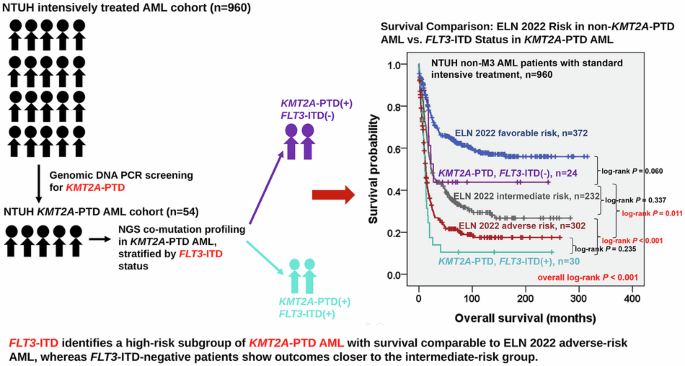
Several limitations should be acknowledged. This was a retrospective single-center study conducted across multiple treatment eras, and only a subset of patients received contemporary FLT3 inhibitors. In addition, transcriptomic and serial molecular analyses were available for only selected patients. Nevertheless, the relatively large KMT2A-PTD cohort, comprehensive molecular characterization, and validation of transcriptomic findings in independent public datasets strengthen the robustness of our conclusions.
In summary, our study provides a comprehensive comparison of KMT2A-PTD and KMT2A-r AML through integrated clinical, genomic, transcriptomic, and longitudinal molecular analyses. We demonstrate that KMT2A-PTD AML is a biologically distinct subtype associated with a HOXA/HOXB-high, stem cell-like transcriptional program, persistent founder clones, and dynamic clonal evolution. Importantly, concurrent FLT3-ITD emerged as the principal determinant of adverse prognosis in KMT2A-PTD AML, identifying a high-risk subgroup with outcomes comparable to ELN adverse-risk AML, whereas KMT2A-PTD without FLT3-ITD exhibited an intermediate-risk phenotype. Because our cohort primarily comprised patients treated with intensive chemotherapy, these results provide an important historical benchmark for evaluating the effectiveness of emerging therapeutic strategies, including venetoclax-based regimens and frontline menin inhibitor–based therapies, in patients with KMT2A-PTD AML.
