


Socio-demographic and participants characteristics
Patients’ socio-demographic characteristics
Seven of the total patients interviewed were male (53.85%), and eleven of them were from rural areas (84.62%). Twelve patients were married (92.30%), and eight of them were Muslim followers (61.54%). Twelve of them had no formal education (92.30%), and eleven of them were farmers (84.64) while the other two were merchant (7.69%) and animal husbandry (7.69%). Clinically, seven of the patients interviewed were diagnosed with Stage III (53.85%) esophageal cancer. The age of the patients ranged from 40 to 84 years, with a median age of 55 years (IQR = 12) (Tables 1 and 2).
Table 1 Study participants characteristic (n = 24), 2026.Table 2 Patients’ Socio-demographic characteristics (n = 13), 2026.
Health care providers’ socio-demographic characteristics
Among the healthcare providers (HCP) interviewed, nine were male (81.82%), and seven were married (63.64%). Five HCP were Orthodox Christian while the others were Muslim (36.36%) and Protestant (18.18%). Seven of the HCP interviewed held Bachelor of Science (BSc) degree (63.64%), while two had a Master’s degree (18.18%) and two were oncologist (18.18%). Professionally, seven of the HCP participated were nurses (63.64%), whereas four were physicians (36.36%). The age of the healthcare providers ranged from 30 to 45 years, with a median age of 32.9 years (IQR = 6years) (Tables 1 and 3).
Table 3 Health care providers’ Socio-demographic characteristics (n = 11), 2026.
Themes identified
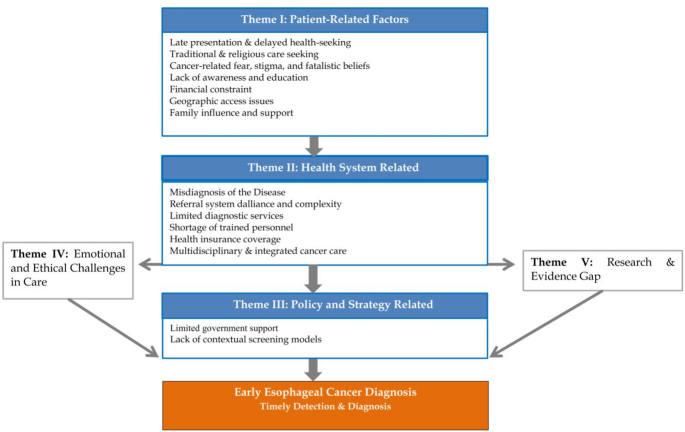
Thematic analysis of interview data from esophageal cancer patients and healthcare professionals identified several interconnected factors that influenced early diagnosis, serving as either barriers or facilitators. These factors were identified across patient, health system, policy and strategy, research and evidence, and emotional and ethical challenge levels. At the patient level, late presentation and delayed health-seeking behavior, reliance on traditional and religious healing practices, cancer-related fear, stigma, and fatalistic beliefs, low awareness and educational attainment, financial barriers, and limited geographic access to healthcare were identified as barriers to early esophageal cancer diagnosis. In contrast, family influence and support acted as facilitators of early diagnosis. At the health system level, early diagnosis of esophageal cancer was hindered by misdiagnosis, a referral system dalliance and complexity, limited diagnostic services, and a shortage of trained healthcare workers, while health insurance coverage and multidisciplinary and integrated cancer care served as facilitators. Additionally, gaps at the policy and strategic level, such as insufficient government support and the lack of locally appropriate screening and diagnostic models, further hindered the early diagnosis of esophageal cancer. Emotional and ethical challenges in care, as well as a lack of research and evidence, emerged as additional themes influencing the early diagnosis of esophageal cancer. Verbatim quotations that capture the essence of each sub-theme have been incorporated into the Results section to validate and ground the findings in participants’ own voices. In addition, we summarized the themes, sub-themes, and representative quotations to improve the clarity and presentations of the results (Fig. 1; Table 4).
Table 4 Summary of themes, sub-themes and representative quotations.Fig. 1
Themes identified for factors influencing early esophageal cancer diagnosis.
Theme I: Patient-related factors
Sub-theme one: late presentation and delayed health-seeking
Most patients sought medical care only after their disease had progressed to advanced stages (Stage III or IV), when symptoms such as severe dysphagia, weight loss, and food obstruction became severe. The vague and non-specific nature of early symptoms often led patients to interpret them as minor gastrointestinal illnesses rather than warning signs of cancer. Consequently, many initially sought care from nearby health centers, private clinics, or traditional healers.
“… Often, this illness does not cause pain… they say, ‘We were expecting to go today, tomorrow, and the day after tomorrow’ so the stage of the cancer was advanced, stage three or four…Many say they went to nearby health centers, private clinics and used traditional methods… they say, ‘we thought this will heal…” (P#13, Male, 23year, Nurse).
Several participants delayed seeking medical care because of competing work demands, limited awareness of esophageal cancer, and underestimating the seriousness of their symptoms. Collectively, these factors reduced the perceived urgency of seeking care, resulting in delayed presentation until symptoms became severe. In retrospect, many participants viewed these delays as missed opportunities that they believed may have affected their treatment outcomes.
“…The reason I failed to realize it quickly was just since I am merchant, I was busy…Within those three months, I didn’t know that it was this disease…” (P#2, 53years, Female, EC Stage IV patient).
Sub-theme two: traditional and religious care seeking
Participants’ narratives indicate that the use of traditional medicine was deeply embedded in cultural beliefs and perceptions of illness. Temporary improvement following traditional treatments often strengthened confidence in these remedies, leading patients to continue seeking traditional care rather than pursuing medical care. This interaction between cultural beliefs, perceived treatment effectiveness, and delayed healthcare seeking contributed to late presentation for diagnosis.
“… they turn to traditional medicine…People often believe that traditional medicine is ‘good medicine given to us’…Some believe it is caused by a curse…” [P#23, Female, 45years, Nurse].
“….The traditional medicine was what I preferred…Something like a small bean, that’s the method, it’s called ‘hoofee’… Yes, they (healers) said it would heal me… It actually healed me. It healed me at that time, and now it has returned again…In my view, traditional medicine is good; I only went there…” [P#4, 84years, Male, EC Stage IV patient].
Participants also described harmful traditional practices that were used in attempts to treat esophageal symptoms. These included thermal cauterization (gubamuu/waaddamuu), the insertion of heated metal through a tube-like plant locally known as Shanbaqqoo into the esophagus, and chest burning (koobaa). According to participants, these practices sometimes resulted in severe complications, including tracheoesophageal fistula, and delayed access to appropriate medical care by diverting patients from biomedical treatment.
“…Some even said they tried traditional healing…They say they put some tube plant (Shanbaqqoo) through the mouth down to the esophagus and then insert hot metal inside to burn it…We’ve seen two or three such cases… It even caused a fistula…it connected the esophagus and the trachea (Tracheoesophageal fistula)… They also apply burning on their chest, called ‘Koobaa’…” [P#19, Male, 38years, Physician].
The findings indicate that religious beliefs shaped participants’ perceptions of illness and appropriate treatment. For some patients, strong faith in divine healing led them to prioritize prayer, holy water, and other religious practices over biomedical care, particularly during the early stages of illness. In some cases, this resulted in delayed acceptance of the diagnosis or postponement of medical treatment, suggesting that religious beliefs interacted with healthcare-seeking decisions and contributed to delayed diagnosis. However, other participants described using religious practices alongside biomedical care, indicating that faith did not universally discourage engagement with health services.
“…Some Muslim patients may rely on prayer… believing it may heal or prevent death…Orthodox Christian patients perform prayers, holy water rituals… thinking these practices will make them healthy…These cultural and religious approaches sometimes delay medical care…” [P#5, Male, 30years, Nurse].
“…Because I was deeply religious and believed strongly in the ‘holy Tabot’ (church shrine), I refused and said, ‘I’ll be healed with holy water.’… I belief it (holy water) will cure me. I was thinking it expels the disease… because I strongly believe in it; it will work for me… Even two years ago, I had some illness… but I didn’t go to a health facility… When I was first examined two years ago, I refused the diagnosis and went for holy water…” [P#10, Female, 60years, EC Stage IV Patient”.
Sub-theme three: cancer-related fear, stigma, and fatalistic beliefs
Participants described fear, stigma, and fatalistic beliefs as interconnected factors that influenced responses to cancer diagnosis and treatment. The perception that cancer inevitably leads to death created fear of diagnosis and reduced patients’ willingness to seek timely medical care or continue treatment. This fear was reinforced by stigma, as some participants associated cancer with a curse, prompting patients to conceal their diagnosis or request that healthcare providers withhold it from family or community members. Fatalistic beliefs that cancer was incurable further discouraged treatment adherence, with some patients discontinuing medication or avoiding follow-up care because they believed that medical intervention could not alter the outcome. Consequently, many participants reported that patients experienced shock upon receiving a cancer diagnosis, which further delayed acceptance of the disease and engagement with appropriate care.
“…People fear cancer when it is mentioned… Some believe cancer is caused by a curse…” [P#7, Female, 29years, Physician].
“…When cancer is mentioned, people become frightened…There is a strong belief that anyone who has cancer will inevitably die…Some patients run away immediately when they hear the word…Almost all of them hide it… They ask us to keep it secret…” [P#5, Male, 30years, Nurse].
“…The day they finally gave me a clear diagnosis, I was shocked and fainted… From the day I knew about this illness, I haven’t been able to get out of bed… If I die with this hair loss… what good is it for me? …” [P#1, Female, 43years, EC Stage III patients].
Participants’ perspectives indicated that fear of surgery, chemotherapy, and endoscopic procedures discouraged engagement with biomedical care. As a result, some patients refused or discontinued recommended treatments, postponed medical care, or turned to traditional or spiritual remedies, contributing to delayed treatment and presentation at more advanced stages of disease.
“…Many people are afraid when they hear the word ‘surgery’… They refused surgery…” [P#23, Male, 45years, Nurse].
“… After undergoing it once, patients often don’t want to repeat it …The patient refuses and says, ‘No, don’t repeat it; that tube doesn’t go into my mouth (Endoscopic procedures)’…” [P#19, Male, 31years, Nurse].
“…We counseled her several times, but she didn’t want chemotherapy… the disease spread and she came back unable to walk…”[P#20, Male, 38years, Oncologist].
“…It wasn’t because I lacked money, but because I was afraid of the surgery …” [P#3, Female, 50years, EC Stage III patient].
The findings suggest that fatalistic beliefs discouraged timely healthcare seeking by reducing patients’ confidence in the benefits of early diagnosis and treatment. The perception that cancer was incurable, reinforced by observing poor outcomes among other patients in their communities, led some participants to delay seeking medical care until their disease had progressed to an advanced stage.
“…Many patients just accept their fate instead of coming early, thinking it’s hopeless…” [P#14, Male, 37years, Oncologist].
“…We were spending money for nothing…They said they’d call, and we also tried calling [for test results]…” [P#15, Male, 82years, EC Stage III patient].
“…In the past, people who got it would just die; we would see it with our own eyes…Even one of my relatives had it…” [P#10, Female, 60years, EC Stage IV patient].
Sub-theme four: lack of awareness and education
The findings suggest that limited awareness among both patients and healthcare providers was a major barrier to early diagnosis. Patients often lacked knowledge of esophageal cancer and misinterpreted early symptoms as less serious conditions, delaying healthcare seeking. Among healthcare providers, limited opportunities for continuing professional training and low clinical suspicion, partly because esophageal cancer was perceived as an uncommon disease, hindered its early recognition and timely referral. Inadequate communication about the diagnosis further reduced patients’ understanding of their condition. Collectively, these factors delayed the recognition, referral, and diagnosis of esophageal cancer.
“…I was the first to receive that training in this hospital…I have not received any training since then…We are still working with the knowledge we had six years ago…I personally feel urgent training is much needed…” [P#5, Male, 30years, Nurse].
“…Cancer is considered as something distant. People think of cancer as if it doesn’t exist…Healthcare workers do not describe cancer separately or explicitly…Rather than only focusing on expanding diagnostic centers… it’s more important to raise awareness among healthcare workers…” [P#20, Male, 38years, Oncologist].
“…I felt pain in my chest, and I had many difficulties, and I thought maybe it was from all the stress. I mistook it, I just thought it was heart-related…I had no idea it was something else… I just didn’t know…” [P#10, Female, 60years, EC Stage IV patient].
“….Do I know anything? They are the ones who know… They told me this is the kind of disease that brings people to the grave…I didn’t know this disease before. Even now, I don’t understand it well… ” [P#8, Male, 65years, EC Stage IV patient].
Sub-theme five: financial constraint
Participants’ narratives indicate that financial constraints hindered timely diagnosis and treatment by limiting patients’ ability to afford diagnostic investigations, treatment, and follow-up care. To cope with these costs, some participants postponed medical care while borrowing money, selling personal belongings, or waiting for seasonal income after harvest. The high cost of diagnostic investigations, particularly CT scans and endoscopy, together with additional expenses for transportation, food, accommodation, and caregivers, further prolonged the pathway to diagnosis. Consequently, some patients postponed recommended investigations, interrupted the diagnostic process, or discontinued treatment until they secured financial support through loans, donations, or other sources. Overall, these economic challenges reduced access to timely diagnosis and continuity of care, contributing to late-stage presentation and treatment interruption.
“…patients are forced to go back home and sell their belongings…It can take as much as 30, 40, or 50 thousand just to get diagnosed…patients are spending 100, 200, or even 300 thousand birr in total…Some are unable to afford the costs…” [P#12, Male, 35years, Nurse].
“…When you tell them that a CT scan is necessary, they go back home to search for money and come back later… Many patients… during the rainy season can’t afford the expenses… They only come when the harvest season arrives… They come after borrowing money, begging, or collecting donations through the mosque…” [P#20, Male, 38years, Oncologist].
“…Transportation cost… one person cannot go alone…There are fees for tests… food… many expenses are incurred… ” [P#23, Female, 45years, Nurse].
“…I don’t even have money for medical tests… we sold the land, did other things… people who have seen this situation pitied me and asked for help….” [P#1, Female, 43years, EC Stage III patient].
“…While trying to sort all this out, I lost all my wealth…” [P#8, Male, 65years, EC Patient].
Sub-theme six: geographic access issues
Participants described that geographic barriers contributed to delays in diagnosis. Limited availability of specialized diagnostic services at lower-level health facilities forced many rural patients to travel to distant referral hospitals, often after being referred between multiple providers. This prolonged the pathway to diagnosis while increasing transportation, accommodation, and other indirect costs, making it more difficult for patients to access and remain engaged in care.
“…CT scan wasn’t available… so we used to refer patients to a town called Dodola. There’s also transport cost involved. Even there, accurate staging is not done properly…” [P#20, Male, 38years, Oncologist].
“…one person cannot go alone; if you look at it personally, a patient often travels with two or three people for diagnosis…” [P#23, Female, 43years, Nurse].
“… After coming here (to Adama), I went to see a Doctor at private clinic. They told me the doctor wasn’t here and sent me to Minilik Hospital …” [P#9, Female, 40years, EC Stage III patient].
Sub-theme seven: family influence and support
Participants identified family support, particularly from patients’ children, as an important facilitator of early diagnosis. By encouraging timely healthcare seeking and providing practical and emotional support throughout the diagnostic process, family members helped patients overcome delays in accessing diagnostic services.
“…It was actually one of my children, who told me to go…They said, you can’t even grind grain anymore… So I followed their advice and came to stay with my children … you’re making your children cry… The children don’t spare any effort… They said it won’t be left behind…Only one of my children refused. …” [P#10, Female, 60years, EC Stage IV patient].
Theme II: health system related
Sub-theme one: misdiagnosis of the disease
Participants described symptom misinterpretation and misdiagnosis as important barriers to early diagnosis. Early symptoms of esophageal cancer, such as dysphagia and dyspepsia, were frequently attributed to benign conditions, including gastritis and peptic ulcer disease, by both patients and primary healthcare providers. Consequently, many patients sought care repeatedly at public and private health facilities without receiving appropriate investigations or referral for suspected esophageal cancer. This low clinical suspicion, particularly at lower-level health facilities, prolonged the pathway to diagnosis and contributed to presentation at advanced stages of the disease.
“…Symptoms may resemble indigestion (dyspepsia)… Because of this, in the early stages, the disease often remains undetected…In lower-level hospitals, patients are often treated for peptic ulcer disease (PUD)… Around 95% of the cases I collected data on were in stages III and IV…” [P#20, Male, 38years, Oncologist].
“…I kept being told it was just gastritis… Whenever they listen to me with a stethoscope, they say it’s gastritis. Wherever they press on my body, they say it’s gastritis …” [P#1, Female, 43years, EC Stage III patient].
“…One doctor in Robe told me, ‘You are fine, there is nothing wrong with you, go home’…One of them told me it was something related to lung disease…He said it came from gastritis and gave me drug for it…Injection, syrup, and tablet…” [P#15, Male, 82years, EC III patient].
Sub-theme two: referral system dalliance and complexity
Participants described inefficiencies within the referral and diagnostic system as a major barrier to early diagnosis. Delayed or inappropriate referrals from lower-level health facilities, together with fragmented diagnostic services, prolonged the pathway to diagnosis. Many patients moved between private clinics, health centers, and referral hospitals before receiving a confirmed diagnosis, often undergoing repeated referrals for endoscopy, CT scans, and laboratory investigations. Limited coordination between health facilities and interruptions in diagnostic services further delayed access to essential diagnosis, requiring patients to travel repeatedly to distant centers. These system-level challenges prolonged waiting times, delayed diagnostic confirmation, and contributed to late presentation.
“…The process (diagnosis) is long… referred for an endoscopy… then sent elsewhere… then referred again for a CT scan… Even after taking a sample… it may take up to a month… If it operates one week, the next week it stops, or they are referred elsewhere… Patients have to travel to other places just to get this disease diagnosed…” [P#19, Male, 31years, Nurse].
“… When you refer, they sometimes send the patient back to you …” [P#20, Male, 38years, Oncologist].
“…The hospital in Gobessa referred me to Asella. Then Asella referred me here, to Adama Hospital… then to Tikur Anbessa Hospital…To find out what the disease was… After going through all this… I finally found something…” [P#8, Male, 65years, EC Stage IV Patient].
“…Then they told me to go to Dodola…We had even gone to Sodo and Gurage…After Dodola, we also went to Borana and Wondo Hospital…The test result came back after a month and fifteen days. What killed me is that the result didn’t come on time… ” [P#15, Male, 82years, EC Stage III patient].
Sub-theme three: limited diagnostic services
Limited availability and poor functionality of diagnostic services emerged as one of the major health system barriers to the early diagnosis of esophageal cancer. Diagnostic investigations were often unavailable, inconsistent, or interrupted, particularly in rural and primary healthcare settings. Many facilities lacked essential diagnostic equipment, including endoscopy, CT scans, and immunohistochemistry (IHC), while existing equipment was sometimes non-functional, even in tertiary hospitals. Consequently, patients were frequently referred to distant specialized centers, such as Adama, Asella, Goba, Addis Ababa and elsewhere, to obtain diagnostic investigations. These repeated referrals, together with prolonged laboratory turnaround times for pathology and other investigations, extended the pathway to diagnosis. Participants perceived these challenges as reflecting broader weaknesses in the healthcare system and contributing to geographic inequities in access to diagnostic services, ultimately resulting in delayed diagnosis and more advanced disease at presentation.
“…The availability of diagnostic centers is currently limited in the country… Diagnoses like CT scans are not found…It exists, but sometimes it doesn’t work…The diagnosis called Immunohistochemistry (IHC) … is often sent outside for identification…” [P#13, Male, 23years, Nurse].
“… There are no proper investigations or specialized doctors in our area…The local doctor treat people casually, so I didn’t expect proper care there…For this illness, they said, ‘We can’t treat this; you must go to the hospital…” [P#22, Male, 83years, EC Stage IV Patient].
“…The tools available here couldn’t see inside the esophagus…He advised me to go to Hawasa for proper diagnosis…” [P#17, Male, 54years, EC Stage III patient].
Sub-theme four: shortage of trained personnel
Participants identified shortages of specialized healthcare professionals and inadequate training as the other major barriers to the early diagnosis and management of esophageal cancer. The limited availability of oncologists, gastroenterologists, and healthcare providers trained in endoscopy, particularly outside major urban centers, restricted access to specialized diagnostic services. In addition, participants reported that pre-service education and continuing professional development did not adequately equip many frontline healthcare providers to recognize the early signs of esophageal cancer. Training opportunities also varied across professional groups, with nurses, pharmacists, and laboratory personnel receiving less cancer-related training than physicians. Consequently, limited diagnostic competence and low clinical suspicion among frontline providers contributed to delayed recognition, inappropriate management, and late referral of suspected cases.
“…We only have one oncologist visiting from Tikur Anbessa once in a while…Most of us didn’t learn much about esophageal cancer in medical school; it’s overshadowed by other cancers…” [P#14, Male, 37years, physician].
“… In other departments like nursing, pharmacy, or laboratory, at the undergraduate level, they don’t study [cancer] thoroughly…They often don’t immediately suspect cancer; instead, they suspect other illnesses first…The awareness I had before studying this master’s program and what I have now is very different…” [P#18, Male, 30years, Nurse].
“…Honestly, the hospital here is in poor condition … There is no doctor who can properly identify the illness…” [P#21, Male 54years, EC Stage IV patient].
“…The doctor here treats people casually…I only went for a different issue, not for this one…” [P#22, Male, 83years, EC Stage IV patient].
Sub-theme five: health insurance coverage
Participants described health insurance as an important facilitator of timely diagnosis by reducing out-of-pocket diagnostic costs. However, limited insurance coverage for essential diagnostic investigations, including CT scans and endoscopy in settings where these services were unavailable locally, meant that many patients still faced substantial financial barriers. As a result, some delayed diagnostic investigations until they could afford the associated costs.
“…Those who have insurance do not worry much…Even though insurance is used… still do not get access at most tertiary hospital level…If their health insurance were properly organized, it would help a lot…Lack of insurance means not having money…” [P#24, Male, 30Years, Physician].
“…Some patients benefit from insurance, which is a good thing…Insurance does not cover CT scans…It only covers X-rays, ultrasound, blood tests, and biopsies…Endoscopy is not available locally…” [P#6, Male, 34years, Nurse].
“…If the diagnosis system is available, insurance will cover it… Most of the time, they are not available…” [P#20, Male, 38years, Oncologist].
Sub-theme six: need for multidisciplinary and integrated cancer care
Participants highlighted multidisciplinary collaboration as a key facilitator of timely diagnosis and management of esophageal cancer. Coordinated teamwork among surgeons, pathologists, radiologists, oncologists, and other specialists was perceived to improve communication, accelerate diagnostic decision-making, and facilitate timely referral and treatment. Participants believed that stronger interdepartmental coordination could streamline the pathway to diagnosis and improve patient outcomes.
“….We, with the surgeons, work closely together… we cannot work alone…Links between departments should be strengthened… we should function as a single unit…” [P#12, Male, 37years, Nurse].
“…We cannot work alone…We need pathologists, radiologists, and surgeons…If there were links between departments… the process could be shortened…” [P#24, Male, 30years, Physician].
Theme three: policy and strategy related
Sub-theme one: limited government support
Participants perceived limited government commitment as a major system-level barrier to the early diagnosis and management of esophageal cancer. Weak policy support, inconsistent funding, and the absence of disease-specific strategies limited the prioritization of esophageal cancer within the national health system. Participants also highlighted the lack of a national cancer registry, which constrained disease surveillance, service planning, and resource allocation. In addition, frequent medication stock-outs, shortages of laboratory reagents, inadequate infrastructure, and inconsistent support from development partners disrupted the availability of diagnostic and treatment services. Collectively, these health system and policy gaps reduced the capacity to provide timely, continuous, and equitable cancer care, contributing to delays in diagnosis and treatment.
“…Up to now, we have not seen any support from anyone…The government needs to give this proper attention… ensure diagnostics are available…There is a significant gap in terms of supply and availability of reagents…The attention given to it is very minimal…” [P#12, Male, 35years, Nurse].
“…There’s no guideline or cancer registry for esophageal cancer like there is for cervical cancer … a standardized and centralized guideline would be very helpful…To tell the truth, based on its prevalence, especially in the Goba (Bale) and Arsi areas; nothing is being done…The government has no motivation or involvement…” [P#20, Male, 38years, Oncologist] “….As a country, it can be said that we don’t do much screening. The most common screening done is only for cervical cancer…If support were available, it should ideally begin with diagnostics…Even patients who could be cured often cannot receive treatment due to lack of resources …” [P#18, Male, 30years, Nurse].
Sub-theme two: lack of contextual screening models
Participants considered globally established screening models impractical in Ethiopia because of limited resources and healthcare infrastructure. Instead, they believed developing context-specific screening approaches for primary healthcare settings and implementing targeted screening among high-risk populations, particularly older adults from high-incidence areas, with dysphagia, smokers, alcohol users, or those with a family history, to facilitate earlier detection of esophageal cancer.
“…We can’t do endoscopy screening for everyone; we need simpler, locally adapted tools…” [P#20, Male, 38years, Oncologist].
“…If screenings were available, it would be very helpful…Screening is especially important for people aged forty-five and above…” [P#19, Male, 31years, Nurse].
Theme four: emotional and ethical challenges in care
Participants reported that caring for patients with advanced esophageal cancer placed a considerable emotional burden on healthcare providers. Poor outcomes associated with late presentation, together with patients’ inability to access or continue care because of poverty and health system failures, contributed to frustration, helplessness, and moral distress. These experiences underscored the broader impact of delayed diagnosis on both patients and healthcare providers.
“…We treat the mental state of the patient… tell them it’s not the end …Simply silently providing care when a patient cannot afford it is not correct… When patients recover well, that is good…It connects you closely with the Creator… This is very painful…” [P#24, Male, 30years, Physician].
“…If I die with this hair loss… what good is it for me?…Honestly, I no longer went to that private doctor who treated me before and made things worse…” [P#1, Female, 43years, EC Stage III patient].
“…How can you say I’m fine when I feel I’m dying?…I cried and left…You wouldn’t understand unless you were sick yourselves…” [P#15, Male, 82years, EC Stage III].
Theme five: research and evidence gap
Participants highlighted the need for locally relevant research to strengthen the early diagnosis of esophageal cancer. They believed that limited evidence on the disease’s causes, risk factors, and the effectiveness of screening has hindered the identification of high-risk populations and constrained the development of context-specific screening strategies and evidence-informed policies. Participants emphasized that generating local evidence would improve understanding of disease patterns, inform targeted screening programs, and support policy decisions aimed at facilitating earlier diagnosis.
“…Even through research, such issues can be identified and studied…I think it would be good to conduct research in their local areas… ” [P#13, Male, 23years, Nurse].
“…For instance, research is lacking to show that screening has a significantly high survival benefit. That’s why those who create policies need to work thoroughly on this issue…” [P#14, Male, 37years, Oncologist].
“… If research were conducted to understand why… that would be good…There are only suspicions; there is no confirmed reason… ” [P#24, Male, 30years, Physician].
