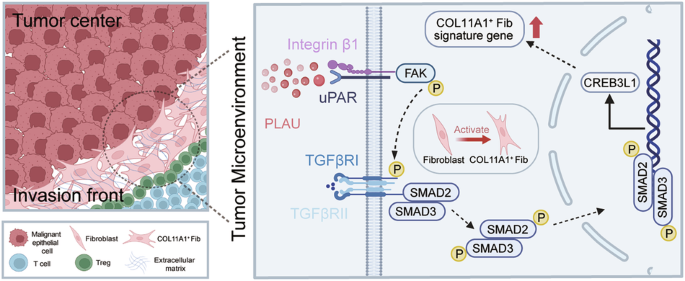
The initiation and progression of cancer are driven by the dynamic interplay between somatic mutations and the tumor microenvironment. Identifying core cell populations driving malignant transformation and understanding the intercellular interactions within the tumor microenvironment are, therefore, crucial for early diagnosis and effective treatment. Here, we construct a spatiotemporal atlas of oral squamous cell carcinoma (OSCC) progression by integrating multi-omics approaches. Our analysis reveals that the critical driver gene PLAU activates the TGF-β pathway via ITGB1, thereby promoting the conversion of fibroblasts into the COL11A1⁺ fibroblast (COL11A1⁺ Fib). These specialized fibroblasts remodel the extracellular matrix (ECM), collectively establishing an immunosuppressive niche composed of malignant epithelial cells, COL11A1+ Fib, and regulatory T cells (Tregs). Importantly, targeting COL11A1+ Fib alleviates this immunosuppressive niche and curbs OSCC progression. Our findings underscore the potential of COL11A1+ Fib as a predictive biomarker, especially in combination with immunotherapy. Collectively, this work demonstrates that the PLAU-ITGB1-TGF-β axis drives the formation of an Epi-COL11A1+ Fib-Treg immunosuppressive niche that fuels OSCC malignancy.
Trending
- Real-World Data Reveals Underdiagnosis of SCLC-Associated LEMS
- In vivo photoacoustic breast imaging and the interactive effects of skin tone, wavelength, beamformer, and depth on target detectability
- Characterisation of TP53 mutational features and outcomes of acute myeloid leukaemia after allogeneic haematopoietic cell transplantation
- Neoadjuvant triplet chemotherapy enables radiotherapy avoidance in human papillomavirus–associated oropharyngeal cancer: a multicentre Phase II trial
- Translational modelling challenges receptor‑occupancy‑based dosing of PD‑1 inhibitors like pembrolizumab
- A pancreatic cancer organoid-macrophage co-culture using starPEG-heparin hydrogel deciphers tumor-immune cell interactions
- How Might WCLC 2026 Clarify the Evolving Role of APPs in Lung Cancer?
- How Is AI Advancing Tumor Boards, Care Coordination, and Treatment Planning?


Sunday, September 6
The PLAU-ITGB1-TGF-β axis orchestrates spatiotemporal reprogramming of fibroblasts at the invasive front to drive dual immunosuppressive niche and immunotherapy resistance in oral squamous cell carcinoma
 By NewsCancer