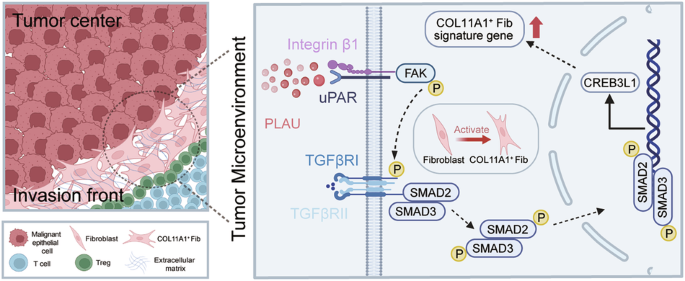
The initiation and progression of cancer are driven by the dynamic interplay between somatic mutations and the tumor microenvironment. Identifying core cell populations driving malignant transformation and understanding the intercellular interactions within the tumor microenvironment are, therefore, crucial for early diagnosis and effective treatment. Here, we construct a spatiotemporal atlas of oral squamous cell carcinoma (OSCC) progression by integrating multi-omics approaches. Our analysis reveals that the critical driver gene PLAU activates the TGF-β pathway via ITGB1, thereby promoting the conversion of fibroblasts into the COL11A1⁺ fibroblast (COL11A1⁺ Fib). These specialized fibroblasts remodel the extracellular matrix (ECM), collectively establishing an immunosuppressive niche composed of malignant epithelial cells, COL11A1+ Fib, and regulatory T cells (Tregs). Importantly, targeting COL11A1+ Fib alleviates this immunosuppressive niche and curbs OSCC progression. Our findings underscore the potential of COL11A1+ Fib as a predictive biomarker, especially in combination with immunotherapy. Collectively, this work demonstrates that the PLAU-ITGB1-TGF-β axis drives the formation of an Epi-COL11A1+ Fib-Treg immunosuppressive niche that fuels OSCC malignancy.
Trending
- How Is AI Advancing Tumor Boards, Care Coordination, and Treatment Planning?
- ITGA5 promotes homologous recombination mediated radioresistance in esophageal squamous cell carcinoma by upregulating RAD51AP1 expression
- Helping stoma bag users to swim with confidence
- Therapy induced senescence promotes immunogenicity in acute myeloid Leukemia through reduced EZH2 activity
- Association between smoking, tumor genetics, and outcomes in men with metastatic prostate cancer
- PD-L1 expression and survival in unresectable/recurrent gastric cancer treated by 1st-line treatment without immune checkpoint inhibitors: JCOG1013A1
- Managing High-Risk BCLC-C HCC in a Younger Fit Patient
- CELMoD Potency and Cereblon-Mediated Activity in Multiple Myeloma


Saturday, September 5
The PLAU-ITGB1-TGF-β axis orchestrates spatiotemporal reprogramming of fibroblasts at the invasive front to drive dual immunosuppressive niche and immunotherapy resistance in oral squamous cell carcinoma
 By NewsCancer