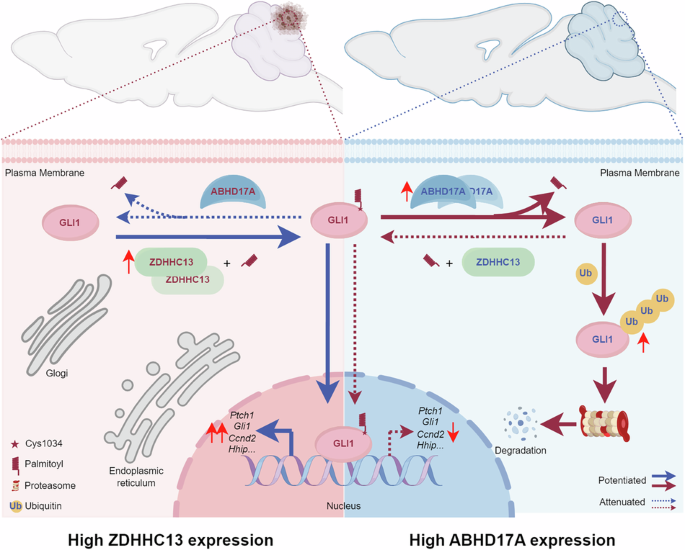
Aberrant activation of the Sonic Hedgehog (SHH)-glioma-associated oncogene 1 (GLI1) signaling pathway is a determinant driver of basal cell carcinoma (BCC) and SHH-subgroup medulloblastoma (MBSHH). Here, we demonstrate the role of S-palmitoylation and depalmitoylation of GLI1 in the regulation of incidence and progression of MBSHH. High expression of acyltransferase ZDHHC13 in MBSHH induces S-palmitoylation of human GLI1 at Cys1034, stabilizes GLI1 by preventing its ubiquitin-dependent proteasomal degradation, and in turn activates this signaling pathway to promote the progression of MBSHH. Conversely, the deacylase ABHD17A depalmitoylates GLI1 at Cys1034, destabilizes GLI1, and in turn inactivates this signaling pathway. As a result, conditional knockout of Zdhhc13 in cerebellar granule neuron precursors (GNPs) significantly alleviates the severity of MBSHH induced by constitutively active Smoothened (Smo-M2) overexpression and markedly extends overall survival, whereas knockout of Abhd17a increases the incidence of MBSHH induced by Patched-1 ablation, rather than its progression. Together, these findings uncover the dynamic regulation of GLI1 palmitoylation and depalmitoylation by the ZDHHC13 and ABHD17A and subsequent GLI1 stabilization and destabilization as a hitherto uncharacterized mechanism controlling SHH/GLI1 signaling and may provide additional targets for therapeutic intervention of MBSHH.
Trending
- FDA Accepts RP1 BLA Resubmission for Advanced Melanoma
- Man takes on 100-hole golf bid after wife’s cancer diagnosis
- Teclistamab Induction Shows Feasibility in Transplant-Eligible Myeloma
- MARIPOSA Trial: EGFR-Mutant Lung Cancer Frontline Strategies
- MARIPOSA Prophylaxis, Biomarkers, and CNS Debate
- Dynamic S-palmitoylation of glioma-associated oncogene 1 regulates the incidence and progression of Sonic Hedgehog medulloblastoma
- No doctor wants to have this conversation with a patient. For everyone’s sake, we must | Ranjana Srivastava
- What I Learned from a Lifetime of Feeling Different


Monday, June 29
Dynamic S-palmitoylation of glioma-associated oncogene 1 regulates the incidence and progression of Sonic Hedgehog medulloblastoma
 By NewsCancer