


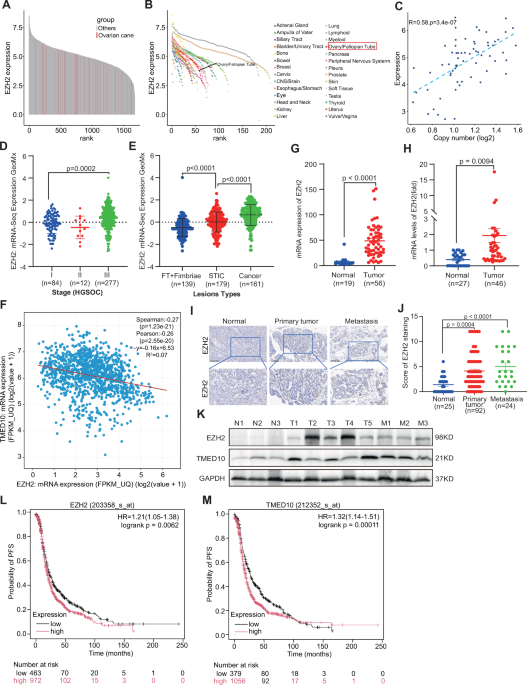
EZH2 and TMED10 are highly expressed in ovarian cancer
To investigate the molecular drivers of ovarian cancer pathogenesis, we found that ovarian cancer cell lines exhibit relatively high expression levels of EZH2 and TMED10 compared to cell lines derived from other tumor types (Fig. 1A, B and Supplementary Fig. 1A, B), by analyzing transcriptomic data from over 1000 human cancer cell lines in the Cancer Cell Line Encyclopedia (CCLE).
Fig. 1: High EZH2 and TMED10 expression in ovarian cancer.
A All cell lines annotated in the Cancer Cell Line Encyclopedia (CCLE) were arranged according to EZH2 transcript levels from the highest (left) to the lowest (right). Each line represents a different cell line. Ovarian cancer cell lines are denoted by red lines. B All cell lines annotated in the CCLE were grouped according to the cancer type. For each cancer type, cell lines were arranged according to the levels of EZH2 transcripts, from highest to lowest. Each dot represents a different cell line. C Correlation between the EZH2 gene copy number and gene expression in ovarian cancer cell lines from the CCLE. Each dot represents a different cell line. Pearson correlation coefficient and p value are shown. EZH2 expression in different stages of HGSOC (D) and different stages of ovarian cancer progression (normal Fallopian Tube/Fimbria, STIC, and invasive ovarian carcinoma; E) in the cBioPortal data (id=Ovary/Fallopian_OC_2024). F Correlation between the EZH2 and TMED10 gene expression (normalized FPKM) in all cancers from the ICGC/TCGA datasets in cBioPortal (id=pancan_pcawg_2020). RNA sequencing (RNA-Seq) analysis of EZH2 mRNA expression in 19 normal tissues and 56 ovarian cancer (OC) tissues (G) and RT-qPCR validation of EZH2 mRNA levels in 27 normal and 46 OC tissues (H). I, J IHC analysis of EZH2 protein expression in ovarian tissues. Representative images show EZH2 staining in normal, primary tumor, and metastatic tissues; scale bar, 100 μm (I). The dot plot quantifies differential EZH2 expression across normal (n = 25), primary tumor (n = 92), and metastatic (n = 24) cohorts, analyzed in a single experimental (J). Data are mean ± s.d.; statistical significance determined by a two-tailed unpaired t-test. K EZH2 and TMED10 protein levels in three normal, five tumors, and three metastatic tissues from patients. Images represent results from two independent experiments. Kaplan–Meier progression-free survival curve of patients stratified by EZH2 (L) or TMED10 (M) expression from the TCGA OV cohort. For (D, E, G, H, J), Data represent the mean ± s.d., and statistical analyses were performed using two-tailed unpaired t-tests.
A positive correlation was observed between gene copy number and transcript levels for both EZH2 and TMED10 in these cell lines (Fig. 1C and Supplementary Fig. 1C), suggesting that gene amplification may contribute to their expression. By analyzing cBioPortal data, we observed predominant gene amplification of EZH2 in ovarian cancer, with more pronounced amplification in advanced-stage disease (Supplementary Fig. 1D). Additionally, EZH2 mRNA expression demonstrated a progressive increase with advancing FIGO stages in high-grade serous ovarian carcinomas (HGSOC). Its expression increased incrementally during the pathological progression from normal fallopian tube to invasive ovarian carcinoma, whereas TMED10 mRNA levels exhibited no significant alterations (Fig. 1D, E and Supplementary Fig. 1E). In addition, stratified analysis of 88 normal tissues and 427 ovarian cancer specimens from the GDC cohort demonstrates elevated EZH2 and TMED10 expression in tumor tissues (Supplementary Fig. 1F). To systematically evaluate the expression landscape across malignancies, we interrogated TCGA datasets encompassing both unpaired and matched tumor-normal cohorts to evaluate its expression landscape systematically across malignancies. Multi-omics analysis revealed significant overexpression of EZH2 and TMED10 in diverse cancer types (Supplementary Fig. 1G).
Next, we performed RNA sequencing on 19 normal tissues and 56 ovarian cancer specimens. Comparative analysis revealed that EZH2 expression was significantly upregulated in tumor tissues (Fig. 1G). Subsequent RT-qPCR validation in 27 normal tissues and 46 ovarian cancer tissues confirmed marked upregulation of EZH2 mRNA in malignant tissues, while there was no significant difference in TMED10 expression (Fig. 1H and Supplementary Fig. 1I). Interestingly, we observed a significantly negative correlation between EZH2 and TMED10 transcript levels across all tumors and ovarian cancer accessed via cBioPortal data (Fig. 1F and Supplementary Fig. 1H). To comprehensively validate these observations, we employed orthogonal methodologies to assess EZH2 expression in patient-derived samples. Immunohistochemical (IHC) staining of 25 normal tissues and 92 ovarian cancer tissues (including 24 metastatic lesions) revealed significantly higher EZH2 protein intensity scores in tumor and metastatic specimens compared to normal tissues (Fig. 1I, J). Western blot analysis of representative subsets (three regulars, five primary tumors, and three metastatic tissues) demonstrated substantially elevated EZH2 and TMED10 protein levels in tumor and metastatic specimens (Fig. 1K). Complementary in vivo investigations utilizing our previously established murine model [18]. revealed a progressive increase in EZH2 expression during tumorigenesis (Supplementary Fig. 1J).
To further elucidate the prognostic implications of EZH2 and TMED10 expression patterns, we demonstrated that patients with elevated EZH2 and TMED10 expression exhibited poorer PFS by Kaplan–Meier survival analyses conducted through online platforms (Fig. 1L, M). Collectively, these findings establish that EZH2 is inversely correlated with TMED10 expression, and they are both overexpression in ovarian cancer.
Moreover, we used the cBioPortal TCGA high-grade serous ovarian cancer cohort (hgsoc_tcga_gdc), integrating RNA-seq expression, BRCA1/2 mutation annotation, and clinical survival data at the patient level. Survival analyses were performed both in the full evaluable cohort and in the BRCA-WT subset, where EZH2 overexpression was most prominent. We compared the top versus bottom quartiles of EZH2 expression within the BRCA-WT subgroup, yielding 101 high-EZH2 and 101 low-EZH2 cases for overall survival analysis, and 40 high-EZH2 and 50 low-EZH2 cases for progression-free survival analysis. In this subgroup-restricted analysis, EZH2 showed only a borderline trend with overall survival and no association with progression-free survival.
We further evaluated EZH2 as a continuous variable in BRCA-WT patients. In univariable Cox regression, EZH2 expression was not significantly associated with overall survival or progression-free survival. We also tested whether the prognostic effect of EZH2 differed by BRCA status in the full cohort. In the full cohort, the EZH2 × BRCA status interaction term was not significant for either overall survival or progression-free survival. In the age-adjusted interaction model, the interaction likewise remained non-significant for overall survival and progression-free survival. In addition to repeating the survival analyses within BRCA-WT tumors, we performed transcriptome-level pathway analysis in the same BRCA-WT subgroup using the cBioPortal TCGA high-grade serous ovarian cancer cohort. Comparing the highest and lowest quartiles of EZH2 expression, Hallmark GSEA demonstrated that EZH2-high BRCA-WT tumors were enriched for proliferation- and cell-cycle-associated programs, including E2F targets, G2M checkpoint, MYC targets, mitotic spindle, DNA repair, and mTORC1 signaling (Supplementary Fig. 1K–M).
EZH2 and TMED10 drive malignant progression in ovarian carcinoma
To investigate the functional impact of EZH2 and TMED10 in ovarian cancer cells, we first assessed their expression profiles across multiple cell lines using Western blot and RT-qPCR. Comparative analyses revealed elevated EZH2 mRNA and protein levels in A2780, OVCAR8, and ES-2 cells relative to normal ovarian epithelial cells (IOSE), while HEY, SKOV3, and OV90 cells exhibited lower baseline expression. By contrast, TMED10 exhibited relatively low expression in OVCAR8 and SKOV3 cells, whereas higher expression was observed in HEY and A2780 cell lines. (Supplementary Fig. 2A, B). To establish causality, we stably overexpressed endogenous EZH2 in these low-expressing cell lines (HEY, SKOV3, OV90), achieving significant upregulation at both transcriptional and protein levels compared to empty vector controls (Fig. 2A, C and Supplementary Fig. 2C). Functional characterization of EZH2-driven oncogenicity revealed pleotropic pro-tumorigenic effects. Cell counts, CCK-8 viability assays combined with RT-qPCR-based CDC25A mRNA quantification demonstrated that EZH2 overexpression (OE) robustly enhanced proliferation in HEY, SKOV3, and OV90 cells compared to empty vector control groups (Fig. 2B, D and Supplementary Fig. 2D, E). Consistent with this pattern, stable overexpression of TMED10 in OVCAR8 and SKOV3 cells also enhanced cellular proliferation compared to control cells (Fig. 2E, F and Supplementary Fig. 2F, G). Colony formation assays further corroborated these findings, with OE cells exhibiting an increase in clonogenic capacity across all tested lines (Fig. 2G and Supplementary Fig. 2H). Given the established correlation between EZH2 overexpression and metastatic burden in ovarian cancer clinical specimens, we systematically evaluated its functional role in metastasis-associated phenotypes. Transwell migration and invasion assays revealed that EZH2-OE cells displayed markedly enhanced migratory and invasive capacities relative to controls (Fig. 2H and Supplementary Fig. 2I), mechanistically linking EZH2 to the aggressive dissemination traits underlying patient mortality. Similarly, TMED10 overexpression also promoted cell migration and invasion (Supplementary Fig. 2I),
Fig. 2: EZH2 and TMED10 drive malignant progression in ovarian carcinoma.
Immunoblotting and RT-qPCR analysis of EZH2 overexpression (OE) levels in HEY (A) and SKOV3 (C) cells transfected with OE or empty vector control (oeNC). Images are representative of at least three independent experiments. Cell counts and CDC25A mRNA expression of HEY (B) and SKOV3 (D) oeEZH2 and oeNC cells over 8 days. Data from three independent cultures. E Immunoblotting and RT-qPCR analysis of TMED10 overexpression (OE) levels in OVCAR8 cells transfected with OE or empty vector control (oeNC). Images are representative of at least three independent experiments. F CCK-8 and CDC25A mRNA expression of OVCAR8-oeTMED10 and oeNC cells over 4 days. Data from three independent cultures. G Clonogenic capacity of HEY, SKOV3-oeEZH2, and OVCAR8-oeTMED10 versus oeNC cells after 14 days; scale bar, 200 μm; data from three independent cultures. H Migration and invasion ability of HEY and SKOV3-oeEZH2 versus oeNC cells. Representative images of migrated and invaded cells are shown; scale bar, 100 μm. Data are from three independent cultures. I Immunoblotting and RT-qPCR analysis of EZH2 knockdown (left) in OVCAR8 and A2780 cells, and TMED10 knockdown (right) in A2780 and HEY cells using two independent shRNAs or non-targeting control (shNC). Images are representative of at least three experiments. J Viability of OVCAR8 and A2780-shEZH2 versus shNC cells over 5 days. Data from three independent cultures. K Clonogenic capacity of OVCAR8 and A2780-shEZH2 compared to shNC cells (left), HEY and OVCAR8-shTMED10 compared to shNC cells after 14 days; scale bar, 200 μm; data from three independent cultures. L Migration and invasion assays of OVCAR8 and A2780-shNC and shEZH2 cells. Representative images of migrated and invaded cells are shown; scale bar, 100 μm; data from three independent cultures. M Metastatic burden in ID8 shEZH2 and shNC tumor-bearing mice (n = 5 per group; single experiment). Representative images of ovarian tumor metastases. N H&E staining and IHC analysis of EZH2, Ki-67, and MMP9 in ID8 shEZH2 and shNC tumor tissues (n = 3 independent tumors per group). Scale bar, 100 μm. For (A–N), Data represent the mean ± s.d., and statistical analyses were performed using two-tailed unpaired t-tests.
To establish the functional necessity of EZH2 and TMED10 in tumor progression, we engineered endogenous EZH2 and TMED10 knockdown (KD) models in (EZH2: A2780, OVCAR8, and ES-2; TMED10: A2780 and HEY) cell lines, which exhibit high baseline EZH2 and TMED10 expression. Transfection with EZH2 and TMED10-targeting shRNAs achieved robust post-transcriptional suppression compared to controls (Fig. 2I and Supplementary Fig. 2J). Subsequent cell proliferation assays revealed a reduction in proliferative capacity across KD lines versus controls (Fig. 2J and Supplementary Fig. 2K, L). Colony formation efficiency was markedly attenuated in KD cells, with over a 50% reduction in macroscopic colony counts (Fig. 2K and Supplementary Fig. 2M). Transwell matrices showed that EZH2 or TMED10 depletion significantly reduced migratory and invasive capacities in all tested lines (Fig. 2L and Supplementary Fig. 2N), inversely reflecting the pro-metastatic effects observed in OE models. We further performed RNA-seq analysis using OVCAR8-EZH2-shNC versus sh4/sh5 cells. GO enrichment analysis revealed that terms such as extracellular matrix organization, extracellular structure organization, and collagen-containing extracellular matrix were significantly enriched among the downregulated genes following EZH2 knockdown (Supplementary Fig. 3A). Subsequently, RT-qPCR analysis showed that the expression levels of MMP9 and MMP2 were increased upon EZH2 overexpression, whereas they were decreased following EZH2 knockdown (Supplementary Fig. 3B). Furthermore, immunoblotting revealed that EZH2 overexpression led to decreased protein expression of TIMP2, along with increased expression of MMP2 and MMP9. Conversely, endogenous EZH2 knockdown resulted in the opposite expression trends (Supplementary Fig. 3C). Furthermore, we employed a DOX‑inducible shRNA expression system. Immunoblotting confirmed the knockdown efficiency of EZH2 in A2780 and OVCAR8 cells following DOX induction (Supplementary Fig. 3D). CCK‑8 assays demonstrated that DOX‑induced cells exhibited reduced proliferative capacity compared to the DOX‑negative control group (Supplementary Fig. 3E). Transwell assays further showed that the numbers of migrating and invading A2780 and OVCAR8 cells were decreased after DOX induction (Supplementary Fig. 3F).
To explore whether EZH2 knockdown affects tumor growth and metastasis in vivo, we established an orthotopic ID8 murine model with stable endogenous EZH2 knockdown (shEZH2) versus non-targeting controls (shNC) (Supplementary Fig. 2O). Longitudinal monitoring revealed that shEZH2-bearing mice exhibited a modest reduction in body weight gain over 7 weeks compared to shNC cohorts (Supplementary Fig. 2P), indicative of diminished tumor-associated cachexia. Meanwhile, shEZH2 mice displayed a marked reduction in ascites volume and decreased metastatic burden across peritoneal surfaces, intestines, and mesenteric tissues compared to shNC groups. Ovarian tumor mass in shEZH2 mice was also reduced (Fig. 2M). Moreover, H&E and immunohistochemical staining revealed decreased staining intensity of Ki-67 and MMP9, markers of cell proliferation and migration/invasion, respectively, in ovarian tissues from EZH2-KD mice (Fig. 2N). To further clarify the effect of EZH2 knockdown on tumor metastasis in vivo, ID8-shNC and ID8-sh1/sh2 cells were orthotopically injected into the ovaries of C57BL/6 mice. Consistent with our in vitro findings, EZH2 knockdown led to slower body weight gain and reduced numbers of intraperitoneal metastatic nodules and ascites (Supplementary Fig. 9A–D). These findings mechanistically position EZH2 as a central orchestrator of malignant progression, whose therapeutic targeting may disrupt both primary tumor expansion and metastatic dissemination in ovarian cancer.
EZH2 upregulation activates the NF-κB-Rap1A signaling
To further explore the molecular pathways through which EZH2 regulates cellular functions, we performed enrichment analysis on the downregulated differentially expressed genes following EZH2 knockdown in our RNA‑seq data. This analysis revealed significant enrichment of the NF‑κB pathway (Fig. 3A). KEGG pathway analysis of differentially expressed genes between TMED10‑high and TMED10‑low groups in the TCGA database showed prominent enrichment of the Rap1 signaling pathway (Supplementary Fig. 4A). It has been reported that EZH2 activates the NF‑κB signaling pathway by regulating RelB transcription, thereby increasing Rap1 protein expression [19,20,21,22,23,24,25]. Accordingly, analysis of differentially expressed genes in the EZH2‑high group from TCGA revealed upregulation of RAP1A and downregulation of TMED10 upon EZH2 overexpression, and a positive correlation between EZH2 and RAP1A expression was observed (Supplementary Fig. 4B). Further validation showed that RAP1A mRNA levels were increased upon EZH2 overexpression and decreased upon EZH2 knockdown (Fig. 3B and Supplementary Fig. 4C). Immunoblotting demonstrated that EZH2 overexpression elevated the protein levels of phosphorylated NF‑κB (Ser536) and RAP1A, whereas EZH2 knockdown reduced RAP1A protein levels (Fig. 3C and Supplementary Fig. 4E). To further investigate this effect, nuclear‑cytoplasmic fractionation assays showed that EZH2 overexpression predominantly promoted the upregulation of RAP1A protein in the cytoplasmic compartment (Supplementary Fig. 4D). The molecular weight of p‑NF‑κB protein was confirmed by immunoblotting (Supplementary Fig. 4D). Subcellular fractionation further revealed that both EZH2 and NF‑κB were mainly localized in the nucleus, while phosphorylated NF‑κB was detected in both the cytoplasmic and nuclear fractions (Supplementary Fig. 4D). Treatment of EZH2‑overexpressing cells with the IκBα/NF‑κB inhibitor BAY 11‑7082 enhanced pathway suppression and reduced p‑NF‑κB levels compared to control cells (Supplementary Fig. 4D).
Fig. 3: EZH2 upregulation activates the NF-κB-Rap1A signaling.
A GSEA (left) and KEGG (right) analysis of differentially expressed genes downregulated with EZH2 in OVCAR8 cells. B RT-qPCR analysis of EZH2 and Rap1A mRNA levels in EZH2-overexpressing HEY and SKOV3 cells. Results from three independent experiments. C Immunoblotting analysis of p-NF-κB, NF-κB, and Rap1A protein levels in HEY and SKOV3 cells overexpressing EZH2 (left), as well as Rap1A protein levels in OVCAR8 and A2780 cells with EZH2 knockdown (right). Blots are representative of at least three independent experiments. Immunoblotting (D) and RT-qPCR (E) validation of Rap1A knockdown using two independent shRNAs or non-targeting control (shNC) in EZH2-overexpressing HEY and SKOV3 cells. Blots are representative of at least two experiments. F Viability of EZH2-OE HEY and SKOV3 cells with Rap1A knockdown (shRNA) or shNC controls over 5 days. Data from three independent cultures. G Clonogenic capacity of HEY and SKOV3 EZH2-OE cells with Rap1A knockdown after 14 days; scale bar, 200 μm; data from three independent cultures. H Migration and invasion ability of HEY and SKOV3 EZH2-OE cells with Rap1A knockdown. Representative images of migrated and invaded cells are shown; scale bar, 100 μm; data from three independent cultures. For (B, E–H), Data represent the mean ± s.d., and statistical analyses were performed using two-tailed unpaired t-tests.
To further investigate whether EZH2 directly regulates the NF‑κB pathway, we first performed immunoblotting. EZH2 overexpression increased the protein levels of H3K4me3, H3K9me3, H3K27me3, and H3K36me3, whereas EZH2 knockdown decreased their levels, with the most pronounced change observed for H3K27me3 (Supplementary Fig. 4F). We then performed ChIP‑seq in HEY‑oeNC and HEY‑oeEZH2 cells. Compared with controls, EZH2 overexpression led to the identification of 2083 significantly differential peaks genome‑wide, including 561 upregulated and 1522 downregulated peaks. A volcano plot displays the top 20 most significantly differential peaks (Supplementary Fig. 4G), and a heatmap shows the genes associated with these peaks (Supplementary Fig. 4H). Notably, no direct binding of EZH2 to the NFKB1, RELA, or RAP1A genes was observed, suggesting that EZH2 may not regulate the expression of these genes by directly binding to their promoters.
To interrogate Rap1A’s necessity in EZH2-mediated tumor progression, we performed genetic rescue experiments in EZH2-OE HEY, SKOV3, and OV90 stable lines. Rap1A knockdown (KD) was achieved via shRNA transfection. We validated the endogenous reduction in Rap1 protein and mRNA levels compared to scramble controls (Fig. 3D, E and Supplementary Fig. 4I). Next, CCK-8 assays demonstrated that Rap1A-KD reversed EZH2-OE-induced proliferation in HEY, SKOV3, and OV90 cells (Fig. 3F and Supplementary Fig. 4J). Colony formation assays confirmed that Rap1A-KD abrogated EZH2-driven clonogenicity across all lines (Fig. 3G and Supplementary Fig. 4K). Finally, Transwell matrices showed that Rap1A-KD attenuated EZH2-enhanced migration and invasion capacities of HEY, SKOV3, and OV90 cells (Fig. 3H and Supplementary Fig. 4L). These rescue experiments mechanistically position Rap1A as the dominant downstream effector of EZH2’s pro-tumorigenic program.
EZH2 orchestrates cholesterol metabolic reprogramming
Based on the previous findings, we further performed whole-transcriptome sequencing (RNA-seq) in HEY cells with stable EZH2 overexpression (OE). Comparative analysis identified 29 significantly upregulated and 42 downregulated genes (|log2FC | >1, padj < 0.05). GSEA enrichment analysis of upregulated genes revealed significant enrichment of lipid metabolism and steroid metabolism pathways. Subsequently, KEGG pathway analysis demonstrated prominent enrichment of cholesterol metabolism (Fig. 4A, B and Supplementary Fig. 5A). At the same time, GO functional enrichment analysis revealed pronounced activation of glycerolipid metabolic process, lipid catabolic process, regulation of protein secretion, lipid transfer activity, and cholesterol transfer activity, etc., in OE cells (Supplementary Fig. 5A). In EZH2-OE cells, the mRNA levels of cholesterol synthesis-related genes (HMGCS, HMGCR, ACACA) were upregulated, as were those of cholesterol esterification and efflux-related genes ACAT2 and ABCA1 (Supplementary Fig. 5B). Consequently, quantification of intracellular cholesterol revealed significantly increased levels of both total and free cholesterol in EZH2-overexpressing HEY and SKOV3 cells. Conversely, EZH2 KD in A2780, OVCAR8, and ES-2 cells markedly reduced intracellular total and free cholesterol levels (Fig. 4C and Supplementary Fig. 5C).
Fig. 4: EZH2 orchestrates cholesterol metabolic reprogramming.
A Gene Set Enrichment Analysis (GSEA) of upregulated pathways in HEY EZH2-OE cells; NES, normalized enrichment score. Data were analyzed using a two-sided permutation test, with P values adjusted using the Benjamini-Hochberg method (left); Kyoto Encyclopedia of Genes and Genomes (KEGG) upregulated signaling set from RNA-seq of HEY-OE versus control cells. n = 3 independent cell cultures (right). B Downregulation analysis of genes after knockdown of EZH2 in OVCAR8 cells via KEGG. C Total cholesterol and free cholesterol levels in EZH2-overexpressing HEY and SKOV3 cells. Data are derived from three independent biological replicates. D Volcano plots of significantly affected (padj<0.05, |log₂FC| > 1) genes in HEY-oeEZH2 cells relative to oeNC cells as revealed by RNA-seq. Both oeEZH2 and oeNC groups contain three biological replicates, assessed as one experiment. P values were calculated using R v4.0.3 software. Data were analyzed by a two-tailed unpaired t-test (left). RT-qPCR analysis of APOB, APOA2, and APOE mRNA levels in EZH2-OE HEY and SKOV3 cells. Results from three independent experiments (right). E APOB and APOA2 levels in conditioned media collected from HEY and SKOV3 cells overexpressing EZH2 following 48-h culture, as determined by ELISA. Data are derived from three independent biological replicates. F Viability of EZH2-OE HEY (left) and SKOV3 (right) cells transfected with two independent shAPOA2 constructs or non-targeting control (shNC) over 5 days. Data from three independent cultures. G Clonogenic capacity of HEY and SKOV3 EZH2-OE cells with APOA2 knockdown after 14 days; scale bar, 200 μm; data from three independent cultures. H Migration and invasion ability of HEY and SKOV3 EZH2-OE cells with APOA2 knockdown and shNC cells. Representative images of migrated and invaded cells are shown; scale bars, 100 μm; cell cultures from three independent experiments. I Migration and invasion ability of HEY and OV90 EZH2-OE cells with siAPOB and siNC cells. Representative images of migrated and invaded cells are shown; scale bars, 100 μm; cell cultures from three independent experiments. J RT-qPCR analysis of mRNA expression levels of cholesterol synthesis, efflux, esterification, and oxidation-related genes in EZH2-OE HEY cells. Data are from three independent biological replicates. K Immunoblotting analysis of SREBP1 (full-length), nSREBP1 (nuclear SREBP1), SREBP2 (full-length), nSREBP2 (nuclear SREBP2), p-AMPKα, AMPKα, AMPKβ1, and SCD1 protein levels in HEY and SKOV3 cells overexpressing EZH2. Representative immunoblots from three independent experiments are shown. L Immunoblotting analysis of SREBP1 (full-length), nSREBP1, SREBP2 (full-length), and nSREBP2 protein levels in ES-2, A2780 and OVCAR8 cells with EZH2 knockdown. Representative immunoblots from three independent experiments are shown. For (C–J), Data represent the mean ± s.d., and statistical analyses were performed using two-tailed unpaired t-tests.
Subsequent analysis of RNA-seq differentially expressed genes (DEGs) identified APOB and APOA2 as significantly altered candidate genes through volcano plot visualization (Fig. 4D). To validate the reliability of the RNA‑seq data, we additionally examined the expression of other significantly differentially expressed genes by RT‑qPCR and confirmed that the expression of the upregulated differentially expressed genes was increased upon EZH2 overexpression (Supplementary Fig. 5D). Concurrently, hierarchically clustered heatmaps displayed the top 19 upregulated and downregulated DEGs, and RT-qPCR confirmed EZH2-dependent upregulation of APOA2, APOB, and APOE in SKOV3 and HEY OE cells compared to controls (Fig. 4D and Supplementary Fig. 5D). Due to the critical roles of APOA2/APOB in cholesterol homeostasis transport, we investigated EZH2’s role in cholesterol metabolic rewiring. ELISA quantification revealed significant increases in extracellular APOB and APOA2 levels in EZH2-overexpressing (OE) HEY and SKOV3 cells versus controls (Fig. 4E). Conversely, EZH2 knockdown (KD) in A2780 and OVCAR8 cells marked reduced APOB and APOA2 secretion (Supplementary Fig. 5E). Thus, EZH2 overexpression promotes APOB and APOA2 expression and secretion. Building on transcriptomic profiling and RT-qPCR validation of EZH2-driven APOA2/APOB upregulation, we systematically examined their functional contributions through genetic rescue models. Stable APOA2 knockdown (KD) in EZH2-OE HEY, SKOV3, and OV90 lines achieved over 65% mRNA reduction compared to scramble controls (Supplementary Fig. 5F). CCK-8 assays revealed that APOA2-KD significantly reversed EZH2-OE-induced proliferation in HEY, SKOV3, and OV90 (Fig. 4F and Supplementary Fig. 5G). Colony formation assays confirmed that APOA2-KD abrogated EZH2-driven clonogenicity across all lines (Fig. 4G and Supplementary Fig. 5H). Finally, transwell assays demonstrated that APOA2-KD markedly suppressed EZH2-enhanced migration in all HEY and SKOV3 lines (Fig. 4H). Moreover, we knocked down APOB using siRNA in HEY and OV90 cells overexpressing EZH2. RT-qPCR confirmed the knockdown efficiency (Supplementary Fig. 5I). Transwell assays indicated that APOB depletion significantly reduced EZH2-enhanced migration and invasion (Fig. 4I). These findings position EZH2 as a master regulator of cholesterol metabolism in ovarian cancer, creating a protumor genic milieu through coordinated apolipoprotein secretion and sterol biosynthesis. And APOA2 and APOB as critical mediators of EZH2’s oncogenic program.
To elucidate the molecular mechanism underlying EZH2-driven cholesterol metabolic rewiring, we systematically examined its regulatory effects on sterol biosynthesis and transport pathways. RT-qPCR analysis revealed that in HEY and SKOV3 cells overexpressing EZH2, the mRNA levels of genes involved in cholesterol synthesis (SREBP2, HMGCR, HMGCS, CYP51, DHCR7, ACACA), cholesterol esterification (ACAT2), and cholesterol oxidation (CH25H, CYP27A1, CYP46A1) were significantly upregulated (Fig. 4J and Supplementary Fig. 5J). Correlation analysis via the cBioPortal database confirmed a statistically significant positive association between EZH2 and SREBF2, HMGCS1 expression in ovarian cancer (Supplementary Fig. 5K). Western blot analysis further demonstrated that in HEY and SKOV3 cells, EZH2-OE significantly upregulated the protein levels of the nuclear transcriptionally active nSREBP2, while downregulating full-length SREBP1 and nuclear nSREBP1. Additionally, EZH2-OE marginally increased p-AMPKα levels but did not alter AMPKβ1 or SCD1 levels (Fig. 4K). Conversely, in ES-2, A2780, and OVCAR8 cells with EZH2 knockdown, the protein levels of nuclear nSREBP2 were decreased, while those of full-length and nuclear nSREBP1 were increased (Fig. 4L). These data establish that EZH2 drives cholesterol metabolic reprogramming in ovarian cancer through SREBP2-dependent transcriptional activation of key synthesis genes while reciprocally suppressing lipogenic pathways via SREBP1 downregulation. The AMPK-independent nature of this regulation highlights EZH2’s role as a master coordinator of sterol homeostasis.
EZH2 negatively regulates TMED10 to reprogram cholesterol metabolism
Given that EZH2 promotes the expression and secretion of apolipoproteins APOA2 and APOB, which facilitate cholesterol efflux, we explored how EZH2 drives cholesterol secretion from cells. TMED10, located in the ERGIC, regulates unconventional protein secretion (UCPS) for leaderless cargoes [26]. Moreover, TMED10 exhibited an inverse correlation with EZH2 expression. Consequently, we investigated the mechanistic basis of EZH2-mediated modulation of TMED10 expression and its functional role in cholesterol metabolism. We first demonstrated that EZH2 overexpression in HEY, SKOV3, and OV90 cells markedly suppressed TMED10 expression, whereas EZH2 knockdown in OVCAR8 cells led to elevated TMED10 protein levels evaluated by RT-qPCR and Western blot (Fig. 5A and Supplementary Fig. 6A).
Fig. 5: EZH2 negatively regulates TMED10 to reprogram cholesterol metabolism.
A Immunoblotting analysis of EZH2 and TMED10 protein levels in HEY, SKOV3, and OV90 cells overexpressing EZH2, and OVCAR8 cells with EZH2 knockdown. Representative immunoblots from three independent experiments are shown. B Kyoto Encyclopedia of Genes and Genomes (KEGG) downregulated signaling from proteomics sequencing of cell culture supernatants with OVCAR8-OE versus control cells. n = 3 independent cell cultures. C Total cholesterol and free cholesterol levels in TMED10-OE OVCAR8 cells. Data are derived from three independent biological replicates. D APOB and APOA2 levels in conditioned media collected from OVCAR8 cells overexpressing TMED10 following 48-h culture, as determined by ELISA. Data are derived from three independent biological replicates. E Correlation between the TMED10 and APOB or APOA2 gene expression in ovarian cancer from the cBioPortal data (id=Ovary/Fallopian_OC_2024). F Heatmap of the genes upregulated in the RNA-seq of HEY EZH2-OE and oeNC but downregulated in the proteomics results of OVCAR8 TMED10-OE and oeNC cells. G Immunoblotting analysis of TMED10 overexpression in EZH2-OE HEY and SKOV3 cells. Representative immunoblots from three independent experiments are shown. H Intracellular total cholesterol and free cholesterol levels in EZH2-OE HEY and SKOV3 cells with TMED10 overexpression. Data represent three independent biological replicates. I ELISA analysis of APOB and APOA2 secretion levels in EZH2-OE HEY and APOB secretion levels in EZH2-OE SKOV3 cells with TMED10 overexpression. Data are from three independent biological replicates. J Immunoblotting analysis of PARP, Cleaved-PARP, and Cleaved-Caspase-3 levels in EZH2-OE HEY and SKOV3 cells with TMED10 knockdown. Representative immunoblots from two independent experiments are shown. For (C, D, H, I), Data represent the mean ± s.d., and statistical analyses were performed using two-tailed unpaired t-tests.
To explore TMED10’s impact on protein secretion, we conducted proteomics sequencing on the culture supernatant of OVCAR8 cells overexpressing TMED10. Interestingly, KEGG pathway analysis identified significant suppression of cholesterol metabolism (Fig. 5B). COG/KOG enrichment analysis revealed that TMED10 overexpression downregulated proteins involved in signal transduction mechanisms and various substances transport and metabolism. Meanwhile, GO enrichment analysis revealed that TMED10-OE downregulated proteins involved in biological and metabolic process regulation compared to controls (Supplementary Fig. 6B). The intracellular cholesterol content was further determined TMED10 overexpression significantly reduced intracellular total and free cholesterol levels in OVCAR8 cells (Fig. 5C). And the supernatant of TMED10-OE cells showed reduced apolipoproteins like APOB, APOM and APOH (Supplementary Fig. 6C). Correlation analysis of ovarian cancer genomics data from the cBioPortal data revealed statistically significant inverse associations between TMED10 expression and transcript levels of APOA2, APOB, APOM, and APOE (Fig. 5E and Supplementary Fig. 6D). ELISA confirmed that TMED10-OE markedly decreased APOB and APOA2 secretion in OVCAR8 cells (Fig. 5D). Integrated analysis of RNA-seq profiles from EZH2-overexpressing cells and proteomic datasets from TMED10-OE models revealed that cholesterol metabolism regulators upregulated by EZH2 overexpression-including APOB, HMGCS, DHCR7, and GALNT2 (which modulates lipid metabolism via O-glycosylation)-were conversely downregulated following TMED10 overexpression. This inverse regulatory pattern was further validated through correlation analysis of independent online databases (Fig. 5F and Supplementary Fig. 6E). Additionally, Western blot analysis demonstrated that TMED10-OE downregulated the levels of full-length and transcriptionally active nSREBP2 and SREBP1 forms of SREBP2 and SREBP1 (Supplementary Fig. 6F).
Next, to explore TMED10’s impact on EZH2-regulated cholesterol metabolism, we overexpressed TMED10 in EZH2-OE HEY and SKOV3 cells. Western blot confirmed significant endogenous overexpression of TMED10 in these cells (Fig. 5G). Intracellular cholesterol analysis revealed that TMED10-OE reversed EZH2’s promotion of cholesterol metabolism, reducing total and free cholesterol levels in HEY and SKOV3 cells (Fig. 5H). Moreover, TMED10-OE markedly decreased the secretion of APOB and APOA2 from HEY and SKOV3 cells (Fig. 5I). To validate TMED10’s role in EZH2-driven cholesterol metabolism and secretion, we knocked down TMED10 in EZH2-overexpressing HEY and SKOV3 cells (Supplementary Fig. 6G). However, consistent with TMED10’s standalone effects on ovarian cancer cells, TMED10 knockdown triggered noticeable apoptosis in HEY and SKOV3 cells. Western blot revealed significantly increased expression levels of apoptosis-related proteins Cleaved-PARP and Cleaved-Caspase-3 (Fig. 5J). Consequently, further investigation into TMED10 knockdown’s impact on cholesterol metabolism and secretion was precluded. In summary, our findings reveal a complex interplay between TMED10 and EZH2 in regulating ovarian cancer cell proliferation and cholesterol metabolism, offering novel insights for potential therapeutic strategies.
EZH2 coordinates metabolic reprogramming through malonyl-CoA diversion and protein malonylation
Our research demonstrates that EZH2 promotes cholesterol biosynthesis by activating cholesterol metabolism-related genes. We employed fluorescent biosensors to monitor real-time metabolic dynamics in live ovarian cancer cells. EZH2-OE HEY cells exhibited significant reductions in malonyl-CoA levels versus controls, while EZH2-KD OVCAR8 and A2780 cells showed noticeable increases (Fig. 6A, B). Concurrently, TMED10-KD in HEY cells significantly reduced malonyl-CoA levels, whereas TMED10-OE in OVCAR8 cells exerted no significant effect on malonyl-CoA concentrations (Fig. 6A, B).
Fig. 6: EZH2 coordinates metabolic reprogramming through malonyl-CoA diversion and protein malonylation.
A Fluorometric analysis of Mal-CoA probe activity in EZH2-OE HEY and EZH2-KD OVCAR8 and A2780 cells using a microplate reader (left). Mal-CoA probe activity in TMED10-OE OVCAR8 and TMED10-KD HEY cells using a microplate reader (right). n = 6 cell cultures from three independent experiments. B Live-cell imaging of malonyl-CoA (Mal-CoA) probe metabolism in EZH2-OE HEY and EZH2-KD OVCAR8 cells (top), and in TMED10-KD HEY and TMED10-OE OVCAR8 cells (bottom). Scale bar, 50 μm. Data are representative of three independent biological replicates. C Fluorometric analysis of Mal-coA probe activity in EZH2-OE HEY and EZH2-KD OVCAR8 cells using a microplate reader. Data represent three independent biological replicates. C Fluorometric quantification of Mal-CoA level restoration in EZH2-OE HEY and SKOV3 cells with TMED10 overexpression. n = 12 cell cultures from three independent experiments. D Live-cell imaging demonstrating Mal-coA level restoration in EZH2-OE HEY and SKOV3 cells with TMED10 overexpression. Scale bar, 50 μm. Data are representative of three independent biological replicates. E Immunoblotting analysis of protein malonylation levels in EZH2-OE HEY and SKOV3 cells, as well as TMED10-OE OVCAR8 cells. Representative immunoblots from at least two independent experiments are shown. F Coomassie staining of SDS-PAGE gels for EZH2-OE SKOV3 and TMED10-OE OVCAR8 cells. Data are representative of two independent experiments. G Venn diagram showing overlapping proteins from mass spectrometry results of SKOV3 and OVCA8 compared to the Malonyl-CoA data (Mal-DB). The representative genes were TPTA, EIF5A, and CDK5. For (A, C), Data represent the mean ± s.d., and statistical analyses were performed using two-tailed unpaired t-tests.
Further metabolic profiling demonstrated that EZH2 overexpression significantly reduced malonyl-CoA levels; subsequent TMED10-OE in these EZH2-high models restored malonyl-CoA concentrations in HEY and SKOV3 cells (Fig. 6C, D). These data demonstrate EZH2-mediated metabolic rewiring that promotes cholesterol biosynthesis via citrate shunting toward sterol production and suppresses fatty acid synthesis through malonyl-CoA depletion.
Given EZH2’s regulation of malonyl-CoA, we explored its overexpression-induced reduction of malonyl-CoA. Western blotting revealed a significant increase in protein malonylation in EZH2-OE HEY and SKOV3 cells but a decrease in TMED10-OE OVCAR8 cells (Fig. 6E). LC-MS/MS analysis of differentially malonylated bands (Fig. 6F) identified 86 proteins (FDR < 0.01, MW 15–20 and 20–40 kDa), with TPT1, EIF5A, and CDK5 prioritized based on cancer relevance (Fig. 6G). However, verification of modification, sites, and mechanisms requires more research. This study establishes EZH2 as a metabolic gatekeeper that redirects acetyl-CoA flux toward cholesterol biosynthesis through malonyl-CoA sequestration via protein malonylation, providing a novel mechanism for sterol-driven oncogenesis.
The therapeutic synergy between pravastatin and EZH2i in ovarian cancer
Because of the crucial role of cholesterol biosynthesis in tumor progression, we explored the therapeutic efficacy of the combination of EZH2 inhibitors (EZH2i) and cholesterol-lowering agents in ovarian cancer. High-throughput drug screen identifies HMG-CoA inhibition as a vulnerability in EZH2-high models. Screening of 2,188 FDA-approved compounds revealed heightened sensitivity of EZH2-overexpressing (OE) HEY cells to pravastatin, an HMG-CoA reductase inhibitor (Fig. 7A). We then assessed the cytotoxic effects of pravastatin, EZH2 inhibitors (GSK126 and Tazemetostat), and their combinations on ovarian cancer cells using CCK-8 and Colony formation assays. Results showed that in cells with low EZH2 expression (HEY, SKOV3, OV90), pravastatin alone had minimal effect, while GSK126 alone significantly inhibited cell viability. Notably, the combination of pravastatin and GSK126 demonstrated a more potent cytotoxic effect than either agent alone (Fig. 7B, C and Supplementary Fig. 7A, B). Similar results were observed in cells with high EZH2 expression (A2780, OVCAR8, ES-2). Moreover, the combination therapy showed greater efficacy in cells with higher EZH2 expression (Fig. 7B, C and Supplementary Fig. 7A, B). Tazemetostat, another EZH2 inhibitor approved by the FDA for epithelioid sarcoma and follicular lymphoma, was also studied. In cells with low EZH2 expression, Tazemetostat alone inhibited cell viability, and its combination with pravastatin further enhanced this inhibition. The same trend was observed in cells with high EZH2 expression (Fig. 7D and Supplementary Fig. 7C). Meanwhile, the combination therapy showed greater efficacy in cells with higher EZH2 expression.
Fig. 7: The therapeutic synergy between pravastatin and EZH2i in ovarian cancer.
A High-throughput drug screening of 2188 FDA-approved compounds on cell viability in EZH2-overexpressing (oeEZH2) HEY and control (oeNC) cells. B Cell viability in low EZH2-expressing HEY and SKOV3 cells (bottom), and high EZH2-expressing A2780 and OVCAR8 cells (top), treated with Pravastatin (15 μM), GSK126 (10 μM), or their combination for 24 h, 48 h, or 72 h; n = 3 biological replicates, assessed as two experiments. C Clonogenic capacity of OVCAR8, A2780, HEY, and SKOV3 cells treated with Pravastatin (15 μM), GSK126 (10 μM), or their combination for 7 days; scale bar, 200 μm; add medicine the next day, data from three independent cultures. D Cell viability in low EZH2-expressing HEY and SKOV3 cells (bottom), and high EZH2-expressing A2780 and OVCAR8 cells (top) treated with Pravastatin (15 μM), Tazemetostat (60 μM), or their combination for 24 h, 48 h, or 72 h; n = 3 biological replicates, assessed as two experiments. E Immunoblotting analysis of EZH2 and SMARCB1 in HEY and SKOV3-oeEZH2 compared to oeNC cells treated with Pravastatin (15 μM), Tazemetostat (60 μM), or their combination for 72 h. Images are representative of three independent experiments. F Immunoblotting analysis of EZH2, TMED10, and SMARCB1 in A2780, OVCAR8, HEY and SKOV3 cells treated with Pravastatin (15 μM), Tazemetostat (60 μM), or their combination for 72 h. Images are representative of two independent experiments. For (B–D), Data represent the mean ± s.d., and statistical analyses were performed using two-tailed unpaired t-tests.
Tazemetostat exhibited favorable tolerability and clinical activity in patients with advanced epithelioid sarcoma characterized by INI1/SMARCB1 deficiency. This agent holds promise for improving treatment outcomes in advanced epithelioid sarcoma [27]. Therefore, we sought to investigate the expression status of SMARCB1 in ovarian carcinomas and whether pravastatin enhances the anti-tumor efficacy of tazemetostat. We first assessed SMARCB1 expression across ovarian carcinoma cell lines, revealing low expression in OVCAR8, A2780, SKOV3, and OV90 cells compared to elevated levels in ES-2. Subsequent validation in EZH2-overexpressing HEY and SKOV3 models demonstrated marginal suppression of SMARCB1 expression in HEY cells but no significant alteration in SKOV3 cells (Supplementary Fig. 7D, E). In EZH2-OE HEY and SKOV3 cells treated with pravastatin and tazemetostat, western blot revealed that tazemetostat monotherapy suppressed both EZH2 and SMARCB1 protein abundance, whereas combination treatment demonstrated enhanced suppression (Fig. 7E). Finally, we evaluated the inhibitory effects of pravastatin and tazemetostat across a panel of ovarian carcinoma cell lines. The results demonstrated significantly enhanced suppression of EZH2 and SMARCB1 protein levels with combination therapy versus tazemetostat monotherapy. Notably, this reduction was more pronounced for SMARCB1 in A2780, OVCAR8, and ES-2 models exhibiting relatively higher baseline SMARCB1 expression. Concomitantly, exogenous suppression of EZH2 expression substantially elevated TMED10 protein abundance (Fig. 7F and Supplementary Fig. 7F).
Given the significant effects of the combination of cholesterol and EZH2 inhibitors, we investigated whether pravastatin could also enhance the sensitivity of PARP inhibitors, using Niraparib as a representative. However, Co-treatment with pravastatin and the PARP inhibitor Niraparib failed to enhance cytotoxicity in either EZH2-high or low models (Supplementary Fig. 7G), confirming the specificity of EZH2-cholesterol metabolic crosstalk. This study provides preclinical evidence for co-targeting EZH2 and cholesterol metabolism as a precision strategy in ovarian cancer, particularly for tumors with elevated EZH2 expression.
Napabucasin emerges as a potent therapeutic agent for EZH2-high ovarian carcinoma
PARP inhibitors have transformed the therapeutic landscape for ovarian cancer patients with BRCA mutations. However, analysis of cBioPortal data revealed significantly higher EZH2 expression in BRCA wild-type versus BRCA-mutated ovarian cancers, while TMED10 expression was statistically independent of BRCA status (Supplementary Fig. 8A). Critically, our work has validated EZH2 as a pivotal oncogenic target in ovarian cancer metastasis. Consequently, identifying therapeutic agents against this target represents a strategic imperative for ovarian cancer management. We conducted high-throughput drug screening across 1962 kinase inhibitors and 2188 FDA-approved compounds using isogenic HEY-oeEZH2 (overexpression) and -oeNC (empty vector control) cells. Napabucasin demonstrated exceptional selectivity against EZH2-OE cells (Fig. 8A). Next, CCK-8 assays confirmed Napabucasin’s enhanced potency in cells with high EZH2 expression, showing significant differential sensitivity at 0.5 μM (Fig. 8B and Supplementary Fig. 8B). Across six ovarian cancer lines stratified by baseline EZH2 expression (EZH2-high: A2780, OVCAR8, ES-2; EZH2-low: HEY, SKOV3, OV90), Napabucasin exhibited lower IC50 values in the EZH2-high group compared to EZH2-low groups at 48 h, indicating greater sensitivity of Napabucasin to cells with high EZH2 expression (Fig. 8C). To explore whether Napabucasin is more effective than traditional EZH2 inhibitors against ovarian cancer cells, we compared its inhibitory effects with those of the well-known EZH2 inhibitors GSK126 and Tazemetostat. Napabucasin demonstrated significantly lower IC50 values than GSK126 and Tazemetostat at 48 h across all models (Fig. 8D). We also found Napabucasin to outperform Niraparib (Supplementary Fig. 8C).
Fig. 8: Napabucasin Emerges as a Potent Therapeutic Agent for EZH2-High Ovarian Carcinoma.
A High-throughput drug screening of 4510 compounds (1962 kinase inhibitors and 2188 FDA-approved agents) on cell viability in EZH2-overexpressing (oeEZH2) HEY and control (oeNC) cells. B Napabucasin sensitivity at varying concentrations (48 h treatment) in HEY oeEZH2 and oeNC cells. Data represent three independent biological replicates. C IC50 values of Napabucasin against cell viability of EZH2-high (OVCAR8, A2780, ES-2) and EZH2-low (HEY, SKOV3, OV90) cell groups; n = 3 biological replicates, assessed as three experiments. D IC50 values of Napabucasin against cell viability of a panel of OV cell lines; n = 3 biological replicates, assessed as three experiments. E Intracellular total cholesterol and free cholesterol levels in EZH2-OE HEY (top) and SKOV3 (bottom) cells treated with Napabucasin (0.5 μM) for 48 h. Data are from three independent biological replicates. F APOB and APOA2 secretion levels in EZH2-OE HEY, and APOB secretion in EZH2-OE SKOV3 cells treated with Napabucasin (0.5 μM) for 48 h. Data are derived from three independent biological replicates. G Immunoblotting analysis of SREBP1 (full-length), nSREBP1 (nuclear SREBP1), SREBP2 (full-length), nSREBP2 (nuclear SREBP2), and EZH2 protein levels in EZH2-OE HEY cells post 48 h Napabucasin treatment. Images are representative of two independent experiments. H Immunoblotting analysis of EZH2, STAT3, p-STAT3, TMED10, and Rap1A protein levels in EZH2-OE HEY and SKOV3 cells following 48 h Napabucasin treatment. Representative immunoblots from at least two independent experiments are shown. I RT-qPCR analysis of IL-6 mRNA levels in EZH2-OE HEY and SKOV3 cells (top), results from three independent experiments; Immunoblotting analysis of EZH2 and IL-6 protein levels in HEY-oeEZH2 compared to oeNC cells following 12 h brefeldin A treatment (1:1000) (bottom). Representative immunoblots from two independent experiments are shown. J Representative images of ovarian tumor metastasis in ID8 oeEZH2 and oeNC mice treated with DMSO or Napabucasin (n = 6 mice per group; single experiment). K Liver and spleen weights of ID8 oeEZH2 and oeNC mice after treatment (n = 6 mice per group; single experiment). L H&E staining and immunohistochemical (IHC) analysis of EZH2, Ki-67, and MMP9 in tumor tissues from treated mice (n = 3 independent tumors per group). Scale bar, 50 μm. M Summary diagram of the full text. For (C–F, I, K, L) Data represent the mean ± s.d., and statistical analyses were performed using two-tailed unpaired t-tests.
We investigated Napabucasin’s impact on EZH2-mediated cholesterol dysregulation. Analysis of intracellular cholesterol showed that Napabucasin markedly inhibited total and free cholesterol levels in EZH2-OE HEY and SKOV3 cells (Fig. 8E). ELISA revealed that Napabucasin significantly reduced APOB and APOA2 secretion in EZH2-OE HEY cells compared to controls. Similar suppression was also observed in SKOV3 EZH2-OE models (Fig. 8F). Furthermore, western blot demonstrated that Napabucasin downregulated SREBP2 expression while upregulating SREBP1 protein levels in EZH2-OE cells (Fig. 8G).
Notably, Napabucasin is a promising STAT3 inhibitor currently under clinical trials [28]. We have shown that EZH2-OE activated STAT3 signaling, resulting in increased p-STAT3 (Tyr705) compared to controls in HEY and SKOV3 cells (Supplementary Fig. 8D). Moreover, Napabucasin more effectively suppressed the protein levels of p-STAT3, EZH2, and downstream Rap1A while upregulating TMED10 protein levels in EZH2-OE cells (Fig. 8H). These findings further underscore Napabucasin’s enhanced sensitivity to cells with elevated EZH2 expression. To elucidate STAT3 activation mechanisms, we performed multiplex cytokine analysis of conditioned media from EZH2-OE HEY cells versus controls. This revealed significantly elevated IL-6 secretion in EZH2-OE cultures (Supplementary Fig. 8E). Consistently, correlation analysis of ovarian carcinoma specimens demonstrated a strong positive association between EZH2 and IL6 transcript levels (Supplementary Fig. 8E). Subsequent RT-qPCR and western blotting validation confirmed IL6 upregulation in EZH2-OE HEY and SKOV3 cells (Fig. 8I). Furthermore, ELISA analysis revealed that overexpression of EZH2 significantly increased, while knockdown of EZH2 markedly decreased, IL-6 secretion (Supplementary Fig. 8F). Finally, we used another STAT3 inhibitor-C188-9, to validate the finding that EZH2 overexpression significantly upregulated the level of p-STAT3. Notably, C188-9 exhibited superior suppression efficacy against p-STAT3 in EZH2-high cells. TMED10 expression patterns remained consistent with prior observations (Supplementary Fig. 8G). This research positions EZH2 activation of the IL-6-STAT3 axis and Napabucasin as a first-in-class agent targeting the EZH2-STAT3-metabolic nexus in ovarian cancer, providing a mechanistic rationale for its prioritized clinical development in biomarker-selected populations.
To validate Napabucasin’s therapeutic efficacy, we established an EZH2-OE ID8 murine ovarian cancer model (Supplementary Fig. 8H). In the ovarian orthotopic tumor model, compared to the oeNC+DMSO group, the oeEZH2+DMSO group exhibited a more significant increase in mouse weight, while the oeNC+Napabucasin and oeEZH2+Napabucasin groups experienced slower weight gain, with the latter being the slowest (Supplementary Fig. 8I). Concurrently, compared to oeNC+DMSO controls, oeEZH2+DMSO mice exhibited extensive intra-abdominal metastasis. Strikingly, Napabucasin treatment induced near-complete resolution of metastases in oeEZH2+Napabucasin mice versus oeNC+Napabucasin counterparts (Fig. 8J). Moreover, the oeEZH2+DMSO group displayed enlarged liver and spleen with increased weights, which were reduced and normalized in Napabucasin-treated mice (Fig. 8K). Finally, H&E and immunohistochemical analyses indicated that EZH2, MMP9, and Ki-67 staining intensities were more substantial in the oeEZH2+DMSO group but significantly weaker in the oeEZH2+Napabucasin group (Fig. 8L). This preclinical validation positions Napabucasin as a promising therapeutic for EZH2-driven ovarian cancer, addressing both primary tumor growth and lethal metastatic dissemination.
