


Setting and study design
This preliminary study was conducted from September 2024 to July 2025 at two tertiary centers, including Mansoura Gastrointestinal Surgical Center and Mansoura Oncology Surgical Center. Eighty-eight participants participated in this study. The study included patients with histopathologically confirmed colorectal carcinoma, colon or rectum, amenable to surgical resection at any TNM stage. The patients included in this study were those who underwent elective colorectal cancer surgery, either the open method or the laparoscopic method, for definitive cures. This study employed a prospective design to establish reference intervals for systemic inflammatory markers. Participants were screened and enrolled consecutively upon admission, following a predefined research protocol designed to capture standard inflammatory trajectories.
Selection of study participants
Consecutive patients presenting for elective colorectal cancer resection were evaluated for study eligibility. Patient recruitment occurred during the preoperative assessment period (1–7 days before surgery), with written informed consent obtained before surgical intervention. Potential participants were identified through the surgical oncology service, and initial screening was performed by trained research coordinators using prospectively developed inclusion and exclusion criteria. Patients aged ≥ 18 years undergoing elective colorectal cancer resection with curative intent via any surgical approach are eligible. Essential to inclusion is achievement of uncomplicated postoperative recovery, defined as Clavien-Dindo Grade I or less (no complications requiring intervention beyond symptomatic treatment) and successful discharge meeting ERAS criteria (adequate pain control on oral analgesia, restored vital signs, independent mobilization, tolerance of oral diet, restored bowel function). Participants must have a prospective collection of complete blood count with serial postoperative measurements. Complete demographic, surgical, and 30-day postoperative documentation must be available.
Exclusion applies to patients aged < 18 years, those unable to consent, pregnant/lactating women, or those on immunosuppressive therapy (corticosteroids ≥ 10 mg/day, biologics, calcineurin inhibitors). Tumor-related exclusions include peritoneal carcinomatosis, non-curative resection (R1/R2), and non-adenocarcinoma histology. Surgical exclusions encompass emergency/urgent procedures, inflammatory bowel disease, familial adenomatous polyposis, reoperation for recurrence, intraoperative conversion due to major complications, or blood loss > 1500 mL. Any Clavien-Dindo Grade II or higher complication—including anastomotic leak, abscess, sepsis, unplanned ICU admission, transfusion ≥ 2 units, or readmission within 30 days—mandates exclusion. Laboratory exclusions include preoperative hemoglobin < 8 g/dL, platelets < 50 or > 1000 × 10⁹/L, WBC < 2.0 or > 20 × 10⁹/L, or < 50% completeness of serial samples. Severe comorbidities (eGFR < 30, Child-Pugh Class C cirrhosis, uncontrolled diabetes HbA1c > 10%, NYHA Class IV heart failure, COPD requiring home oxygen, recent MI/stroke within 6 months) are excluded. Neoadjuvant therapy completed < 4 weeks pre-surgery or active systemic infection within 7 days of surgery also results in exclusion.
Data collection and laboratory data
Baseline demographic information was collected via a structured questionnaire at enrollment, including age, sex, body mass index (BMI, calculated as weight in kilograms divided by height in meters squared), and relevant medical and surgical history. Baseline laboratory parameters were obtained within 7 days before surgery, including complete blood count with differential. Operative data were documented prospectively, including operative time (minutes, from skin incision to skin closure), blood loss (estimated), type of resection performed (right hemicolectomy, left hemicolectomy, anterior resection, abdominoperineal resection, or subtotal colectomy), surgical approach (open, laparoscopic, robotic), conversion status if applicable, and intraoperative complications. Perioperative anesthetic and hemodynamic data were extracted from operative records. Neoadjuvant therapy (yes/no, type, completion date) and planned adjuvant chemotherapy (yes/no) were documented.
Postoperative follow-up and complications assessment
Postoperative hospital course was documented daily through discharge, including vital signs, pain scores (Visual Analog Scale), oral intake tolerance, bowel function recovery (documented timing of first flatus and first stool), and any adverse events. All postoperative events and complications were classified using the Clavien-Dindo Classification System (Grades 0–V) by a physician researcher blinded to inflammatory marker results. Discharge summaries, operative notes, and hospital records were reviewed to confirm uncomplicated recovery status and absence of Grade II or higher complications. Patients were contacted at 30 days postoperatively via telephone to assess for any additional complications, readmission, or emergency department visits not reflected in hospital records.
Blood sample collection and processing
Collection protocol and timing
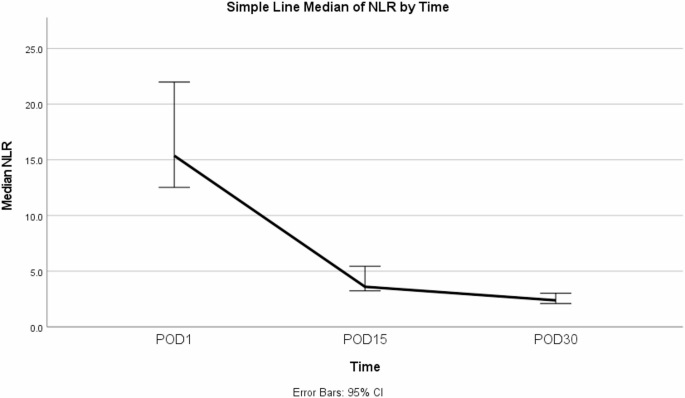
Venous blood samples were obtained prospectively 24 h postoperatively (POD1), days 15 and 30, for complete blood count analysis and calculation of NLR, PLR, and SII. Blood samples were collected into EDTA (ethylenediaminetetraacetic acid) tubes (lavender-topped tubes, 2.7 mL or 3 mL volume) for complete blood count and differential analysis. Samples were collected before intravenous medication administration when feasible. A fasting state was not required for postoperative samples, given acute postoperative metabolic alterations; however, samples were obtained at standardized times to minimize diurnal variation in white blood cell differentials.
Sample handling and analysis
Immediately after collection, blood samples were labeled with two patient identifiers (name and medical record number), collection date and time, and tube type. Samples were gently inverted 8–10 times to ensure adequate mixing with anticoagulant but were not shaken vigorously to prevent hemolysis. Transportation to the laboratory occurred within 30 min of collection at room temperature (20–24 °C). Samples were not refrigerated before processing to avoid temperature-induced alterations in cell counts. Complete blood count and five-part white blood cell differential (neutrophils, lymphocytes, monocytes, eosinophils, basophils) were performed using automated hematology analyzers [specify analyzer model and manufacturer: e.g., Sysmex XN-9100, Beckman Coulter DxH 900]. Instrument calibration and quality control were performed daily according to manufacturer specifications. Samples were analyzed within 2 h of collection. The analyzer measured absolute counts (cells/µL) for neutrophils, lymphocytes, monocytes, and platelets. If an automated differential was flagged as abnormal by the analyzer (e.g., immature cells, atypical lymphocytes), manual 100-cell differential review was performed by a certified laboratory technologist. Hemolyzed, clotted, or lipemic samples were rejected, and recollection was requested within the protocol window when feasible. All results were recorded directly into a secure electronic laboratory information system.
Statistical analysis
All statistical analyses were performed using IBM SPSS Statistics for Windows, version 27.0 (IBM Corp., Armonk, NY, USA). A two-sided P-value < 0.05 was considered statistically significant. Continuous variables are presented as medians with interquartile ranges (IQRs) due to non-normal distributions (assessed by the Shapiro–Wilk test and visual inspection of histograms/Q–Q plots). Categorical variables are expressed as frequencies and percentages. The study included 88 patients who underwent curative resection for colorectal cancer and had complete serial blood sampling on postoperative day 1 (POD1), day 15, and day 30. Patients were classified into two groups based on the occurrence of 30-day postoperative complications according to the Clavien–Dindo classification (any grade ≥ II was considered a complication). Because the primary aim of the final analysis was to describe the normal postoperative trajectory in patients with uncomplicated recovery, the main results focus on the subgroup of patients without complications (n = 47). Baseline demographic and clinical characteristics of this uncomplicated subgroup are summarized using descriptive statistics only. The postoperative course of three systemic inflammatory markers was evaluated in patients with uncomplicated recovery:
-
Neutrophil-to-Lymphocyte Ratio (NLR) = absolute neutrophil count / absolute lymphocyte count.
-
Platelet-to-Lymphocyte Ratio (PLR) = platelet count / absolute lymphocyte count.
-
Systemic Immune-Inflammation Index (SII) = (platelet count × absolute neutrophil count) / absolute lymphocyte count.
Values of NLR, PLR, and SII were calculated at three time points: POD1, day 15, and day 30.
To describe the overall trajectory (change over time) within the uncomplicated group, the Friedman test (non-parametric equivalent of repeated measures ANOVA) was applied to each marker separately. This test assesses whether there is a statistically significant change across the three related time points. Exploratory percentile distributions (5th–95th percentiles) were calculated to provide preliminary benchmarks of expected inflammatory marker behavior in uncomplicated recovery rather than formal clinical reference intervals. Percentiles were calculated using the default percentile estimation method implemented in IBM SPSS Statistics (Explore procedure), which is based on the empirical distribution of the observed data with interpolation between adjacent ordered observations when required. These percentile values are intended to represent the expected range of inflammatory marker levels during normal postoperative recovery after colorectal cancer surgery. The calculation of exploratory percentile-based benchmarks was based on this prospectively tracked cohort to ensure that the benchmarks reflect a controlled, ‘normal’ recovery environment rather than retrospective clinical convenience. All analyses were performed on complete cases (patients with available data at all three time points). No imputation was required for missing data in the uncomplicated subgroup used for the primary analysis.
