


This research study complies with all relevant ethical regulations.
Differentiated and stem cell patient-derived cell lines
Several patient-derived GBM models were used in this study. GDCs were maintained in DMEM supplemented with FBS 10% and antibiotics, whereas GSCs were cultured in DMEM/F12 with GlutaMAX supplemented with B27 supplement and b-FGF, EGF both at 10 ng ml−1 with antibiotics (GSC medium). Ge269, 518, 688, 738, 835, 258, 904 and 970.2 were gifts from V. Dutoit and P.-Y. Dietrich to E. Cosset. Both GDCs and GSCs were confirmed to be Mycoplasma negative before experiments. Ge269, 738, 835, 904, 970.2 and 258 originated from male patients, whereas Ge518 and 688 originated from female patients. The patient-derived models used in the study were obtained through a material transfer agreement and were collected in a biobanking protocol, with no access to patient clinical data, except gender, approved by the ethics committee of Geneva. All patients provided written informed consent and did not receive any compensation. The molecular subtyping was evaluated by quantitative PCR with reverse transcription (qRT–PCR) and genomic DNA analysis (Ion Ampliseq Cancer Hotspot Panel v2) revealed a MET mutation in Ge518 (ref. 65).
Chemicals
EN460 (HY-1283), DTT (441496P) and diamide (D3648) were purchased from MedChem Express, VWR and Sigma-Aldrich, respectively and were used at the respective concentrations of 25 µM, 10 mM and 5 mM. Then, Gkt (Sigma, 5.34032), Ru265 (Sigma, 27056-01-05), TBHQ (tert-butylhydroquinone 97%, Sigma, 112941), Mkt-077 (MedChem Express, HY-15096) and xestospongin C (Cayman, 64950) were used at the concentrations indicated in the figures.
Lentivectors
The lentiviral shRNAs ERO1α (Horizon, RHS3979-201777540 and RHS3979-201777542) were used to knockdown ERO1α expression. The firefly luciferase–GFP lentivirus (CAG, Puro) (Cellomics, PLV-10174-50) was used for the in vivo experiments.
Lentivectors expressing ERO1A mutants
To perform rescue experiments in ERO1A-silenced cells, we first introduced by In-Fusion cloning (Takara Bio), silent point mutations in the region that is targeted by the shRNA in the ERO1A-myc complementary DNA66. This cDNA was then re-cloned into the CSII-puro lentivector with primers ERO1-CSII-F and ERO1-CSII-R and subsequently mutated on serine 143, serine 145, serines 153 and 145, cysteines C94 and 99, and cysteines 394 and 397 to generate the vectors expressing ERO1α-wt, ERO1α-S143A, ERO1α-S145A, ERO1α-S143A/S145A, ERO1α-C94A/C99A and ERO1α-C394A/C397A, respectively. All vectors were verified by Sanger sequencing.
Primers used for ERO1A mutagenesis
The primers used for ERO1A mutagenesis were purchased from IDT-DNA Europe and are presented in Supplementary Table 5.
Cell fractionation
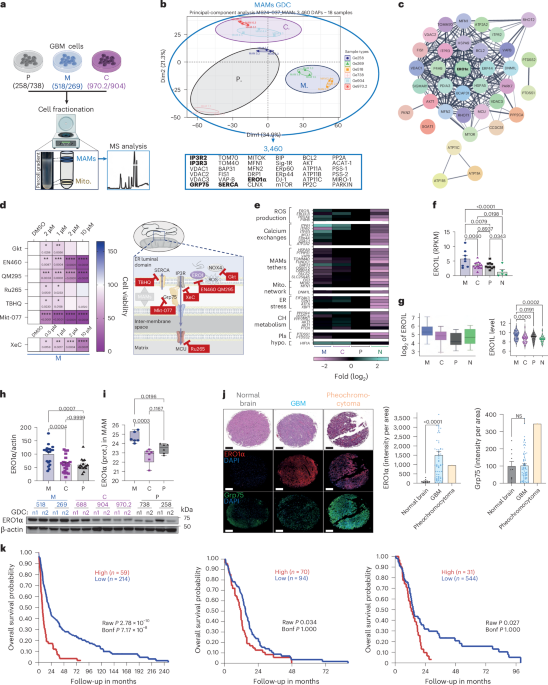
Subcellular fractionation was conducted on GDCs and GSCs cells in accordance to the litterature67. In brief, cells were grown to 80–90% confluency in ten 10-cm dishes for GDC cells and eight T75 flask for GSC cells per condition and resuspended in 5 ml of pre-cold homogenization buffer (0.25 M sucrose, 10 mM HEPES–NaOH, 1 mM EDTA and 1 mM EGTA, pH 7.4) supplemented with protease and phosphatase inhibitors. After centrifugation (400g, 10 min), the pellets were resuspended in 1 ml of homogenization buffer and were passaged at least 30 times through 26G5/8-gauge syringes during 10 min on ice. Broken cells states were evaluated with Trypan-blue staining for each cell line. Broken cells were centrifuged several times at 700g (1 × 10 min and 2 × 5 min at 4 °C) to remove the nucleus part (pellet). The supernatant was centrifuged for 10 min at 10,000g (4 °C) and separated into two parts (1) and (2).
Then, (1) the supernatant containing cytosol and light membranes was centrifuged twice for 10 min at 10,000g (4 °C) to remove heavy materials and for 1 h at 100,000g (4 °C) to separate light membranes contained in the pellet and cytosol contained in the supernatant. After one night at −20 °C with cold acetone, the cytosol precipitate part was centrifuged at 16,000g for 20 min (4 °C).
In parallel, (2) heavy membranes (mito. crude) containing mitochondria and MAMs were centrifuged twice for 10 min at 10,000g (4 °C) to remove light materials. The pellet was resuspended in 1 ml homogenization buffer, deposed on 8 ml of 18% Percoll (GE17-0891-02) homogenization buffer and centrifuged for 35 min at 100,000g (4 °C). Then, the MAM fractions (top band) were centrifuged at 100,000g for 1 h at 4 °C and the pellet was collected as the MAM fraction. The mitochondria fractions (bottom band) were centrifuged at 12,000g (4 °C) for 15 min and at 16,000g (4 °C) for 20 min and the pellet was collected as the pure mitochondria fraction67.
Immunoblotting
RIPA lysis buffer (RIPA buffer; 50 mM Tris-HCl, pH 7.4, 150 mM NaCl, 5 mM MgCl2, 1% NP-40 and 0.25% sodium deoxycholate), supplemented with protease and phosphatase inhibitors was used to prepare cell lysates, which were then quantified using the Pierce BCA kit (Thermo Fisher). Nuclei and unbroken cells were removed by 12,000g centrifugation for 15 min (4 °C). Then, 15–20 µg of protein was prepared, mixed with Laemmli buffer containing DTT and boiled at 95 °C for 5 min. Samples were loaded onto a denaturing SDS–PAGE, transferred to PVDF membranes and blotted with anti-rabbit or anti-mouse HRP-conjugated secondary antibodies (Bio-Rad or Invitrogen). The following antibodies were used for immunoblotting: ERO1α (GeneTex, GTX112589, 1:1,000 dilution), PERK (Abcam, ab65142, 1:800 dilution), p-PERK (R&D, AF3999, 1:800 dilution), EIF2α (Cell Signalling, 5324S, 1:1,000 dilution), p-EIF2α (Cell Signalling, 3398S, 1:1,000 dilution), ATF4 (Cell Signalling, 11815S, 1:1,000 dilution), CHOP (Cell Signalling, 2895T, 1:1,000 dilution), ERO1βα (Abcam, 197290, 1:500 dilution), α-tubulin (Thermo Scientific, MA1-850, 1:10,000 dilution), SERCA2 (Abcam, ab150435, 1:1,000 dilution), VDAC1/3 (Abcam, 14734, 1:1,000 dilution), MCU (Cell Signalling, 14997S, 1:1,000 dilution) and β-actin (Sigma, A3854, 1:10,000 dilution). For the non-reducing experiments, fresh samples were collected and prepared in Laemmli buffer free of DTT and loaded on SDS–PAGE (without a boiling step) the same day.
Cell viability
Cell viability was assessed through two different readouts of CellTiter-Glo assay kit (CTG, Promega) and CellTiter-Fluor assay kit (CTF, Promega) for GDCs and CTG for GSCs following the manufacturer’s recommendations. In brief, 5,000 to 20,000 cells per well in 96-well plates were seeded in triplicate in the respective control and deprived medium treated for 24 to 96 h with or without EN460 in LG (0.45 g l−1) or complete medium, HG (4.5 g l−1). Luminescence or fluorescence was assessed using a Spectramax ID3 (Molecular Devices) reader.
Cell proliferation and migration
The Incucyte S3 (Sartorius), a live-cell imaging and analysis system was used to measure cell proliferation and migration (scratch wound automatic with the woundmaker 96-well plate), according to the manufacturer’s recommendations. Cells were seeded on a 96-well plate at 5,000 cells and 20,000 cells per well for proliferation and migration assay, respectively, in the following conditions: complete medium (HG), deprived glucose condition (0.45 g l−1) with or without EN460. Plates were transferred to the Incucyte for incubation over 100 h and images were collected every 2 h.
Annexin V/propidium iodide staining
Cell apoptosis and necrosis was evaluated with annexin V/propidium iodide staining following manufacturer recommendations (Thermo-Fisher, V13245) by flow cytometry analysis carried out using a FACS Fortessa (Flow Cytometry Core Facility of the Cancer Research Centre of Lyon; CRCL) and data were processed using BD FACSDiva software.
3D cell invasion in Matrigel
GSC were seeded into 96-well ultra-low attachment plates. After 24 h, 75 µl of Matrigel were loaded on each sphere, on ice. Then, 200 µl GSC medium was added on top of polymerized Matrigel and GSCs were incubated at 37 °C for 24 to 72 h to allow invasion assessment. Images were acquired using an EVOS microscope (Life Technologies) and analysed using the ‘Analyze – Measure − Length’ feature in Fiji software.
In silico analysis
The R2 web application-based genomics analysis and visualization application (http://r2.amc.nl) was used to obtain survival curves and g:Profiler Bioinformatics resources to perform gene enrichment analyses68. The Ivy Glioblastoma Atlas Project was used to visualize ERO1α expression as well as the genes of interest, listed in the corresponding figure, in GBM tumours. Broad Institute tools were used to produce the single-cell diagram based on a glioblastoma study6.
Fusion/fission measurements
The mitochondrial morphology and network were assessed using the MitoTracker Red CMXRos fluorescent probe (M7512, Thermo Fisher) at 100 nM following manufactory recommendations. Cells were treated for 30 min at 37 °C, then fixed, mounted and imaged using the Opera-Phenix (PerkinElmer). Mitochondrial length, width and area were quantified automatically using Harmony software.
Cell immunofluorescence staining and imaging
Before fixation, mitochondria were stained with a MitoTracker Red CMXRos fluorescent probe (M7512, Thermo Fisher) at 100 nM (see above). Then, cells were washed twice with PBS and fixed with 4% paraformaldehyde for 15 min at room temperature, followed by quenching with 50 mM NH4Cl for 10 min. After washing, cells were permeabilized with 0.3% Triton X-100 for 15 min and blocked in 5% BSA–0.1% Triton X-100 for 1 h. Cells were incubated with primary antibodies against ERp57 (1:50 dilution, Abcam 242367) overnight at room temperature in a humidified, light-protected chamber. Following washes (PBS with 0.3% Triton X-100 and 0.2% BSA, then PBS), cells were incubated with Alexa Fluor-conjugated secondary antibodies (1:400 dilution) for 1 h. After the final washes, coverslips were mounted using PBS:glycerol (1:1). Images were acquired using a confocal Zeiss 880 or OPERA-Phenix HCS inverted fluorescence microscope equipped with a ×63 objective.
mtDNA quantification
The mitochondrial DNA content was assessed using RT–qPCR69. In brief, total RNA isolation was carried out using a NucleoSpin DNA kit from Macherey-Nagel (740952.50) according to the manufacturer’s instructions. Here, mitochondrial DNA content (COX1) relative to nuclear DNA (PPIA) was evaluated with the primers sequences provided in Supplementary Table 5.
ROS measurement
To measure cytoplasmic and mitochondrial ROS, CellROX Deep Red (C10422, Invitrogen) and MitoSOX RED Mitochondrial (M36008, Invitrogen) were used following manufacturer recommendations. Before Opera-Phenix (PerkinElmer) microscopy, cells were incubated with 5 mM CellROX or 5 mM MitoSOX for 30 min, at 37 °C. Then cells were washed (2× PBS) and fixed (PFA 4%) for 15 min before staining with DAPI (4,6-diamidino-2-phenylindole). Fixed cells were maintained in PBS:glycerol (1:1) in the dark. The fluorescence signals of CellROX far-red and MitoSOX were quantified by Opera-Phenix (PerkinElmer). Signal intensities and cell number and area were automatically analysed using Harmony software.
To measure the ER redox poise, roGFP2 was overexpressed 48 h. Then, the measurements were performed by Opera-Phenix (PerkinElmer) in live imaging with an automatic injection of DTT (10 mM) after 60 s of acquisition. Signal ratio intensities were analysed with the time series analyser tool on Fiji software after the removal of background fluorescence.
Immunofluorescence on tissue sections
Mouse brains were fixed in 4% PFA for 24 h at room temperature, dehydrated and embedded in paraffin. Formalin-fixed paraffin-embedded mouse brain sections (8 µm) and GBM tissue arrays were deparaffinized, rehydrated and subjected to antigen retrieval in citrate buffer (0.01 M, pH 6.0) using microwave heating (620 W, 3 × 5 min)69. Sections were incubated overnight at 4 °C with primary antibodies diluted in PBS containing 0.3% Triton X-100: rabbit anti-ERO1α (Abcam, 177156, 1:100 dilution), mouse anti-GRP75 (Abcam, 2799, 1:200 dilution) and rabbit anti-GFAP (Abcam or Dako, Z0334, 1:50 dilution). After washing in PBS, sections were incubated for 1 h at room temperature with Alexa Fluor 488- or 555-conjugated secondary antibodies raised in goat or donkey against mouse or rabbit IgG (Invitrogen, 1:1,000 dilution). Nuclei were counterstained with Hoechst (1:5,000 dilution) for 10 min before mounting in Fluoromount-G (Invitrogen, 00-4958-02). HPS staining (Hémalun, Phloxine, Safran) was used to visualize tumour regions in mouse brain sections. Images were acquired using a Thunder Leica microscope, and quantification of immunofluorescence-positive cells was performed using Fiji (National Institutes of Health; NIH).
Electron microscopy
GDCs and GSCs were washed and fixed by adding an equal volume of 4% glutaraldehyde directly to the culture medium and incubated for 15 min at 4 °C. The solution was then replaced with a mixture of 4% glutaraldehyde and 0.2 M cacodylate buffer (1:1, pH 7.4). Cells were sectioned for transmission electronic microscopy (TEM)69. Fiji software (NIH) was used to quantify ER length, mitochondria circumference, distance between ER and mitochondria (up to 50 nm), as well as contact number and length of contacts. Here, a minimum of 60 pictures were taken per condition, and at least 100 cells were analysed per group.
Proximity ligation assay
Cells were seeded on 96 wells plate (PerkinElmer). After 24 h of infection with FATE-1, cells were treated with LG (0.45 g l−1) or HG (4.5 g l−1) medium containing 10 mM glutamine or with or without EN460 (25 µM) for 24 h. Cells were fixed, permeabilized, blocked and incubated overnight at 4 °C with a mixture of anti-IP3R3 (Millipore AB9076, 1:400 dilution) and VDAC1 (Abcam 14734, 1:400 dilution) primary antibodies following the Naveniflex kit (NaveniFlex Cell MR Atto647N, NC.MR.100.ATTO) following the manufacturer’s recommendations. Nuclei were stained using DAPI incubated for 10 min in pre-heated humidity chamber and maintained in PBS:glycerol (1:1) in the dark. Images were acquired in 0.25-mM stacks using Opera-Phenix (PerkinElmer). Dot numbers, dot intensities, cell number and cell area were automatically analysed using Harmony software.
FRET imaging
The FRET imaging consisted of 5,000 cells seeded in 200 µl per well on a cell carrier 96-well plate (Greiner uClear bottom)70. At 24 h after seeding, the cells were transduced for 6 h. Then, 24 h later the medium was changed to HG or LG in the presence or absence of EN469. Following an additional 24 h of incubation, the cells were fixed imaged using an Operetta High Content imaging system (PerkinElmer). FEMP imaging using the Operetta System was carried out with the following filters: CFP (excitation 410–430, emission 460–500), YFP (excitation 490–510, emission 520–560) and YFPFRET (excitation 410–430, emission 520–560) and images were analysed using PerkinElmer Harmony 3.5 image analysis software. The YFP channel was selected to spot the region of interest (ROI) and around each ROI, a second boundary was drawn to quantify the background intensity. FRETbasal and FRETmax were calculated as (FYFPFRETcell − FYFPFRETbg)/(FCFPcell − FCFPbg). The FRET ratio was calculated as (FRETmax – FRETbasal)/FRETbasal.
Seahorse assay
The OCR and ECAR were measured using Seahorse XFe96 Analyzer (Agilent). Cells were seeded at 10,000–20,000 cells per well in a Seahorse cell plate, at least in triplicate, and incubated in XF medium (DMEM-based medium) with additional HG (4.5 g l−1) or LG (0.45 g l−1) and 10 mM glutamine with or without EN460 or overexpression of Fate-1 or Linker proteins for 48 h. A Cell Mito Stress kit was used following the manufacturer’s instructions, treating cells with 1.5 μM oligomycin, 1.5 μM FCCP and 0.5 μM rotenone/antimycin A. All wells were normalized against protein concentration using the Pierce BCA protein quantification assay (Thermo Fisher).
Proteomics
Before cell fractionation, cells were seeded and treated according to our conditions (HG, LG with or without EN460). liquid chromatography (LC)–MS/MS data were normalized to the total protein amount. Fractions were first quantified and equal amounts of protein were processed for LC–MS/MS analysis (25 µg per sample for MS24-037 and 20 µg per sample for MS24-055). Of note, the datasets used for the differential analyses were highly homogeneous, with a coefficient of variation calculated across all samples within each dataset (MS24-037 and MS24-055) <5%. Samples were processed, subjected to short electrophoresis and trypsin in-gel digestion as reported71. For shotgun proteomics analysis, peptide batches were resolved by their hydrophobicity with a 90-min acetonitrile gradient by reverse-phase chromatography and subjected to high-resolution MS/MS with an Exploris 480 (Thermo)72, except that the data-independent analysis mode was activated. The raw data were processed with DIA-NN v.1.8.1 software73 with RT-dependent cross-run normalization and then log2 transformed. For each protein, missing values were imputed the value 1,000 (background) with the in silico predicted spectral library was generated from the SwissProt_Human database (20,550 sequences and 11,382,592 residues). PCA was performed using the PCA module from the FactoMineR package in R.
Metabolomics
The MxP Quant 500XL assay (from Biocrates) was used to measure several endogenous metabolites including lipids and hexoses measured by flow injection analysis (FIA)–MS/MS using 5500 QTRAP instrument (AB Sciex) with an electrospray ionization (ESI) source, and small molecules were quantified by LC–MS/MS also using the same instrument. The metabolic peaks were normalized by the cell number collected for each sample.
Lipidomics
Following treatments, 100 µg of the MAM fraction sample was used for lipidomics. The lipids were extracted from each sample using the Folch method. Then, 0.5 ml NaCl 0.73% was added to each sample, which was then vortex-homogenized and transferred to a glass tube. Then, 5 ml of CHCl3:methanol (2:1) was added to the glass tube and centrifuged (3,000 rpm for 3 min) following homogenization. The lower organic phase was collected then subjected to evaporation under nitrogen flux. The lipids were taken up in 1 ml of CHCl3:methanol (2:1) and transferred to a vial. The latter was again subjected to evaporation under nitrogen flux. Then, 200 μl of CHCl3:methanol (2:1) was added to this vial, which was then homogenized before being placed in an insert. The vial was stored at −30 °C. LC–HRMS analysis was performed using a Thermo Ultimate 3000 coupled with Orbitrap Fusion Tribid Mass Spectrometer equipped with an EASY-MAX NG ion source (Thermo Scientific) and an Acquity UPLC ethylene-bridged HILIC column 1.7 µm, 2.1 × 100 mm (Waters), allowing the separation of several polar lipid classes according to their polarity. Analysis were performed with Xcalibur software.
13C tracing
Cells were seeded at 200,000 per 9.6-cm2 dish. After 24 h, cells were treated with 0.45 g l−1 (LG) or 4.5 g l−1 (HG) of glucose 13C (D-glucose-13C6, Clinisciences, TRC-G595007) in DMEM containing 10% FBS, 1% penicillin–streptomycin and 10 mM glutamine with or without EN460 (25 µM) or DMSO for 24 h. Cells were trypsinized, counted and store as dry pellet at −80 °C before further LC–MS-based metabolomic analyses. Frozen pellets were used for metabolite extraction. The volume of the extraction solution was adjusted to the cell number. After addition of extraction solution, samples were vortexed for 5 min at 4 °C and centrifuged at 16,000g for 15 min at 4 °C. LC–MS analyses were conducted on a QExactive Plus Orbitrap mass spectrometer equipped with an Ion Max source and a HESI II probe coupled to a Dionex UltiMate 3000 UPLC system (Thermo Fisher Scientific). The 5-μl samples were injected onto a ZIC-pHILIC column (Millipore) for LC separation. Buffer A was 20 mM ammonium carbonate, 0.1% ammonium hydroxide (pH 9.2) and buffer B was ACN. The chromatographic gradient was run at a flow rate of 0.200 μl min−1 as follows: 0 to 20 min, linear gradient from 80 to 20% of buffer B; 20 to 20.5 min, linear gradient from 20 to 80% of buffer B; and 20.5 to 28 min, 80% buffer B. The metabolites were detected across a mass range of 75–1,000 mass/charge ratio (m/z) at a resolution of 35,000 (at 200 m/z). The peak areas of metabolites and isotopologues were determined using Thermo TraceFinder software (Thermo Fisher Scientific), identified by the exact mass of each singly charged ion and by the known retention time on the high-performance LC column74.
Ca2+ measurements
Calcium transfer from ER to mitochondria was performed with the non-ratiometric Mito-R-GECO probe. The ratiometric 4mtD3cpv (RRID: Addgene_36324) or erGAP1 biosensors were used to measure basal mitochondrial or ER calcium content, respectively75. Probes were overexpressed for 48 h. For cytoplasmic Ca2+ measurements, Fluo-8 AM (AATBioquest/CliniSciences, AAT-21097) was used in accordance with the manufacturer’s recommendations.
Ca2+ measurements were performed in transparent DMEM (Thermo Fisher, A1443001) containing drugs or different glucose levels. Live-imaging curves of erGAP1 probes were performed in HBSS supplemented with 1.75 mM MgCl2, 410 mM MgSO4, 100 mM EGTA and live-imaging curves of 4mtD3cpv probes were performed in HBSS, Ca2+ and Mg2+.
Cells were treated with 600 µM final of ATP (Sigma-Aldrich, A2383) to stimulate Ca2+ transfer from ER to mitochondria. Measurements were performed at 37 °C in 5% CO2 with an automatic injector (20 µl in 180 µl per well of 96 wells) using an Opera-Phenix confocal (PerkinElmer) concerning adherent cells (GDCs) transfected with Mito-R-GECO or stained with Fluo-8 AM. Experiments performed on sphere cells (GSCs) or with the erGAP1 and 4mtD3cpv probes were performed in 37 °C using a Zeiss 980 confocal microscope. TBHQ (60 µM final) or ATP (600 µM final) were injected manually (20 µl in 180 µl per well of 96 wells). The fluorescence ratio of basal or post-stimulated Ca2+ levels was quantified using the time series analyser tool on Fiji software after the removal of background fluorescence. The average curves of all analysed cells and histograms show basal or stimulated Ca2+ levels by cell in at least three independent experiments.
Generation of brain organoids and co-culture
The induced pluripotent cell line WTSIi024-A (EBiSC, 66540094) was used to generate the brain organoids56. In brief, human induced pluripotent stem cells were maintained on Matrigel-coated dishes in StemFlex medium supplemented with FGF2 (2 ng ml−1) and penicillin–streptomycin. Cells were passaged using a gentle dissociation solution and used for differentiation at ~70% confluence. For organoid generation, induced pluripotent stem cells were dissociated in the presence of ROCK inhibitor (Y-27632, 10 µM) and seeded at 200 µl per well onto 96-well ultra-low attachment plates to allow aggregation. Plates were centrifuged (290g for 2 min) to promote the formation of uniform embryoid bodies.
Differentiation was induced by sequential exposure to the defined medium, with medium changes every 2 days. The basal medium consisted of DMEM/F12 and Neurobasal (1:1), supplemented with B27 without vitamin A, non-essential amino acids (1%) and penicillin–streptomycin (1%).
From D0 to D4 (day 0–4), neural induction was achieved by dual SMAD inhibition using SB431542 (10 µM) and LDN193189 (0.5 µM). During this period, cells were also cultured in the presence of ROCK inhibitor (Y-27632, 10 µM; D0–D1) and WNT signalling was inhibited using XAV939 (1 µM; D2–D7).
From D5 to D6, SB431542 was withdrawn, while LDN193189 (0.5 µM) and XAV939 (1 µM) were maintained. From D7 to D9, FGF2 (10 ng ml−1) was added to promote neural progenitor expansion, together with cyclopamine (1 µM) to inhibit the Hedgehog pathway, while LDN193189 and XAV939 were maintained.
At D10, LDN193189 and XAV939 were removed, whereas FGF2 (10 ng ml−1) and cyclopamine (1 µM) were maintained. From D11 to D21, CHIR99021 (1 µM), a GSK3 inhibitor and WNT activator, was added in combination with FGF2 and cyclopamine.
From D22 to D30, neuronal and glial maturation was supported by supplementation with BDNF (20 ng ml−1) and GDNF (20 ng ml−1), while maintaining organoids in differentiation medium.
For co-culture experiments, organoids were transferred to 96-well plates (Phenoplate, PerkinElmer) and GSC spheres (40,000 cells per well) were deposited onto individual organoids and maintained for 1 week, with medium changes three times per week. Live co-culture imaging was performed at D1 and after 1 week using a high-resolution microscope (Thunder, Leica). Organoids were then collected at the indicated time points, fixed in 4% paraformaldehyde for 24 h at 4 °C and washed in PBS before embedding in paraffin.
In vivo experiments
Animals and housing conditions
All procedures involving animals were conducted in the CRCL small animal facility (P-PAC, accredited under approval number D693880202) in accordance with European Directive 2010/63/EU and were approved by the local Institutional Animal Care (ACCeS ethical committee) and Use Committee and authorized by the French Ministry of Research (APAFIS no. 40391). Mice were housed in individually ventilated cages at a maximum density of five animals per cage, on poplar wood bedding (SAFE Select Fine). Environmental enrichment was provided with at least two dental cotton rolls per cage. Animals had ad libitum access to acidified drinking water (pH 3.0 ± 0.5).
Bedding was replaced every 2 weeks, and full cage changes were performed every 8 weeks. Animals were maintained under a 12-h light–dark cycle (lights on at 07:00 and off at 19:00), at an ambient temperature of 21 ± 2 °C. Relative humidity was approximately 45 ± 30% and was not actively regulated.
Mouse experiments
The 6–10-week-old female nu/nu nude immunocompromised mice weighing 20–25 g (Envigo) or C57BL/6JOlaHsd immunocompetent mice weighing 18–22 g (Envigo) were housed five per cage, with standard husbandry for specific-pathogen-free conditions provided by staff of the animal core facility (P-PAC, CRCL). Mice were allowed to acclimate for 2 weeks before experimentation. SB28 (10,000 cells) and GSC Ge518 (3 × 10⁵ tumour cells) were injected intracranially in 2 µl of PBS with a Hamilton syringe mounted on the frame into the C57BL/6J and nude mice putamen (through the preformed hole to a depth of 3.6 mm, a site far from the ventricles, and with little critical activity in the mouse), respectively. Twice a week (for the duration of the experiments) and before injection, body weight was measured and a 15% decrease from the pre-procedure body weight led to killing. To evaluate tumour progression, animals were monitored daily and bioluminescence was measured with the Biospace instrument. Those exhibiting signs of morbidity and/or development of neurological symptoms were killed immediately. Tumour presence was quantified using luciferase activity following intraperitoneal (i.p.) injection of luciferin. Mice were then randomly assigned to the different groups. Mice were treated 2–3 times a week by retro-orbital injection of 0.5–1 mg kg−1 EN460 or DMSO; or given access to water containing 4% sucrose, with or without doxycycline (1 mg ml−1).
Zebrafish model
Transgenic Tg(fli1:EGFP) zebrafish were maintained at 28.5 °C under a 14-h light–10-h dark cycle in the Zebrafish Facility at the Walther Straub Institute, Ludwig Maximilians University (LMU) Munich. The water was changed daily and larvae older than 7 days were fed twice a day with ground brine shrimp. All experimental procedures involving zebrafish were performed in accordance with the guidelines of the Regierung von Oberbayern, the European equivalent of the NIH’s Guide for the Care and Use of Laboratory Animals (Directive 2010/63/EU) and the ARRIVE guidelines (https://www.nc3rs.org.uk/arrive-guidelines). Zebrafish younger than 5 days post-fertilization (dpf) are not classified as protected animals under regulations governing scientific procedures, adhering to the principles of the 3Rs. Three-day post-fertilized eggs were treated with 1 mg ml−1 pronase to dechorionate the larvae. The larvae were then anaesthetized using tricaine (MS-222), and their heads were carefully exposed on the agarose before cancer cell injection. All injections were performed using a FemtoJet 4i microinjector (Eppendorf). Injected zebrafish larvae were maintained in six-well plates containing 5 ml of E3 buffer (5 mM NaCl, 0.17 mM KCl, 0.33 mM CaCl2 and 0.33 mM MgSO4, pH 6.8–6.9). The larvae were imaged immediately after injection (D0) using a confocal ZEISS 980 (Carl Zeiss) and again at the end of D4 using the Thunder 3D imager (Leica). Images were analysed using ImageJ.
Statistics and reproducibility
Data shown, presented as mean ± s.e.m., are representative of results obtained for multiple experiments as noted in the figure legends. P values < 0.05 were considered significant. Following confirmation of data normality (using Shapiro–Wilk or Agostino and Pearson omnibus normality test) and homogeneity (using Bartlett’s test), one-way or two-way analysis of variance (ANOVA) was performed to test the effects of the experimental conditions. Once a significant effect was noticed, a posteriori Bonferroni correction, Tukey correction or Fisher’s test was used to analyse pairwise differences. For comparison between two groups, data were analysed with Kruskal–Wallis or a Student’s t-test. Statistical analysis was performed using GraphPad Prism software. Concerning in vivo experiments (nu/nu nude immunocompromised and C57BL/6JOlaHsd immunocompetent), the minimum number of mice required by the group was determined with G*Power 3 software. For in vitro and ex vivo data, no statistical method was used to predetermine sample sizes. During image analysis (IF, live imaging and EM), dead cells, identified by their round and small size, were excluded from the quantification data. No additional data points were excluded from the analyses. The investigators were not blinded to allocation, during experiments and outcome assessment. However, for live imaging and IF, automatic acquisition and injections were performed using Harmony software. Data collection and analysis were not performed blind to the conditions of the experiments.
Reporting summary
Further information on research design is available in the Nature Portfolio Reporting Summary linked to this article.
