


UKCTOCS data
The UKCTOCS was a general population trial of average-risk postmenopausal women aged 50 to 74 years of age with 50,640 (25.0%) randomised to the MMS arm, 50,639 (25.0%) to an ultrasound only arm (USS) and 101,359 (50.0%) to no screening between 2001-2005 [20]. The screening arms offered annual tests through December 31, 2011. Compliance with scheduled screening exams was 78% in the USS arm and 81% in the MMS arm. Initial follow-up ended on December 31, 2014, and extended follow-up ended on June 30, 2020.
The MMS arm implemented annual screening using the Risk of Ovarian Cancer Algorithm (ROCA) [21, 22], which assesses an individual’s likelihood of ovarian cancer based on her sequence of CA125 measurements. High- and intermediate-risk ROCA scores led to repeat tests, and if confirmed, to ultrasound. Persistent abnormal findings were followed by a referral for clinical assessment and then to biopsy or surgery, which usually involved laparoscopic removal of tubes and ovaries.
We sourced individual-level data on screening histories (age at and result of each screen); age, mode (screen- or interval detected), and type (HGSC or non-HGSC) of ovarian cancer diagnosis; and age and status at last follow-up (died of ovarian cancer, died of other causes, or censored). Access to the UKCTOCS data was via the UCL Data Safe Haven, a secure computing environment for storing and analysing sensitive data.
To create the analytic dataset, we excluded women who were assigned to a screening arm but did not undergo screening; and we censored women at the time of an abnormal screening outcome other than ovarian cancer, following non ovarian cancer histology at trial surgery or at diagnosis of non-HGSC. We defined early stage as AJCC-7 [23] stage I or II and late stage as III or IV. The 1% of HGSCs that were unstaged were assigned to early stage. In the screen arm HGSC diagnoses and person years at risk were calculated by screen number and year of follow-up after the last screen. In the control arm, diagnoses were tabulated by year of age.
Ethics approval and consent to participate
All methods were performed in accordance with the relevant guidelines and regulations. The UKCTOCS trial was registered with ISRCTN (ISRCTN22488978) and ClinicalTrials.gov (NCT00058032). All trial participants provided written informed consent for participation. The UKCTOCS study received ethical approval from the UCL Research Ethics Committee (reference 2233.005). The current secondary analysis was determined to be exempt by the Oregon Health & Science University Institutional Review Board.
Natural history model
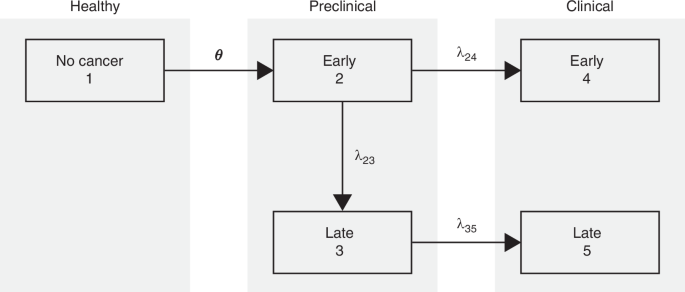
Our natural history model builds on a classic model of progression between a healthy state and early- and late-stage cancer states [24] (Fig. 1). The “healthy state” encompasses individuals with no cancer, with pre-cancer, or with pre-clinical cancer that is not detectable via screening. The event of transition from the healthy state (state 1) to an early-stage, detectable pre-clinical state (state 2) is termed “pre-clinical detectable onset.” This event occurs when existing diagnostic modalities, here MMS and USS, may detect the disease with some (non-zero) sensitivity. From this point, the tumour may either progress to pre-clinical late stage (state 3) or transition to a clinical or symptomatic state in early stage (state 4). State 5 represents clinically detected late-stage disease.
Fig. 1The alternative text for this image may have been generated using AI.
Five-state progressive natural history model.
Model specifications
For pre-clinical detectable onset, we use a flexible transition rate that varies with age [25, 26] (Appendix A.I, Web Fig. 1). We assume constant transition rates from state 2 (early pre-clinical disease) to 3 (late pre-clinical disease) along with stage-specific sensitivities. We assume a common natural history for individuals in the USS and MMS arms, but allow sensitivities to vary by screening arm. Sensitivity in the model is defined as the probability that the sequence of first and repeat/second line tests identify a cancer if it is present. Lange et al [15] refer to this measure as screening episode sensitivity.
Model calibration to UKCTOCS data
We estimate the state transition rates and stage-specific sensitivities via maximum likelihood, assuming counts of screen- and interval-detected cases by stage follow a Poisson distribution (Appendix A.II-III). To check the fit of the model, we compare the observed and projected rates of diagnoses over time in the screen and control arms. All statistical analyses are programmed in R 4.4.2 [27]. Model fitting relied on customisation of functions from the R package cthmm (https://rdrr.io/rforge/cthmm/).
We also conducted a separate sensitivity analysis using Bayesian calibration with moderately informative priors for the sensitivity parameters (Appendix A.IV).
Simulating the trial for validation and hypothetical scenarios
For model validation and investigation of alternative scenarios, we implement repeated simulations (\(N=400\)) of the trial given a specified study design and values for state transition rates and screening test performance (Fig. 2A). Each simulation projects diagnoses of and deaths from HGSC over time for 50,000 women representing each of the MMS and TVS arms and 100,000 representing the control arm. Starting ages and numbers of screens are simulated to replicate those in the trial population. To replicate the follow-up time distribution as observed in the trial, we fit a distribution for the time to censoring to the UKCTOCS data by age at entry and screening arm. Then, using the fitted distribution, we simulate an independent time of loss to follow-up or other-cause death.
Fig. 2: Schematic describing the UKCTOCS simulation.The alternative text for this image may have been generated using AI.
a Overview of the trial simulation approach. b Example of a woman’s simulated natural history events under no screening. Death is projected assuming late stage at diagnosis. c Example of the same woman’s simulated natural history events and time of diagnosis under screening. Given she is detected in an early stage, death is projected post-lead time assuming early stage at diagnosis.
To project deaths from HGSC without screening, we model HGSC-specific survival as driven by stage at detection. Stage-specific survival times are based on mixture-cure survival models fit to women diagnosed with HGSC in the control arm (Appendix A.V, Web Table 1, Web Fig. 2), estimated with the cuRe package [28]. Under screening, cancers detected at an earlier stage receive an increase in their cancer-specific life expectancy based on the difference in survival between early- and late-stage diagnoses without screening. This stage-shift assumption reflects the basic intuition underlying the early detection endeavour and is encoded in the most common mechanistic models of cancer screening benefit [29].
Based on the calibrated natural history model, we simulate individual-level events across each woman’s lifetime, including the age at pre-clinical onset of HGSC, the age at transitions between early and late pre-clinical stages, and age and stage at clinical diagnosis (Fig. 2B). We then superimpose annual screening times and, given test sensitivity, obtain the age at screen diagnosis (Fig. 2C).
To validate the modelled trial outcomes, we compare simulated to observed relative reductions in late-stage diagnosis and HGSC mortality in control and MMS arms. To project results under the scenario of continued screening, we simulate annual screening through 2020. To project results under improved treatment for early-stage cancer, we improve survival for early-stage diagnoses using a hazard ratio of 0.5. To project results of trials under improved disease detectability, we extend the early-stage pre-clinical detectable state to a specified duration (6 months, 1 year, or 1.5 years) under a range of early-stage sensitivities (70–100%). For each specified duration, we re-estimate the model to advance the point of pre-clinical early-stage onset while preserving the distributions of age and stage at diagnosis without screening. We simulate trials under these re-estimated natural history models fixing late-stage sensitivity at the original estimated value.
With the replicate simulation runs, we can estimate uncertainty intervals around the projected outcomes and statistical power. We predict power by calculating the proportion of simulated trials in which the mortality risk ratio or hazard ratio between the control and MMS arms is statistically significant (two-sided \(p \, < \, 0.05\)) under Cox regression analysis.
