


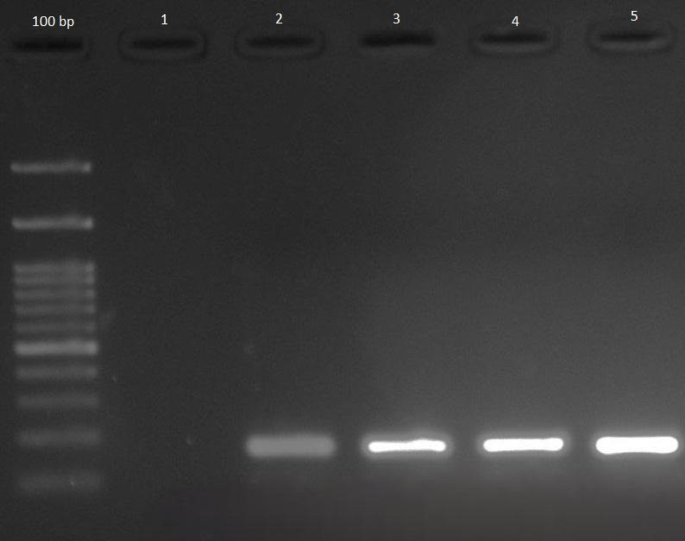
Confirmation of srf gene presence using PCR
The Surf 176 bp fragment, corresponding to the B. subtilis sfp gene (GenBank accession no CP034943.1) at positions 384,088–384,264, was PCR-amplified using the following primers (Biovision, Inc, USA), sense: GGGCTTTGATCCTGAACGG-3, and antisense: ATCATCTTTCGCTTGGCCCT. Amplification was accomplished with BIO-RAD T100 Thermal Cycler according to4. Different annealing temperatures (56 to 62 °C). After the amplification, the PCR reaction product was analyzed by 2% agarose gel electrophoresis.
Studying culturing conditions on Bacillus
subtilis 6633
Ten-fold dilutions of Bacillus subtilis ATCC6633 (Central Reference Laboratory for Public Hospitals) were prepared and cultivated on four LB agar plates incubated at 37 °C for 24 h.
Mineral salt medium (MSM) was first prepared according to12 with a modification13 whereas 2% of filtered glucose was added to the medium. Three colonies of (1:100,000) were inoculated into 50 mL of MSM medium and incubated at 150 rpm, 35 ◦ C, for 72 h14,15.
Optimization of fermentation media for surfactin production
Carbon and nitrogen sources
Carbon sources used were: glucose, glycerol, maltose, sucrose, dextrose, and used cooking oil. MSM was prepared with a stable nitrogen source concentration (0.4% ammonium sulfate) and tested carbon source concentrations ranging from 0.1% to 4% depending on the source. B. subtilis was cultivated for three days16,17. For nitrogen source, four concentrations of ammonium sulfate were selected: 0.2, 0.4, 0.8, and 1.6%, in MSM media containing 2% gluose18,20.
Effect of pH and temperature
Four pH values were selected: 5.7, 6.7, 7.7, and 8. MSM was prepared by adding 2% glucose. For studying the temperature effect, five temperatures were selected: 31, 33, 35, 37, and 39 °C. The cultured bacteria were incubated for three days19,20.
Extraction and purification of surfactin
The crude biosurfactant was initially recovered by acid precipitation followed by solvent extraction, in which the cell-free supernatant was obtained by centrifugation of the culture broth at 5,000 rpm and 4 °C for 40 min. According to Barale et al., acid precipitation was carried out using 1 M HCl to obtain a pH of 2. The culture supernatant was then incubated for 24 h at 4 °C followed by centrifugation at 10,000 rpm and 4 °C for 40 min, then extraction using 70% ethanol (v/v), evaporated at 40 °C, and dried at 40 °C. The surfactin yield was determined gravimetrically by weighing the dried extract, as previously described for surfactin production in Bacillus subtilis. All measurements were performed in triplicate21,22.
Purification of surfactin using FPLC
AKTA Purifier 100 FPLC system (GE Healthcare Life Sciences, Sweden) was used in the purification of surfactin using different column types.
Desalting chromatography
The partially purified bacterial lipopeptide pellet, surfactin, with a concentration of 0.673 mg/mL, was applied onto 5 mL HiTrap column (GE Healthcare Life Sciences) and eluted with sodium phosphate buffer (20 mM; pH 7.5) with 5 column volumes (CV). Fractions were collected for further assessment. chromatography for lipopeptide, surfactin, purification21,23.
Anion exchange chromatography
Weak anion DEAE (Diethylaminoethyl) cellulose, anion ANX, and Hitrap QFF 1 mL columns (GE Healthcare Life Sciences) were utilized and equilibrated with washing buffer (20 mM Tris buffer pH 6.8) and elution buffer (20 mM Tris pH 6.8 and 1 M NaCl). A 0.2 mg of purified surfactin from desalting was loaded. The column was washed using the washing buffer to remove other proteins, then linear gradient elution (20 CV) was carried out using the elution buffer. The eluted peaks were collected, and oil displacement activity was evaluated. The active fractions were further analyzed by HPLC, FTIR, NMR, and GC–MS47.
Oil displacement assay
The fractions obtained were assessed for oil-displacement activity. In a Petri dish with a diameter of 8 cm, 30 mL of distilled water was placed. Subsequently, 200 µL of crude oil was used to form an oil film under the aqueous surface, then 10 µL of a surfactin solution was added under the oil surface. Oil dispersion was measured by the diameter of the halo formed using ImageJ software. Anionic surfactant sodium dodecyl sulfate (SDS) was used as a positive control, and water was used as a negative control24.
Thin-layer chromatography (TLC)
The fractions were subjected to TLC using Silica-coated aluminum plate immersed in chloroform: methanol: acetic acid (85:10:5). The plate was developed, dried, and visualized under UV light of 254 nm and 365 nm (Silufol, Kavalier Germany) for fluorescence quenching spots, and Rf value of the surfactin spot was evaluated using the following formula and results recorded25.
$${\text{Rf}} = \;{\text{Distance travelled by the solute (cm)/Distance travelled by the solvent (cm)}}.$$
Characterization of surfactin
High Performance Liquid Chromatography (HPLC)
The purified lipopeptide was injected to HPLC chromatograph YL-9100 system with a C18 column (Agilent Technologies). At a flow rate of 1.0 mL/min, a gradient elution was performed over 35 min using buffer A (0.1% TFA in water) and buffer B (0.1% TFA in acetonitrile)26.
Infrared analysis (FTIR)
The samples were prepared by mixing 1 mg of purified surfactin with 100 mg of KBr and pressing the mixture into a pellet form at 134 MPa for 2–3 min to obtain transparent pellets. The IR spectrum of the pellet was collected from 400 to 4000 wavenumbers (cm− 1), and is an average of 32 scans obtained using a FTIR (4100typeA) spectrometer27.
Hydrogen and carbon nuclear magnetic resonance (NMR)
A 400 MHz spectrometer was used to perform the H NMR of the purified surfactin. The material was dissolved in deuterated methanol (MeOD) at 298.1 K to obtain the spectra. A 100 MHz spectrometer was used for the C NMR analysis, and the sample was prepared in deuterated chloroform (CDCl₃). To achieve the best resolution, both spectra were processed using typical exponential window functions (LB = 0.30 Hz for H)28.
GC-mass analysis of beta-hydroxy fatty acids in surfactin
GC-MS operating analysis was performed using Thermo Scientific TRACE GC Ultra system (Thermo Fisher Scientific, Walthman, MA UAS). TSQ8000 evo triple quadrupole model specification equipment and injector TR-59MS USA equipment with a 30-mm diameter, 0.25-mm internal diameter, and 0.25-mm film thickness was used. Temperatures for the injector and detector was 270. The opening oven temperature was held for five minutes at 50 °C and then allowed to increase to 230 °C at a rate of 5 °C/min. The flow rate for the helium gas was fixed at 1 mL/min. Prior to injection, the sample was diluted at a ratio of 1:10 in petroleum ether and purified using a 0.2 L m filter with syringe attachment. The collected components were matched with NIST database equipped with GC-MS method to classify the sample’s chemical compounds29.
Preparation of the Dox-loaded surfactin/chitosan nanoparticles
Dox-Surf/CS nanoparticles were produced using a micelle-assisted ionic gelation technique as described by11,30. A0.5 mL of Dox.HCl solution (1 mg/mL) and 0.5 mL of surfactin solution (2.5 mg/mL) were combined. To create a sustain dispersion, the mixture was gently vortexed every 10 min for 30 to 60 min at room temperature (25 °C). the Dox–surf micelles (with a mass ratio of 1:2.5 and total volume 1 mL) was firstly centrifuged to collect the generated nanoparticles at 15,000 rpm for 30 min at 10 °C using an ultracentrifuge (supra25K, Hanil science industrial, Korea) and the supernatant was decanted and stored. The pellet was resuspended in 1 mL deionized H2O and gradually added to the 10 mL 0.2% chitosan solution in 1% acetic acid. After 15 min of stirring, 4 mL of sodium tripolyphosphate (TPP) solution (1 mg/mL in deionized water) was gradually added over the course of 5–10 min to initiate ionic crosslinking between the cationic chitosan and the anionic TPP. To ensure full gelation and stability of the Dox-Surf/CS nanoparticles, stirring was maintained for a further half hour to an hour. Centrifugation at 15,000 rpm for 10 min at 10 °C was performed, and The pellet was resuspended in 1 mL of deionized water and directly subjected to the freeze dryer (Edwards Modulyo, UK) to produce dried powder, which was then collected and kept at 4 °C. The Dox/CS without Surf and the blank CS nanoparticles without both Dox and Surf were formed by the same method.
Evaluation of Dox encapsulation efficiency and drug loading
The supernatant obtained from Dox-Surf/CS nanoparticles was used to indirectly quantify the drug loading content (DL%) and encapsulation efficiency percentage (EE%). A UV-Vis spectrophotometer (Model: se6100 UV-Vis double beam, Abbotta Corporation, USA) was used to measure the sample three times at 480 nm11,31,32,33. The data were displayed as the mean ± SD. Using known Dox.HCl values (1, 0.5, 0.25, 0.125, 0.125, 0.0625, 0.03125, 0.0156, 0.0078, 0.0039, 0.00195, 0.000975, and 0.0000487) mg/mL, a standard calibration curve, and equations (1) and (2) were used to determine the EE% and DL%.
$$\:\:\:\:\:\:\:\:\:\:\:\:\:\:\:\:\:\:\:\:EE\left(\text{\%}\right)=\frac{\:CONC\:administered\:Dox-CONC\:of\:free\:Dox}{conc\:of\:total\:Dox}100$$
(1)
$$\:DL\left(\%\right)=\frac{M\:administered\:Dox-M\:free\:Dox\:\:\:}{M\:of\:surf}\times\:100$$
(2)
where CONC of administered Dox, M of administered Dox, and M of Surf are the initial concentrations. M free Dox and M of surf: are the mass of Dox and Surfactin used in the nanoparticle formation technique.
In vitro release study of Dox from both the DOX-Surf/CS and DOX- CS nanoparticles
The released amount of Dox from the Dox-Surf/CS and Dox/CS nanoparticles was investigated at two pH values in simulated dissolution media: pH 4.8 simulating the pH of cancerous cells, and pH 7.4 simulating the environment of the normal tissues, over a period of 72 h. A 1 mg sample of Dox-Surf/CS and Dox- CS nanoparticles was separately added to 2 mL of 1x PBS at (pH 7.4 or pH 4.8) and incubated shaking at 37 °C. A 200-µL aliquot of the supernatant was taken at different time intervals (0.5, 1, 2, 4, 6, 12, 24, 48, and 72 h) and supplemented with a 200-µL fresh 1x PBS solution to maintain the total volume. The absorbance of released Dox was measured at 480 nm using UV–Vis spectrophotometer according to Fahmi et al., standard curves31.
$$\:The\:cumulative\:drug\:release\:\left(\%\right)=\:\frac{amount\:of\:Dox\:released}{initial\:amount\:of\:Dox}x\:100\:\:\:\:\:\:\:\:\:\:\:\:\:\:\:\:\:\:\:\:\:\:\:\:\:\:\:\:\:\:\:\:\:\:\:\:\:\:\:\:\:\:\:\:\:\:\:\:\:\:\:\:\:\:$$
Morphology of Dox‑Surf/CS nanoparticles
The shape of the nanoparticles was determined using a transmission electron microscope (TEM) (JEM-1400, Jeol, USA). The average size and PDI of the nanoparticles were measured using DLS (Malvern, UK). The sample was diluted and sonicated for 5 min and then measured at room temperature. The surface charges of the obtained nanoparticles were measured as a function of zeta potential by DLS (Nanotrac, wave2, UK).
In vitro studies of Dox-Surf/CS nanoparticles
Hemolytic activity assay
Blood was collected from three adult healthy male mice (Swiss albino, weighing 25 ± 2.6 g) via the retro-orbital sinus under light anesthesia, and whole blood was collected in EDTA tubes. The animals were obtained from the animal facility of TBRI. All experimental procedures involving animals were conducted in accordance with relevant guidelines and regulations (Approval No: FWA 00010609/PT 766).
The hemolysis assay was performed according to Mohamed et al., Serial dilutions of surfactin in PBS from 170.66 to 0.33 µg/mL were prepared from acid-precipitated and solvent-extracted fractions. RBCs with PBS (no surfactin) served as the negative control, and RBCs mixed with 0.01% Triton X-100 served as the positive control. The hemolysis percentage was calculated using the following equation, and the data were displayed as the mean ± SD13,34.
$$\% {\text{Hemolysis}}\: = \frac{{({\text{OD}}540\;{\text{sample}}\: – \:\:\:{\text{OD}}540\:{\text{negative}}\:{\text{control}})}}{{({\text{OD}}540\:{\text{positive}}\:{\text{control}} – \:\:\:{\text{OD}}540\:{\text{negative}}\:{\text{control}})}} \times \:100$$
In vitro cytotoxicity on normal and cancer cell lines
Normal fibroblast (FB) and liver cancer (HepG2) cell lines (Department of Cell Culture, Vacsera, Egypt) were chosen by the crystal violet assay35. The HepG2 and FB cells were cultured separately in two 96-well cell culture plates at a density of 5000 cells per well for 24 h at 37 °C in a 5% CO2 incubator in a DEMEM media containing 10% Fetal Bovine Serum (FBS) (Lonza Bioscience), 1% antibiotic Fungizone (Lonza Bioscience), and 1% HEPES (BioWest, USA). Cells were then treated for 24 h with free Dox, Dox-Surf/CS nanoparticles, and Dox-CS nanoparticles solutions, separately at concentrations suspended in a DEMEM media containing 2% FBS. In parallel, he cytotoxic effect of empty chitosan nanoparticles and surfactin solution (1000, 500, 250, 125, 62.5, 31.25, 15.625, 7.8, 3.9, 1.9, and 0) µg/mL was also studied against HepG2 and FB cell lines. After crystal violet staining, the absorbance at 570 nm was measured using a microplate reader, and cell viability is expressed as a percentage of viability using the following equation:
$$\:Viable\:cells\left(\%\right)\:\:=\:\:\frac{\text{A}\:\text{T}\text{r}\text{e}\text{a}\text{t}\text{e}\text{d}\:}{\text{A}\:\text{c}\text{o}\text{n}\text{t}\text{r}\text{o}\text{l}\:\:}\times\:100\:\:\:\:\:\:\:\:\:\:\:\:\:\:\:\:\:\:\:\:\:\:\:\:\:\:\:\:\:\:\:\:\:\:\:\:\:\:\:\:\:\:\:\:\:\:\:\:\:\:$$
Each experiment was carried out in triplicate, and the results are expressed as mean ± SD.
Statistical analysis
The data were presented as the mean ± SD of at least three replicates. The test of significance was performed by GraphPad Prism 7 (San Diego, California, USA). A two-tailed multiple T-test was employed to determine the significance of differences between normal and cancer cells. The ρ-value < 0.05 was considered to indicate a statistically significant difference.
