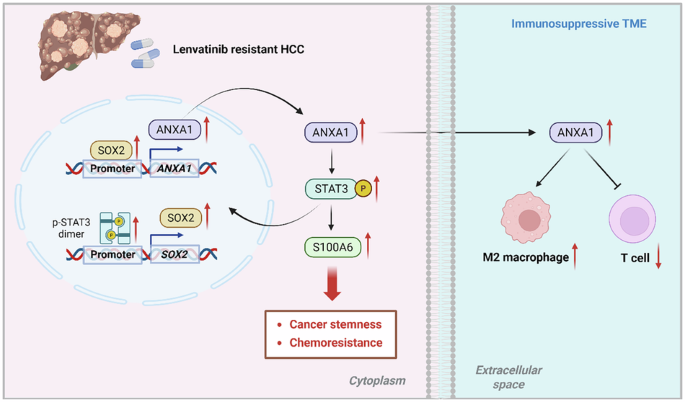
Lenvatinib has been approved by the FDA as a front-line treatment for advanced hepatocellular carcinoma (HCC), but its survival benefits are limited by acquired drug resistance. In this study, we investigate the mechanisms underlying lenvatinib resistance in HCC by establishing lenvatinib-resistant (LenR) patient-derived tumor xenograft (PDTX) and analyzing their genetic profiles via single-cell RNA sequencing (scRNA-seq). Through single-cell regulatory network inference and clustering (SCENIC) analysis, we find that Annexin A1 (ANXA1) is significantly enriched in LenR HCC clusters. Using knockdown and overexpression strategies, we demonstrate the critical role of ANXA1 in regulating cancer stemness-driven lenvatinib resistance. ANXA1 mediates resistance by regulating S100A6 expression, while its expression is regulated by SOX2 via promoter activation, forming a positive feedback loop with STAT3. Notably, we reveal that ANXA1 secreted from LenR HCC cells reshapes the tumor microenvironment (TME) by inducing M2 macrophage polarization via FPR2 binding and activation of ERK and NF-κB signaling, leading to decreased T cell infiltration. Targeting ANXA1 via an adeno-associated virus serotype 8 (AAV8) approach improves lenvatinib efficacy in our LenR Tp53KO/MycOE HCC mouse model, accompanied by the suppression of an immunosuppressive TME. In conclusion, HCC-derived ANXA1 regulates lenvatinib resistance both intrinsically and extrinsically. Targeting the SOX2/ANXA1/STAT3/S100A6 positive loop may provide a novel therapeutic strategy for HCC treatment.
Trending
- Cancer treatment alters the selection of pre-existing somatic mutations in normal esophagus
- Patient-derived 3D organotypic co-cultures as a long-term ex vivo model for pleomorphic adenoma of the parotid gland
- Teclistamab versus lenalidomide-dexamethasone in high-risk smoldering multiple myeloma: a randomized phase 2 trial
- MMSDH facilitates ACSL4 propionylation to counteract ferroptosis upon hypoxia and impairs PDAC chemotherapy efficacy
- Development and preclinical evaluation of a decoy DLL4-encoding oncolytic HSV-1 for high-grade glioma
- ATR inhibition induces NF-κB-dependent immunogenicity in Merkel cell carcinoma independent of cGAS-STING
- Debating CAR T-Cell Therapy Vs Bispecifics at First Relapse in Myeloma
- A pro-inflammatory metastasis-associated macrophage subset induces tumor-promoting mesothelial cell conversion in ovarian cancer via IL-1α secretion


Sunday, September 13
Tumor-derived annexin A1 drives lenvatinib resistance by regulating SOX2/STAT3/S100A6 feedback loop and M2 macrophage polarization in hepatocellular carcinoma
 By NewsCancer