


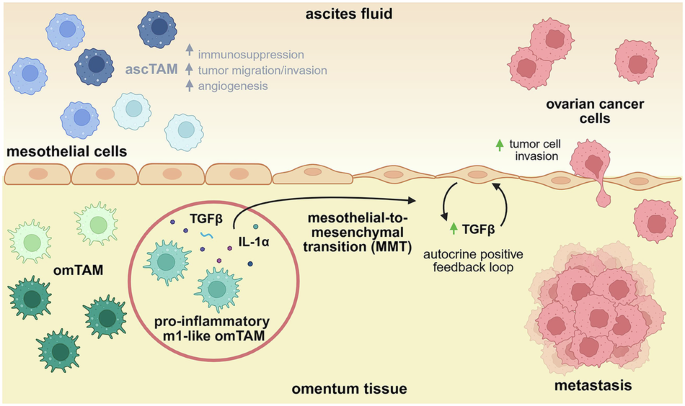
Tumor-associated macrophages (TAMs) are key regulators of the tumor microenvironment, yet the functional specialization of TAM subsets in metastatic progression remains incompletely defined. Here, we characterized distinct TAM populations contributing to tumor-promoting mesothelial cell conversion in high-grade ovarian carcinoma using single-cell RNA sequencing of patient-derived macrophages from ascites (ascTAMs) and omental metastases (omTAMs). TAMs from these anatomical sites were clearly distinguishable by polarization states, with omTAMs exhibiting a mixed M1⁺/M2⁺ phenotype, in contrast to the M1low/M2⁺ profile observed in ascTAMs. Transcriptomic analysis further revealed functional divergence of these subsets. Notably, omTAMs displayed gene signatures associated with mesothelial-to-mesenchymal transition (MMT), a critical process enabling tumor invasion across the peritoneal lining. Functionally, conditioned media from omTAMs, similar to that from classically activated M1 macrophages, induced MMT in primary mesothelial cells via TGFβ and ERK/p38 MAPK signaling pathways. This phenotypic transition enhanced transmesothelial tumor cell invasion. Proteomic analysis identified IL-1α as a key MMT-inducing factor secreted by pro-inflammatory macrophages. Mechanistically, IL-1α cooperates with TGFβ by activating an autocrine TGFβ/TGFBR1 feedback loop in mesothelial cells, thereby amplifying MMT. Consistent with these findings, IL1A expression was enriched in omTAM clusters across independent patient samples and was confirmed by immunohistochemical analysis of clinical samples. From a therapeutic perspective, our study identifies new avenues to counteract the mesothelial reprogramming driven by IL-1α⁺ TAMs, potentially impeding metastatic progression.
Created in BioRender. Heidemann, S. (2026) https://BioRender.com/aeu6yd0.
