


Banja, J. D., Hollstein, R. & Bruno, M. A. When artificial intelligence models surpass physician performance: medical malpractice liability in an era of advanced artificial intelligence. J. Am. Coll. Radiol. 19, 816–820 (2022).
Google Scholar
Mezrich, J. L. Is artificial intelligence (AI) a pipe dream? Why legal issues present significant hurdles to AI autonomy. Am. J. Roentgenol. 219, 152–156 (2022).
Google Scholar
Song, E. C. et al. Accessing AI mammography reports impacts patient follow-up behaviors: the unintended consequences of including AI in patient portals. npj Digit. Med. https://doi.org/10.1038/s41746-025-02201-0 (2025).
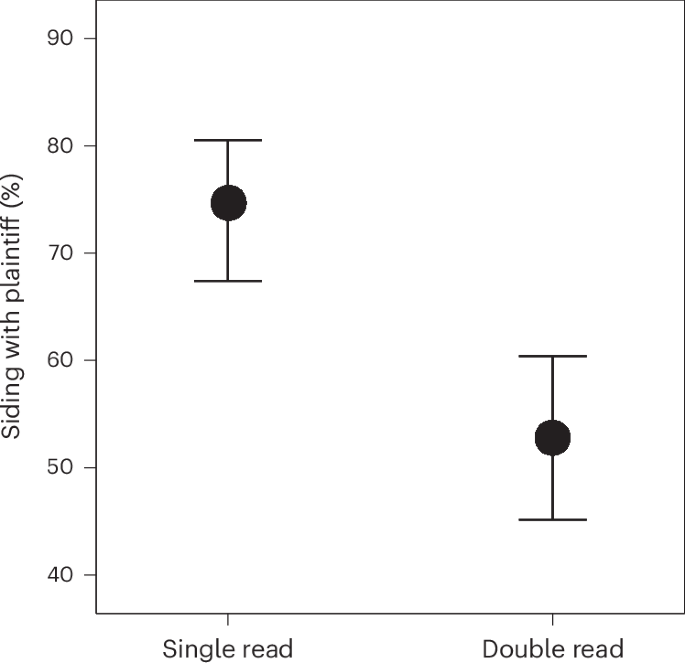
Bernstein, M. H., Sheppard, B., Bruno, M. A., Lay, P. S. & Baird, G. L. Randomized study of the impact of AI on perceived legal liability for radiologists. NEJM AI https://doi.org/10.1056/AIoa2400785 (2025).
Rock v. Crocker, 884 N.W.2d 227, 232–233 (Mich. 2016); https://www.courts.michigan.gov/4a41ce/siteassets/case-documents/briefs/msc/2024-2025/167716,167720/167716_78_02_at_apx.pdf
Bernstein, M. H. et al. Can incorrect artificial intelligence (AI) results impact radiologists, and if so, what can we do about it? A multi-reader pilot study of lung cancer detection with chest radiography. Eur. Radiol. https://doi.org/10.1007/s00330-023-09747-1 (2023).
Ryan, K., Yang, H. J., Kim, B. & Kim, J. P. Assessing the impact of AI on physician decision-making for mental health treatment in primary care. npj Ment. Health Res. 4, 1–8 (2025).
Google Scholar
Ross, L. Mock juries, real trials: how to solve (some) problems with jury science. J. Law Soc. 51, 324–342 (2024).
Google Scholar
Wells, G. L. Naked statistical evidence of liability: Is subjective probability enough? J. Pers. Soc. Psychol. 62, 739–752 (1992).
Google Scholar
Curley, L. J. et al. Verdict spotting: investigating the effects of juror bias, evidence anchors and verdict system in jurors. Psychiatry Psychol. Law https://doi.org/10.1080/13218719.2021.1904450 (2021).
Curley, L. J., Murray, J., MacLean, R. & Laybourn, P. Are consistent juror decisions related to fast and frugal decision making? Investigating the relationship between juror consistency, decision speed and cue utilisation. Med. Sci. Law 57, 211–219 (2017).
Google Scholar
Moore, M. J. et al. To tPA or not to tPA: two medical-legal misadventures of diagnosing a cerebrovascular accident as a stroke mimic. Clin. Pract. Cases Emerg. Med. 3, 194–198 (2019).
Google Scholar
Pereira et al. Attitudes about medical malpractice: an American Society of Neuroradiology survey. Am. J. Neuroradiol. 35, 638–643 (2014).
Google Scholar
Price, W. N., Gerke, S. & Cohen, I. G. How much can potential jurors tell us about liability for medical artificial intelligence? J. Nucl. Med. 62, 15–16 (2021).
Google Scholar
Bal, S. B. An introduction to medical malpractice in the United States. Clin. Orthop. Rel. Res. 467, 339–347 (2009).
Google Scholar
Price, W. N. Potential liability for physicians using artificial intelligence. JAMA 322, 1765–1766 (2019).
Google Scholar
