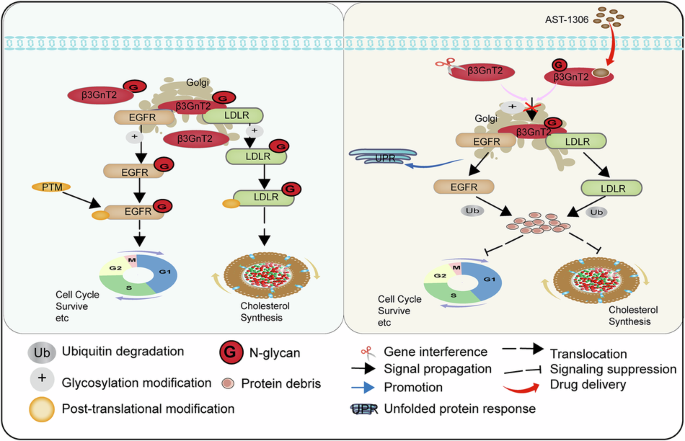
Glioblastoma (GBM) is the most aggressive primary brain tumor, characterized by a poor prognosis and limited therapeutic options. In this study, we identify β3GnT2 (β-1,3-N-acetylglucosaminyltransferase 2) as a critical driver of GBM progression and a potential therapeutic target. β3GnT2 is significantly upregulated in GBM tissues, and its high expression correlates with unfavorable patient survival. Functional assays demonstrate that β3GnT2 promotes GBM cell proliferation, migration, invasion, and tumorigenicity. Mechanistically, β3GnT2 enhances the N-glycosylation and protein stability of both EGFR and LDLR, leading to activation of the PI3K/AKT signaling and cholesterol biosynthesis pathways. Conversely, β3GnT2 knockdown induces endoplasmic reticulum stress and mitochondrial apoptosis. Through molecular docking and enzymatic screening of over 9000 compounds, we identified AST-1306 as a potent β3GnT2 inhibitor. AST-1306 suppresses β3GnT2 activity with an IC50 of approximately 1.4 μM, reduces GBM cell viability, inhibits subcutaneous xenograft growth, and induces fragmentation of patient-derived GBM organoids, without causing major organ toxicity. These findings reveal that β3GnT2 promotes GBM malignancy by stabilizing EGFR and LDLR via N-glycosylation. Therefore, this study identifies β3GnT2 as a promising therapeutic target and positions AST-1306 as a potential treatment for GBM.
Trending
- Data Science: unpicking data diversity and inclusive research design – Cancer Research UK
- Dover woman challenges ‘throw-away’ culture in cancer care
- NHS to roll out at-home HPV cervical screenings in Wolverhampton
- CpG hypermethylation and WNT/AP-1 cooperativity define the epigenetic landscape and a clinical subgroup of high-risk pediatric adrenocortical carcinoma
- Campaigner praises Coronation Street male breast cancer storyline
- Brain tumour patients call for more treatment options
- Interleukin-1 receptor-associated kinase 1 controls chemoresistance and immuno-killing in non-small cell lung cancer
- Indigenous Leader Raoni Receives Palliative Care in Brazil After Cancer Diagnosis


Tuesday, September 15
β3GnT2-mediated N-glycosylation of EGFR and LDLR drives glioblastoma progression and can be targeted by AST-1306
 By NewsCancer