


MDM2 is best known as a key negative regulator of the tumor suppressor p53 [1], but several additional roles of MDM2 have since emerged. In the current study from the Dobbelstein laboratory, Weber and colleagues expand this spectrum by identifying RNA polymerase III (Pol III) as a new target of MDM2 [2].
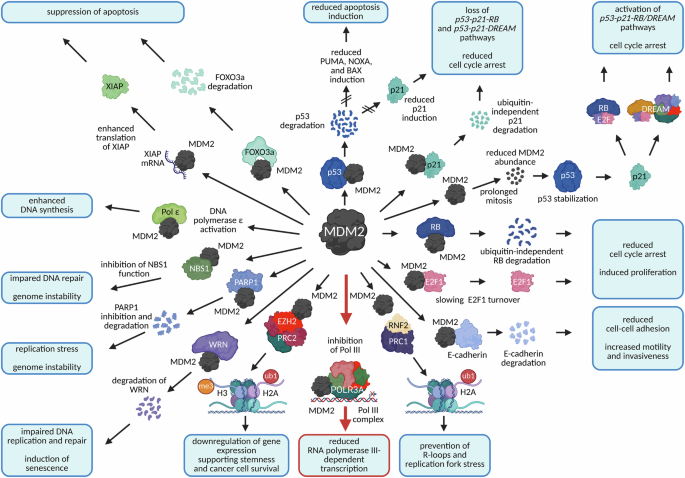
At the core of the canonical p53-MDM2 autoregulatory feedback loop, p53 induces MDM2 expression, whereas MDM2 acts as an E3 ubiquitin ligase that inhibits p53 and promotes its degradation [1]. Consequently, increased MDM2 activity attenuates p53-dependent cell cycle arrest and apoptosis (Fig. 1). Differences in p53 abundance and response element affinity can influence target gene selection, with comparatively lower levels of active p53 being sufficient to induce the cell cycle regulator p21/CDKN1A, whereas the activation of apoptosis-inducing genes such as PUMA, NOXA, and BAX generally requires stronger p53 activity. Thus, p53 contributes to cell cycle arrest or apoptosis, respectively [1, 3, 4].
Fig. 1: The MDM2 universe.
The functional repertoire of MDM2 comprises both p53-dependent and p53-independent mechanisms that regulate cell cycle progression, apoptosis, DNA replication and repair, genome stability, chromatin, cell adhesion, and innate immunity. Some of these activities depend on the E3 ubiquitin ligase function of MDM2 and promote ubiquitination and degradation of specific target proteins, whereas others are mediated through protein or RNA interactions independently of ubiquitination. Notably, several MDM2-controlled processes show context-dependent and sometimes opposing outcomes, particularly in the regulation of cell fate and genome maintenance. The newly identified interaction of MDM2 with RNA polymerase III described by Weber et al. adds repression of Pol III-dependent transcription and innate immune signaling to this expanding network of MDM2 functions. Created in BioRender; Engeland, K. (2026) https://BioRender.com/vp2amas.
The essential nature of this regulatory circuit is illustrated by Mdm2-null mice, which die during early embryogenesis through unrestrained p53-dependent apoptosis, whereas concomitant loss of p53 rescues this lethality [5]. Conversely, MDM2 overexpression or gene amplification lowers p53 activity and p21/CDKN1A induction, thereby interrupting the p53-p21-RB and p53-p21-DREAM pathways and compromising cell-cycle arrest [4, 6].
Several p53-independent activities of MDM2 reinforce its ability to promote cell cycle progression [7, 8]. MDM2 promotes proteasomal degradation of p21/CDKN1A and RB, thereby weakening CDK inhibition and RB/E2F-mediated transcriptional repression (Fig. 1). In parallel, MDM2 binds and stabilizes E2F1 by slowing its turnover, thereby enhancing proliferative E2F1 activity [4, 7, 8]. MDM2 can, however, also influence cell cycle control through another distinct mechanism. During prolonged mitosis, attenuated protein synthesis combined with continued rapid MDM2 turnover progressively lowers MDM2 abundance below the threshold required to restrain p53. The resulting post-mitotic accumulation of p53 and p21 activates RB/DREAM-dependent arrest in the subsequent G1 phase, limiting propagation of cells exposed to prolonged mitosis and exhibiting potential chromosomal instability [4, 6, 9].
A similar bias toward cell survival is evident in several p53-independent effects of MDM2 on apoptotic signaling. Following irradiation, MDM2 binds XIAP mRNA and enhances its translation, increasing XIAP protein levels and suppressing apoptosis [8]. MDM2 also promotes degradation of the transcription factor FOXO3a, thereby attenuating FOXO3a-dependent pro-apoptotic signaling [8]. Beyond survival and proliferation, MDM2 can promote tumor cell metastasis by binding and ubiquitinating E-cadherin, leading to its proteasomal degradation, loss of cell-cell adhesion, and increased tumor cell motility and invasiveness [8].
Particularly diverse, and partly opposing, effects of MDM2 emerge in DNA replication, repair, and genome stability (Fig. 1). MDM2 binds the catalytic subunit of DNA polymerase ε and strongly stimulates its polymerase activity in vitro, suggesting a potential role in activating DNA synthesis [7]. In contrast, MDM2 binding to NBS1 inhibits MRN-dependent DNA double-strand-break repair, providing a direct route by which MDM2 can compromise genome maintenance [7, 8]. MDM2 also binds and ubiquitinates PARP1, reducing its abundance and activity, suppressing replication fork reversal, and accelerating RECQ1- and PRIMPOL-dependent fork progression; thus, MDM2-mediated acceleration of DNA synthesis may come at the cost of increased replication stress and genome instability [10]. Similarly, MDM2 ubiquitinates the WRN helicase and promotes its proteasomal degradation, impairing functions in DNA replication and repair and inducing p53-independent senescence [11]. Notably, WRN and other replication- and repair-associated factors, including Fanconi proteins, are also transcriptionally repressed through the p53-p21-RB/DREAM regulatory network [4, 6]. Therefore, these factors are expected to be upregulated in response to MDM2 activity. Thus, MDM2 can exert opposing control over WRN abundance. Direct MDM2-mediated ubiquitination decreases WRN protein, whereas MDM2-dependent suppression of p53 can relieve transcriptional repression of WRN through the p53-p21-RB/DREAM pathways.
Other p53-independent functions of MDM2 can support replication-associated genome stability. MDM2 associates with EZH2, the catalytic subunit of the Polycomb repressor complex 2 (PRC2), and promotes accumulation of the histone modifications H3K27me3 and H2AK119ub1, thereby repressing lineage-specific genes and maintaining stem-like properties [12]. MDM2 also cooperates functionally with the PRC1 ubiquitin ligase RNF2 to support H2AK119 ubiquitination and limit the accumulation of RNA:DNA hybrids (R-loops). Accordingly, depletion of MDM2 or RNF2 increases R-loops, slows replication forks, and induces replication stress independently of p53 [13]. These findings illustrate that MDM2 can either impair genome maintenance, for example through NBS1, WRN, and PARP1, or support efficient replication by limiting transcription-associated obstacles such as R-loops (Fig. 1).
The Dobbelstein group now describes an additional p53-independent mechanism of MDM2 function [2]. MDM2 associates through its amino-terminal region with the catalytic RNA polymerase III subunit POLR3A, reduces Pol III occupancy at target genes, and suppresses the synthesis of tRNAs and 5S rRNA. Importantly, this interaction also connects MDM2 to innate immunity; inhibition of Pol III limits the production of immunostimulatory RNA from cytosolic DNA and thereby attenuates RIG-I-TBK1-IRF3 signaling. Thus, although MDM2-mediated Pol III repression may constrain biosynthetic activity, the same mechanism promotes survival after genotoxic stress by suppressing interferon responses and may thereby facilitate immune evasion and resistance to DNA-damaging therapies.
Collectively, these findings establish MDM2 as a context-dependent regulator with overlapping and sometimes opposing functions. MDM2 promotes proliferation and survival by suppressing p53-dependent cell cycle arrest and apoptosis, regulating p21, RB, E2F1, XIAP, and FOXO3a, and attenuating innate immune signaling; yet MDM2-dependent WRN degradation can induce senescence, while progressive MDM2 depletion during prolonged mitosis permits p53-dependent post-mitotic arrest. The effects that MDM2 exerts on genome maintenance are similarly bidirectional. Its effects on genome maintenance are similarly bidirectional. MDM2 can support replication fork progression and suppress R-loops while also compromising DNA repair and fork protection through regulation of NBS1, PARP1, and WRN. Even Pol III repression illustrates this duality, potentially limiting cellular biosynthesis while simultaneously increasing survival by suppressing DNA-triggered innate immunity. Which outcome prevails likely depends on cell type, MDM2 abundance, its interaction partners, p53 status, protein modifications, and the nature of cellular stress. By identifying another p53-independent function of MDM2, the study by Weber and colleagues adds a further dimension to this regulatory network and expands the MDM2 universe.
