


Commentary on Zeng et al., Human haematopoietic stem cells remember inflammatory stress. Nature, 2026
Three long-standing observations- the persistence of haematological perturbations after severe infection, the acceleration of biological ageing by chronic inflammatory disorders, and the preferential expansion of clonal haematopoiesis (CH) in older or inflamed individuals- have long suggested that the haematopoietic stem cell (HSC) compartment must retain a cellular record of past insults. The demonstration that human HSCs retain inflammatory memory may represent a conceptual shift comparable to the discovery of clonal haematopoiesis itself, providing a mechanistic framework linking infection history, ageing, and cancer evolution. In mice, the molecular nature of this record has been gradually delineated over the past decade [1, 2]. In humans, however, the evidence has been almost entirely indirect. The recent study by Zeng and colleagues closes much of this gap by combining xenograft inflammation–recovery models with single-cell multiomic profiling, and by triangulating the resulting xenograft-derived signatures with patient cohorts representing severe COVID-19, sickle cell disease (SCD), physiological ageing, and CH [3].
The authors transplanted cord-blood CD34⁺CD38⁻ cells into immunodeficient mice and exposed them to repeated TNF or LPS challenges followed by a 10-week recovery period. Single-cell ATAC+ RNA profiling of 27,492 HSPCs after recovery revealed that what had been regarded as a single long-term HSC pool comprises two transcriptionally and epigenetically distinct subsets, designated HSC-I (baseline) and HSC-iM (inflammatory memory). HSC-iM was enriched for quiescence, TNF/NF-κB and TGFβ signalling, and exhibited chromatin remodelling at AP-1 and NF-κB binding sites that persisted weeks after the stimulus was cleared. Functionally, HSC-iM exhibited deeper quiescence and restrained haematopoietic output, contributing fewer differentiated lymphoid/myeloid progeny than HSC-I (baseline). Strikingly, the chromatin accessibility landscape of HSC-iM, particularly AP-1 motif usage, was shared with memory CD8⁺ T cells, suggesting that long-lived blood cells across lineages may employ convergent logics to encode immunological experience [3].
Inflammatory persistence in trained states had already been documented in murine HSCs and in epithelial stem cells of skin and gut, with effects on regenerative output and tumour susceptibility [2, 4]; the contribution of Zeng et al. is the first systematic cross-validation of this concept across multiple human contexts. The HSC-iM transcriptional signature was significantly enriched in peripheral blood HSCs sampled 2–4 months after recovery from severe COVID-19, in bone marrow HSCs from middle-aged and older donors, and in HSCs from paediatric patients with SCD. In each of these contexts, when benchmarked by GSEA against more than 8000 reference gene sets, the HSC-iM program ranked among the most strongly enriched in affected HSCs relative to healthy controls. Independently, bone marrow HSC-iM corresponded to the HSC2 subset previously identified by TARGET-seq⁺ in CH samples [5], indicating that the same molecular state is reached through experimental and physiological routes.
Rather than acting as a consequence of clonal expansion, inflammatory memory may constitute the selective landscape upon which somatic evolution operates. Three findings deserve particular attention. First, both wild-type and mutant HSCs from DNMT3A- or TET2-mutated individuals were enriched for HSC-iM after adjustment for age and other covariates, suggesting that the inflammatory marrow milieu, not the mutation itself, drives induction. Second, CH mutations preferentially dysregulated transcription within HSC-iM and attenuated its hallmark inflammation-induced quiescence, providing a cellular framework for the expansion of DNMT3A and TET2 mutant clones under inflammatory conditions [6]. Third, the inflammatory program was inherited by differentiated immune cells, and in a cohort of 428 Ontario Health Study participants, the HSC-iM signature in mature blood cells correlated with a higher modified Intermountain Risk Score for all-cause mortality [7], particularly in younger individuals.
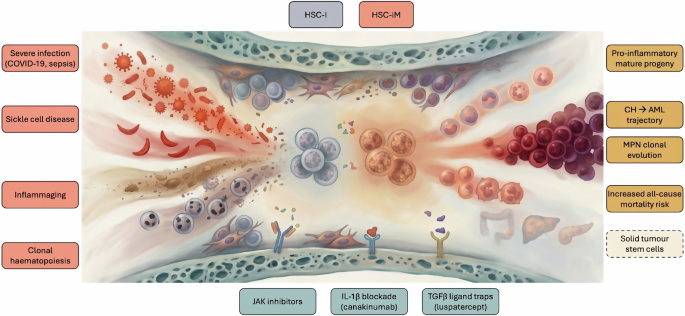
For oncology, the implications extend well beyond myeloid disease. Within haematology, HSC-iM was enriched in HSCs from patients with acute myeloid leukaemia (AML), placing it on the trajectory from CH to overt malignancy and consistent with the detectability of pre-leukaemic HSCs years before AML diagnosis [8]. The framework also converges with phylogenetic reconstructions in myeloproliferative neoplasms (MPN), where JAK2V617F and related drivers arise decades before diagnosis in marrow environments progressively shaped by chronic inflammation [9]. Beyond myeloid disease, the convergence with inflammatory memory programmes in epithelial stem cells [4] raises the possibility that an analogous axis operates in tissue stem cells of the colon, liver, and pancreas, where chronic inflammation is an established driver of transformation [10]. In this view, HSC-iM may be a haematological prototype of a broader principle linking inflammation, stem-cell memory, and clonal selection across cancer types (Fig. 1).
Fig. 1: HSC-iM as a convergent inflammatory memory state linking diverse pathophysiological contexts to haematological malignancy and mortality.
Conceptual synthesis of the central findings of Zeng et al. [3] integrated with their broader oncological implications, combining a painterly cross-section of human bone marrow with clean schematic captions. Left (coral boxes), four distinct inflammatory and physiological contexts converge into the marrow space: severe infection (COVID-19, sepsis), depicted as a swarm of viral and bacterial silhouettes; sickle cell disease (SCD), depicted as a stream of sickled erythrocytes; inflammaging (chronic age-related inflammation), depicted as a sepia-toned sediment populated with senescent cells and cellular debris; and clonal haematopoiesis (CH) driven by DNMT3A or TET2 mutations, depicted as haematopoietic stem cells (HSCs) carrying small irregular nuclear marks. Cytokine motifs (TNF, IL-1, TGFβ) drift through the convergence zone. Centre (top labels), two transcriptionally and epigenetically distinct HSC subsets are depicted: HSC-I (baseline) in cool blue tones with smooth chromatin, and HSC-iM (inflammatory memory) in warm coral tones with luminous nuclear chromatin representing persistent remodelling at AP-1, NF-κB, and TGFβ binding sites and selective transcriptional rewiring by CH mutations. Right (amber boxes), divergent downstream consequences carry the warm signature of HSC-iM into pro-inflammatory mature lymphomyeloid progeny, into a densely packed cluster of immature blasts representing the cellular trajectory connecting CH to acute myeloid leukaemia (CH → AML trajectory), into a morphologically distinct cluster of myeloproliferative neoplasm (MPN) progenitors with characteristic megakaryocyte-like cells, and into increased all-cause mortality risk as captured by the modified Intermountain Risk Score (IRS). A speculative extension (dashed box) proposes that an analogous axis may operate in tissue stem cells of the colon, liver, and pancreas, where chronic inflammation is an established driver of malignant transformation. Bottom (teal boxes), three therapeutic intervention points already deployed or in active clinical development in oncology act on nodes of the central HSC-iM transcriptional program: JAK inhibitors, IL-1β blockade with canakinumab, and TGFβ superfamily ligand traps including luspatercept.
Translationally, the model is equally concrete. For SCD, a major public health burden in Latin America and sub-Saharan Africa, the enrichment of HSC-iM in paediatric HSCs supports a view of premature haematopoietic ageing mechanistically distinct from chronological ageing and may help explain the heterogeneous engraftment seen after gene therapy [11]. For CH, HSC-iM enrichment may serve as a prognostic variable beyond variant allele frequency, complementing risk stratification based on mutation identity and clone size.
Several caveats deserve attention. The xenograft setting, while necessary to isolate defined stimuli, cannot recapitulate the cell-extrinsic complexity of the human marrow niche, including inflammatory feedback loops between mature progeny and HSCs. The mortality association based on the Intermountain Risk Score (IRS) is correlative and derived from a single, geographically constrained cohort; replication in independent cohorts, including from low- and middle-income settings, would be valuable. The age-dependence of the IRS–HSC-iM correlation, strong in younger individuals but attenuated in older ones, remains mechanistically unexplained. Finally, HSC-iM is currently defined solely by molecular signatures; clinically useful prospective markers must be identified before the concept can be translated into routine practice.
Conceptually, the work reframes the human HSC compartment as functionally heterogeneous along an inflammatory memory axis and offers one of the most explicit unifying frameworks to date linking infection history, inflammaging [12], clonal evolution, and mortality risk. From an evolutionary perspective, inflammatory memory may reflect an adaptive mechanism that enhances preparedness for recurrent immune challenges early in life, while inadvertently promoting stem-cell dysfunction and clonal selection during ageing. Therapeutically, it strengthens the rationale for a growing line of oncology practice that targets the inflammatory milieu rather than the malignant cell alone. JAK inhibitors are MPN mainstays and dampen much of the cytokine signalling enriched in HSC-iM; IL-1β blockade with canakinumab reduced incident lung cancer in an exploratory analysis of the CANTOS trial [13]; and TGFβ superfamily ligand traps such as luspatercept are already established in lower-risk MDS [14]. The HSC-iM framework offers a unifying logic for these strategies and raises the prospect of pre-emptive interventions in individuals with high HSC-iM scores well before overt malignancy, extending current CH surveillance paradigms. Whether such strategies can be deployed without compromising HSC self-renewal remains an open question. For now, the most important contribution of this work is conceptual: human HSCs do remember, and they do so in ways with measurable consequences across the cancer continuum and the lifespan.
