


Eng C, Yoshino T, Ruíz-García E, Mostafa N, Cann CG, O’Brian B, et al. Colorectal cancer. Lancet (Lond, Engl). 2024;404:294–310.
Google Scholar
Gmeiner WH. Recent advances in therapeutic strategies to improve colorectal cancer treatment. Cancers. 2024;16:1029.
Iveson T, Saunders MP, Kelly C, Kerr RS, Cassidy J, Hollander NH, et al. Three versus 6 months of adjuvant oxaliplatin-fluoropyrimidine chemotherapy for colorectal cancer: final results of SCOT-an international, randomized, phase III, noninferiority trial. J Clin Oncol : Off J Am Soc Clin Oncol. 2026;44:534–9.
Google Scholar
Comella P, Casaretti R, Sandomenico C, Avallone A, Franco L. Role of oxaliplatin in the treatment of colorectal cancer. Ther Clin Risk Manag. 2009;5:229–38.
Google Scholar
Li Y, Gan Y, Liu J, Li J, Zhou Z, Tian R, et al. Downregulation of MEIS1 mediated by ELFN1-AS1/EZH2/DNMT3a axis promotes tumorigenesis and oxaliplatin resistance in colorectal cancer. Signal Transduct Target Ther. 2022;7:87.
Google Scholar
Hu F, Song D, Yan Y, Huang C, Shen C, Lan J, et al. IL-6 regulates autophagy and chemotherapy resistance by promoting BECN1 phosphorylation. Nat Commun. 2021;12:3651.
Google Scholar
Niu X, You Q, Hou K, Tian Y, Wei P, Zhu Y, et al. Autophagy in cancer development, immune evasion, and drug resistance. Drug resistance updates: reviews and commentaries in antimicrobial and anticancer chemotherapy 2025;78:101170.
Zhao P, Yin S, Qiu Y, Sun C, Yu H. Ferroptosis and pyroptosis are connected through autophagy: a new perspective of overcoming drug resistance. Mol cancer. 2025;24:23.
Google Scholar
Liu W, Zhang Z, Zhang Y, Chen X, Guo S, Lei Y, et al. HMGB1-mediated autophagy modulates sensitivity of colorectal cancer cells to oxaliplatin via MEK/ERK signaling pathway. Cancer Biol Ther. 2015;16:511–7.
Google Scholar
Li W, Zhou C, Yu L, Hou Z, Liu H, Kong L, et al. Tumor-derived lactate promotes resistance to bevacizumab treatment by facilitating autophagy enhancer protein RUBCNL expression through histone H3 lysine 18 lactylation (H3K18la) in colorectal cancer. Autophagy. 2024;20:114–30.
Google Scholar
Gao Z, Li C, Sun H, Bian Y, Cui Z, Wang N, et al. N(6)-methyladenosine-modified USP13 induces pro-survival autophagy and imatinib resistance via regulating the stabilization of autophagy-related protein 5 in gastrointestinal stromal tumors. Cell Death Differ. 2023;30:544–59.
Google Scholar
Abedin MJ, Wang D, McDonnell MA, Lehmann U, Kelekar A. Autophagy delays apoptotic death in breast cancer cells following DNA damage. Cell Death Differ. 2007;14:500–10.
Google Scholar
Chang H, Zou Z. Targeting autophagy to overcome drug resistance: further developments. J Hematol Oncol. 2020;13:159.
Google Scholar
Ge J, Chen Z, Huang J, Chen J, Yuan W, Deng Z, et al. Upregulation of autophagy-related gene-5 (ATG-5) is associated with chemoresistance in human gastric cancer. PloS one. 2014;9:e110293.
Google Scholar
Wang HL, Li JN, Kan WJ, Xu GY, Luo GH, Song N, et al. Chloroquine enhances the efficacy of chemotherapy drugs against acute myeloid leukemia by inactivating the autophagy pathway. Acta Pharmacol Sin. 2023;44:2296–306.
Google Scholar
Shin D, Kim EH, Lee J, Roh JL. RITA plus 3-MA overcomes chemoresistance of head and neck cancer cells via dual inhibition of autophagy and antioxidant systems. Redox Biol. 2017;13:219–27.
Google Scholar
Wang Y, Chen YY, Gao GB, Zheng YH, Yu NN, Ouyang L, et al. Polyphyllin D punctures hypertrophic lysosomes to reverse drug resistance of hepatocellular carcinoma by targeting acid sphingomyelinase. Mol Ther J Am Soc Gene Ther. 2023;31:2169–87.
Google Scholar
Galluzzi L, Vitale I, Aaronson SA, Abrams JM, Adam D, Agostinis P, et al. Molecular mechanisms of cell death: recommendations of the Nomenclature Committee on Cell Death 2018. Cell Death Differ. 2018;25:486–541.
Google Scholar
Wang F, Salvati A, Boya P. Lysosome-dependent cell death and deregulated autophagy induced by amine-modified polystyrene nanoparticles. Open Biol. 2018;8:170271.
Papadopoulos C, Kravic B, Meyer H. Repair or lysophagy: dealing with damaged lysosomes. J Mol Biol. 2020;432:231–9.
Google Scholar
Halaby R. Influence of lysosomal sequestration on multidrug resistance in cancer cells. Cancer Drug Resist (Alhambra, Calif). 2019;2:31–42.
Park NY, Jo DS, Yang JY, Bae JE, Kim JB, Kim YH, et al. Activation of lysophagy by a TBK1-SCF(FBXO3)-TMEM192-TAX1BP1 axis in response to lysosomal damage. Nat Commun. 2025;16:1109.
Google Scholar
Hopfner KP, Hornung V. Molecular mechanisms and cellular functions of cGAS-STING signalling. Nat Rev Mol cell Biol. 2020;21:501–21.
Google Scholar
Khan F, Petrosyan E, Liu Y, Bahrami A, Taefi E, Geula C, et al. Microglial TBK1 signaling promotes breast cancer brain metastasis. Cancer Res. 2026;86:12–21.
Google Scholar
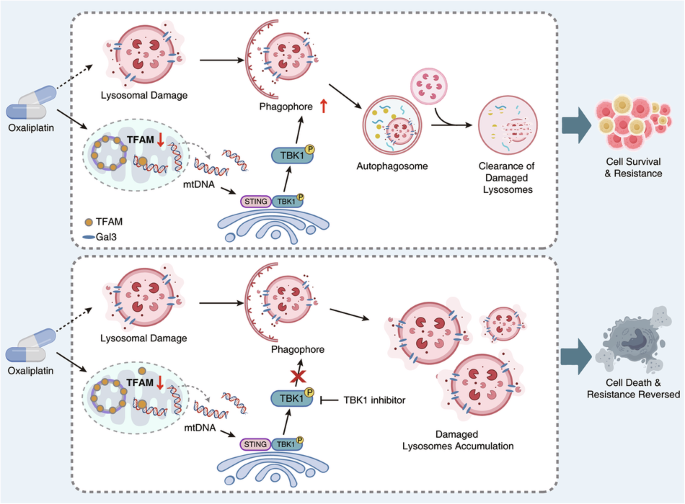
Li Y, Yang Q, Chen H, Yang X, Han J, Yao X, et al. TFAM downregulation promotes autophagy and ESCC survival through mtDNA stress-mediated STING pathway. Oncogene. 2022;41:3735–46.
Google Scholar
Zhao J, Cui M, Yao X, Jiang Z, Qi L, Chen J, et al. Targeting TFAM downregulation mediated mtDNA-NLRP3 pathway suppresses TAM infiltration and HCC progression. Oncogene. 2025;44:2956–69.
Google Scholar
Wang Y, Huang ZJ, Yu NN, Liang JZ, Zeng YH, Zhao Q, et al. MLKL/retromer axis controls PD-L1 recycling to compromise antitumor immunity during VCP inhibition-induced necroptosis. Proc Natl Acad Sci USA. 2025;122:e2518675122.
Google Scholar
Ye T, Wu C, Na J, Liu X, Huang Y. Multi-pathway study for oxaliplatin resistance reduction. Curr Issues Mol Biol. 2025;47:172.
Yamashita G, Takano N, Kazama H, Tsukahara K, Miyazawa K. p53 regulates lysosomal membrane permeabilization as well as cytoprotective autophagy in response to DNA-damaging drugs. Cell Death Discov. 2022;8:502.
Google Scholar
Yang M, Sun L, Feng X, Xu W. Mitochondrial transcription factor a as a guardian of mitochondrial integrity and emerging therapeutic target in human diseases: a review. Int J Biol Macromol. 2025;319:145706.
Google Scholar
Nicholls TJ, Gustafsson CM. Separating and segregating the human mitochondrial genome. Trends Biochem Sci. 2018;43:869–81.
Google Scholar
Quan S, Fu X, Cai H, Ren Z, Xu Y, Jia L. The neuroimmune nexus: unraveling the role of the mtDNA-cGAS-STING signal pathway in Alzheimer’s disease. Mol Neurodegener. 2025;20:25.
Google Scholar
Sprenger HG, MacVicar T, Bahat A, Fiedler KU, Hermans S, Ehrentraut D, et al. Cellular pyrimidine imbalance triggers mitochondrial DNA-dependent innate immunity. Nat Metab. 2021;3:636–50.
Google Scholar
Culy CR, Clemett D, Wiseman LR. Oxaliplatin. A review of its pharmacological properties and clinical efficacy in metastatic colorectal cancer and its potential in other malignancies. Drugs. 2000;60:895–924.
Google Scholar
Hu J, Tang Z, Beeraka NM, Xu R, Liu J, Zhao X, et al. Multi-pathway therapeutics in colorectal cancer: targeting EMT, CSCs, and non-apoptotic cell death for drug resistance reversal. J drug Target. 2026;34:939–60.
Google Scholar
Yin J, Shao Y, Huang F, Hong Y, Wei W, Jiang C, et al. Peroxisomal membrane protein PMP70 confers drug resistance in colorectal cancer. Cell Death Dis. 2025;16:293.
Google Scholar
Wang Y, Xu C, Yang X, Liu X, Guo Z, Lin X, et al. Glycerol-3-phosphate acyltransferase 3-mediated lipid droplets accumulation confers chemoresistance of colorectal cancer. MedComm. 2024;5:e486.
Google Scholar
Scott O, Saran E, Freeman SA. The spectrum of lysosomal stress and damage responses: from mechanosensing to inflammation. EMBO Rep. 2025;26:1425–39.
Google Scholar
Tian Z, Wu Y, Yi B, Li L, Liu Y, Zhang H, et al. ESCRT III-mediated lysosomal repair improve renal tubular cell injury in cisplatin-induced AKI. Autophagy. 2025;21:1927–44.
Google Scholar
Li N, Zheng Y, Chen W, Wang C, Liu X, He W, et al. Adaptor protein LAPF recruits phosphorylated p53 to lysosomes and triggers lysosomal destabilization in apoptosis. Cancer Res. 2007;67:11176–85.
Google Scholar
Vargas JNS, Hamasaki M, Kawabata T, Youle RJ, Yoshimori T. The mechanisms and roles of selective autophagy in mammals. Nat Rev Mol cell Biol. 2023;24:167–85.
Google Scholar
Meyer H, Kravic B. The endo-lysosomal damage response. Annu Rev Biochem. 2024;93:367–87.
Google Scholar
West AP, Khoury-Hanold W, Staron M, Tal MC, Pineda CM, Lang SM, et al. Mitochondrial DNA stress primes the antiviral innate immune response. Nature. 2015;520:553–7.
Google Scholar
Desdín-Micó G, Soto-Heredero G, Aranda JF, Oller J, Carrasco E, Gabandé-Rodríguez E, et al. T cells with dysfunctional mitochondria induce multimorbidity and premature senescence. Sci (N Y, NY). 2020;368:1371–6.
Google Scholar
Lu T, Zhang Z, Bi Z, Lan T, Zeng H, Liu Y, et al. TFAM deficiency in dendritic cells leads to mitochondrial dysfunction and enhanced antitumor immunity through cGAS-STING pathway. J Immunother Cancer. 2023;11:e005430.
Tian J, Zhang D, Kurbatov V, Wang Q, Wang Y, Fang D, et al. 5-Fluorouracil efficacy requires anti-tumor immunity triggered by cancer-cell-intrinsic STING. EMBO J. 2021;40:e106065.
Google Scholar
Hong C, Schubert M, Tijhuis AE, Requesens M, Roorda M, van den Brink A, et al. cGAS-STING drives the IL-6-dependent survival of chromosomally instable cancers. Nature. 2022;607:366–73.
Google Scholar
Zhou Z, Qi J, Lim CW, Kim JW, Kim B. Dual TBK1/IKKε inhibitor amlexanox mitigates palmitic acid-induced hepatotoxicity and lipoapoptosis in vitro. Toxicology. 2020;444:152579.
Google Scholar
Runde AP, Mack R, Breslin JP, Zhang J. The role of TBK1 in cancer pathogenesis and anticancer immunity. J Exp Clin cancer Res : CR. 2022;41:135.
Google Scholar
Labrie M, Brugge JS, Mills GB, Zervantonakis IK. Therapy resistance: opportunities created by adaptive responses to targeted therapies in cancer. Nat Rev Cancer. 2022;22:323–39.
Google Scholar
