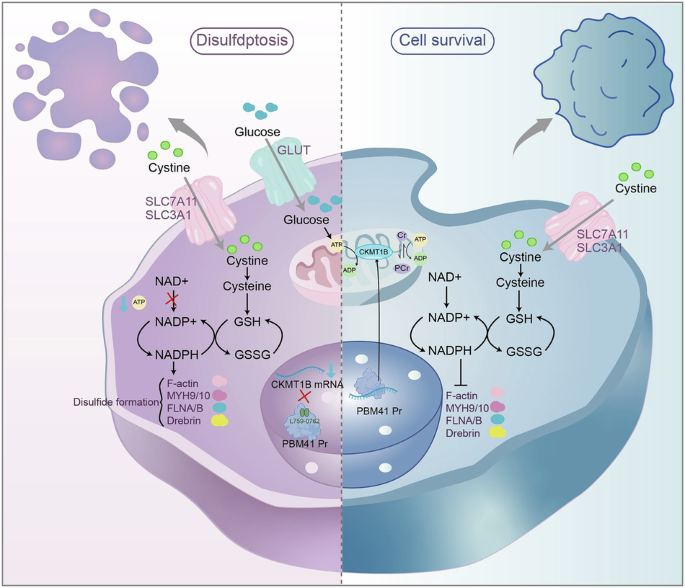
Clarifying the mechanisms by which metabolic stress induces cell death in tumor cells is essential for the development of effective therapies targeting tongue squamous cell carcinoma (TSCC). In this study, we demonstrate that the RNA-binding motif protein 41 (RBM41) stabilizes CKMT1B mRNA through its RRM1 domain, thereby conferring resistance to disulfidptosis under conditions of glucose deprivation in TSCC. We explored the expression and functional role of RBM41 using both in vitro and in vivo models, which included RBM41-knockout, RRM1-domain-knockout, and RBM41-overexpressing TSCC cell lines. Our findings reveal that RBM41-mediated stabilization of CKMT1B mRNA is crucial for protecting TSCC cells from disulfidptosis during metabolic stress. Based on this mechanism, we designed a structure-specific inhibitory small molecule, L759-0762, which disrupts the interaction between RBM41 and CKMT1B mRNA. L759-0762 selectively sensitizes TSCC cells to disulfidptosis under glucose deprivation by abolishing the protective function of RBM41. Collectively, our findings identify RBM41 as a viable therapeutic target and demonstrate that pharmacological disruption of its interaction with CKMT1B mRNA represents a promising strategy for inducing disulfidptosis in TSCC.
Trending
- UK doctors develop non-invasive test for womb cancer in women bleeding after menopause | Women’s health
- Should you get a PSA test for prostate cancer?
- Performance and safety of a multi-cancer early detection test: the PATHFINDER 2 study
- EPA Announces $93.4M Plan to Rid California Superfund Site of Dangerous Chemicals
- PANXEON Liquid Biopsy Demonstrates Potential for Detecting Early Pancreatic Cancer
- Tebentafusp Sustains Survival Benefit at 5 Years in Metastatic Uveal Melanoma
- Adipocyte methionine reduction promotes cancer cachexia
- Form follows function: decoding pancreatic cancer – Cancer Research UK


Tuesday, September 22
Targeting RBM41-mediated CKMT1B mRNA stability triggers disulfidptosis and suppresses tongue squamous cell carcinoma
 By NewsCancer