


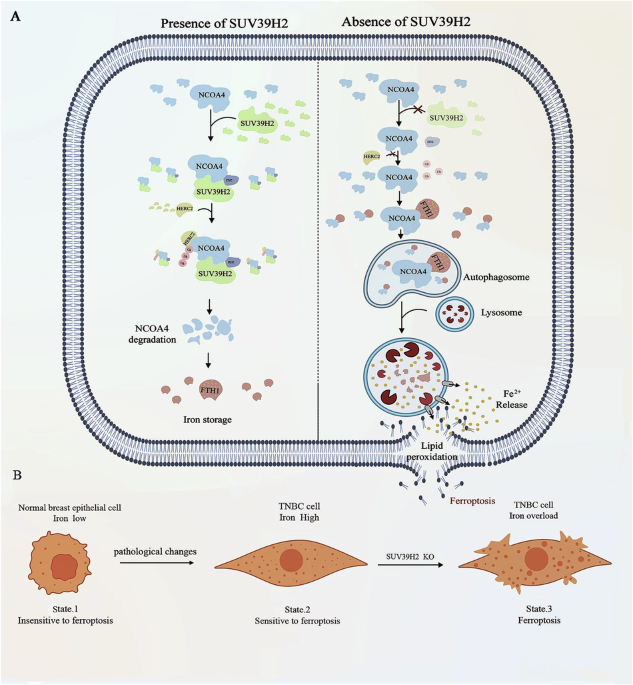
Triple-negative breast cancer (TNBC) exhibits iron homeostasis that supports tumor growth and proliferation, yet the regulatory mechanisms controlling iron flux remain poorly defined. Here, we identify a ferritinophagic cargo receptor NCOA4 as a novel substrate of the lysine methyltransferase SUV39H2, uncovering a previously unrecognized mechanism that regulates ferritinophagy and ferroptosis. SUV39H2 directly binds and mono-methylates NCOA4 at lysine 356, a modification that reduces NCOA4 stability. Mechanistically, K356 methylation enhances NCOA4 interaction with the E3 ligase HERC2, promoting its ubiquitination and proteasomal degradation. This degradation increases FTH1 stability, suppresses ferritinophagic flux, limits iron release, maintains the high-risk iron homeostasis and ferroptosis resistance, ultimately promoting tumor proliferation and chemoresistance. Conversely, genetic or pharmacologic inhibition of SUV39H2 (OTS186935) inhibit NCOA4 methylation, stabilizes NCOA4 protein, enhances ferritinophagy, and triggers ferroptosis. Furthermore, SUV39H2 inhibition sensitizes TNBC cells to chemotherapy in vitro and in vivo, indicating OTS186935 treatment is a feasible therapeutic strategy. Collectively, the SUV39H2-NCOA4-HERC2 axis as a critical regulatory pathway in iron metabolism and ferroptosis, and highlight inhibition of NCOA4 K356 methylation as a promising therapeutic target in TNBC.
The mechanistic scheme of SUV39H2 depletion to facilitate ferroptosis in TNBC. A SUV39H2 binds and methylates NCOA4, which enhanced the interaction between NCOA4 and the E3 ubiquitin ligase HERC2, leading to NCOA4 ubiquitination and proteasomal degradation. As a result, iron metabolism was reprogramed via enhancing ferritinophagy, leading to an increase in the level of iron, ultimately triggering ferroptosis. B Cell-state transitions induced by SUV39H2.
