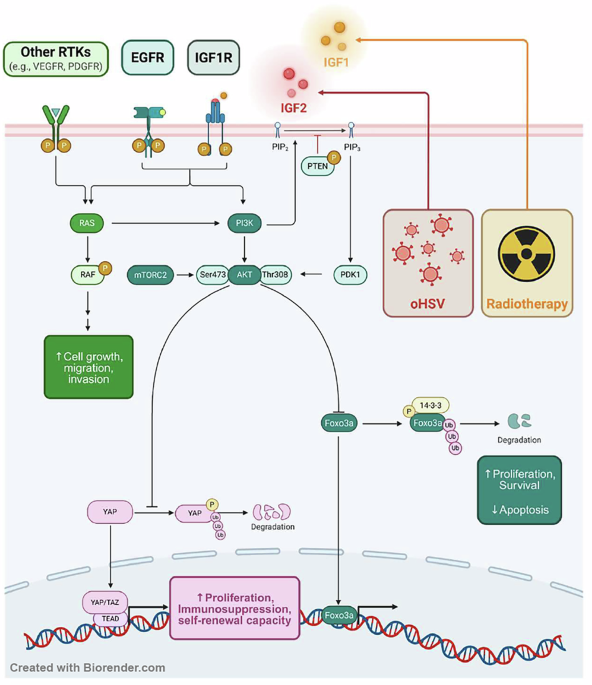
FDA-approved oncolytic herpes simplex virus-1 (oHSV) therapy has emerged as a promising viro-immunotherapy for solid tumors. However, tumor- and tumor microenvironment (TME)-associated adaptations following viral treatment, such as feedback immune suppression, neoangiogenesis, and enhanced tumor aggressiveness, often hinder complete tumor eradication. A deeper understanding of the molecular mechanisms underlying resistance to oHSV is crucial to enhancing its clinical impact. We recently discovered that oHSV induces Insulin-like growth factor 2 (IGF2) secretion, shaping an immunosuppressive TME. Similarly, radiotherapy (RTx) activates the IGF1/IGF1R and YAP1 signaling pathways, further promoting therapeutic resistance. In this study, we investigated how oHSV-induced Insulin-like growth factor 1 receptor (IGF1R) signaling drives feedback pro-survival and proliferative pathways in tumor cells and evaluated the therapeutic potential of combining IGF1R blockade with oHSV and RTx. We first demonstrated that oHSV activates IGF1R signaling in vitro and in vivo, promoting tumor proliferation. While IGF1R-targeted monotherapies have shown limited cytotoxicity, its combination with oHSV led to a modest but significant increase in cytotoxicity across tested breast cancer (BC) and primary glioblastoma (GBM) cells in vitro and in vivo xenograft models. Furthermore, we observed that co-treatment with oHSV and RTx robustly activated both IGF1R and YAP1 in resistant cells, revealing the IGF1R/YAP1 axis as a key mediator of resistance to dual oHSV and RTx therapy. Notably, the triple combination of oHSV, RTx, and IGF1R blockade yielded synergistic anti-tumor effects, abolished YAP1 expression and nuclear localization, and significantly enhanced survival in orthotopic BC and GBM models. Collectively, these findings identify the IGF1R/YAP1 axis as a critical driver of resistance to oHSV and RTx and provide a strong rationale for the clinical evaluation of this triple-combination strategy to enhance therapeutic efficacy in patients with BC and GBM.
Trending
- MCAT-mediated mitochondrial fatty acid metabolism regulates Lauren subtype divergence and suppresses gastric cancer progression through ROS/P53-dependent mitophagy and ferroptosis
- Drinking very hot drinks could triple risk of oesophageal cancer, study finds | Cancer
- Cancer care review at Coventry hospital finds ‘betrayal of trust’
- A single-cell lens into the co-evolution of genotypes and phenotypes in cancer
- Dad’s death inspired my cancer research, says scientist
- Metabolic predictors of response to immunotherapy in locally advanced or metastatic esophageal cancer: unveiling the obesity paradox
- Very hot drinks may damage the food pipe and increase cancer risk
- New UK study links hot drink consumption to one type of oesophageal cancer – Cancer Research UK


Wednesday, September 9
Overcoming IGF1R-mediated resistance to oncolytic HSV1 and radiotherapy via triple combination therapy
 By NewsCancer