


The workshop next assessed the current status and future potential for clinical trial development in four key rare tumour type exemplars with significant unmet need: Craniopharyngioma, CPC, VHR-MB and REST with a particular focus on ETMR.
Craniopharyngioma
Adamantinomatous craniopharyngioma (ACP) is a low incidence tumour (approximately 30 new UK cases in children and young people up to 25 years of age per year [4] with severe long-term morbidity and major endocrine and quality of life (QoL) consequences. ACP is frequently cystic in nature, and despite advances in hypothalamic sparing surgery and increased use of radiotherapy, around 25% of patients continue to have recurrence. Experience from the UK proton radiotherapy centres highlights there remains variation in surgical practice and timing of referral for radiotherapy across the UK [15,16,17,18]
Clinical trials—led by CONNECT and PNOC—have been developed, however, to date it has not been possible to open these trials in the UK, with a higher priority given to open other CONNECT and PNOC trials in the UK first.
The UK has been at the forefront of craniopharyngioma biology, with the development of genetically engineered mouse models, pre-clinical therapeutics and ‘omic studies of ACP trials [19,20,21,22]. Recent advances using BRAF/MEK inhibitors in papillary craniopharyngioma demonstrate clinical potential, including potential neoadjuvant and adjuvant opportunities for craniopharyngioma patients [23]. Novel agents, including MEK inhibitors, WNT pathway inhibitors, anti-inflammatory agents, and anti-VEGF targeted therapies, have emerging pre-clinical or early clinical signals [20, 23]. Imaging segmentation tools and cyst-focused strategies are also rapidly evolving [24].
Consensus emerged strongly that ACP represents the most immediately feasible opportunity for a UK‑led interventional trial in rare CNS tumours, with adequate patient numbers to support comprehensive initiatives. Key elements proposed included: (i) A UK initiated trial, focusing initially on progression pre- and post-radiotherapy and potential peri-radiotherapy windows, and (ii) Biologically-driven trial arms, specially focused on solid and/or cystic disease where appropriate, leveraging early phase access to novel agents or repurposing of existing agents. Radiology-driven endpoints (e.g., using automated segmentation and volumetric response in addition to the existing craniopharyngioma RAPNO criteria [24]) were considered important, alongside embedded biological sampling, especially of cystic fluid, to support mechanistic evaluation; experience in these is available in the UK [19] and wider networks [25]. Consideration of other relevant outcomes, including endocrine and patient reported outcomes, will be important within any trial pipeline, and early evidence of tumour efficacy was seen as critical. The group recognised the work to improve management of the consequences of craniopharyngioma through interventions such as anti-obesity drugs [e.g. Setmelanotide [26]].
There was universal agreement on the need to establish a national craniopharyngioma advisory multidisciplinary team (MDT), to support early clinical decision making [27] and support clinical trial recruitment.
Choroid plexus carcinoma (CPC)
CPC is extraordinarily rare (3–6 UK cases/year) [4] and challenging due to its association with high-risk biology, poor outcomes, germline cancer predisposition (Li-Fraumeni syndrome(LFS)), and high treatment morbidity. Previous international trials have been limited by poor recruitment and resulted in a failure to assess significance [28, 29], highlighting the need for novel trial designs. Insufficient patient numbers preclude a UK/European trial and therefore global collaboration is essential. However prohibitively high trial costs in Europe (estimated at >€2.7 M for this trial at 2026 costs—representing costs to open multiple countries to recruit a rare disease) has resulted in the inability to secure a European sponsor for the upcoming North American-led PNOC trial (PNOC033), which consequently stopped UK and European participation [30]. Robust preclinical evidence for candidate agents is lacking, in part due to limited tissue availability, and learning from clinical experience has been limited by a lack of comprehensive data collection.
The Workshop consensus was that a new trial in the UK or Europe is not currently feasible, as current data and insufficient patient numbers do not support an alternative treatment strategy that differs significantly from the proposed PNOC trial, unless run as a parallel academic trial. A separate European sponsored trial using the same treatment concept and pooling the data for analysis may offer the opportunity to overcome the regulatory differences and contribute UK patients.
Critical actions were nonetheless identified, and the group agreed that efforts should be focused on a UK CPC service evaluation, participation in international registries such as the International SIOP-CPT Registry (www.uke.de/cpt) and sharing of biological samples to develop key datasets to support future trials. The potential to engage more broadly with tumour agnostic immunotherapy concepts/trials (e.g. B7-H3 targeted CAR-T) should also be explored, and CPC should be considered in inclusion criteria alongside other rare tumour entities, as part of platform trials or in biologically appropriate early phase trials.
Very-high risk medulloblastoma (VHR-MB)
While medulloblastoma is the most common malignant brain tumour of childhood (approximately 60-65 new diagnoses per year in the UK) [4, 31], advances in its molecular subclassification have led to the recognition of smaller well-defined molecular groups with distinct clinical characteristics and outcomes [31, 32]. Specifically, Group3-MYC and SHH-MYCN carry the poorest prognoses (5-year progression-free survival <20%) and are essentially unresponsive to current multi-modal therapies. However, while new approaches are urgently required, these subgroups are rare (5–8 UK cases per year in total) and are underserved by current trials [4, 6]. Although the SIOP-HRMB clinical trial for high-risk medulloblastoma represents a major advance, the Group3-MYC and SHH-MYCN very-high-risk molecular subgroups are uncommon within the broader high-risk population and were not the primary focus of trial-specific therapeutic development [33].
The group reaffirmed the urgent need for new early‑phase capacity for MYC/MYCN‑driven medulloblastoma and related high‑risk subgroups including relapsed disease [34]. The workshop recognized that pre-clinical data are most advanced for the MYC/MYCN subgroups [35] (e.g. Aurora-A Kinase inhibition and checkpoint kinase (CHK1/2) inhibition [36, 37]), alongside the need to work across international partners, using innovative methodologies, to support meaningful conclusions and advance concepts based on the most efficient use of small patient numbers.
An emerging European ITCC phase 1/2 platform proposal was reviewed, which incorporates: A phase 1/2 component for all‑comers with relapsed embryonal brain tumours, mandated tissue and liquid biopsy to appraise circulating tumour DNA (ct-DNA), Bayesian dose‑finding, expansion cohorts, and potential combination strategies. A Phase 2 component which would, in the first instance, be based on highly-selected upfront MYC/MYCN‑amplified cohorts (infant and non‑infant), introducing targeted agents into established maintenance (non‑infant) or induction (infant) chemotherapy regimens [33, 38]. Importantly, the proposed trial design would also enable phase 2 expansion of patient-cohorts, not limited to VHR-MB, demonstrating early objective responses. As understanding of the role of liquid biopsy and clinical/survival correlates develops, future cohorts could include patients with evidence of residual disease post-therapy or early relapse, defined by CSF sampling and measurement of molecular biomarkers/ct-DNA [39].
This platform is intended to act as a pipeline for successive agents, including targets in other high-risk medulloblastoma groups such as TP53 mutated SHH-MB and Group3-MB. Key strengths include preclinical candidates nearing readiness, strong engagement with ITCC, and enthusiastic UK support. Challenges include drug availability, harmonisation with SIOPE late-phase trials, engaging the patient/parent community on acceptability of trial concepts which include proposed changes to upfront therapies, and operational complexity. Ongoing discussions within the relevant European collaborative groups (SIOPE, ITCC) are addressing harmonisation of future studies in relapsed disease.
Rare embryonal and sarcomatous tumours (REST) and embryonal tumours with multilayered rosettes (ETMR)
In the molecular era, re-classification of paediatric brain tumours has led to the recognition of several novel entities under the umbrella of REST with distinct genetic, histopathological, and clinical characteristics; ETMR is a prominent example [40]. Historically, REST were often treated uniformly, with treatment extrapolated from other embyonal tumours such as medulloblastoma, and so prospective data is required to establish optimal therapeutic approaches especially as many of these tumours have poor outcomes. A European REST registry (funded by The Brain Tumour Charity; currently in set-up) aims to collect data and biological samples. Challenges include absence of uniform management strategies to allow comparison of outcome data and ensuring optimal patient recruitment and collection of samples across Europe.
ETMR is among the rarest and most lethal paediatric brain tumours (approximately 20 cases per year in Europe; 1–3 per year in the UK; 25% 5-year overall survival) [5]. Three international initiatives—PNOC, CONNECT, and SIOPE—have developed different trial concepts with additional challenges with respect to alignment. The PNOC group has now been joined by the SIOPE REST Group, including UK leaders, that have led to improvements in trial design, including randomisation of therapies and more standardised treatment pathways.
The workshop was in consensus that a global trial is required, but opening PNOC trials in Europe is extremely difficult due to sponsorship, regulatory, and data transfer barriers. A parallel European academic trial, potentially led by CRCTU, could be feasible pending statistical review but issues remain regarding funding a single disease trial with multiple sites, each expected to recruit only one to two patients.
A REST platform trial which allows recruitment of several REST entities may be a future vision but requires development of robust trial questions and designs for each tumour type. The European REST registry together with other similar initiatives may offer the greatest immediate benefit in building prospective datasets to learn from, as well as providing real-life controls for future trials.
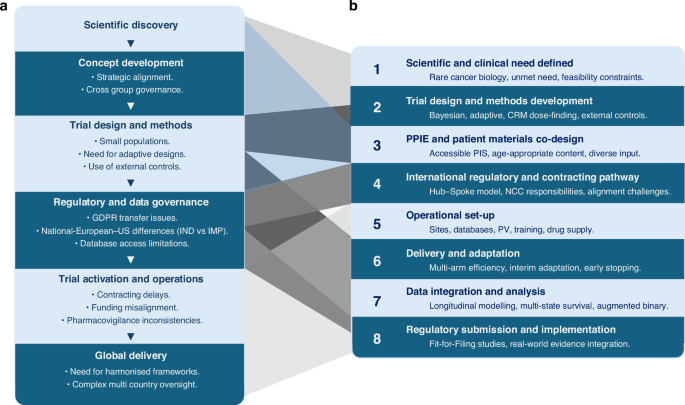
Key outputs from Session Four are summarised in Fig. 3.
Fig. 3
Rare childhood CNS tumour clinical trials in key exemplar tumour types: Status, opportunities and next steps
