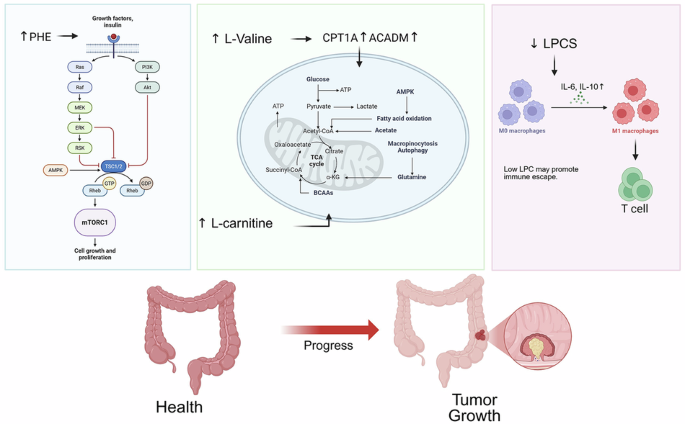
Colorectal cancer (CRC) is accompanied by complex metabolic alterations, but the diagnostic value and biological relevance of circulating metabolites require further clarification. In this study, untargeted serum metabolomics was performed in 90 individuals, including 45 patients with CRC and 45 healthy controls. Differential metabolites were screened and further prioritized using LASSO regression and random forest modelling, yielding an 11-metabolite panel. The random forest model showed AUCs of 0.989 in the training set and 0.906 in the testing set. To evaluate whether this panel provided information beyond common clinical variables, we compared a clinical-covariate model, the metabolite model, and a combined model in the testing set. The clinical-covariate model showed limited discrimination (AUC = 0.4089), whereas the metabolite and combined models showed higher AUCs of 0.9911 and 0.9956, respectively, with sensitivity of 1.0000 and specificity of 0.8000 at the training-set Youden cutoff. Pathway and cell-based analyses further linked phenylalanine and L-valine with mTOR-associated proliferative and migratory phenotypes, and L-carnitine with fatty-acid-oxidation-related metabolic activity in CRC cells. These findings suggest that serum metabolic profiling may provide candidate markers for CRC classification and biological stratification, although larger prospective and externally validated studies are needed before clinical translation.
Trending
- Serum metabolomics identifies phenylalanine and carnitine-associated vulnerabilities in colorectal cancer
- Total body irradiation versus chemotherapy before stem cell transplantation in children aged two to four with acute lymphoblastic leukemia—an EBMT pediatric diseases working party study
- Coming full circle | Nature Cancer
- HER2/Neu Conversion Rates Make Retesting Essential in GYN Cancers
- County-Level Medical Debt Tied to Later-Stage Cancer Diagnosis, Worse Survival
- Managing Diarrhea and Optimizing Dose Reductions With NALIRIFOX
- Discussing Advances in the Stereotactic Management of Brain Metastases
- CD44v5 promotes triple-negative breast cancer cisplatin resistance by enhancing IL-4/IL-4Rα/STAT3 pathway and stabilizing membranous SLC7A11


Saturday, August 22
Serum metabolomics identifies phenylalanine and carnitine-associated vulnerabilities in colorectal cancer
 By NewsCancer