


Myelofibrosis (MF) is caused by expansion of mutated hematopoietic stem and progenitor cells that results in bone marrow (BM) fibrosis, ineffective erythropoiesis, elevated inflammatory cytokines, and extramedullary hematopoiesis. Most MF patients experience constitutional symptoms that impair quality of life. Cytopenias, thromboembolism, and leukemic transformation cause morbidity and mortality [1]. Aberrant JAK/STAT pathway activation by mutations in JAK2, CALR, or MPL is central to MF pathogenesis, and JAK inhibitors (JAKis) are the standard of care. Ruxolitinib, the first JAKi approved for MF, effectively reduces spleen volume and symptoms in ~40% of patients, but many responses are only transient [2]. Myelosuppression frequently necessitates dose reduction, compromising symptom control. While JAK2V617F variant allele frequency (VAF) and fibrosis are reduced in some patients, JAKis do not eliminate the malignant clone, leaving patients at risk of progression. The limited efficacy of JAKis has stimulated research into targeting other pathways involved in MF pathogenesis [3]. Although activity was observed for several agents, to-date, JAKis have remained the only FDA-approved MF drugs. Allogeneic stem cell transplant (SCT), while potentially curative, is associated with high morbidity and mortality, and many patients are ineligible [4].
We have previously identified exportin-1 (XPO1)-mediated nuclear-cytoplasmic export (NCE) as a vulnerability in MF cells [5]. Selinexor, a first-in-class XPO1 inhibitor approved for multiple myeloma and diffuse large B-cell lymphoma, selectively killed CD34+ MF over normal cells and reduced disease burden in a JAK2V617F-driven MPN mouse model [5]. Here we report a phase II study to evaluate the efficacy and safety of selinexor in patients with myelofibrosis refractory or intolerant to JAKis (ESSENTIAL, NCT03627403). Eligibility included age ≥18 years, MF diagnosis, life expectancy ≥6 months, hemoglobin ≥70 g/L, platelets ≥30 × 109/L, and neutrophils ≥500 × 109/L. JAKi resistance was defined as palpable splenomegaly ≥10 cm below the left costal margin or splenomegaly ≥5 cm plus active MF symptoms after ≥3 months of JAKi therapy (Suppl. Information). JAKi intolerance was defined as grade ≥3 non-hematologic adverse events (AEs) or any grade ≥2 AEs requiring treatment discontinuation plus splenomegaly ≥5 cm. Selinexor starting dose was 80, 60 or 40 mg weekly, with modifications per protocol (Suppl. Fig. 1). The primary endpoint was the rate of ≥35% spleen volume reduction (SVR35) by MRI or CT at week-24. Secondary endpoints included the rate of ≥50% reduction in total symptoms score (TSS) by week-24, evaluated by 10-point MF-SAF, excluding fatigue (Suppl. Information), progression-free survival (PFS) and overall survival (OS). Exploratory endpoints included changes in circulating cytokines, BM fibrosis and JAK2, CALR and MPL VAF. Statistical design: Suppl. Information.
Between May 2019 and March 2023, 9 males and 8 females [median age 66 (range, 43–80) years] were enrolled. All patients provided informed consent according to the Declaration of Helsinki. Dynamic International Prognostic Scoring System score was low, intermediate-1, and intermediate-2 in 1, 7, and 9 patients. JAK2V617F, CALR mutations and MPLW515L were present in 11, 5 and 1 patients, respectively. Ten patients (59%) had at least one high-molecular-risk mutation. All patients had failed ruxolitinib, and one patient each had failed fedratinib or pacritinib [median duration of JAKi therapy: 13 (range, 0.5–96 months)] (Table 1; Suppl. Table 1). Fifteen patients were JAKi-resistant, and two were intolerant. Median spleen volume at baseline was 1300 cm3 (range, 410–5790 cm3) and median TSS 28 (range, 0–100). Selinexor starting dose was 80 mg (n = 6), 60 mg (n = 6) or 40 mg weekly (n = 5). One patient started on 40 mg weekly and increased to 60 mg after 12 weeks.
Table 1 Baseline characteristics (N = 17).
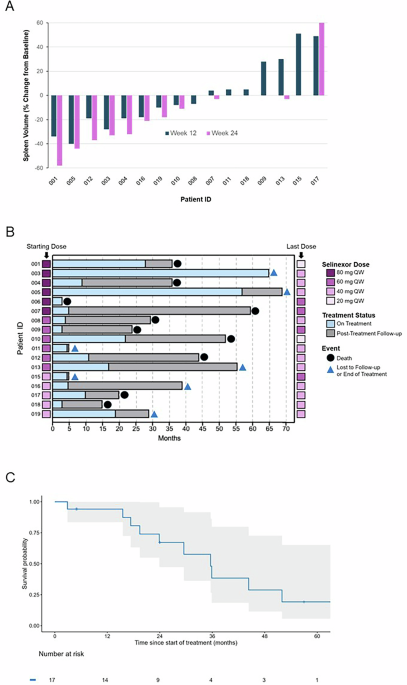
Of 16 patients evaluable for week-12 spleen response, one achieved SVR35, three SVR25, and eight SVR10. One patient died in week-12 from a liver abscess (deemed unrelated to the study drug). Of 11 patients evaluable for week-24 spleen response, three had SVR35, and five SVR25 (Fig. 1A Supplementary Fig. 2). In the intent-to-treat (ITT) population, week-24 SVR35 rate was 17%, and SVR35 rate at any time was 23%. There was no obvious correlation between genotype and response; however, the cohort is small. Three patients remained on treatment for up to 96 weeks, all with sustained spleen response (Suppl. Table 2). Three patients underwent SCT on days 806, 216, and 64 after stopping selinexor. Two of these died from transplant-related complications, and one was alive in remission on day 545 post SCT. In the ITT population, TSS50 rates at week-24 and at any time were 11% and 29%, respectively (Suppl. Table 3). Nine patients were TSS-unevaluable (two with missing baseline score, one with TSS of 0, and 6 who discontinued treatment). For response by 2013 IWG-ELN criteria, see Suppl. Information.
Fig. 1: Efficacy parameters for selinexor in myelofibrosis.
A Percent spleen volume change from baseline at week-12 and week-24. B Swimmer plot showing selinexor starting dose, treatment duration, and patient disposition at last follow-up. C Overall survival with 95% confidence intervals.
At last follow-up, all patients had discontinued selinexor (Fig. 1B). Causes were liver abscess (n = 1), leukemic transformation (n = 1), progressive splenomegaly (n = 1), alternative treatment (n = 6), consent withdrawal (n = 3), and toxicity (n = 5). Median PFS was 28 months (95% CI 4.4 months to undefined). As of this analysis, 9 patients have died, for an estimated median OS of 35.6 months (95% confidence interval, 23.9 months to undefined) (Fig. 1C). Causes of death were liver abscess (n = 1), acute myeloid leukemia (AML) (n = 1), SCT complications (n = 2) and MF without transformation to AML (n = 5). Grade 3 adverse events (AEs) and grade 1/2 AEs in >20% are summarized in Suppl. Table 4. The most common grade 1/2 TEAEs were nausea, fatigue, anorexia, diarrhea, and weight loss, consistent with selinexor’s known toxicity profile. Blood counts were stable, and no patient discontinued selinexor for hematologic toxicity (Supplementary Fig. 3A-D). Serum LDH declined steeply over the first month, then remained stable (Supplementary Fig. 3E). According to 2024 IWG-ELN criteria, among eight patients with non-transfusion-dependent anemia (TDA), three achieved major and one minor response, and one stable disease [6]. One patient with major non-TDA response developed polycythemia vera and required cytoreduction; teardrop cells disappeared, but MF persisted. Of three patients with TDA, one achieved a minor response. One patient required PRBC transfusions at treatment initiation but achieved transfusion independence ≥24 weeks (Supplementary Fig. 4). At baseline, 10 (58.8%) patients had MF-2 reticulin fibrosis, and 7 (41.2%) MF-3. At EOT, in five of 14 (35.7%) evaluable patients, MF had decreased by one grade, and in one by two. One patient progressed from MF-2 to MF-3 (Supplementary Table 5; Suppl. Fig. 5). Ten patients were evaluable for VAF at week-24. One patient had a 24.9% reduction of JAK2V617 and one a 21.0% reduction of mutated CALR (Suppl. Fig. 6A), with reductions <20% in four patients (Supplementary Fig. 6B).
Elevated inflammatory plasma cytokines are characteristic of MF [7]. To assess selinexor’s impact on cytokines, we measured 50 analytes at baseline, week-12 and 24, and/or EOT in 47 unique plasma samples from 16 patients and 20 healthy controls (Suppl. Information). Ordering based on change between baseline and controls identified three analyte clusters (Fig. 2). Most cluster 1 analytes were increased compared to controls and showed reductions at weeks 12 and 24. At EOT, several cytokines (e.g., IL-6) had increased back to baseline, likely reflecting loss of response. Hepcidin was elevated at baseline and decreased on selinexor, with a borderline significant correlation between hepcidin decrease and hemoglobin improvement, potentially explaining anemia responses (Suppl. Fig. 3 and Supplementary Fig. 7). Anemia responses with pacritinib and momelotinib have been linked to inhibition of ACVR1 [8, 9]. How selinexor regulates hepcidin remains to be determined. Cluster 2 analytes were reduced at baseline and tended to exceed the normal range on selinexor, most evident for eotaxin and G-CSF. Cluster 3 cytokines were strongly reduced at baseline, with some demonstrating increases at week-12 and levels similar to baseline at week-24. Some cytokine changes resemble those observed in patients treated with ruxolitinib, e.g., the reduction of IL-6 and TNF-α [2]. While it is possible that selinexor inhibits JAK/STAT signaling, the lack of significant myelosuppression argues against this, and mechanistic studies will be needed to clarify the situation. A limitation of the cytokine data is that only 37/60 (60%) of planned samples were available for analysis, reflecting disruption by the COVID19 pandemic. Ongoing prospective trials will comprehensively assess selinexor-induced cytokine changes.
Fig. 2
Median Cytokine Changes from Baseline (BL) to week-12, week-24 and end of treatment (EOT).
While direct comparisons are not possible, selinexor’s efficacy seems to be within the range of JAKis approved for second-line therapy and novel single-agent non-JAKi therapies currently under development. For instance, week-24 SVR35 and TSS50 rates with fedratinib were 36% and 34%, with pacritinib 9.3% and 7.4%, and with momelotinib 25% and 9%, respectively [10,11,12]. Week-24 SVR35 and TSS50 were 10% and 32% with imetelstat (telomerase inhibitor), and 18% and 28% with pelabresib (BRD4 inhibitor) [13, 14].
Within the limitations of a small trial with considerable early drop-out, the ESSENTIAL study suggests that selinexor is safe and tolerable in JAKi-resistant MF patients, with modest clinical activity. The overlap of MF symptoms with selinexor toxicities mandated doses lower than those approved for myeloma (100–160 mg weekly) or lymphoma (120 mg weekly), which in turn compromised efficacy: none of the patients initiated on selinexor 40 mg weekly achieved SVR35. As a result, in the phase 1 portion of a subsequent trial of selinexor combined with ruxolitinib (SENTRY study), 60 mg weekly was recommended as the phase 3 dose, balancing tolerability, efficacy and exposure-response relationships [15]. The combination proved superior with respect to spleen volume reduction and overall survival, with comparable symptom improvement and only mildly increased toxicity, validating the concept of targeting NCE in myelofibrosis.
