


The screening program
In 2008, the Region of Stockholm-Gotland, Sweden, started to implement a CRC screening program9. When fully expanded, the program biennially invited all residents 60–69 years old, to start screening at the age of 60, i.e., five screening rounds. The invitation included a test-kit with three gFOBT samples (Hemoccult, Beckman Coulter, Indianapolis, U.S.A.), instructions on how to perform the test, information on CRC screening, and a prepaid return envelope10. In the case of non-response, a reminder was sent after eight weeks. Individuals with a negative test result (three negative samples) were informed by letter and was re-invited in two years. Individuals with a positive test (at least one out of three samples positive) were referred to the endoscopy clinic responsible for assessment of positive individuals in the catchment area, to schedule a colonoscopy within two weeks. If a CRC or advanced adenomatous polyps (adenomas ≥ 10 mm, high-grade dysplasia or villous histology, serrated polyps with dysplasia or ≥ 10 mm in size or ≥ 3 low-risk adenomas) were detected, individuals were referred for surgery or an adenoma surveillance program. Otherwise, when false positive FOBT, they returned to the screening program. In October 2015, the gFOBT was replaced by FIT (OC-Sensor, Eiken Chemical Co, Tokyo, Japan) with a cut-off level of 40 ug Hb/g feces for a positive test in women and 80 ug/g in men11.
Study design
The study was performed on a cohort of approximately 400,000 individuals, who resided in the Region of Stockholm-Gotland in 2008–2012 and was born between 1938 and 1954. No exclusions. The individuals were randomized by birth years to different calendar years of start of invitation to screening or not, with 2008 as the first year and 2015 as the last year to start screning.
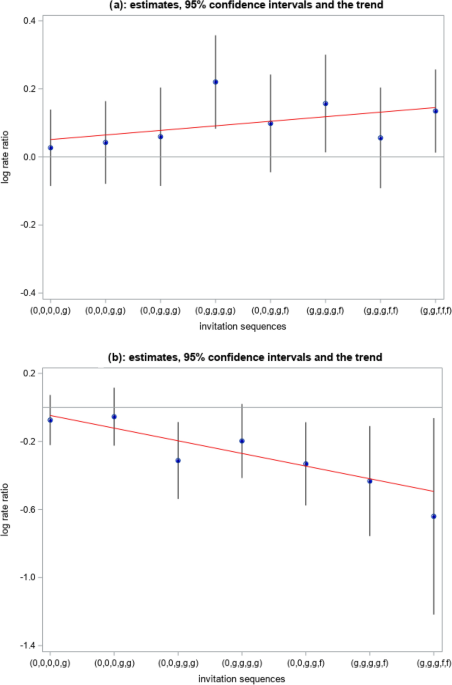
As a result, the total number of screening invitations differed according to the age at first invitation. There was a total of 17 birth year cohorts with different ages at first invitation and different sequences of invitation to gFOBT (g), FIT (f) or no invitation (0) over the 10-year screening period from 60 to 69 years of age (Table 1). Three of the sequences were control sequences (birth cohorts 1938, 1939 and 1941), in which no invitation was made throughout the 10-year screening period. The sequences were denoted by (var1, var2, var3, var4, and var5), where var1 represented invitation at 60 years of age, …, and var5 at 68, each variable taking the value of either g, f or 0. Thus (0, 0, 0, 0, 0) is the control sequence corresponding to the non-invited.
Table 1 Invitation scheme to the Stockholm-Gotland FOBT screening program by birth year and invitation year. The vertical line marks the shift from gFOBT to FIT in October 2015. Because of short follow-ups, we exclude birth cohorts 1953 and 1954 for the screening-period study (60–69) and additional 1951 and 1952 for the post-screening-period study (70–73).
Consequently, we have CRC incidence and stage as outcomes and invitation sequences as exposures like intention-to-treat as exposure in randomized trials. All individuals started the follow-up at the age of 60 and ended the follow-up at the date of a CRC diagnosis, emigration, death, or on December 31, 2020, whichever occurred first. With start of invitations in 2008, the maximum follow-up was 13 years. The overall compliance to the program was 63.3%, and has been previously reported12.
Since all sequences started at age 60, we did not need to adjust for age. Due to our study design, we did not need to adjust for the testing results such as adenomatous polyps or non-compliance to the testing. Furthermore, because all invitation sequences started in close calendar years, other potential CRC risk factors prior to 60 were evenly distributed in different invitation sequences and not needed to be adjusted for. Therefore, we only dealt with gender and calendar year.
Data retrieval and follow-up
By using the individually unique national registration number assigned to all Swedish residents, the data on cohort individuals, including information on emigration, were retrieved from Statistics Sweden. The individuals were linked to the Cancer Register and the Cause of Death Register at the National Board of Health and Welfare to retrieve information on mortalities during follow-up and CRC diagnosis from 1958 to 202013,14. The CRC diagnoses were coded according to the International Classification of Diseases 7 (ICD-7) as 153.X (malignant neoplasm of large intestine) or 154.0 (malignant neoplasm of rectum), excluding the codes C24; 091 (neuroendocrine tumor), 093 (lymphoma), 094 (adenoma), 144 (squamous cell carcinoma) and 793 (gastrointestinal stroma tumor). Information on CRC stage was retrieved from the Swedish Colorectal Cancer Register (SCRCR), classified according to the TNM system in stage I-IV: stage I (T1-2, N0, M0), stage II (T3-4, N0, M0), stage III (T1-4, N1-2, M0) and stage IV (M1). Early CRC was defined as stage I-II and late CRC as stage as III-IV.
The study was approved by the Swedish Ethical Review Authority (No. 020-06757) and performed in accordance with the Declaration of Helsinki. Informed consent was waived, when all individual data were pseudonymized with code key at Statistics Sweden. All methods were conducted and reported following the Strengthening the Reporting of Observational Studies in Epidemiology (STROBE) Checklist for cohort studies (Supplementary file 1).
Statistical analyses
We conducted sequential analysis, in which we compared the CRC incidence and stage for different sequences of invitation.
Two follow-up periods were evaluated: between 60 and 69 years of age (screening period), and from 70 to 73 years of age (post screening period). During the screening period, the maximum follow-up was 10 years. During the post screening period, the maximum follow-up was 3 years. We excluded sequences (g, g, f, f, f) and (g, f, f, f, ?), with “?” indicating unknown invitation, because follow-up was too short for individuals to reach 70 years of age by 2020. As the CRC stage information was only available from 2008 and onwards, we conducted the stage analysis only for the post screening period.
Regarding the CRC incidence, the effectiveness of the screening program was measured as the rate ratio (RR) of the invitation sequence relative to the control sequence (non-invited), where rate was defined as the number of incident CRCs divided by the person-years during the follow-up of the sequence. The RRs with 95% confidence intervals (CI) were then estimated using Poisson regression.
CRC stage was categorized into three levels: no CRC, stage I-II and stage III-IV. The stage rate was defined as the number of stage I-II (or III-IV) divided by the person-years during the follow-up of the invitation sequence. The effectiveness of the screening program on stage was measured as the stage rate ratio (RR) of the invitation sequence relative to the control sequence. Because CRC and, hence, different stages of CRC, are rare events in the population, stage rates are well approximated by odds, hence multinomial logistic regression was employed to estimate stage rate ratios. To deal with missing stages, the multiple imputation technique was applied using the multinomial regression conditional on gender and the invitation sequence, where the missing at random is a reasonable assumption conditional on gender and the invitation sequence.
The trend of CRC incidence and stage was analyzed using the ordinary trend test with a linear regression of y on x, where y is the log rate ratio as a continuous variable and x is an ordinal variable with the sequences from low to high, with one unit between each x.
Even if gender is not a confounder according to our study design, we still included it in the above statistical modeling. Furthermore, we needed to address the influence of the calendar year as potential confounder. Because different invitation sequences compiled different calendar years, it was not possible to make adjustment for the calendar year. On the other hand, the calendar year was expected to have minimal influence on CRC risk and stage across the different invitation sequences. In a sensitivity analysis, we used the Swedish population as reference, i.e., the CRC incidence rates at different calendar years in the Swedish male and female populations.
