


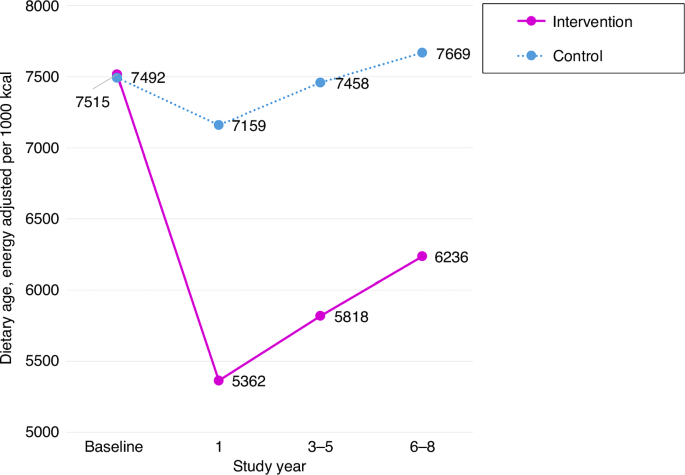
In the current analysis, a low-fat dietary pattern was associated with reductions in dAGE intake over 7 years of follow-up. These findings build on prior WHI evidence linking dAGE exposure and dietary patterns to breast cancer outcomes. Among 2023 women with breast cancer enrolled in the WHI Observational Study and the WHI DM trial, higher dAGE intake has been associated with increased risk of breast cancer-specific, cardiovascular, and all-cause mortality [20]. Similarly, a secondary analysis of the WHI DM randomized trial among 1764 women diagnosed with breast cancer demonstrated improved 10-year breast cancer survival in the dietary intervention versus the usual-diet comparison group (82% vs 78%, P = 0.01) [21].
The present report extends these observations by demonstrating that the WHI low-fat dietary intervention was associated with a significant and sustained reduction in dAGE intake. Although the intervention was not specifically designed to reduce dAGE intake, it produced meaningful changes in dietary patterns relevant to dAGE exposure. Early in the intervention, total fat intake decreased by 24.3 g/day relative to controls, driven primarily by reductions in added fats (−9.1 g/day), meats (−4.6 g/day), and desserts (−3.9 g/day) [22]. These changes reflect reduced consumption of foods such as butter, oils, dressings, red and processed meats, and baked goods, which are recognized contributors to dietary AGE intake. Over a longer follow-up, these changes were partially attenuated but remained substantial, with fat intake reduced to approximately 25% of energy at year 1 and ~30% at years 5–7 compared with ~35–36% in controls, alongside increased intake of fruits, vegetables, and grains [23].
These dietary shifts are consistent with patterns expected to lower dAGE exposure, as diets higher in animal fats and processed foods tend to be AGE-rich, whereas plant-based foods are generally lower in dAGE. The WHI low-fat dietary pattern also shares features with the Dietary Approaches to Stop Hypertension (DASH) diet, characterized by higher intake of fruits, vegetables, and grains and lower intake of red meat and higher-fat foods [24]. Furthermore, evidence from the Prostate, Lung, Colorectal, and Ovarian (PLCO) cohort supports the relevance of these dietary changes to dAGE exposure [12]. In PLCO, dAGE intake was primarily driven by fats and oils (~21%), red meat (~15%), mixed dishes (~15%), and processed meats (~9%), whereas fruits and vegetables contributed minimally (<3%) [12]. These patterns align closely with the WHI intervention, which reduced intake of fats and meats while increasing plant-based foods, supporting the plausibility of the observed reductions in dAGE. Together, these findings suggest that adoption of a low-fat, plant-forward dietary pattern may contribute to meaningful reductions in dAGE intake in free-living populations.
Importantly, the WHI DM intervention did not explicitly target dAGE reduction through mechanisms known to influence AGE exposure, such as modification of cooking methods, reduction of ultra-processed foods, or specific food preparation practices. This represents a key limitation, as the relative contribution of these factors to the observed reduction in dAGE cannot be determined. Notably, emerging interventional studies are now directly targeting dAGE reduction, including a recently completed clinical trial in breast cancer survivors, with results pending, evaluating the effects of a low-AGE diet on metabolic and inflammatory biomarkers and potential prognostic pathways (NCT05265715). Additionally, dAGE estimates were derived from FFQ data and are not directly linkable to individual foods or preparation methods, limiting mechanistic interpretation. Importantly, the reduction in dAGE observed in this study occurred without targeted modification of cooking methods or food processing, that broader dietary pattern changes alone may substantially influence dAGE exposure. Nonetheless, this analysis provides novel empirical evidence from a large randomized trial that a broadly implemented dietary pattern intervention can result in meaningful and sustained reductions in dAGE exposure.
Higher dAGE intake may influence insulin resistance, metabolic dysfunction [6, 25] and weight gain [26], factors associated with adverse breast cancer outcomes. In the WHI DM trial, a low-fat dietary pattern intervention was associated with reduced metabolic syndrome risk [3], and higher metabolic syndrome burden has been linked to poorer prognosis breast cancers (p = 0.03) and increased breast cancer-specific mortality (HR 1.44, 95% CI 1.02–2.04, p < 0.03) [4]. These pathways may provide a biologically plausible link between dietary patterns, dAGE exposure, and breast cancer outcomes, although causal mediation was not evaluated in the present study.
Strengths of this study include the randomized trial design, a large and diverse cohort of 40,209 post-menopausal women, and repeated dietary assessments over 7 years. Limitations include the secondary, hypothesis-generating nature of the analysis, reliance on self-reported dietary intake, and the inability to directly link dAGE estimates to specific foods or preparation methods.
