


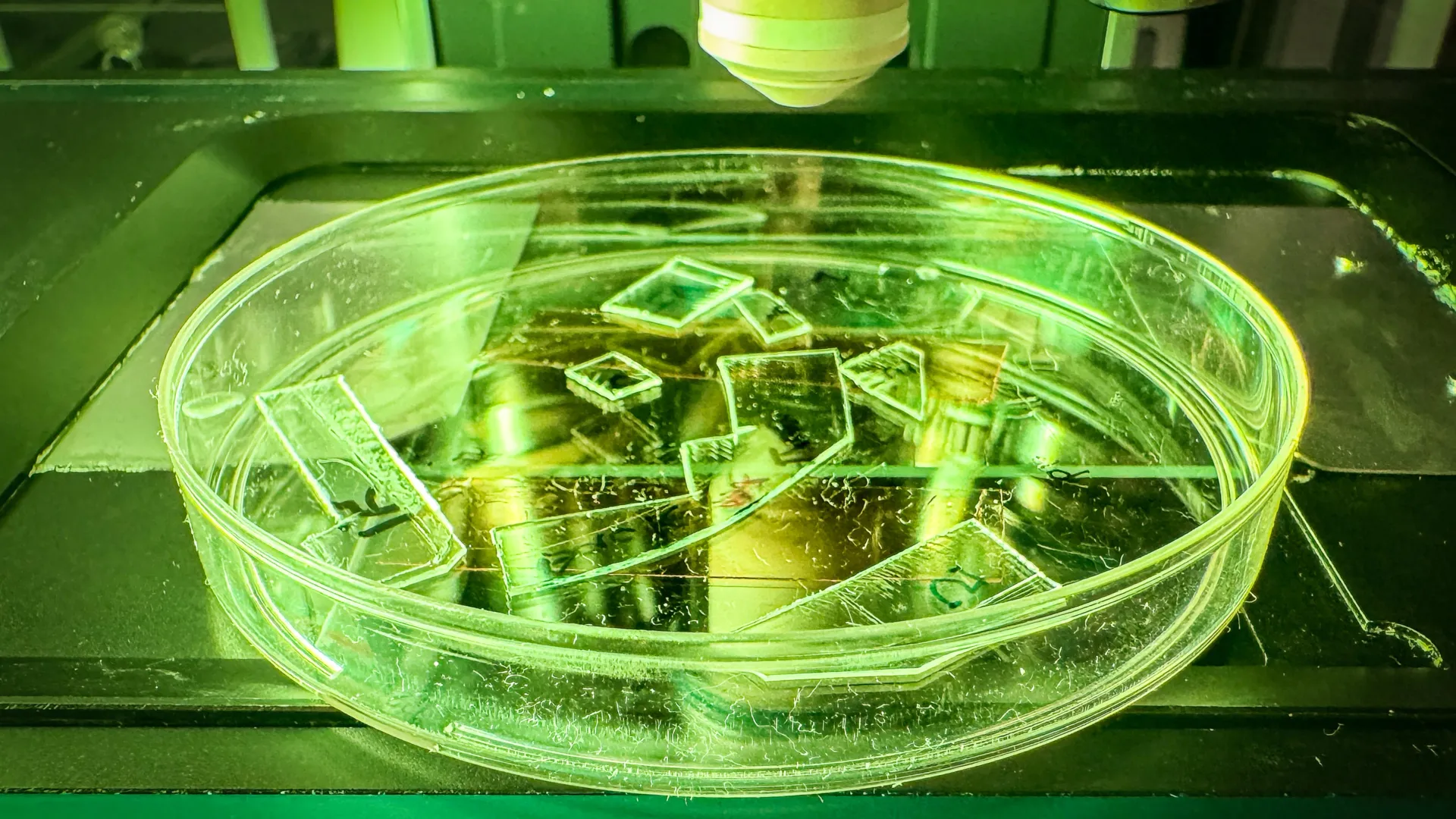
Scientists have created a thin plastic film that can physically destroy viruses the moment they land on its surface. The breakthrough could help reduce the spread of disease from frequently touched items like smartphones, keyboards, and hospital equipment.
Beyond its effectiveness, the material is also designed to be practical for real-world use. Unlike earlier antiviral surfaces made from metals or silicon, this new approach uses flexible plastic that can be produced at scale.
How Nanopillars Tear Viruses Apart
The film is made from acrylic and covered with extremely small structures known as nanopillars. These tiny features grip onto a virus and stretch its outer layer until it breaks apart. Instead of relying on chemical disinfectants, the surface uses mechanical force to disable the virus.
Research published in Advanced Science found that this stretching method is more effective than earlier designs that attempted to puncture viruses.
Lab Tests Show Strong Virus Inactivation
In experiments using the human parainfluenza virus 3 (hPIV-3) — which causes bronchiolitis and pneumonia — the results were striking. Within one hour of contact, about 94% of virus particles were either torn apart or damaged so severely that they could no longer reproduce and cause infection.
Study lead author and PhD candidate Samson Mah from Australia’s RMIT University said the team intentionally used low-cost materials that could be manufactured easily.
“As nanofabrication tools get better, our results give a clearer guide to which nanopatterns work best to kill viruses,” he said.
“We could one day have surfaces like phone screens, keyboards and hospital tables covered with this film, killing viruses on contact without using harsh chemicals.
“Our mold can be adapted to roll-to-roll manufacturing, meaning antiviral plastic films could be produced at scale with existing factory equipment.”
Why Nanopillar Spacing Matters Most
The researchers also discovered that how closely the nanopillars are spaced plays a much bigger role than how tall they are.
“By tweaking the spacing and height of the nanopillars, we discovered how tightly they are packed together is far more important than how tall they are for breaking viruses apart,” Mah said.
“When the nanopillars are closer together, more of them can press on the same virus at once, stretching its outer shell past breaking point.”
A Simple Design Rule for Virus-Killing Surfaces
Earlier work on rigid materials like nanospike silicon showed that viruses could be physically disrupted. This study expands on that idea by showing that both sharp and blunt nanoscale features can be effective when arranged correctly.
The findings suggest a clear design principle: the closer the nanostructures such as spikes or nanopillars are to each other, the more effective they are at destroying viruses.
The strongest performance came from surfaces where nanopillars were spaced about 60 nanometers apart. Increasing that distance to 100 nanometers reduced the antiviral effect, while spacing of 200 nanometers nearly eliminated it.
Next Steps and Real-World Potential
So far, the research has focused on hPIV-3, which is an enveloped virus with a fatty outer membrane. The team now plans to test smaller and non-enveloped viruses to determine how broadly the technology can be applied.
An enveloped virus has a fragile fatty membrane around it that can be more easily disrupted by nanopillars, while a non-enveloped virus lacks this outer layer, making it harder to kill.
Scientists also want to examine how well the textured film works on curved surfaces, since curvature can change the spacing between nanopillars.
Study co-author Distinguished Professor Elena Ivanova from RMIT said the team is eager to move toward real-world applications.
“We think this texturing is a strong candidate for everyday use and we’re ready to partner with companies to refine it for large-scale manufacturing,” she said.
