


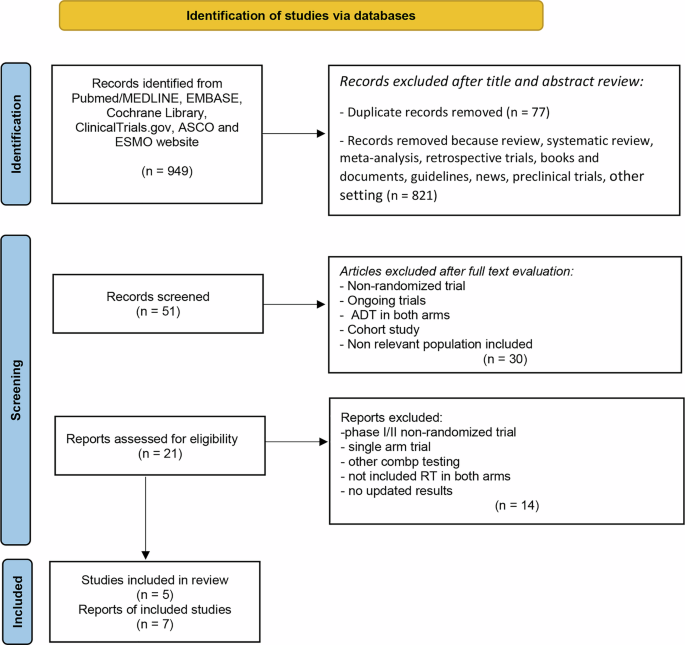
BCR is an independent risk factor for the development of DM, PCSM, and to a lesser extent overall mortality (OM) [2]. Notably, a PSA doubling time (PSA-DT) < 12 months and pathological Gleason Score (pGS) ≥ 8 are the main prognostic factors for DM, PCSM, and OM in patients with BCR following RP [2]. According to EAU guidelines, patients with BCR after RP can be stratified into low-risk BCR (PSA-DT > 12 months and pGS <8) or high-risk
BCR (PSA-DT < 12 months or pGS 8–10) [3]. Therefore, optimizing the clinical management, particularly for patients with high-risk BCR, remains an unmet need. SRT to the prostate bed has long been the standard of care, yet the added value of HT implementation remains uncertain. EAU guidelines provide only weak recommendations and clinical practice varies widely [3]. Given the low certainty of available evidence, we conducted a meta-analysis to better identify patients who derive the greatest benefit from combining SRT with HT. Our analysis was restricted to men with confirmed BCR, excluding adjuvant and immediate salvage RT to reduce heterogeneity and focus on a well-defined clinical scenario. To our knowledge, this is the first meta-analysis incorporating data from the SALV-ENZA trial, the first randomized study evaluating the addition of an ARPI to SRT in this setting [17]. Our findings consistently showed that the addition of HT to SRT significantly improved PFS, bPFS, and MFS. Subgroup analyses indicated that the MFS benefit was primarily observed in patients with positive surgical margins, with no clear advantage in those with pGS ≥8 or negative margins. This finding should be interpreted cautiously, as high-grade disease was underrepresented across most trials and subgroup analyses were not powered to detect differential benefit in this population. Although patients with high-grade disease (GG ≥ 4) are generally expected to derive greater benefit from systemic intensification, this effect was not clearly observed in our analysis, likely due to the limited representation of this subgroup across the included trials. Conversely, patients with EAU low-risk BCR may derive limited absolute benefit from ADT intensification, supporting a more individualized and potentially de-escalated approach in this subgroup.
In addition, the lack of a statistically significant OS improvement may be influenced by factors such as crossover, subsequent treatments, heterogeneous follow-up and competing risks, highlighting the need to refine patient selection.
Several differences across trials may have contributed to the variability in outcomes. Definitions of BCR varied across trials, with some studies including patients with persistently detectable PSA or PSA levels up to 2 ng/mL after surgery. All RCTs enrolled men with pT2-pT3 disease, whereas RADICALS-HD uniquely included pT1 cases. The proportion of patients with GS ≥ 8 was generally underrepresented among the trials included in the analysis, with the only exception being SALV-ENZA, which enrolled the highest proportion of patients with GS ≥ 8 (45%). Radiotherapy fields were generally limited to the prostate bed, with only a minority receiving pelvic nodal irradiation (PNRT). Importantly, PNRT was analysed as a separate arm only in RTOG 0534, and this arm was excluded from our analysis. Additionally, patients with positive nodal status after RP were excluded from
GETUG-AFU 16 and RTOG 0534. Moreover, RADICALS-HD trial randomized patients to receive RT alone, RT with short-course ADT or RT plus long-course ADT. Patients enrolled could choose two-way randomization (no ADT vs. short-course ADT) or three-way randomization (no ADT vs. short-course ADT vs. long-course ADT). Two-way randomization was the preferred option, with 1150 participants choosing it compared to 492 choosing the three-way option. Of those who opted for two-way randomization, 571 patients were assigned in the no ADT arm, whilst 166 patients were allocated to the no ADT arm with three-way randomization. Thus, our analysis considered a total of 737 patients in the no ADT arm for the RADICALS-HD trial. These differences in eligibility criteria, treatment strategies and endpoint definitions likely contributed to heterogeneity in the reported outcomes.
Follow-up duration also varied substantially across trials, ranging from a few years to more than a decade in RTOG 9601, potentially influencing OS estimates. Regarding PFS definitions, they differed among studies: since RADICALS-HD defined PFS exclusively based on clinical progression, its PFS data were not included in our pooled analysis [11,12,13,14,15,16,17]. Another important limitation is that, despite the recognized prognostic impact of PSA-DT, none of the included trials reported subgroup analyses according to the high-risk definition proposed by the EAU (PSA-DT < 12 months). Available subgroup data are mainly restricted to pathological features, such as GS/ISUP grade or surgical margin status, with only limited information for ISUP 4 disease and no stratification by PSA kinetics. As a result, the magnitude of benefit from adding ADT or ARPIs to SRT in patients with high-risk BCR according to EAU criteria remains largely unexplored.
Nevertheless, our results are aligned with the DADSPORT meta-analysis reporting improved MFS and prostate-cancer specific survival (PCSS) with either short- or long- course ADT combined with postoperative RT [27]. Similarly, a recent network meta-analysis by Le QC et al. evaluated the impact of concomitant ADT and its duration in the postoperative setting [28]. Compared with these analyses, our study specifically focuses on patients with confirmed BCR after RP and incorporates recent evidence on treatment intensification, including ARPI-based strategies.
However, the potential benefits of treatment intensification must be carefully balanced against its toxicity profile. Indeed, long-term HT is associated with a broad spectrum of adverse effects, including sexual dysfunction, hot flashes, gynecomastia, fatigue, decreased bone mineral density, neurocognitive and psychological sequelae, and an overall decline in quality of life (QoL) [29].
Although a RCT is currently ongoing to define the optimal duration of ADT in combination with SRT (NCT05781217), a promising strategy to refine treatment selection is the integration of molecular biomarkers into clinical decision-making [30]. Several genomic classifiers, including Decipher, Prolaris, and Oncotype DX, as well as emerging multigene signatures, have demonstrated improved ability to predict recurrence after RP in patients with adverse pathological features [31,32,33,34,35]. Beyond their prognostic role, these genomic tools are increasingly being investigated as potential predictive biomarkers to identify patients more likely to benefit from treatment intensification strategies. Supporting this evidence, the first biomarker-driven RCT showed that patients with BCR and luminal B prostate cancer, identified using the PAM50 genomic signature, experienced a significant improvement in MFS and biochemical progression when apalutamide was added to SRT [36]. Similarly, the detection of circulating prostate cells (CPCs) after surgery has also been associated with an increased risk of early BCR and disease progression [37].
In addition to tissue-based biomarkers, advances in molecular imaging may further refine patient stratification at the time of BCR. In particular, PSMA PET has demonstrated superior sensitivity for detecting early metastatic disease and may help guide treatment intensification strategies [38]. Notably, a randomized phase II trial demonstrated that PSMA PET-guided SRT improved failure-free survival and delayed the need for subsequent therapies, with a greater benefit observed among patients who did not receive concomitant ADT with SRT [39].
In parallel, intensification of the radiotherapy field represents another potential strategy. This approach was supported by the RTOG 0534/SPPORT trial, in which the addition of PNRT combined with short-term ADT significantly improved PFS compared with prostate bed RT alone [14]. However, whether pelvic nodal irradiation can replace systemic therapy in biologically low-risk patients remains uncertain. Future trials incorporating molecular and imaging biomarkers will be crucial to define whether treatment escalation should preferentially rely on systemic intensification, radiation field expansion, or a tailored combination of both. In this rapidly evolving therapeutic landscape, our work reinforces the view that prostate cancer management should increasingly rely on the biological and clinical characteristics of each patient, ensuring a truly individualized approach.
Beyond radiotherapy-based intensification strategies, systemic approaches are also being explored in patients with biochemical recurrence. In the phase III EMBARK trial, patients with high-risk biochemical recurrence were randomized to enzalutamide plus ADT, ADT
alone, or enzalutamide monotherapy [40]. Enzalutamide plus ADT significantly improved metastasis-free and overall survival compared with ADT alone, whereas enzalutamide monotherapy improved metastasis-free survival without a significant overall survival benefit. Importantly, patients enrolled in EMBARK were not candidates for salvage radiotherapy, and therefore these findings reflect a different clinical scenario from the post- prostatectomy salvage setting evaluated in the present meta-analysis.
