


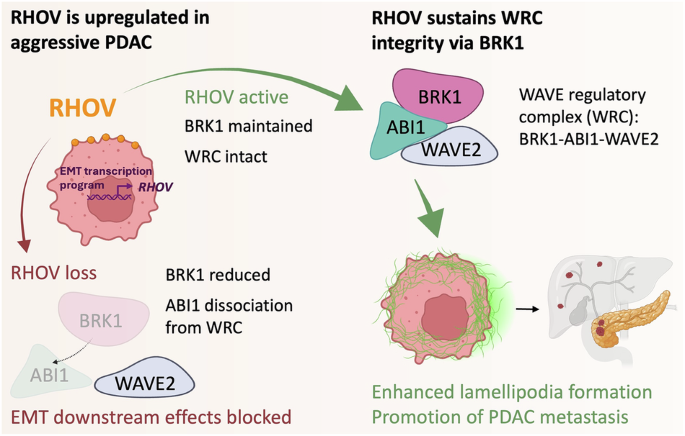
Pancreatic ductal adenocarcinoma (PDAC) is characterized by early invasion and rapid metastatic dissemination, yet the cytoskeletal mechanisms that enable these aggressive behaviors remain incompletely defined. Here, we identify the atypical Rho GTPase RHOV as a critical regulator of invasive progression and metastasis in PDAC. Integrated analyses of independent patient cohorts, patient-derived models, and single-cell transcriptomic datasets revealed that RHOV is selectively overexpressed in malignant epithelial cells, with high RHOV expression correlating with advanced disease stage and poor patient survival. Genetic suppression or deletion of RHOV impaired PDAC cell invasion, migration, clonogenic growth, and context-dependent sphere formation in vitro, while reducing tumor-initiating capacity and metastatic colonization in vivo. Mechanistically, RHOV maintains BRK1-dependent WAVE regulatory complex integrity to sustain lamellipodia formation and invasive motility. Loss of RHOV uncoupled EMT-associated transcriptional programs from cytoskeletal execution of invasion, resulting in compensatory EMT gene expression without restoration of invasive behavior. Re-expression of BRK1 rescued invasion defects following RHOV inhibition. Together, these findings identify RHOV as an executional dependency that enables PDAC invasiveness by linking transcriptional plasticity to actin-based motility.
The alternative text for this image may have been generated using AI.
