


ARF6 augments a dynamic pool of oncogenic BRAF protein
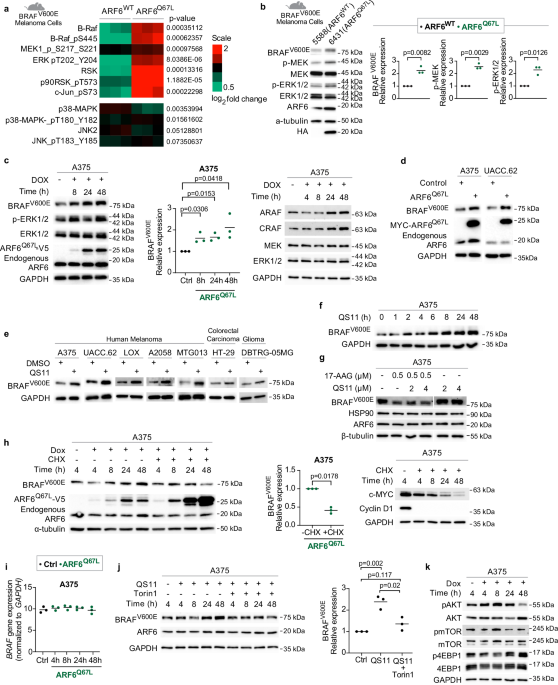
In early passage murine melanoma cell lines with homozygous BRAFV600E mutation, derived from our genetically engineered murine melanoma models [8, 12], proteomic analysis showed higher levels of BRAFV600E protein, and increased phosphorylated MEK1, ERK, RSK and Jun, in cells expressing constitutively active ARF6-GTP (ARF6Q67L) compared to ARF6WT (Fig. 1a). In contrast, p38 MAPK-JNK signaling was unaltered (Fig. 1a). ARF6-GTP-induced BRAFV600E expression was confirmed by Western blot (Fig. 1b). These findings align with our previously published genomic data from this tumor model showing upregulation of genes in the MAPK cascade in bulk tumor transcriptomes [8]. Based on these findings, we hypothesized that ARF6 controls MAPK signaling by regulating oncogenic BRAF expression. In pursuit of this, we interrogated human melanoma cells and found that doxycycline-induced, ectopically expressed ARF6-GTP, in the form of ARF6Q67L (Fig. S1a), or adenoviral delivered ARF6Q67L, augmented endogenous BRAFV600E expression in human melanoma cells (Fig. 1c–d). Endogenous levels of ARAF, CRAF and phosphorylation of ERK rose in parallel with BRAFV600E (Fig. 1c). Consistent with genetic activation of ARF6, pharmacological activation of ARF6 with QS11 (Fig. S1b), an inhibitor of ARF GTPase Activating Protein 1 [31], increased BRAFV600E protein expression in human melanoma, colorectal carcinoma, and glioma cell lines (Fig.1e, S1c). BRAFV600E protein levels rose quickly after treatment with the ARF6 agonist QS11, as early as two hours, and continued to accumulate over 48 h (Fig. 1f). Wild-type, endogenous BRAF protein increased in a similar manner in SKMel2 human melanoma cells (Fig. S1d). These data demonstrate that sustained ARF6 activation is sufficient to acutely increase endogenous RAF proteins.
Fig. 1: ARF6 is sufficient to control oncogenic BRAF protein levels through protein translation.The alternative text for this image may have been generated using AI.
a Relative amount of MAPK signaling proteins in tumor cells derived from BrafV600E; Cdkn2af/f; Arf6WT or BrafV600E; Cdkn2af/f; Arf6Q67L mice, detected by Reverse Phase Protein Array, two-tailed t-test. n = 3 replicates per cell line. b–h, j, k Western Blot for indicated proteins. b Murine melanoma cells derived from BrafV600E; Cdkn2af/f; Arf6WT, or BrafV600E; Cdkn2af/f; Arf6Q67L mice., n = 3 biological independent experiments. c Human A375 melanoma with doxycycline (DOX)-inducible ectopic expression of ARF6Q67L, BRAFV600E Western blot n = 3 biological independent experiments, h = hours. d Human UACC.62 and A375 cells with or without adenoviral-mediated ectopic expression of ARF6Q67L, control= empty vector. e 4 μM QS11 for 48 h in human A2058 melanoma, HT-29 colorectal carcinoma, and DBTRG-05MG glioma. 2 μM QS11 for 24 h in other cell lines. f 2 μM QS11, h = hours. g 17-AAG and QS11 for 24 h in A375 cells. h 20 μg/ml cycloheximide (CHX) in A375 cells with doxycycline (Dox)-inducible ectopic expressed ARF6Q67L. BRAFV600E protein quantification at 48 h., n = 3 biological independent experiments. i Quantitative RT-PCR for BRAF mRNA in A375 cells with doxycycline (Dox)-inducible ectopic expressed ARF6Q67L, n = 3 biological independent experiments, h=hours. j 4 μM QS11 and 250 nM Torin 1 in A375 cells. BRAFV600E protein quantification at 48 h, n = 3 biological independent experiments. k A375 cells with doxycycline (Dox)-inducible ectopic expressed ARF6Q67L. h = hours. b, c, h, j Two-tailed ratio paired t-test.
The BRAFV600E oncoprotein is stabilized by the chaperone protein HSP90 [32, 33], limiting proteasome-mediated degradation. Consistent with this, BRAFV600E was stable in the presence of cycloheximide for at least 24 h (Fig. S1e), whereas decay was readily observed within this time frame when cells were treated with the HSP90 inhibitor 17-AAG (Fig. S1f). These data confirm that HSP90 prolongs the half-life of the BRAF oncoprotein. Unlike HSP90, ARF6 prevents lysosome mediated degradation of proteins through endosomal recycling [12, 34, 35]. Thus, we asked if BRAFV600E might be degraded by the lysosome. Blocking lysosomal degradation by Bafilomycin A1 or DC661 failed to increase BRAFV600E protein (Fig. S1g). Thus, it is unlikely that ARF6 regulates oncogenic BRAF expression through endolysosomal trafficking. Activation of ARF6 did not alter HSP90 protein expression (Fig. S1h), nor did it rescue BRAFV600E from degradation during 17-AAG treatment (Fig. 1g), when the oncoprotein is vulnerable to proteasome degradation. Taken together, these data suggest that ARF6 does not regulate machinery controlling RAF degradation. Interestingly, inhibition of protein translation with cycloheximide prevented the accumulation of BRAFV600E, ARAF, and CRAF proteins upon ARF6 activation (Fig. 1h and S1i). Activation of ARF6 failed to alter BRAF mRNA levels in A375 melanoma cells, which harbor a homozygous BRAFV600E mutation (Fig. 1i), demonstrating that ARF6-mediated upregulation of BRAFV600E occurred without altering BRAF oncogene expression.
Because ARF6 has been reported to potentiate mTOR signaling [8, 36, 37], we hypothesized that ARF6-GTP mediated BRAFV600E expression could be mTOR dependent. Inhibition of mTOR activity with Torin 1 prevented the boost in BRAFV600E protein induced by QS11 (Fig. 1j), supporting that ARF6 activation might augment mTOR-mediated protein translation. Consistent with this, ARF6-GTP increased phosphorylation of 4EBP1 in human melanoma cells (Fig. 1k). Overall, these data confirm that ARF6 activation is sufficient to increase BRAFV600E protein levels and raise the possibility that ARF6 regulates mTOR-dependent protein translation.
ARF6 is necessary for maintenance of the BRAFV600E protein
In contrast to ARF6 activation, deletion of Arf6 in BRAFV600E murine melanoma tumors [12] reduced total BRAFV600E levels and downstream phosphorylated MEK (p-MEK) and ERK (p-ERK), detected by immunofluorescence in situ (Fig. 2a and S1j). Consistently, silencing of Arf6 downregulated BRAFV600E and p-MEK detection in murine melanoma cells (Fig. 2b). To test whether inactivation of ARF6 (ARF6-GDP) could produce the same effect in human melanoma, we treated A375 cells with SecinH3, an ARF6 guanine exchange factor inhibitor that reduces ARF6-GTP levels [11, 38] (Fig. S1k) and reduces spontaneous metastasis of human BRAFV600E melanoma xenograft tumors [11]. In human melanoma cells, SecinH3 significantly reduced BRAFV600E protein within 48 h of treatment (Fig. 2c). NAV-2729, a direct inhibitor of ARF6 GTPase function [13] and ARF GEFs and GAPs [39] (Fig. S1l), also reduced BRAFV600E protein after 48 h (Fig. 2d). Because SecinH3 and NAV-2729 are not highly specific inhibitors of ARF6, we tested ectopic expression of a dominant-mutant interfering form of ARF6, ARF6T27N, which reduced ARF6-GTP (Fig. S1m) and BRAFV600E protein (Fig. 2e), suggesting that ARF6 activation may be necessary to maintain expression of endogenous BRAFV600E. Importantly, the kinetics of endogenous BRAFV600E decay, between 24 and 48 h after SecinH3 or NAV-2729 treatment, was identical to cycloheximide (Fig. S1e). Together these data demonstrate that ARF6 may be necessary to maintain steady state levels of the BRAFV600E oncoprotein and suggest that targeted inhibition of ARF6 might be an alternative approach to reducing BRAFV600E oncoprotein expression.
Fig. 2: ARF6 is necessary to maintain oncogenic BRAF protein levels.The alternative text for this image may have been generated using AI.
a Representative immunofluorescence images of cryo-embedded frozen tumor tissues from BrafV600E; Cdkn2af/f; Arf6WT or BrafV600E; Cdkn2af/f; Arf6f/f mice, ×1200 magnification. Two-tailed unpaired t-test. b–e Western blot for indicated proteins. b Murine melanoma cells derived from BrafV600E; Cdkn2af/f; Arf6WT mice, transiently transfected with siRNAs, n = 3 biological independent experiments. c Human A375 melanoma cells treated with 10 μM SecinH3, BRAFV600E protein quantification at 48 h, n = 3 biological independent experiments. d Human A375 melanoma cells treated with 5 μM NAV-2729. e Human A375 cells with or without adenoviral-mediated ectopic expression of ARF6T27N, control= empty vector. b, c Two-tailed ratio paired t-test.
ARF6-GTP promotes tumor survival by protecting against apoptosis
Because MAPK signaling opposes the intrinsic apoptotic signaling pathway [5], we reasoned that ARF6-mediated fluctuations in BRAFV600Eprotein might be linked to survival. Proteomic clues to ARF6-mediated survival were evident in murine melanoma cell lines cultured in full serum (Fig. 3a, b). Compared to ARF6WT, cells expressing ARF6Q67L showed significantly increased levels of the anti-apoptotic protein MCL-1 and phosphorylation (inactivation) of BAD at residue S112 (pS112) [5], as well as decreased levels of pro-apoptotic proteins BAX and FOXO3 (Fig. 3a). ARF6 dependent expression of MCL-1 and FOXO3 were confirmed by Western blot (Fig. 3b). ERK signaling has been reported to increase MCL-1 [40] and decrease FOXO3 [41] protein levels [5]. Thus, our data suggest that ARF6 activation might promote tumor cell survival through ERK-mediated anti-apoptotic signaling.
Fig. 3: ARF6 promotes tumor survival and accelerated disease progression.The alternative text for this image may have been generated using AI.
a Apoptotic protein profile of tumor cells derived from BrafV600E; Cdkn2af/f mice detected by Reverse Phase Protein Array. Two-tailed t-test, n = 3 replicates per cell line. b Western Blot for indicated proteins in murine melanoma cells derived from BrafV600E; Cdkn2af/f mice. Two-tailed ratio paired t-test, n = 3 biological independent experiments. c Apoptosis detection, measured at 48 h, dox-inducible ectopic expressed ARF6WT and ARF6Q67L in A375 cells. One-way ANOVA with multiple comparisons, n = 4 replicates per condition. d Apoptosis detection, 4 μM QS11, measured at 48 h. Two-tailed unpaired t-test, n = 5 for A375 and n = 3 for A2058 replicates per condition. e Cell viability detection, measured at 72 h. Two-tailed unpaired t-test, n = 5 replicates per condition. f Rate of tumor growth measured from the time of initial detection in BrafV600E; Cdkn2af/f; Arf6WT mice. Two-tailed t-test with Welch’s correction, n = 24 PtenWT, n = 14 Ptenf/f mice. g Rate of tumor growth measured from the time of initial detection in BrafV600E; Cdkn2af/f; Ptenf/f mice. Two-tailed t-test with Welch’s correction, n = 14 Arf6WT, n = 22 Arf6f/f mice. h Survival of mice (before primary tumor reached 2 cm) after Cre injection (day 0) within 130 days, n = 14 Arf6WT, n = 18 Arf6f/f mice, Log-rank (Mantle-Cox) test. Solid line within data points = mean. i, Apoptotic protein profile of whole tumors from BrafV600E; Cdkn2af/f; Ptenf/f mice (n = 6 mice per group) detected by Reverse Phase Protein Array, two-tailed t-test.
To test whether ARF6 activation could protect against apoptosis, we deployed a doxycycline-inducible system to express either ectopic ARF6Q67L or ARF6WT in human melanoma cells (Fig. S1a and S2a). Doxycycline alone did not alter viability of A375 parental cells, (Fig. S2b), while doxycycline-induced ARF6Q67L significantly reduced apoptosis caused by serum withdrawal (Fig. 3c). In contrast, doxycycline-induced ectopic expression of ARF6WT did not alter apoptosis caused by serum withdrawal (Fig. 3c), suggesting that the active form of ARF6 is required for the survival benefit. Consistent with ARF6Q67L, pharmacological activation of ARF6 with QS11 protected against apoptosis caused by serum starvation (Fig. 3d). QS11 alone failed to alter cell viability during steady-state conditions, when cells were cultured in full serum (Fig. S2c), indicating that the compound does not stimulate proliferation. Overall, these data demonstrate that ARF6 activation can protect against apoptosis during growth signal deprivation.
Given that ARF6 can regulate both PI3K-AKT [8] and BRAFV600E -MAPK signaling (Fig. 1) and apoptosis upon serum withdrawal (Fig. 3c, d), we asked if ARF6 supports the viability of BRAF-mutant human cancer cells grown in full serum. Consistent with this, ARF6 silencing led to significantly reduced viability in multiple human melanoma cell lines (Fig. 3e). Similarly, treatment with NAV-2729, a direct inhibitor of ARF6 GTPase function [13], reduced ARF6-GTP levels (Fig. S1l) and decreased cell viability in most of the human melanoma cells tested (Fig. S2d), although not as effectively as ARF6 silencing (Fig. 3e). These data demonstrate that ARF6 can optimize survival during normal growth conditions.
ARF6 is required for accelerated tumor progression caused by PTEN loss
In parallel with the MAPK pathway, survival signaling can also originate from the PI3K-AKT pathway [42] and we previously reported that activation of ARF6 enhanced PI3K expression and PI3K-AKT signaling [8]. PTEN loss of function mutations activate the PI3K-AKT pathway, are frequently detected in cutaneous melanoma [6], cooperate with mutant BRAF or NRAS to drive melanomagenesis [43, 44], and accelerate primary tumor growth in genetically engineered Dct::TVA, BrafV600E; Cdkn2aflox/flox murine melanoma models induced in epidermal melanocytes of the ear pinnae [45]. Like pinnae tumors, deletion of Pten dramatically accelerated the growth of BRAFV600E melanoma induced in the flank (Fig. 3f). To test the necessity of ARF6 in this highly aggressive model, we crossed Arf6flox/flox (Arf6f/f) mice with the Dct::TVA, BrafV600E; Cdkn2af/f; Ptenf/f mice. In this model, tumor-specific loss of Arf6 (Fig. S2e) significantly reduced tumor growth to a level equivalent to PtenWT tumors (measured from the time of tumor formation, Fig. 3g), and prolonged overall survival despite the absence of PTEN (Fig. 3h). Unlike PtenWT mice [12], loss of ARF6 did not reduce overall tumor incidence in Ptenf/f mice (Fig. S2f), demonstrating that loss of PTEN is sufficient to overcome the weakened tumor initiation phenotype we previously observed with Arf6 knockout. Nevertheless, loss of ARF6 significantly delayed tumor onset in Ptenf/f mice (Fig. S2f). Consistent with the PtenWT tumor cell lines (Fig. 3b), tumors from Ptenf/f; Arf6f/f mice showed increased levels of pro-apoptotic proteins BAK and BIM (Fig. 3i), suggesting enhanced apoptosis signaling in the absence of ARF6. Given that Arf6 deletion prevented primary tumor acceleration caused by PTEN loss (Fig. 3f, g), there is a component of ARF6-dependent survival that is necessary for, and/or functions independently of the PI3K pathway. Indeed, ARF6-dependent survival may also originate from rheostatic control of RAF expression (Figs. 1–2) and downstream, MAPK-mediated anti-apoptotic signaling.
ARF6 is activated by RAF inhibition, protects against MAPK inhibitor-induced apoptosis, and potentiates resistance to MAPK inhibition
Because ARF6 can regulate RAF protein expression (Figs. 1–2), we asked if BRAF inhibition alters ARF6 activation. Remarkably, class I BRAF inhibitors, vemurafenib or dabrafenib, increased ARF6-GTP levels (Fig. 4a). This occurred both in the presence and absence of serum and is reproducible in independent BRAFV600E cell lines (Fig. 4a and S3a). In contrast to ARF6, ARF1-GTP remained constant with dabrafenib treatment (Fig. 4a and S3b). Notably, the pan-mutant BRAF inhibitor PF-07799933, which inhibits BRAF mutant monomers and dimers and has antitumor activity in treatment refractory patients [46], also increased ARF6-GTP levels in human melanoma (Fig. 4a). Importantly, ARF6 activation occurred rapidly after BRAF inhibition, as early as one hour (Fig. 4a, b), suggesting that ARF6 activation functions in an acute adaptive response pathway to BRAF-targeted therapy.
Fig. 4: ARF6 activation protects against MAPKi-induced apoptosis and promotes the development of MAPKi-resistance cells.The alternative text for this image may have been generated using AI.
a, b Total ARF6 and ARF6-GTP pulldown in A375, 5 μM vemurafenib for 4 h or as indicated, Dabrafenib treatment for 4 h, PF-07799933 treatment for 2 h in 0% FBS media. c–f Apoptosis detection. One-way ANOVA with multiple comparisons. c 1 μM Vemurafenib, dox-inducible ectopic expressed ARF6WT and ARF6Q67L in A375, apoptosis measured at 48 h, Ctrl= no doxycycline, n = 5 replicates per condition. d 1 μM Vemurafenib, 4 μM QS11 for A375, n = 4 replicates per condition, apoptosis measured at 48 h, 2 μM Vemurafenib, 4 μM QS11 for UACC.62, n = 3 replicates per condition, apoptosis measured at 24 h. e 1.25 μM Dabrafenib, 0.0625 μM Trametinib, dox-inducible ectopic expressed ARF6WT and ARF6Q67L in A375, apoptosis measured at 48 h, Ctrl= no doxycycline, n = 3 replicates per condition. f 1.25 μM Dabrafenib, 0.0625 μM Trametinib, 4 μM QS11, apoptosis measured at 48 h, n = 3 replicates per condition. g Western Blot for indicated proteins. 1 μM Vemurafenib, 4 μM QS11 in A375. 2 μM Vemurafenib, 4 μM QS11 in UACC.62. h, i Colony outgrowth assay in A375. Two-tailed unpaired t-test. n = 4 biological independent experiments. h 1 μM Vemurafenib, 4 μM QS11, for 30 days. i 250 nM Dabrafenib, 12.5 nM Trametinib, 2 μM QS11, 4 μM QS11, for 30 days.
Because ARF6 was rapidly activated upon RAF inhibition and ARF6-GTP promoted survival upon serum withdrawal (Figs. 4a, b, 3c, d), we asked whether ARF6 activation can facilitate survival during MAPK inhibitor (MAPKi) treatment. Indeed, genetic activation of ARF6 dramatically reduced apoptosis after 48 h of vemurafenib (Fig. 4c), whereas silencing of Arf6 significantly increased apoptosis induced by vemurafenib (Fig. S3c), consistent with a role for ARF6 in early tumor cell survival during targeted therapy. Overexpression of wildtype ARF6 also decreased vemurafenib-induced apoptosis, but to a lesser extent than ARF6Q67L (Fig. 4c). Similar to ARFQ67L, pharmacological activation of ARF6 with QS11 almost completely abrogated vemurafenib induced apoptosis (Fig. 4d).
Combination RAF + MEK inhibition is the preferred choice of MAPKi therapy in BRAFV600E melanoma patients, due to superior clinical outcomes compared to single agent RAF inhibition [47]. Thus, we interrogated ARF6 in this context. A375 melanoma cells are highly sensitive to both single-agent RAF inhibition and combination RAF + MEK inhibition in short-term cultures (Fig. S3d-e). In contrast, A2058 melanoma cells are resistant to vemurafenib (Fig. S3d), possibly due to a MAP2K1 P124S mutation [48], but remain sensitive to the combination of dabrafenib + trametinib (Dab+Tram) (Fig. S3e). Importantly, genetic or pharmacologic activation of ARF6 reduced Dab+Tram sensitivity in these cell lines by significantly reducing apoptosis (Fig. 4e–f). These combined data suggest that the consequence of ARF6 activation upon BRAF inhibition (Fig. 4a, b and S3a) might be the emergence of resistance.
Because ARF6 activation can fortify RAF proteins (Fig. 1, S1 c, S1d, and S1i), we reasoned that ARF6 might facilitate recovery of MAPK signaling after RAF inhibition. Indeed, ARF6 activation by QS11 resulted in a markedly faster recovery of phosphorylated ERK (pERK) after vemurafenib treatment (Fig. 4g and S3f). Additional evidence that ARF6-GTP boosted MAPK recovery manifested in ERK-mediated inhibition of the apoptotic proteins BAD and BIM [5]. Unlike the control, QS11 significantly recovered ERK-mediated phosphorylation (inhibition) of BAD 24 – 48 h after vemurafenib (Fig. 4g and S3f). Furthermore, downregulation of BIM was more pronounced with QS11 (Fig. 4g and S3f). These findings demonstrate that ARF6 activation can potentiate MAPK reactivation and anti-apoptotic signaling after BRAF inhibition.
To test if ARF6-GTP promotes the emergence of DTP cells, leading to therapy resistance, we quantified colony formation during vemurafenib (Fig. 4h) or Dab+Tram treatment (Fig. 4i). Activation of ARF6 with QS11 significantly increased drug-resistant colony formation in both conditions (Fig. 4h–i and S3g-h). Hence, our overall data supports that ARF6 is activated in the early phases of adaptive resistance, acutely responding to diminished MAPK signaling, and facilitating the survival of drug-tolerant persister cells in melanoma.
ARF6 inhibition sensitizes patient-derived, MAPK inhibitor-resistant melanoma cells
Because ARF6 activation significantly reduced tumor cell death after MAPKi (Fig. 4c–f), we asked whether inhibition of ARF6 could sensitize melanoma to clinically acquired or innate MAPKi resistance. For this, we pivoted to early-passage, patient-derived xenograft (PDX) melanoma cell lines (Table S1, Fig. 5a). We recently reported that the MET gene is amplified in MTG013/CM013 PDX cells [49], which may explain the patient’s history of disease progression through vemurafenib treatment because HGF-MET signaling is a common mechanism of reactivation of MAPK signaling after RAFi [14]. Similar to the patient’s clinical outcome (progression through vemurafenib), MTG013 PDXs are resistant to high dose Dab+Tram [50]. We transduced these PDX cells with a doxycycline-inducible shRNA construct to conditionally knockdown ARF6 expression after subcutaneous injection into immunodeficient NRG mice, or during in vitro colony forming assays (Fig. 5a). Doxycycline-induced knockdown of ARF6 significantly reduced tumor growth in vivo (Fig. 5b), demonstrating that ARF6 has a role in tumor progression that is independent of the ARF6-mediated adaptive immune suppression we observed in immunocompetent mice [12]. In vitro, MTG013 cells were increasingly resistant to rising concentrations of Dab+Tram (Fig. 5c), likely a result of progressive relief of an ERK negative feedback loop [5] and reactivation of MAPK signaling [51]. From these Dab+Tram dose responses, we chose a low and a high dose Dab+Tram regimen to test in combination with knockdown (Fig. 5d–f, m) or pharmacologic inhibition of ARF6 (Fig. 5g–i, k–l). Change in viability was measured over 48 h of treatment. By itself, silencing ARF6 caused incomplete but significant loss of viability similar to Dab+Tram (Fig. 5e). Thus, inhibition of MAPK or ARF6 were equally cytostatic, but cell viability persisted above the baseline viability at time zero, indicating a low level of tumor cell survival (illustrated in Fig. 5d). Importantly, silencing of ARF6 re-sensitized MTG013 cells to Dab+Tram (Fig. 5e). Specifically, when ARF6 knockdown was combined with Dab+Tram, there was a pronounced cytotoxic effect, where cell viability after 48 h of treatment was less than time zero, and we observed this trend with both low and high combination doses of Dab+Tram (Fig. 5e). Consistently, silencing of ARF6 increased apoptosis induced by Dab+Tram (Fig. 5f). Like genetic depletion of ARF6, prevention of ARF6 activation with the ARF6 GEF inhibitor SecinH3 [38] (Fig. 5g), or direct inhibition of ARF6 with NAV-2729 [13] (Fig. 5h), decreased viability after Dab+Tram. NAV-2729 also significantly improved sensitivity to Dab+Tram during a 14- day colony outgrowth assay (Fig. 5i). Overall, the concordance between these orthogonal methods of ARF6 inhibition demonstrates reproducible efficacy in reversing clinically acquired MAPK inhibitor resistance.
Fig. 5: ARF6 inhibition sensitizes MAPKi-resistant cells.The alternative text for this image may have been generated using AI.
a Schematics of in vivo and in vitro experiments with patient-derived xenograft cell lines. b Rate of tumor growth measurements started six days after initial engraftment of MTG013 cells [stably transduced with doxycycline-induced short hairpin RNA (shRNA) for ARF6] in NRG mice, n = 10 controls fed regular chow, n = 10 fed doxycycline chow (shARF6). Tumor growth rate: two-tailed unpaired t-test with Welch’s correction. Tumor growth: Two-way ANOVA, error bars = SD. c, e, g, h, j, k, l Cell viability detection measured at 48 h in patient-derived cell lines (see Supplementary Table 1). c Dose response to Dabrafenib plus Trametinib (Dab+Tram) in MTG013, n = 5 replicates per condition, error bars = SD. d Schematic showing interpretation of following cell viability assays. e, f Doxycycline-induced shARF6. e n = 4 replicates per condition. f Apoptosis detection. n = 3 replicates per condition. g, h, i, k, l Pharmacologic inhibition of ARF6. g, h n = 5 replicates per condition. i, m Colony outgrowth assay in MTG013 and MTG030 for 14 days. Two-tailed unpaired t-test. i MTG013 treated with 5 μM Dabrafenib and 0.25 μM Trametinib ± 1.25 μM NAV-2729. n = 4 biological independent experiments. j Dose response of Dab+Tram in MTG030. n = 5 replicates per condition, error bars = SD. k, l n = 4 replicates per condition. m MTG030 treated with 5 μM Dabrafenib and 0.25 μM Trametinib, Ctrl=no doxycycline. n = 4 biological independent experiments. e, f, g, h, k, l One-way ANOVA with multiple comparisons.
Unlike MTG013, MTG030 cells have an increased copy number of MAP2K1 (Table S1), which encodes for the BRAF substrate and effector protein MEK1. In addition, HRAS is amplified. These genetic changes may explain why these PDX melanoma cells were tolerant of Dab+Tram (Fig. 5j). In fact, intermediate to high doses of Dab+Tram enhanced tumor cell viability/growth in the first 48 h of treatment (Fig. 5k, middle and right panels), and these cells appeared to be more resistant to MAPKi than MTG013 (Fig. 5c). The ARF6 GEF inhibitor, SecinH3, prevented the immediate burst in viability after Dab+Tram (Fig. 5k). Direct inhibition of ARF6 with NAV-2729 was cytotoxic when combined with low to intermediate doses of Dab+Tram (Fig. 5l, left and middle panels). Similar to SecinH3, NAV-2729 prevented the burst of enhanced viability that occurred with high dose Dab+Tram (Fig. 5l, right panel). With longer treatments (14 days), Dab+Tram reduced tumor colony formation, however, a low level of resistant tumor colonies persisted (Fig. 5m), and this was significantly diminished by knockdown of ARF6 (Fig. 5m and S3i). Hence, these data suggest that targeting ARF6 may render melanomas with resistance mutations more vulnerable to MAPK inhibitors.
