


Satyamoorthy K, Li G, Gerrero MR, Brose MS, Volpe P, Weber BL, et al. Constitutive mitogen-activated protein kinase activation in melanoma is mediated by both BRAF mutations and autocrine growth factor stimulation. Cancer Res. 2003;63:756–9.
Google Scholar
Cancer Genome Atlas Network. Genomic classification of cutaneous melanoma. Cell. 2015;161:1681–96.
Rajkumar S, Watson IR. Molecular characterisation of cutaneous melanoma: creating a framework for targeted and immune therapies. Br J Cancer. 2016;115:145–55.
Google Scholar
Davies H, Bignell GR, Cox C, Stephens P, Edkins S, Clegg S, et al. Mutations of the BRAF gene in human cancer. Nature. 2002;417:949–54.
Google Scholar
Kwong LN, Costello JC, Liu H, Jiang S, Helms TL, Langsdorf AE, et al. Oncogenic NRAS signaling differentially regulates survival and proliferation in melanoma. Nat Med. 2012;18:1503–10.
Google Scholar
Brose MS, Volpe P, Feldman M, Kumar M, Rishi I, Gerrero R, et al. BRAF and RAS mutations in human lung cancer and melanoma. Cancer Res. 2002;62:6997–7000.
Google Scholar
Flaherty KT, Puzanov I, Kim KB, Ribas A, McArthur GA, Sosman JA, et al. Inhibition of mutated, activated BRAF in metastatic melanoma. N Engl J Med. 2010;363:809–19.
Google Scholar
Larkin J, Ascierto PA, Dreno B, Atkinson V, Liszkay G, Maio M, et al. Combined vemurafenib and cobimetinib in BRAF-mutated melanoma. N Engl J Med. 2014;371:1867–76.
Google Scholar
U.S. Food and Drug Administration. COTELLIC (cobimetinib) tablets, for oral use: Prescribing Information. 2022. https://www.accessdata.fda.gov/drugsatfda_docs/label/2022/206192s005lbl.pdf (accessed 2025-12-17).
Welsh SJ, Rizos H, Scolyer RA, Long GV. Resistance to combination BRAF and MEK inhibition in metastatic melanoma: where to next? Eur J Cancer. 2016;62:76–85.
Google Scholar
Sullivan RJ, Hollebecque A, Flaherty KT, Shapiro GI, Rodon Ahnert J, Millward MJ, et al. A phase I study of LY3009120, a Pan-RAF inhibitor, in patients with advanced or metastatic cancer. Mol Cancer Ther. 2020;19:460–7.
Google Scholar
Fernandez MF, Choi J, Sosman J. New approaches to targeted therapy in melanoma. Cancers. 2023;15:3224.
Janku F, Kim TM, Iyer G, Spreafico A, Elez E, de Jonge M, et al. First-in-human study of naporafenib (LXH254) with or without spartalizumab in adult patients with advanced solid tumors harboring MAPK signaling pathway alterations. Eur J Cancer. 2024;196:113458.
Google Scholar
Cox AD, Fesik SW, Kimmelman AC, Luo J, Der CJ. Drugging the undruggable RAS: mission possible? Nat Rev Drug Discov. 2014;13:828–51.
Google Scholar
Skoulidis F, Li BT, Dy GK, Price TJ, Falchook GS, Wolf J, et al. Sotorasib for lung cancers with KRAS p.G12C mutation. N Engl J Med. 2021;384:2371–81.
Google Scholar
Awad, Liu MM, Rybkin II S, Arbour KC, Dilly J, Zhu VW, et al. Acquired resistance to KRAS(G12C) inhibition in cancer. N Engl J Med. 2021;384:2382–93.
Google Scholar
Isermann T, Sers C, Der CJ, Papke B. KRAS inhibitors: resistance drivers and combinatorial strategies. Trends Cancer. 2025;11:91–116.
Google Scholar
Holderfield M, Lee BJ, Jiang J, Tomlinson A, Seamon KJ, Mira A, et al. Concurrent inhibition of oncogenic and wild-type RAS-GTP for cancer therapy. Nature. 2024;629:919–26.
Google Scholar
Jiang J, Jiang L, Maldonato BJ, Wang Y, Holderfield M, Aronchik I, et al. Translational and therapeutic evaluation of RAS-GTP inhibition by RMC-6236 in RAS-driven cancers. Cancer Discov. 2024;14:994–1017.
Google Scholar
Aust O, Thiel MRT, Blanc E, Luthen M, Hollek V, Astaburuaga-Garcia R, et al. Reporter-based screening identifies RAS-RAF mutations as drivers of resistance to active-state RAS inhibitors in colorectal cancer. Sci Signal. 2025;18:eadr3738.
Google Scholar
Sang B, Ye LF, Hu F, Pourfarjam Y, Cuevas-Navarro A, Fan S et al. Mechanisms of resistance to active state selective tri-complex RAS inhibitors. bioRxiv. 2025; https://doi.org/10.1101/2025.04.24.649345.
Jeon H, Tkacik E, Eck MJ. Signaling from RAS to RAF: the molecules and their mechanisms. Annu Rev Biochem. 2024;93:289–316.
Google Scholar
Terrell EM, Morrison DK. Ras-mediated activation of the Raf family kinases. Cold Spring Harb Perspect Med. 2019;9:a033746.
Warne PH, Viciana PR, Downward J. Direct interaction of Ras and the amino-terminal region of Raf-1 in vitro. Nature. 1993;364:352–5.
Google Scholar
Tran TH, Chan AH, Young LC, Bindu L, Neale C, Messing S, et al. KRAS interaction with RAF1 RAS-binding domain and cysteine-rich domain provides insights into RAS-mediated RAF activation. Nat Commun. 2021;12:1176.
Google Scholar
Cutler RE Jr., Stephens RM, Saracino MR, Morrison DK. Autoregulation of the Raf-1 serine/threonine kinase. Proc Natl Acad Sci USA. 1998;95:9214–9.
Google Scholar
Kubicek M, Pacher M, Abraham D, Podar K, Eulitz M, Baccarini M. Dephosphorylation of Ser-259 regulates Raf-1 membrane association. J Biol Chem. 2002;277:7913–9.
Google Scholar
Luo Z, Tzivion G, Belshaw PJ, Vavvas D, Marshall M, Avruch J. Oligomerization activates c-Raf-1 through a Ras-dependent mechanism. Nature. 1996;383:181–5.
Google Scholar
Dhillon AS, Meikle S, Yazici Z, Eulitz M, Kolch W. Regulation of Raf-1 activation and signalling by dephosphorylation. EMBO J. 2002;21:64–71.
Google Scholar
Freeman AK, Ritt DA, Morrison DK. Effects of Raf dimerization and its inhibition on normal and disease-associated Raf signaling. Mol Cell. 2013;49:751–8.
Google Scholar
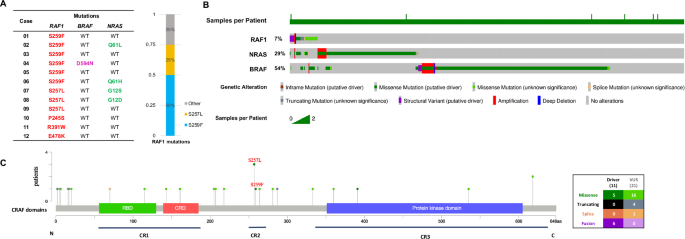
cBioPortal for Cancer Genomics. Skin Cutaneous Melanoma (TCGA, PanCancer Atlas). 2025. https://www.cbioportal.org/study?id=skcm_tcga_pan_can_atlas_2018 (accessed 2025-10).
Wang P, Laster K, Jia X, Dong Z, Liu K. Targeting CRAF kinase in anti-cancer therapy: progress and opportunities. Mol Cancer. 2023;22:208.
Google Scholar
Riaud M, Maxwell J, Soria-Bretones I, Dankner M, Li M, Rose AAN. The role of CRAF in cancer progression: from molecular mechanisms to precision therapies. Nat Rev Cancer. 2024;24:105–22.
Google Scholar
Cerami E, Gao J, Dogrusoz U, Gross BE, Sumer SO, Aksoy BA, et al. The cBio cancer genomics portal: an open platform for exploring multidimensional cancer genomics data. Cancer Discov. 2012;2:401–4.
Google Scholar
Gao J, Aksoy BA, Dogrusoz U, Dresdner G, Gross B, Sumer SO, et al. Integrative analysis of complex cancer genomics and clinical profiles using the cBioPortal. Sci Signal. 2013;6:pl1.
Google Scholar
Pandit B, Sarkozy A, Pennacchio LA, Carta C, Oishi K, Martinelli S, et al. Gain-of-function RAF1 mutations cause Noonan and LEOPARD syndromes with hypertrophic cardiomyopathy. Nat Genet. 2007;39:1007–12.
Google Scholar
Razzaque MA, Nishizawa T, Komoike Y, Yagi H, Furutani M, Amo R, et al. Germline gain-of-function mutations in RAF1 cause Noonan syndrome. Nat Genet. 2007;39:1013–7.
Google Scholar
Molzan M, Schumacher B, Ottmann C, Baljuls A, Polzien L, Weyand M, et al. Impaired binding of 14-3-3 to C-RAF in Noonan syndrome suggests new approaches in diseases with increased Ras signaling. Mol Cell Biol. 2010;30:4698–711.
Google Scholar
Antony R, Emery CM, Sawyer AM, Garraway LA. C-RAF mutations confer resistance to RAF inhibitors. Cancer Res. 2013;73:4840–51.
Google Scholar
Imielinski M, Greulich H, Kaplan B, Araujo L, Amann J, Horn L, et al. Oncogenic and sorafenib-sensitive ARAF mutations in lung adenocarcinoma. J Clin Invest. 2014;124:1582–6.
Google Scholar
Louveau B, Jouenne F, Tetu P, Sadoux A, Gruber A, Lopes E, et al. A melanoma-tailored next-generation sequencing panel coupled with a comprehensive analysis to improve routine melanoma genotyping. Target Oncol. 2020;15:759–71.
Google Scholar
Barbieux S, Jouenne F, Machet MC, Fraitag S, Macagno N, Battistella M, et al. Re-evaluation of the concept of basaloid follicular hamartoma associated with naevoid basal cell carcinoma syndrome: a morphological, immunohistochemical and molecular study. Pathology. 2025;57:49–56.
Google Scholar
Poulikakos PI, Zhang C, Bollag G, Shokat KM, Rosen N. RAF inhibitors transactivate RAF dimers and ERK signalling in cells with wild-type BRAF. Nature. 2010;464:427–30.
Google Scholar
Hatzivassiliou G, Song K, Yen I, Brandhuber BJ, Anderson DJ, Alvarado R, et al. RAF inhibitors prime wild-type RAF to activate the MAPK pathway and enhance growth. Nature. 2010;464:431–5.
Google Scholar
Hu J, Stites EC, Yu H, Germino EA, Meharena HS, Stork PJS, et al. Allosteric activation of functionally asymmetric RAF kinase dimers. Cell. 2013;154:1036–46.
Google Scholar
Bennett DC, Cooper PJ, Hart IR. A line of non-tumorigenic mouse melanocytes, syngeneic with the B16 melanoma and requiring a tumour promoter for growth. Int J Cancer. 1987;39:414–8.
Google Scholar
Yang Y, Wu J, Demir A, Castillo-Martin M, Melamed RD, Zhang G, et al. GAB2 induces tumor angiogenesis in NRAS-driven melanoma. Oncogene. 2013;32:3627–37.
Google Scholar
Chiloeches A, Mason CS, Marais R. S338 phosphorylation of Raf-1 is independent of phosphatidylinositol 3-kinase and Pak3. Mol Cell Biol. 2001;21:2423–34.
Google Scholar
Diaz B, Barnard D, Filson A, MacDonald S, King A, Marshall M. Phosphorylation of Raf-1 serine 338-serine 339 is an essential regulatory event for Ras-dependent activation and biological signaling. Mol Cell Biol. 1997;17:4509–16.
Google Scholar
Jaumot M, Hancock JF. Protein phosphatases 1 and 2A promote Raf-1 activation by regulating 14-3-3 interactions. Oncogene. 2001;20:3949–58.
Google Scholar
Dhillon AS, Pollock C, Steen H, Shaw PE, Mischak H, Kolch W. Cyclic AMP-dependent kinase regulates Raf-1 kinase mainly by phosphorylation of serine 259. Mol Cell Biol. 2002;22:3237–46.
Google Scholar
Medina M, Avila J, Villanueva N. Use of okadaic acid to identify relevant phosphoepitopes in pathology: a focus on neurodegeneration. Mar Drugs. 2013;11:1656–68.
Google Scholar
Farrar MA, Alberol- IlaJ, Perlmutter RM. Activation of the Raf-1 kinase cascade by coumermycin-induced dimerization. Nature. 1996;383:178–81.
Google Scholar
Noeparast A, Giron P, Noor A, Bahadur Shahi R, De Brakeleer S, Eggermont C, et al. CRAF mutations in lung cancer can be oncogenic and predict sensitivity to combined type II RAF and MEK inhibition. Oncogene. 2019;38:5933–41.
Google Scholar
Atefi M, Titz B, Tsoi J, Avramis E, Le A, Ng C, et al. CRAF R391W is a melanoma driver oncogene. Sci Rep. 2016;6:27454.
Google Scholar
King AJ, Sun H, Diaz B, Barnard D, Miao W, Bagrodia S, et al. The protein kinase Pak3 positively regulates Raf-1 activity through phosphorylation of serine 338. Nature. 1998;396:180–3.
Google Scholar
Chan EY, Stang SL, Bottorff DA, Stone JC. Mutations in conserved regions 1, 2, and 3 of Raf-1 that activate transforming activity. Mol Carcinog. 2002;33:189–97.
Google Scholar
Nassar N, Horn G, Herrmann C, Scherer A, McCormick F, Wittinghofer A. The 2.2 A crystal structure of the Ras-binding domain of the serine/threonine kinase c-Raf1 in complex with Rap1A and a GTP analogue. Nature. 1995;375:554–60.
Google Scholar
Cregg J, Edwards AV, Chang S, Lee BJ, Knox JE, Tomlinson ACA, et al. Discovery of daraxonrasib (RMC-6236), a potent and orally bioavailable RAS(ON) multi-selective, noncovalent tri-complex inhibitor for the treatment of patients with multiple RAS-addicted cancers. J Med Chem. 2025;68:6064–83.
Google Scholar
Schulze CJ, Seamon KJ, Zhao Y, Yang YC, Cregg J, Kim D, et al. Chemical remodeling of a cellular chaperone to target the active state of mutant KRAS. Science. 2023;381:794–9.
Google Scholar
Burd CE, Liu W, Huynh MV, Waqas MA, Gillahan JE, Clark KS, et al. Mutation-specific RAS oncogenicity explains NRAS codon 61 selection in melanoma. Cancer Discov. 2014;4:1418–29.
Google Scholar
Park E, Rawson S, Schmoker A, Kim BW, Oh S, Song K, et al. Cryo-EM structure of a RAS/RAF recruitment complex. Nat Commun. 2023;14:4580.
Google Scholar
Anastacio Da Costa Carvalho L, Tovbis Shifrin N, Phadke MS, Emmons MF, Pechuan-Jorge X, Mbuga F, et al. RAS(ON) multiselective inhibition drives antitumor immunity in preclinical models of NRAS-mutant melanoma. Cancer Immunol Res. 2026;14:90–106.
Google Scholar
Ozgu E, Aydin E, Adibi A, Tokat UM, Tutar O, Hu J, et al. Exceptional response to MEK inhibition in a patient with RAF1-mutant myxofibrosarcoma: case report and mechanistic overview. JCO Precis Oncol. 2023;7:e2300299.
Google Scholar
Wolpin BM, Park W, Garrido-Laguna I, Spira A, Starodub A, Sommerhalder D, et al. Daraxonrasib in previously treated advanced RAS-mutated pancreatic cancer. N Engl J Med. 2026;394:1790–802.
Google Scholar
