


Comprehensive genetic analysis reveals distinct molecular features in pediatric AML-M0
We included 23 pediatric AML-M0 patients who were strictly diagnosed through a central review by the JCCG and evaluation of flow cytometry data. Most early studies on AML-M0 were based on “classic” criteria, defined as MPO negativity, absence of B- and T-lineage markers, and positivity for CD13 and/or CD33 [1, 2]. However, these criteria include acute undifferentiated leukemia (AUL) and other immature leukemia subtypes based on the current criteria. In this study, the blast cells expressed at least two myeloid-associated markers (CD13, CD117, and/or CD33). The clinical characteristics of the patients are summarized in Supplementary Table S1. To comprehensively characterize the genomic landscape of pediatric AML-M0, we performed WES in 23 patients and WGS in 19 patients. We compared our results with those from pediatric patients with non-M0 AML and other types of leukemia in publicly available databases.
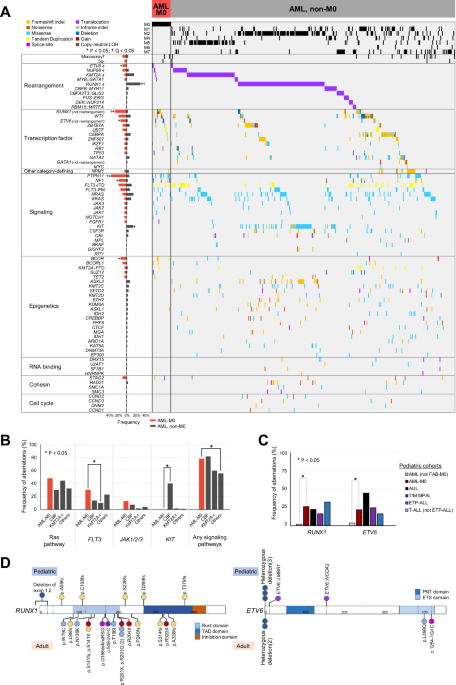
The most frequent genetic alterations in AML-M0 were RUNX1 (26%) and ETV6 (22%). After correction for multiple testing, RUNX1 and PTPN11 were found to be significantly more prevalent than in non-M0 pediatric AML (Fig. 1A and Supplementary Tables S4–7). Other recurrent alterations, including ETV6, NF1, and BCOR, showed a tendency toward a higher prevalence in AML-M0, but these differences were not statistically significant after correction for multiple comparisons. Most RUNX1 and ETV6 aberrations are frameshift, nonsense, or heterozygous deletions that are likely to result in loss-of-function alterations.
Fig. 1: Landscape of genomic alterations in pediatric AML-M0.The alternative text for this image may have been generated using AI.
A Cytogenetic and genomic alterations in pediatric AML-M0 (n = 23) and non-M0 pediatric AML patients (n = 351). Each column represents a single scenario. Alteration frequencies are shown on the left-hand side. B Comparative frequencies of signaling pathway mutations between AML-M0 and various subtypes of pediatric AML, including those with core-binding factor (CBF) rearrangements, such as RUNX1::RUNX1T1 and CBFB::MYH11, KMT2A rearrangements, and other non-M0 pediatric AML cases. C The frequencies of RUNX1 loss-of-function alterations (left) and ETV6 aberrations (right) observed in pediatric leukemia subtypes (non-M0 AML, n = 351; AML-M0, n = 23; AUL, n = 9; T/myeloid MPAL, n = 49; ETP-ALL, n = 31; and non-ETP T-ALL, n = 90). D Details of the alterations in RUNX1 (left) and ETV6 (right) observed in pediatric (upper) and adult (lower) AML-M0 cohorts.
Category-defining genomic lesions, as recently described in pediatric AML [11], including UBTF tandem duplications (TD), CEBPA bZIP domain mutations, NPM1 mutations, NUP98::NSD1 fusion, and MYB::GATA1 fusion, have also been identified in individual cases. Notably, activating mutations in signaling pathways were identified in 83% of the cases, with mutations in RAS pathway genes (48%), FLT3 (30%), JAK genes (13%), and FGFR1 (4%). Among these genes, PTPN11 was the most frequently mutated (35%). Enrichment of these signaling mutations was more pronounced in AML-M0 than in non-M0 AML without core-binding factors or KMT2A rearrangements (Fig. 1B).
Notably, RUNX1 and ETV6 aberrations were frequently observed in immature pediatric leukemia subtypes, including AUL, T/myeloid mixed-phenotype acute leukemia (MPAL), and ETP-ALL (Fig. 1C), suggesting shared molecular features across immature acute leukemia phenotypes.
Additionally, we compared the genomic alterations in 23 pediatric AML-M0 patients with those in 34 adult AML-M0 patients (TCGA-LAML: n = 15; Beat AML: n = 19). Consistent with the pediatric cohort, RUNX1 aberrations were the most prevalent genetic alteration in adult AML-M0 patients, occurring in 38% of cases (Supplementary Fig. S1). Biallelic RUNX1 alterations were observed in 62% (8/13) of affected adult cases. These alterations included missense mutations within the DNA-binding Runt domain, nonsense mutations, and frameshift variants (Fig. 1D). In addition, ETV6 loss-of-function aberrations (12%) occurred exclusively with RUNX1 alterations, as observed in pediatric AML-M0. In contrast to pediatric AML-M0, adult cases had more frequent alterations in TP53 (21%) and epigenetic and splicing regulators, such as IDH2 (24%), DNMT3A (15%), and ASXL1 (15%) (Supplementary Fig. S1).
AML-M0 exhibits unique gene expression and DNA methylation profiles
To explore the molecular features of AML-M0, we analyzed its gene expression profile using RNA sequencing (RNA-seq) across various types of pediatric acute leukemia, including AML, T-ALL, B-ALL, and ALAL, which comprise AUL, T/myeloid MPAL, B/myeloid MPAL, and other MPAL subtypes. T-distributed stochastic neighbor embedding (t-SNE) analysis revealed three primary clusters corresponding to AML, T-ALL, and B-ALL, with ALAL samples distributed between these clusters (Fig. 2A). AML-M0 samples were localized within the AML cluster and were closely adjacent to ALAL, which was consistent with their immature phenotype and supported the current WHO-based classification in our cohort. Similarly, ETP-ALL clustered near ALAL within the T-ALL group, suggesting that leukemia with the immature phenotype represented a continuous molecular spectrum.
Fig. 2: Comparisons of AML-M0 and other leukemic subtypes.The alternative text for this image may have been generated using AI.
A T-SNE projections of gene expression data from in-house samples and publicly available pediatric datasets (AML-M0, n = 19; non-M0 AML, n = 656; T-ALL, n = 388; B-ALL, n = 253; ALAL, n = 85). The 1000 most variable genes (based on absolute median deviation) were used with a perplexity of 100 to investigate global relationships. B Unsupervised hierarchical clustering of AML samples (n = 131) was performed using the 1000 most variably expressed genes and 1000 most variably methylated probes integrated through similarity network fusion.
In the AML cohort, AML-M0 formed a transcriptionally distinct subgroup with a high pediatric leukemic stem cell (pLSC6) score [37] (Supplementary Fig. S2). Subsequently, we evaluated the DNA methylation profiles, which are known to reflect the molecular basis of the disease and are useful for AML subclassification [38]. Most AML-M0 samples were included in a coherent cluster and co-localized with those harboring monosomy 7, indicating shared epigenetic features (Supplementary Fig. S3).
To refine the classification and further clarify the relationship between AML-M0 and other AML subtypes, we integrated transcriptome and methylation data using similarity network fusion, followed by consensus clustering. AML-M0 samples primarily belonged to cluster 7, which was characterized by high CD34 and CD3D expression, consistent with an immature phenotype (Fig. 2B). Notably, this cluster included samples with monosomy 7 or a FUS::ERG fusion gene, both of which are associated with a poor prognosis. AML-M0 cases in other clusters harbored subtype-specific alterations, including CEBPA mutations, MYB::GATA1 fusions, and FLT3 internal tandem duplications. Collectively, these findings highlight that AML-M0 is a heterogeneous subgroup but a major subset of AML-M0 cases, particularly those without defining alterations, shared similar gene expression signatures and DNA methylation profiles, reflecting an immature phenotype.
AML-M0 is characterized by global DNA hypermethylation and downregulation of widespread biological processes
To further elucidate the molecular characteristics of pediatric AML-M0, we performed a comparative analysis of the gene expression and DNA methylation profiles of pediatric non-M0 AML. Compared to non-M0 AML cells, AML-M0 cells display widespread DNA hypermethylation and reduced gene expression. A total of 1333 probes were significantly hypermethylated (q < 0.05, ΔB > 0.2), 25% of which were located on CpG islands. In addition, 545 genes were significantly downregulated, of which 77 were classified as underexpressed genes with hypermethylated probes (Fig. 3A). These “hypermethylated and under-expressed” genes included MPO, CSTA, MS4A3, and ELANE, all of which are closely related to myeloid differentiation (Supplementary Table S8). In contrast, overexpressed genes with hypomethylated probes included BAALC, a gene known to inhibit myeloid differentiation and associate with leukemogenesis, chemoresistance, and poor prognosis [39, 40]. The differentially methylated regions in these genes were not consistently located in the promoter regions (Supplementary Table S8). Therefore, the direct contribution of DNA methylation changes to the observed alterations in gene expression remains unclear.
Fig. 3: Gene expression and DNA methylation profiles of AML-M0.The alternative text for this image may have been generated using AI.
A Starburst plot illustrating gene expression and DNA methylation profiles in pediatric AML-M0 (gene expression, n = 19; DNA methylation, n = 20) compared to non-M0 pediatric patients with AML (gene expression, n = 389; DNA methylation, n = 116). Each dot represents a methylation probe, plotted according to the difference of methylation (Δβ) and corresponding gene expression (Log2FC). Probes with |Δβ|>0.2 and |Log2FC|>2 are highlighted as red dots. B Enrichment analysis of stemness-related signatures. C Enrichment analysis of myeloid developmental signatures according to the FAB classification. Enrichment scores were calculated for each individual sample using GSVA, and the median value for each signature in each group is displayed. D Comparison of pLSC6 scores between patients with AML-M0 and non-M0 AML. E, F Enrichment analysis was performed using the TRRUST and pathway/process databases in Metascape. A list of the 500 most significantly downregulated genes in AML-M0 cells was used. G Enrichment analysis using OxPhos and Ribosome-related gene sets was performed using GSEA. H Volcano plot illustrating differentially expressed genes between AML-M0 and non-M0 AML. Genes with a q-value < 10–1, and Log2FC > 1 or Log2FC < –1 are highlighted as red dots or blue dots, respectively.
GSEA and gene set variation analysis (GSVA) revealed that AML-M0 was enriched in stemness-associated signatures (Fig. 3B, C). These findings remained consistent when the analysis was restricted to cases from clusters 7 and 2 in Fig. 2B (Supplementary Fig. S4). Additionally, the pLSC6 score was significantly higher in AML-M0 patients than in non-M0 AML patients (Fig. 3D). Furthermore, enrichment analysis using the TRRUST database in Metascape revealed that the genes regulated by transcription factors associated with myeloid hematopoiesis (SPI1, CEBPA, CEBPE, and RUNX1) were significantly downregulated (Fig. 3E). These findings validate the stem-like properties of AML-M0 based on its gene expression profile and morphological and immunophenotypic features.
Widespread biological suppression is another hallmark of the disease. GSEA revealed the negative enrichment of 46 of the 50 hallmark gene sets in AML-M0 cells (Supplementary Fig. S5). Oxidative phosphorylation (OxPhos) and ribosome-related genes were markedly downregulated in the Metascape analysis (Fig. 3F), which was further validated using GSEA software (Fig. 3G). These findings were consistent even when the samples from Clusters 7 and 2 were analyzed independently (Supplementary Fig. S4). Notably, genes related to other metabolic processes, including glycolysis, were negatively enriched (Supplementary Fig. S5). Differentially expressed gene (DEG) analysis revealed upregulation of ETNK1 (Fig. 3H), a gene involved in the conversion of ethanolamine to phosphoethanolamine, which inhibits mitochondrial respiration and the OxPhos system.
Similar trends were observed in adult AML datasets. Consistent with the pediatric cohort, adult AML-M0 cells were characterized by the significant downregulation of genes associated with myeloid differentiation and upregulation of stemness signatures, as demonstrated by DEG analysis, GSEA, GSVA, and the 17-gene leukemia stem cell (LSC17) scoring system [41] (Supplementary Fig. S6A–D). Adult AML-M0 cells also exhibited negative enrichment of numerous hallmark gene sets, notably the downregulation of genes associated with the OxPhos and glycolysis pathways. However, the ribosome-related genes were less affected (Supplementary Fig. S6E, F).
Loss-of-function alterations of RUNX1 are associated with poor prognosis in pediatric AML-M0
Previous studies have reported that AML-M0 has a poor prognosis [4, 5]. To assess the clinical impact, we performed survival analysis using the AML-M0 and JPLSG AML-12 clinical trial cohorts. The 5-year overall survival (OS) was 78.9% for AML-M0 vs. 76.9% for non-M0 AML (P = 0.34; Fig. 4A), and the relapse-free survival (RFS) was 50.2% vs. 68.7% (P = 0.37; Fig. 4B). Notably, AML-M0 patients with RUNX1 alterations had significantly lower OS (P = 2 × 10⁻³; Fig. 4C) and RFS (P = 3 × 10⁻⁴; Fig. 4D) than other AML-M0 patients. Cox regression analysis identified RUNX1 alterations as an independent risk factor for relapse in AML-M0 (HR = 6.96; 95% CI, 1.31–62.3), whereas other frequent alterations, such as ETV6, WT1, and PTPN11, were not significantly associated with survival (Fig. 4E).
Fig. 4: Survival analysis of AML-M0.The alternative text for this image may have been generated using AI.
Overall survival (A) and relapse-free survival (B) of in-house AML-M0 (n = 23) and non-M0 (n = 353) AML patients (JPLSG AML12). Overall survival (C) and relapse-free survival (D) of the in-house AML-M0 cohort comparing cases with (n = 6) and without (n = 17) RUNX1 alterations. E Forest plot showing the results of multivariate Cox regression analysis of the effects of different parameters on relapse-free survival. Circles represent hazard ratios, and horizontal lines represent 95% confidence intervals.
The clinical characteristics did not differ between the RUNX1-altered and RUNX1-wildtype patients (Supplementary Table S1). All six AML-M0 patients with RUNX1 alterations were treated using the JPLSG AML-05 or AML-12 protocols. Two patients underwent hematopoietic stem cell transplantation as part of their initial treatment, and subsequently relapsed. Three patients were treated with conventional chemotherapy only, two of whom relapsed within one year and one within five years. One patient harboring the t(3;3) (p25;q26.2) translocation experienced primary induction failure.
To explore the molecular mechanisms underlying the poor prognosis of RUNX1-altered AML-M0 patients, we compared the gene expression and DNA methylation profiles of RUNX1-altered and RUNX1-wildtype patients (Supplementary Fig. S7A). The “hypermethylated and underexpressed” genes included CSTA and MS4A3, both of which are associated with myeloid differentiation (Supplementary Fig. S7B). On the other hand, “hypomethylated and overexpressed” genes included BAALC, DNTT, and BLNK, which are typically expressed in immature hematopoietic progenitors. GSEA also showed the enrichment of stemness-related gene sets; however, there was no clear difference in the expression of OxPhos- or ribosome-related genes (Supplementary Fig. S7C). These results suggested that RUNX1 loss may promote an undifferentiated phenotype in AML-M0 cells.
We performed survival analysis in adult AML cohorts to determine whether a similar trend was observed in adult patients. Although RUNX1 alterations were associated with a trend toward poorer prognosis, the differences were not statistically significant (Supplementary Fig. S8).
RUNX1 depletion downregulates ribosome- and OxPhos-related pathways and reduces sensitivity to chemotherapy
To validate the pathogenic role of RUNX1 alterations, we performed in vitro experiments using the recently established pediatric AML-M0 cell line, YCU-AML2 [35], which lacks RUNX1 alterations. The CRISPR/Cas9 system targeting the Runt domain of RUNX1 achieved more than 85% knockout efficiency with multiple frameshift alterations (Fig. 5A; Supplementary Fig. S9A and Supplementary Table S9).
Fig. 5: RUNX1 knockout in AML-M0 cell line “YCU-AML2.”.The alternative text for this image may have been generated using AI.
A RUNX1 knockout YCU-AML2 cells were established via lentiviral transduction with Cas9 and sgRNAs targeting exon 5 of the RUNX1 gene. Three independent knockout clones were compared with mock-transduced control cells. RUNX1 protein expression levels were analyzed using intracellular flow cytometry. A schematic representation was created using https://biorender.com. B Cell proliferation assay comparing RUNX1-knockout (blue) and mock control (gray) cells. C Cell cycle assay of RUNX1-knockout (blue) and mock control (gray) cells. D Enrichment analysis of stem cell-related signatures using GSEA. E Enrichment analysis of hallmark gene sets calculated using GSEA. Gene sets with q-value < 0.1 are shown. F Enrichment analysis of Gene Ontology (GO) gene sets calculated using GSEA. The top 20 negatively enriched gene sets in RUNX1-knockout cells are shown. G Seahorse extracellular flux analysis of YCU-AML2 cells comparing RUNX1-knockout (blue) and mock control (gray). Oxygen consumption rate (OCR; left) and extracellular acidification rate (ECAR; right) were measured under basal conditions using the Seahorse XF Real-Time ATP Rate Assay Kit. H Sensitivity to representative drugs is presented as a drug effect score by comparing RUNX1-knockout cells (blue) and mock-transfected control cells (gray).
Short-term cell proliferation and cell cycle assays showed no significant differences between RUNX1-knockout and mock control cells (Fig. 5B, C). In contrast, clonogenic assays demonstrated a reduced colony-forming capacity in RUNX1-knockout cells (Supplementary Fig. S9B). As stemness signatures were upregulated in RUNX1-altered AML-M0 cells in clinical samples, the upregulation of leukemic stem cell signatures was observed in these in vitro experiments. (Fig. 5D). GSEA using hallmark gene sets revealed downregulation of genes involved in multiple biological pathways, including the OxPhos and ROS pathways in RUNX1-knocked-out cells (Fig. 5E). Additionally, GSEA using Gene Ontology gene sets showed a marked downregulation of ribosome-related and OxPhos-related gene sets in RUNX1-knocked-out cells (Fig. 5F).
To functionally assess the metabolic changes indicated by our transcriptomic analyses, we performed a Seahorse extracellular flux assay. Both the OCR and ECAR were reduced in RUNX1-knockout cells compared to controls, supporting the coordinated attenuation of oxidative phosphorylation and glycolytic activity (Fig.5G and Supplementary Fig. S9C).
Finally, we performed a drug-screening test using RUNX1-knockout YCU-AML2 cells. Drug sensitivity testing revealed that RUNX1 disruption induced resistance to multiple drugs, including key drugs for AML treatment such as cytarabine and anthracyclines (Fig. 5H and Supplementary Fig. S9D). Resistance to the MEK inhibitors Trametinib and Selumetinib was also observed. In contrast, L-Asparaginase, Docetaxel, and Gemcitabine remain effective despite not being used in standard AML treatment regimens.
These findings suggest that RUNX1 loss-of-function increases stemness and impairs OxPhos and ribosome function, potentially leading to reduced ROS and DNA damage, which could contribute to chemoresistance in AML-M0 cells.
