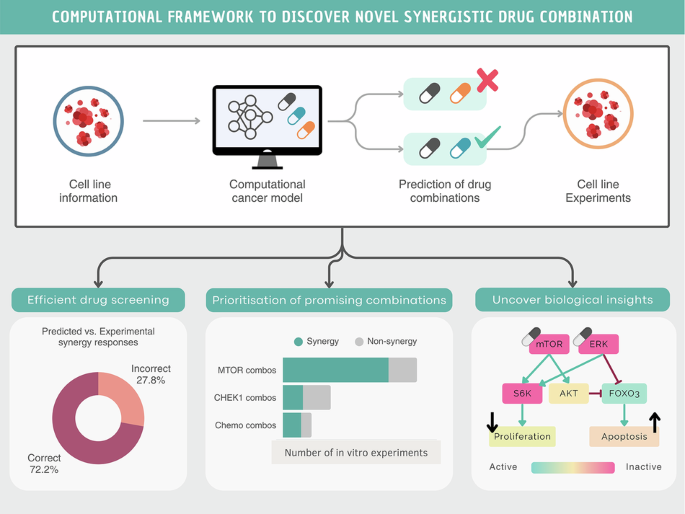
Colorectal cancer (CRC) exhibits high genetic heterogeneity and frequent resistance to single-agent therapies, highlighting the need for rationally designed drug combinations. We apply a mechanistic modelling framework to prioritise synergistic combinations in 16 CRC cell lines. Simulations of 210 double perturbations among 21 targeted inhibitors guided the selection of 17 combinations for experimental validation. Of 704 tested conditions, 68% showed synergy, most involving PI3K/AKT/MTOR-related inhibitors. We report six novel compound combinations that inhibit CRC cell-line growth by targeting MTOR and ERK, or MTOR and BCL2. In silico analysis indicates that feedback suppression via S6K–FOXO3 mediates the MTORi–ERKi synergy, whereas apoptotic reinforcement explains the MTORi–BCL2i effect. These results demonstrate that model-guided prioritisation enables the efficient discovery of synergistic drug pairs, mechanistic insight into their action, and a scalable route to rational combination-therapy design in CRC.
Trending
- MMSDH facilitates ACSL4 propionylation to counteract ferroptosis upon hypoxia and impairs PDAC chemotherapy efficacy
- Development and preclinical evaluation of a decoy DLL4-encoding oncolytic HSV-1 for high-grade glioma
- ATR inhibition induces NF-κB-dependent immunogenicity in Merkel cell carcinoma independent of cGAS-STING
- Debating CAR T-Cell Therapy Vs Bispecifics at First Relapse in Myeloma
- A pro-inflammatory metastasis-associated macrophage subset induces tumor-promoting mesothelial cell conversion in ovarian cancer via IL-1α secretion
- Scientists find a way to break pancreatic cancer’s protective shield
- Perioperative Durvalumab Combo Boosts Survival in Resectable Gastric Cancer
- Targeting mitochondrial dysfunction and apoptosis in 5-fluorouracil–induced cardiotoxicity using kaempferol-mediated selenium nanoparticles


Sunday, September 13
Model-guided discovery of MTOR-oriented synergistic drug combinations in colorectal cancer
 By NewsCancer