


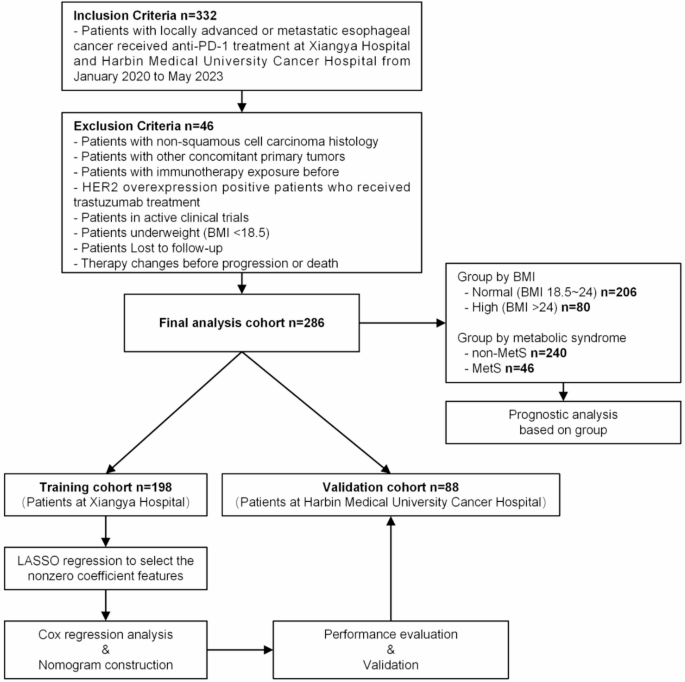
We conducted a multi-center study of anti-PD-1 therapy in locally advanced or metastatic esophageal cancer patients from two large Chinese hospitals, revealing that adequate nutritional status, predominantly reflected by high BMI, significantly correlates with improved treatment response and survival, alongside a potential prognostic trend for MetS. Consequently, we developed and validated a prognostic prediction model that integrates obesity status with other key clinical determinants. This finding aligns with the growing body of evidence describing a similar “obesity paradox” in other malignancies treated with immunotherapy15,16,18,25. However, the implications of obesity for anti-PD-1 efficacy in esophageal cancer remain unexplored, paradoxically despite its well-established role as an independent risk factor for the disease13,26,27. This gap in knowledge is particularly critical for patients with locally advanced or metastatic disease, in whom anti-PD-1 therapy has emerged as a promising new standard-of-care. A key contribution of our work is the systematic elucidation of this phenomenon in esophageal cancer immunotherapy, which both broadens the landsframework for patient stratification that could inform the development of more cape of the “obesity paradox” in oncology and provides a refined treatment approaches.
The most immediate clinical implication of our study lies in the construction of a practical prognostic model. By incorporating obesity status alongside conventional clinical factors, this tool enables a more nuanced stratification of patients in whom improved survival is observed. A review of the existing literature indicated that the association between obesity and treatment outcomes could be influenced by kinds of clinical factors. For instance, a sex-specific obesity paradox has been reported in metastatic melanoma patients receiving immunotherapy, wherein the association between obesity and a lower risk of mortality or disease progression is driven predominantly by the male population28,29. Furthermore, a striking association exists between obesity and gynecologic cancers, implicating the role of female sex steroids in their pathogenesis. Notably, obesity exhibits differential risk profiles by gender for several cancers, including those of the colon, rectum, gallbladder, kidney, and pancreas13,26,30,31. Age must also be considered within the obesity paradox framework, particularly for cancers with wide age distributions such as leukemia. This is evidenced by a study of acute myeloid leukemia where advanced age and low BMI jointly predicted significantly increased mortality—a relationship potentially mediated by age-related physiological changes, such as increased fat stores and decreased lean body mass, which alter the association between BMI and mortality31,32.
Given the close relationship between obesity and a chronic, low-grade inflammatory state33, we investigated PIV as a novel biomarker reflective of this dysregulated immune response. By integrating multiple immune and inflammatory signals, PIV offers a more comprehensive profile of a patient’s immune status than traditional biomarkers, establishing it as a promising tool for predicting immunotherapy outcomes and personalizing treatment34,35,36. Therefore, these variables were included in the analysis to account for their potential influence. Thus, our model translates the observed association into a clinically applicable stratification tool. By incorporating readily available variables like obesity, it achieves a synergistic enhancement of prognostic precision, offering direct potential for clinical implementation.
It is noteworthy that while both BMI and MetS demonstrated significant prognostic value in the univariate analysis, only BMI maintained robust, independent significance in the multivariable Cox model, thereby justifying its exclusive selection for the final parsimonious nomogram. The attenuation of MetS to marginal significance likely stems from some factors. Due to their inherent conceptual overlap, the stronger prognostic signal of BMI likely absorbed a substantial portion of their shared statistical variance. MetS is a highly heterogeneous composite syndrome, it’s constituent components may exert contradictory effects on tumor progression (e.g., protective nutritional reserve versus detrimental systemic inflammation), thereby diluting its overall prognostic magnitude. Finally, this marginal significance may also reflect limited statistical power (a potential Type II error), indicating that larger cohorts are needed to definitively evaluate its independent role.
Despite the intriguing findings presented above, several limitations of this study should be acknowledged. First, our definition of obesity relied solely on BMI and MetS status. The practicality of BMI is offset by its inability to accurately assess body composition, as it does not differentiate lean from fat mass. Given this limitation, it is imperative to include supplementary measures that more comprehensively reflect adiposity. Parameters such as waist and hip circumference, and when feasible, body composition analysis for fat and muscle percentage, are essential for a correct definition of overweight and obesity as a comprehensive trait37,38,39,40. Additionally, the exclusion of underweight patients (BMI < 18.5 kg/m²), while intended to reduce confounding by cancer cachexia, limits the generalizability of our findings to this specific patient subgroup. Future studies should explicitly include underweight patients to investigate the distinct interplay between cachexia, host metabolism, and immunotherapy efficacy, which may reveal unique biological drivers and inform tailored therapeutic strategies for this vulnerable subgroup. Second, although this study utilized data from two large Chinese hospitals, the sample size in certain subgroups became limited after stratification, which may have constrained the robustness of our sub-analyses. Furthermore, the predictive model requires external validation in large-scale, prospective, multi-center cohorts to establish its generalizability. Our ongoing research efforts are directed toward clinical application, with the aim of iteratively refining and optimizing the model through real-world deployment. Third, a deep mechanistic understanding of the obesity paradox in esophageal cancer is still lacking. Current explanations are predominantly speculative and await experimental confirmation. This uncertainty charts a clear path for our future work, aimed at probing the molecular and immunology basis of this phenomenon, with the ultimate goal of understanding whether the metabolic features associated with obesity can be therapeutically harnessed.
We recognize that the principal value of this study lies in its hypothesis-generating nature and the development of a predictive tool. Our findings should be considered exploratory, not definitive, and they illuminate a clear path for future mechanistic investigations and large-scale clinical validation.
