


Proteomic landscape across normal, preneoplastic and neoplastic gastric tissue
We employed a DIA-MS-based approach to characterize the proteomic landscape of the stomach. A total of 46 patients were included: 10 controls, 10 with CG, 7 with IM-LGD, 10 with EGC and 9 with GC. Among them, 27 (58.7%) were women and 19 (41.3%) were men, with a mean age of 64.4 years (SDs 15.2). The descriptive data of the participants are shown in Table 1. Biopsies from patients with IM-LGD, EGC and GC were taken from L and NL areas (Additional file 1: Table S1).
Table 1 Baseline characteristics of the participants according to the cohort. Categorical variables are described by numbers (percentages) and continuous variables by means (±SDs). * CG = chronic gastritis, IM-LGD = intestinal metaplasia-low grade dysplasia, EGC = early gastric cancer, and GC = gastric cancer, H. pylori = Helicobacter pylori.
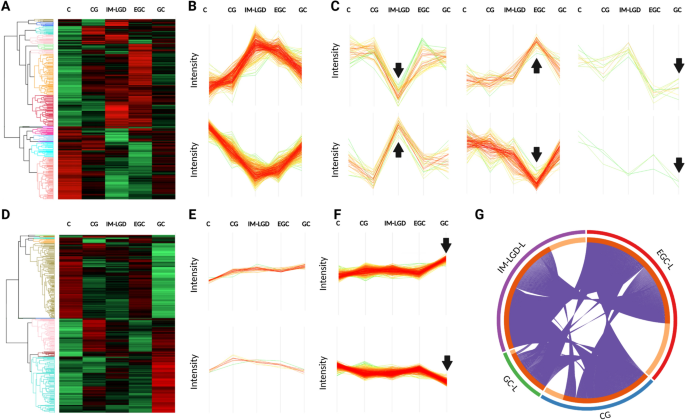
Across the 3.272 quantified proteins from all experimental groups, we identified distinct subsets of proteins displaying differential modulation depending on the pathological or non-pathological nature of the tissue (Fig. 1A-F and Additional file 2: Figure S1). These modulations varied according to disease stage (Fig. 1C, 1F), revealing stage-specific proteomic signatures as the disease progressed. Moreover, we found that specific components of the differential stomach proteome were consistently altered across different malignancy stages (Fig. 1G), suggesting shared molecular mechanisms underlying gastric carcinogenesis.
Fig. 1
Proteomic variations in digestive tissue at different stages of gastric carcinogenesis. A. Heatmap showing the proteome of biopsies from L gastric tissue across groups C, G, IM-LGD, EGC, and GC. B. Protein clusters associated with disease progression. C. Protein clusters peaking at various stages. D. Heatmap showing the proteome of biopsies from NL gastric tissue across groups C, G, IM-LGD, EGC, and GC. E. Protein clusters associated with disease progression. F. Protein clusters peaking in the GC stage (non-tumoral tissue). G. Circos plot representing the deregulated proteome in stomach tissue shared between lesions. Inside, dark orange indicates proteins shared by multiple lists, while light orange indicates proteins unique to a dataset. Purple lines connect proteins shared across biological conditions. (CG = chronic gastritis, IM-LGD = intestinal metaplasia-low grade dysplasia, EGC = early gastric cancer, and GC = gastric cancer, NL = non-lesional, L = lesional).
Our analysis identified 728, 1.019, 1.220, and 338 DEPs in CG, IM-LGD-L, EGC-L, and GC-L samples (Fig. 2). Despite a relatively balanced distribution of upregulated and downregulated proteins across these stages (Fig. 2A), elevated protein levels were particularly prominent during the IM-LGD-L and EGC-L stages, likely reflecting heightened cellular activity related to inflammation, tissue repair, and immune responses—processes standard in precancerous and early stages16.
Fig. 2
Differentially expressed proteins in the stomach across CG, IM-LGD, EGC, and GC. A. Differential gastric proteome distribution across L stages. B. Venn diagram of standard and unique differential protein between lesional stages. C. Differential stomach proteome distribution across non-lesional stages. D. Venn diagram of standard and unique differential protein between non-lesional stages. (CG = chronic gastritis, IM-LGD = intestinal metaplasia-low grade dysplasia, EGC = early gastric cancer, and GC = gastric cancer, NL = non-lesional, L = lesional). Barplots were made using Biorender.com and diagrams with online tool 17.
Despite these general trends, 136 DEPs were consistently modulated across all stages and 54 DEPs were uniquely associated with malignant transformation (Fig. 2B). (Additional file 3: Table S2). In contrast, NL tissue from IM-LGD, EGC, and GC exhibited 334, 120, and 1.078 DEPs, respectively (Fig. 2C). Among these, 40 DEPs were common across the three stages (Fig. 2D).
Only four DEPs were shared between L and NL tissues (Additional file 3: Table S2 and Additional file 4: Figure S2). These were related to cell adhesion (MAGI1), innate immunity (NLRX), lipid metabolism (CHKB), and apoptosis regulation (TIGAR). Neutrophil degranulation was the only shared signaling pathway between common L and NL tissue proteins (Additional file 4: Figure S2).
Commonalities and differences across tissue types
To uncover common and distinct biological processes associated with gastric carcinogenesis, stage-dependent proteomic datasets from NL and L gastric tissues were subjected to functional enrichment analysis. As shown in Figs. 3A, 3B, functional similarities were observed between L and NL tissues across disease stages. Vesicle-mediated transport, extracellular matrix organization, trans-Golgi network vesicle budding, and neutrophil degranulation pathways were commonly enriched in L and NL gastric tissue (Fig. 3A, 3B). However, distinct pathways, such as aflatoxin activation and detoxification, expressed lesion-specific disruption across IM-LGD, EGC, and GC (Fig. 3A).
Fig. 3
Pathway enrichment and protein expression changes in gastric tissue. A, B. Heatmaps illustrating commonly enriched pathways in L and NL gastric tissue across different disease stages using Reactome database through Metascape tool. Yellow arrows indicate biological processes commonly altered in L and NL tissues in all cohorts. The green arrow indicates a biological process only presented in lesions. Blue arrows indicate biological processes commonly altered in EGC-L and GC-NL. C. Boxplots of MDH1 protein expression changes in IM-LGD-L, EGC-L, GC-NL, and GC-L. D. Boxplots of PDP1 protein expression changes in IM-LGD-L and EGC-L. E. Boxplots of NDUFB6 protein expression changes in IM-LGD-L, EGC-L, and GC-L. F. Boxplots of CAMP protein expression changes in IM-LGD-L, GC-NL, and GC-L. G. Boxplots of S100A11 protein expression changes in IM-LGD-L, EGC-L, and GC-L. H. Boxplots of STOM protein expression changes in EGC-L, GC-NL and GC-L. I. Boxplots of ANPEP protein expression changes in EGC-NL, EGC-L, GC-NL and GC-L. J. Boxplots of COTL1 protein expression changes in IM-LGD-L and EGC-L. Boxplots show the distribution of protein expression intensity in each group vs.control group. The box represents the interquartile range (IQR), the line within the box is the median, and the whiskers extend to 1.5 times the IQR. Individual points represent the expression in each sample. Error bars represent the IQR. Significance labels indicate the statistical significance of the difference between groups: *p < 0.05, **p < 0.01, and ***p < 0.001. (CG = chronic gastritis, IM-LGD = intestinal metaplasia-low grade dysplasia, EGC = early gastric cancer, and GC = gastric cancer, NL = non-lesional, L = lesional).
Pathway enrichment and shared DEPs between EGC-L and GC-NL tissues
The analysis revealed several intriguing comparisons across different tissues (Additional file 5: Table S3). Notably, we observed significant enrichment of specific pathways between EGC-L and GC-NL tissues, which appeared similar based on quantification results. These two cohorts exhibited the highest number of DEPs, with 796 DEPs common between them. Key enriched pathways included rRNA processing, lysine catabolism, and phase II: conjugation of compounds (Figs. 3A, B). In rRNA processing, 25 common proteins were identified (Additional file 6: Figure S3), primarily upregulated (e.g., NOB1, BYSL, RPS15A, EBNA1BP2, GNL3), with only two downregulated (RPL22, HSD17B10). Lysine catabolism showed downregulation of all three common proteins (DLST, GCDH, and DHTKD1) (Additional file 6: Figure S3). Phase II: conjugation of compounds also displayed predominantly inhibited proteins, except for PAPSS2 and TRMT112 (Additional file 6: Figure S3).
Enriched pathways in premalignant and advanced stages of gastric carcinogenesis
Regarding gastric carcinogenesis, aflatoxin activation and detoxification were uniquely enriched in malignant stages (Fig. 3A), involving MGST1, MGST3, and AKR7A3 (Additional file 7: Figure S4). AKR7A3 is associated with AFB1 detoxification, protecting against its carcinogenic effects18. Formation of fibrin clot (clotting cascade) and antimicrobial peptides were consistently present across both tissue types (Figs. 3A, B). PRTN3 was the sole common protein, upregulated across almost all tissues (not in CG), with higher significance in L and GC-NL tissues (Additional file 7: Figure S4).
Protein expression changes were also observed during the transition from early to advanced cancer. Pathways such as vpr-mediated induction of apoptosis, signaling by high-kinase activity BRAF, hyaluronan uptake and degradation, and mutants’ regulation of IGF transport, were enriched in IM-LGD-L, EGC-L, and GC-NL, but diminished in advanced L tumors (Figs. 3A, B). This included the downregulation of SLC25A4, SLC25A5, and SLC25A6 in apoptosis induction, and upregulation of CSK, FGA, FGB, CD44, GUSB, APOB, APOE, C3, CP, FGA, FUCA2, ITIH2, and PLG in the other three pathways (Additional file 8: Figure S5).
Consistently dysregulated pathways: aerobic respiration and neutrophil degranulation
Focusing on the most significantly altered pathways (with higher z-scores), we found that aerobic respiration, respiratory electron transport, and neutrophil degranulation were consistently dysregulated throughout disease progression (Figs. 3A, B). Within respiratory electron transport, a core set of proteins, including UQCRFS1, VDAC1, COX4I1, NDUFS3, NDUFB3, NNT, NDUFB8, NDUFA9, COX6C, NDUFS2 and UQCRQ, exhibited consistent inhibition across tissue types, from CG to GC-L, including its adjacent tissues (except EGC-NL) (Additional file 9: Figure S6). Further analysis revealed specific protein expression changes: MDH1 was downregulated from IM-LGD-L to GC-L, including its adjacent tissue (Fig. 3C), PDP1 inhibition was exclusively detected in precancerous or early stages (Fig. 3D), and NDUFB6 was inhibited only in the three L tissues (Fig. 3E). Similarly, neutrophil degranulation displayed a common set of upregulated proteins, including CTSZ, ITGB2, GYG1, PRTN3, and GGH (Additional file 10: Figure S7). This pathway showed altered expression across all disease stages, regardless of tissue type (Figs. 3A, B). Specifically CAMP, S100A11, ANPEP, STOM, MMP9, PGLYRP1, LTF, MVP, SERPINB1, HSPA8, HEXB and CCT8 were upregulated, whereas COTL1, CKAP4 and MAGT1 were downregulated compared to healthy donors (Figs. 3G-J and Additional file 11: Figure S8). To highlight the dynamics of the alterations, we focused on key proteins demonstrating notable patterns. STOM was upregulated in EGC-L, GC-L, and GC-NL, and ANPEP in EGC-L, EGC-NL, GC-L, and GC-NL (Figs. 3H, I). Discontinuous expression changes were observed in CAMP upregulation in IM-LGD-L, GC-L, and GC-NL (Fig. 3F), and COTL1 downregulation in IM-LGD-L and EGC-L (Figs. 3J). Finally, S100A11 was consistently upregulated across all three malignancy stages (Fig. 3G).
Pathway-specific alterations during gastric carcinogenesis
We constructed protein-scale interaction networks to explore the cooperative interactions among DEPs, focusing on proteins deregulated across various GC stages (Fig. 4). Using IPA software, we developed protein interactomes for each stage (pathological and non-pathological). This integrative network-based approach allowed us to uncover deregulated proteins’ biological functions and molecular contexts in each stage and create a framework to map interactions between deregulated proteins as the GC cascade progresses. Functional protein interaction networks revealed distinct deregulation patterns across the stages of gastric pathology, including CG, IM-LGD, EGC, and GC. Regardless of the tissue state (benign vs. malignant), there was a certain level of protein deregulation, with some proteins being upregulated (red) and others downregulated (green) (Figs. 4A-D). Even in premalignant stages, such as CG (Fig. 4A), kinases like Akt appear as central nodes in the signaling pathway. As the lesion worsens, the interactions become more complex, with dense connections between deregulated proteins (Figs. 4B-D). The complexity of the network reflects widespread dysfunction in molecular pathways, characteristic of advanced cancer. Signaling hubs such as ERK, AMPK, and MAPK were especially prominent in GC-L (Fig. 4D), underscoring their critical role in regulating cancer progression. To validate these predictions, Western blot analyses of the same samples were performed. Given their centrality in the proteomic interactomes and their established roles in inflammatory and tumorigenic signaling, we selected NF-kB p65 and p38 MAPK for validation. The proteomic data suggested activation of NF-kB and MAPK pathways, accordingly, western blot analysis demonstrated stage-dependent changes in total and phosphorylated NF-kB p65 (S536) and p38 MAPK (Figs. 4E-G). These trends were consistent with the predicted activation states derive from the proteomic networks.
Fig. 4
Protein interaction network maps generate by IPA software and western blot expression levels of p65-NF-kB and p38 MAPK, in CG, IM-LGD, EGC, and GC. Functional networks associated with CG (A), IM-LGD-L (B), EGC-L (C), and GC-L (D). Green and red indicate down and up‑regulated proteins, respectively. Orange and blue indications are activation or inhibitory mechanisms proposed by the IPA algorithm. Protein expression levels of pp65-NF-kB (E) and p65-NF-kB (F) across Control, IM-LGD-NL, IM-LGD-L, EGC-NL, EGC-L, IGC-NL, IGC-L, DGC-NL, and DGC-L. Protein expression levels of pp38-MAPK (G) and p38-MAPK (H) across Control, IM-LGD-NL, IM-LGD-L, EGC-NL, EGC-L, IGC-NL, IGC-L, DGC-NL, and DGC-L. Western blotting was performed, and representative images are shown. Equal gel loading was confirmed using stain-free digitalization. The panels display histograms of band densities. The quantification of Fig.4E-H were analysed by ImageLab. The blots were cropped from different gels. Uncropped blots are available in Supplementary 5. Data are presented as mean ± SD. *p < 0.05; **p < 0.01, ***p < 0.001 vs. control group and between groups (FOC: fold of change, CG = chronic gastritis, IM-LGD = intestinal metaplasia-low grade dysplasia, EGC = early gastric cancer, GC = gastric cancer, IGC = intestinal gastric cancer, DGC = diffuse gastric cancer, NL = non-lesional, L = lesional).
As shown in Figures 4E and 4F, CG tissues exhibited a significant increase in total p65 and pp65, indicating heightened NF-kB activity within this inflammatory environment. Delving into IM-LGD tissues, our analysis unveiled a significant upswing in total p65 across L and NL areas, while pp65 was higer in NL tissue, aligning with the likely presence of inflammation, possibly gastritis(Fig. 4F). Moving to EGC, we found a significant increase in total p65 and pp65, indicating a progressive increase in NF-kB activation during gastric carcinogenesis(Figs. 4E, F). This pattern remained consistent when comparing EGC to the control and more advanced cancer groups, IGC and DGC (Figs. 4E, F). A discernible shift in the p65 NF-kB activation pattern emerged in IGC and DGC. Both subtypes displayed a similar trend of pp65 downregulation (Fig. 4E). However, total p65 levels persisted significantly higher in DGC across L and NL tissue (Fig. 4F).
Additionally, the data showed in CG a noticeable, though not statistically significant, increase in pp38 and p38 MAPK levels compared to control (Figs. 4G, H), suggesting a possible compensatory role for p38 MAPK in gastritis’ inflammatory response alongside pp65 NF-kB. In IM-LGD tissues, total p38 is elevated in L and NL tissues (Fig. 4G), but unlike pp65 NF-kB, pp38 MAPK levels were higher in L areas (Fig. 4H). In EGC, we observed differentials in total and phosphorylated p38 MAPK levels. While total p38 MAPK levels were similar between NL and L tissues (Fig. 4H), pp38 MAPK was predominantly higher in L tissue when compared with the control group and advanced cancer stages (Fig. 4G). This contrasts with the trend observed for p65 NF-kB, where total p65 levels were higher in L tissue, while pp65 was slightly higher in NL tissue (though no statistical significance within the same cohort was found). EGC demonstrates a significant pp38 MAPK increase, mirroring the considerable rise in both p65 and pp65 observed in this stage, strengthening the argument for coordinated inflammatory pathway activation in gastric carcinogenesis. In advanced stages, IGC and DGC, the pattern diverges. While pp38 MAPK shows a trend towards reduction, particularly in IGC (Fig. 4G), p38 remains elevated, specifically in DGC (Fig. 4H). This parallels the complex shift in p65, where pp65 was downregulated, but total p65 remained high in DGC.
Activation and inhibition patterns of upstream regulators and signaling pathways across lesional and non-lesional gastric tissue
Analysis of upstream regulators were performed using IPA. The analysis revealed potential changes in the activation state of signaling pathways, upstream regulators, and biological functions based on the expression patterns of DEPs across stages (Fig. 5). According to the profiles of DEPs, pathways related to electron transport, oxidative phosphorylation, and mitochondrial import exhibited an inhibitory trend across all cohorts (Fig. 5A). In contrast, specific pathways such as the degradation of the extracellular matrix and microautophagy signaling were modulated only in the malignancy stages and in GC-NL (Fig. 5A). Additionally, biological functions such as granulocyte response and oxygen consumption tended to be activated in a stage-modulated manner (Fig. 5B). The analysis also highlighted that the differential gastric proteome identified signaling molecules that were either activated or inhibited during gastric carcinogenesis (Fig. 5C-F), particularly in the IM-LGD-L, EGC-L, and GC-NL cohorts (Fig. 5D, E) or specifically modulated in EGC-L, GC-L, and GC-NL (Fig. 5F).
Fig. 5
Predictive activation profile of pathways, biofunctions and upstream regulators in gastric carcinogenesis. Based on proteomic data sets for each stage (lesion and non-lesion), Systems Biology analysis was performed through the Ingenuity Pathway Analysis software15. Activation prediction of significantly altered pathways and biofunctions (A, B) and upstream regulators (C–F). The activation z-score is calculated as previously described15. It makes predictions about potential regulators using information about the direction of protein regulation and comparing it with a model that assigns random regulation directions. Blue and orange squares indicate inhibition and activation directionality, respectively. Blue triangles refer to processes/molecules with an activation score exclusively associated with IM-LGD-L, EGC-L, and GC-NL. Orange triangles indicate molecules with an activation profile associated with EGC-L, GC-L, and GC-NL. Red triangles refer to processes with an activation score exclusively associated with IM-LGD-L, EGC-L, GC-L, and GC-NL. Yellow triangles refer to processes with an activation score exclusively associated with IM-LGD-L, EGC-L, and GC-L. Red: up-regulation; green: down-regulation (CG = chronic gastritis, IM-LGD= intestinal metaplasia-low grade dysplasia, EGC = early gastric cancer, GC = gastric cancer, NL = non-lesional, L = lesional).
