


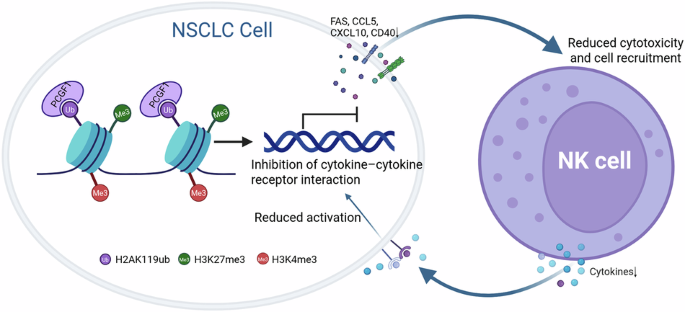
Precise regulation of the activating H3K4me3 and repressive H3K27me3 histone modifications at bivalent promoters is essential for normal development but is frequently disrupted in cancer. Among the polycomb group (PCGF) family members, which are key components of polycomb repressive complex 1 (PRC1), PCGF1 emerged as the factor most strongly associated with poor prognosis in non-small cell lung cancer (NSCLC) based on analyses of The Cancer Genome Atlas (TCGA) cohort. In lung cancer cells, PCGF1 upregulation enhanced the deposition of H2AK119ub and H3K27me3 at chromatin. These depositions inhibit the cytokine–cytokine receptor interaction pathway, especially CCL5, CXCL10, CD40, and FAS. Single-cell RNA sequencing further indicated that PCGF1 acts as a negative regulator of natural killer (NK) cell effector function. When NK cell-derived cytokines attempted to activate the cytokine–cytokine receptor interaction pathway in tumor cells, this repressive chromatin state attenuated pathway activation. Consequently, reduced expression of these genes weakened NK cell recruitment and cytotoxic responses. Collectively, this study uncovers a previously unrecognized mechanism by which PCGF1-driven disruption of bivalent promoter balance silences immune signaling cascades, enabling tumor cells to evade NK cell-mediated immunity in NSCLC. These findings highlight bivalent chromatin as a critical regulatory node in tumor immune escape and establish PCGF1 as a promising epigenetic target for immunotherapeutic intervention.
PCGF1 promotes immune evasion in NSCLC by suppressing cytokine–cytokine receptor interaction pathway. Upregulation of PCGF1 in NSCLC cells enhances the deposition of the repressive histone modifications H2AK119ub and H3K27me3 while reducing the enrichment of the transcriptionally active histone modification H3K4me3 at target chromatin regions, thereby suppressing cytokine–cytokine receptor interaction pathway. This epigenetic repression reduces the expression of immune-related genes, including CCL5, CXCL10, CD40, and FAS. Consequently, tumor-cell responses to NK cell-derived cytokines are attenuated, leading to impaired NK cell recruitment and cytotoxicity. The schematic diagram was created using BioRender.
