


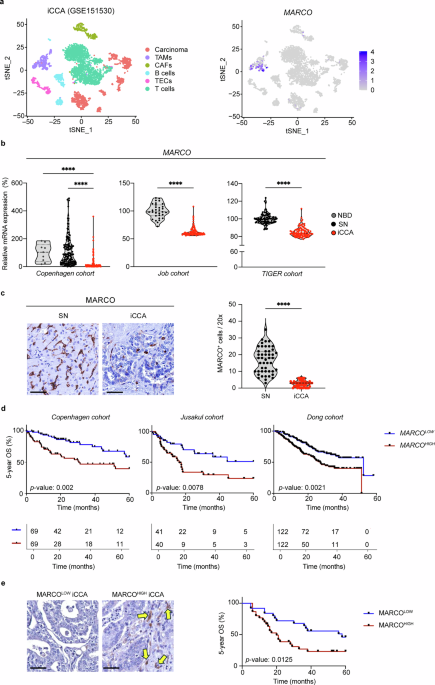
MARCO is expressed in TAMs in human iCCA tumors, correlating with worse overall survival (OS)
To investigate the potential role of MARCO in human iCCA, we first analyzed MARCO expression in healthy and cirrhotic human livers, as well as in iCCA tumors, utilizing publicly available single-cell RNA sequencing data. MARCO is mainly expressed in macrophages in normal and cirrhotic livers, and not in other non-parenchymal or liver epithelial cells (Supplementary Fig. 1a, b). In iCCA tumors, the expression of MARCO was restricted to TAMs (Fig. 1a and Supplementary Fig. 1c, d). Immunofluorescence confirmed this finding, additionally demonstrating MARCO expression within a subset of CD68+ or CD206+ TAMs (Supplementary Fig. 2a).
Fig. 1The alternative text for this image may have been generated using AI.
MARCO is expressed in tumor-associated macrophages (TAMs) and correlates with poor patient survival. a Left: graph-based clustering using t-distributed stochastic neighbour embedding (t-SNE) projection depicting the cellular composition of different human samples. Cells that share similar transcriptome profiles are grouped by colors and were annotated using lineage specific markers. Right: t-SNE plot depicting MARCO expression in TAMs in iCCA tumors [GSE151530 (n = 12)]. b MARCO mRNA (microarray) expression in iCCA tumors compared to surrounding normal (SN) and normal bile ducts (NBD) in the Copenhagen cohort (iCCA, n = 151; SN, n = 143; NBD, n = 9), Job cohort (iCCA, n = 78; SN, n = 31) and TIGER cohort (iCCA, n = 91; SN, n = 91). Data are shown as mean ± SEM. Wilcoxon test was used. **** represents a P value of <0.0001. c MARCO protein expression in iCCA tumors compared to SN in samples from the European CCA Histology Registry (iCCA, n = 55; SN, n = 47). Scale bar = 50 µm. Data are shown as mean ± SEM. **** represents a P value of <0.0001. d Five-year OS curves of patients with iCCA from the Copenhagen (n = 120), Jusakul (n = 81) and Dong (n = 244) cohorts. Red and blue lines indicate patients with iCCA classified according to high MARCO (above median) vs low MARCO (at or below median) expression, respectively. Log-rank test was used. e Immunohistochemistry for MARCO on iCCA samples. Tumors were dichotomized into MARCOLOW and MARCOHIGH iCCA based on the median number of MARCO+ cells per high-powered microscopic field. Representative images are shown; arrows indicate MARCO+ cells. The 5-year OS curves of patients with iCCA from the European CCA Histology Registry (n = 55) are shown on the right. Log-rank test was performed. CAF cancer-associated fibroblast, iCCA intrahepatic cholangiocarcinoma, MARCO macrophage receptor with collagenous structure, NBD normal bile duct, SN surrounding normal, TAM tumor-associated macrophage, TEC tumor endothelial cell, tSNE t-distributed stochastic neighbour embedding
MARCO expression levels were lower in human iCCA samples compared to non-tumor liver tissues [non-tumor surrounding normal (SN) and normal bile ducts (NBD)] in three independent patient cohorts18,19,20,21 (Fig. 1b). Of note, while MARCO expression was lower in all iCCA tumors regardless of their mutational profile, compared to NBD or SN liver tissues, KRAS mutated tumors and advanced-stage (Stage IV) tumors exhibited the highest MARCO expression (Supplementary Fig 2b, c). To strengthen these findings, we next examined MARCO protein levels in 55 iCCA human tissue samples from the ENS-CCA Histological Registry. Immunohistochemistry confirmed higher MARCO expression levels in the surrounding liver tissue compared to the tumor, although some tumors also exhibited MARCO expression within the tumor (Fig. 1c).
We next addressed the potential prognostic value of MARCO expression in iCCA tumors. Importantly, in three independent cohorts,18,22,23 high MARCO tumor expression (above the median) was associated with worse patients’ OS (Fig. 1d). This was independent of the presence of KRAS mutations in these tumors, and both MARCO expression and KRAS mutations were found to be independent markers of poor prognosis (Supplementary Fig. 2d). At the protein level, classifying samples from the ENS-CCA Histological Registry as MARCOLOW or MARCOHIGH based on the median value of the number of MARCO+ cells within the tumor mass demonstrated that MARCOHIGH iCCAs exhibited a worse 5-year OS than MARCOLOW iCCAs, confirming previous observations at the RNA level (Fig. 1e).
MARCO
+ TAMs are involved in immunosuppression and ECM remodeling
We next characterized MARCO-expressing (MARCO+) TAMs. The refined clustering of TAMs in three independent iCCA patient cohorts revealed distinct clusters with prominent MARCO expression (Fig. 2a–d). Suggesting a heterogeneous origin, MARCO-expressing TAMs expressed markers of both Kupffer cells (KCs) (VSIG4, FOLR2, HMOX1) and monocyte-derived macrophages (CD14, LYZ, S100A8, S100A9, VCAN) (Fig. 2e and Supplementary Fig. 3a).24,25,26,27 Comparing MARCO+ and MARCO- TAMs revealed differential gene expression profiles (Supplementary Fig. 3b). Reactome analysis of genes commonly upregulated in MARCO+ TAMs indicated involvement of pathways related to neutrophil degranulation (e.g., S100A8, S100A9, LGALS3) which is linked to immunosuppression in other solid carcinomas28 or anti-inflammatory and immunosuppressive interleukin-10 (IL-10) signaling.29 Suggestive of a role in fibrosis, MARCO+ TAMs were also associated with pathways related to the assembly of collagen fibrils and the degradation of ECM (e.g., CTSB, CTSD, CTSL, CTSSS, VCAN) (Fig. 2f, g). Conversely, gene sets downregulated in MARCO+ TAMs were associated with the immune system and interferon gamma signaling (Fig. 2h, i).
Fig. 2The alternative text for this image may have been generated using AI.
Analysis of MARCO expression in TAMs by single-cell RNA sequencing. a–c Graph-based clustering using t-distributed stochastic neighbour embedding (t-SNE) projection depicting different TAM compositions in three independent human iCCA datasets. TAMs that share similar transcriptome profiles are clustered by numbers and MARCO expression is depicted therein a GSE125449 (n = 10), b GSE138709 (n = 4 T, 3 SL) and c GSE151530 (n = 12). d Violin plots illustrating the distribution of MARCO expression across the identified TAM cluster. e Expression of key KC and monocytic markers in the identified TAM clusters in GSE138709. f Venn diagram including genes that are increased in MARCO+ vs MARCO- TAMs in the three cohorts of patients with iCCA. g Reactome analysis of the commonly upregulated genes. h Venn diagram including genes that have decreased expression in MARCO+ vs MARCO- TAMs. i Reactome analysis of the commonly downregulated genes. MARCO macrophage receptor with collagenous structure, TAM tumor-associated macrophage, tSNE t-distributed stochastic neighbour embedding
Noting the heterogeneous nature of MARCO expressing TAMs (Fig. 2e and Supplementary Fig. 3a), we next compared MARCO+ TAMs in the TME with MARCO+ macrophages in non-tumor sites (healthy or SN liver) in all aforementioned datasets (Supplementary Fig. 4a–d). These data indicated that compared to MARCO+ macrophages in non-tumor tissue, MARCO+ TAMs lose key homeostatic and immunological functions typically attributed to KCs such as complement cascade activity, heme scavenging and binding/uptake of ligands by scavenger receptors.30,31,32 In this analysis, we also noted that gene sets upregulated in MARCO+ TAMs in comparison to MARCO+ macrophages in non-tumor sites (healthy or SN liver) included those related to mitosis, cell cycle and collagen chain trimerization (Supplementary Fig. 4e). Together, these findings suggest that MARCO expression within TAMs may impact iCCA development and progression, possibly via immunosuppression and ECM remodeling. We thus next correlated MARCO expression with all the mRNA transcripts expressed in iCCA tumors from different cohorts of patients. Reactome analysis of the common genes positively correlating with MARCO ratified that MARCO expression in iCCA samples was associated with neutrophil degranulation, IL-10 signaling, collagen biosynthesis/modification and notably IL-4/IL-13 signaling (Supplementary Fig. 5a). Genes negatively correlating with MARCO expression were involved in FGFR and PI3K signaling pathways, insulin receptor signaling, and the assembly of the cilium (Supplementary Fig. 5b), a sensory organelle key for cholangiocyte differentiation.33 These results suggest that MARCO regulates signaling pathways involved in cholangiocarcinogenesis and that type 2 cytokines found in the TME might promote MARCO expression within TAMs. Supportive, exogenous treatment of macrophages with IL-4/IL-13 robustly induced MARCO expression (Supplementary Fig. 5c, d). Noting this, we next determined which cell types in the SN tissue and tumor of iCCA patients produce IL-4 and IL-13. Suggesting that in the context of iCCA a subset of T cells likely polarized to TH2 cells augment MARCO expression, scRNA-seq analysis revealed T cells exclusively produce IL-4/IL-13 (Supplementary Fig. 6).
MARCO expression is associated with TH2 responses and immunosuppression in iCCA
Considering the association of MARCO+ TAMs with immune responses, we next used the ConsensusTME tool,34 correlating MARCO expression with 18 innate and adaptive immune cell gene signatures in iCCA samples.22 MARCO expression was most strongly associated with immune cell types involved in tumor progression, such as M2 macrophages and fibroblasts, and not with other cell types that present a direct anti-tumoral response, such as NK cells (Supplementary Fig. 7).
Using the tumor immune dysfunction and exclusion (TIDE) algorithm,35 high MARCO-expressing tumors were found to exhibit greater T cell dysfunctionality than low MARCO-expressing tumors in three independent patient cohorts (Fig. 3a). Similarly, specific correlations of MARCO with markers of T cell exhaustion revealed MARCO positively correlated with markers of T cell exhaustion (Fig. 3b).
Fig. 3The alternative text for this image may have been generated using AI.
MARCO expression is associated with T cell exhaustion and dysfunction in iCCA. a T cell dysfunction score in human iCCA tumors according to MARCO expression employing the TIDE algorithm. Samples were categorized into low or high MARCO expression groups based on the median of MARCO mRNA expression levels in the Copenhagen (n = 138), Jusakul (n = 82) and Dong (n = 244) cohorts of patients. Data are shown as mean ± SEM. *** and **** represent P values of <0.001 and <0.0001, respectively. b Correlation of MARCO mRNA expression with genes linked to T cell exhaustion in iCCA tumors from the TIGER cohort of patients (n = 91). Parametric Pearson and non-parametric Spearman’s rank correlation test were used, correlation coefficient (r) and P value are shown. c Spatial proteomic analysis comparing MARCO+ and MARCO− regions within iCCA tumors, based on the presence or absence of MARCO+ cells identified by immunofluorescence. CD45+ immune cells and tumor epithelial cell fractions were segmented and analyzed separately. Green arrows indicate some CD45+ cells, whereas red arrows highlight MARCO+ cells. Scale bar = 50 µm. d Comparison of the CD45+ immune cell fraction in iCCA tissue with CD45+ cells from normal portal tracts, categorized by MARCO+ and MARCO- regions. Red circle indicates significance versus normal portal tracts. e, f Dot plots showing immune checkpoint protein expression in the CD45+ cell fraction as sampled by spatial proteomics analysis in e MARCO− and f MARCO+ areas compared to normal portal tracts (controls). Individual values and means are shown. Mann–Whitney test was used. *, ** and *** denote P values of <0.05, <0.01 and <0.001, respectively. B7-H3 B7 homolog 3, BTLA B and T lymphocyte associated, CTLA-4 cytotoxic T-lymphocyte-associated protein 4, HAVCR2 hepatitis A virus cellular receptor 2, IDO1 Indoleamine 2,3-dioxygenase 1, LAG3 lymphocyte activation gene 3, MARCO Macrophage receptor with collagenous structure, panCK pan-cytokeratin, PD-1 programmed cell death protein 1, PD-L1 programmed Death-Ligand 1, TIGIT T cell immunoreceptor with Ig and ITIM domains, TIM3 T-cell immunoglobulin and mucin-domain containing-3
To confirm these observations, we next performed a spatial proteomic analysis on an independent cohort of iCCA samples, identifying MARCO+ and MARCO− areas using immunofluorescence. In this setting, CD45+ immune cells and tumor epithelial cell fractions were segmented and analyzed separately (Fig. 3c). When comparing CD45+ immune cells within tumors to those in normal portal tracts, we observed a profound upregulation of several immunosuppressive markers. Notably, MARCO+ tumors exhibited elevated PD-L1 and PD-1 protein expression, suggesting MARCO-expressing TAMs modulate PD-L1/PD-1 signaling in the iCCA TME (Fig. 3d–f).
We next explored the broader immunosuppressive phenotype associated with MARCO expression. Therein, the tumor immunophenotype profiling (TIP) tool36 was used to assess immune activity during the cancer-immunity cycle. MARCO expression was positively associated with several defined steps of the tumor-immunity cycle, including the release of cancer cell antigens (step 1), presentation of tumor antigens (step 2), traffic or recruitment of immune cells to the tumor, such as eosinophils, macrophages and TH2 cells (step 4) and recognition of cancer cells by T cells (step 6) in the iCCA samples (Fig. 4a and Supplementary Fig. 8). These findings were supported by TIP analysis at the protein level (Fig. 4b). Further, specific correlations of MARCO with genes linked to TH2 response ratified the association between IL4/IL-13 producing T cells and MARCO expression (Fig. 4c and Supplementary Fig. 6).
Fig. 4The alternative text for this image may have been generated using AI.
MARCO expression is associated with the TH2 response. a Volcano plot illustrating the correlation between MARCO mRNA expression and different stages of the cancer-immunity cycle in iCCA samples from the Jusakul (n = 82) and Dong (n = 244) cohorts of patients. Spearman’s rank correlation coefficient was used. b Volcano plot depicting the correlation of MARCO protein expression with different stages of the cancer-immunity cycle in iCCA samples from the Dong (n = 208) cohort of patients. Spearman’s rank correlation coefficient was used. c Correlation of MARCO mRNA expression with genes linked to a TH2 response in iCCA tumors from the TIGER cohort of patients (n = 91). Spearman’s rank correlation coefficient was used, correlation coefficient (r) and P value are shown. IL interleukin, MARCO macrophage receptor with collagenous structure
MARCO+ TAMs in human iCCAs are primarily located in desmoplastic areas
iCCA is characterized by desmoplastic stroma linked to accumulation of ECM.37 Noting that MARCO+ TAMs exhibited enriched gene sets related to ECM remodeling when compared to MARCO+ macrophages in non-tumor sites (healthy or SN liver) or MARCO- TAMs (Fig. 2f, g and Supplementary Fig. 4e), we next examined the relationship between MARCO+ TAMs and desmoplasia in iCCA histological sections from the ENS-CCA Histology Registry. In agreement, MARCOHIGH iCCA tumors were characterized by both higher collagen content and higher number of α-smooth muscle actin+ (αSMA+) cells compared to MARCOLOW tumors (Fig. 5a, b). Further, the number of MARCO+ cells within the tumor positively correlated with Sirius Red+ (SR+) and αSMA+ areas (Fig. 5c). Together, these data indicate that MARCO-expressing TAMs are found in histopathological fibrotic lesions in iCCA tumors, which are linked to tumor progression and invasiveness.37
Fig. 5The alternative text for this image may have been generated using AI.
MARCO+ TAMs are associated with collagen deposition. a Representative immunohistochemical images of MARCO expression in iCCA tumors, classified as MARCOLOW or MARCOHIGH based on the median number of MARCO+ cells. Additionally, Sirius Red staining and immunohistochemical staining for α-SMA are shown in both MARCOLOW and MARCOHIGH iCCAs from the European CCA Histology Registry (n = 55). Scale bars = 75 µm. b Quantification of Sirius Red (SR)+ areas and α-SMA+ areas in MARCOLOW and MARCOHIGH iCCAs. Data are shown as median. * represents a P value of <0.05. c Correlation between SR+ areas and the number of MARCO+ cells, as well as the correlation between α-SMA+ areas and MARCO+ cells in iCCA tumors. Spearman’s rank correlation coefficient was used; correlation coefficient (r) and P value are shown. α-SMA α-smooth muscle actin, MARCO macrophage receptor with collagenous structure, SR Sirius Red
Marco
−/− mice are partially protected from biliary tumorigenesis and present a reduction of cells associated with a TH2 response
Marco expression was analyzed in different primary cell types isolated from normal mouse livers. As observed in humans, Marco expression was mainly found in KCs (Supplementary Fig. 9).
To investigate how MARCO impacts cholangiocarcinogenesis and whether it does so via immunosuppressive mechanisms, we next performed an oncogene-driven iCCA mouse model38 in WT and Marco-deficient (Marco−/−) mice (Fig. 6a). Versus WT controls, Marco−/− mice showed fewer liver tumors (Fig. 6b, c) with CK19 expression confirming these tumors were biliary tumor cells (Supplementary Fig. 10a). To understand the mechanisms behind this reduced tumorigenesis, we next analyzed the hepatic immune cell landscape. Compared to WT controls, Marco−/− mice exhibited lower CD9+ levels on their macrophages, suggesting MARCO impacts scar-associated macrophages (SAMs)39 (Fig. 6d and Supplementary Fig. 11a). Furthermore, there was a reduction of type 2 innate lymphoid cells (ILC2s) which are well described to produce IL-4 and IL13,40 as well as B cells (Fig. 6e and Supplementary Figs. 12 and 13a, b). Although Marco−/− mice presented a trend toward increased NK cells, these differences were not statistically significant (Supplementary Fig. 10b). In addition, qRT-PCR revealed lower levels of Tnf-α, which promotes CCA invasiveness,41 and decreased Il-10, in Marco−/− mice compared to WT mice (Supplementary Fig. 10c).
Fig. 6The alternative text for this image may have been generated using AI.
Marco−/− mice are partially protected from biliary tumorigenesis. a WT (n = 10) and Marco−/− (n = 11) mice were subjected to a biliary tract oncogene transduction of constitutively activated AKT (myr-AKT) and YAP combined with a partial bile duct ligature and subsequent systemic IL-33 administration. Mice were sacrificed 24 weeks after surgery. b Representative images of iCCA tumors. c Number of tumors per liver. d MFI of CD9 in liver macrophages (CD45+B220-CD3-LY6G-F480+LY6C-CD9+). e Percentage of ILC2 population (CD45+THY1.2+CD127+NKP46-) and B cells (B220+ CD45+) among total immune cells (CD45+). f WT (n = 7) and Marco−/− (n = 8) mice received constitutively activated AKT (myr-AKT), Fbxw7ΔF and SB using hydrodynamic tail vein injection and were sacrificed 20 weeks later. g Representative images of iCCA tumors. h Liver-to-body weight ratios (%). i Serum levels of albumin (g/dL). j Representative images of livers stained with Sirius Red and quantification of the percentage of the stained area. k MFI of CD9 in liver macrophages (CD45+B220-CD3-LY6G-F480+LY6C-CD9+). l Percentage of ILC2 population (CD45+THY1.2+CD127+NKP46-) among total immune cells (CD45+). Data are shown as mean ± SEM. Parametric two-tailed Student’s t test and non-parametric Mann–Whitney test were used, except in (c, h), in which one-tailed Student’s t test was employed. * and ** denote P values of <0.05 and <0.01, respectively. ILC innate lymphoid cell, Marco macrophage receptor with collagenous structure, MFI mean fluorescence intensity
In a second iCCA model42 (Fig. 6f), although the macroscopic tumor burden was not measured due to multiple small tumors, Marco−/− mice showed a lower liver-to-body weight ratio compared to WT mice (Fig. 6g, h and Supplementary Fig. 14a). Marco−/− mice also had higher serum albumin levels (Fig. 6i), approaching levels seen in healthy WT mice (~4 g/dL, data not shown), suggesting better-preserved liver function under tumor-bearing conditions. Additionally, Marco−/− mice exhibited a strong albeit statistically insignificant tendency towards lower hepatic transcript levels of cytokines involved in cholangiocarcinogenesis (Il-6, Il-10) and liver fibrosis (Col1a1, α-SMA) (Supplementary Fig. 14b, c). Importantly, Sirius red staining indicated that iCCA suffering Marco−/− mice had lower ECM deposition, indicative of attenuated desmoplasia or fibrosis (Fig. 6j). Further, there was a similar immune profile to the previous model, as a tendency towards reduced levels of CD9 in macrophages and a reduction in the number of ILC2 cells were observed (Fig. 6k, l). Marco−/− mice also had more monocyte-derived DCs and the population of DCs presented lower levels of PD-L1, suggesting enhanced antigen presentation activity (Supplementary Fig. 15a, c). Moreover, Marco−/− mice had less neutrophils compared to WT counterparts (Supplementary Fig. 15b).
Marco
−/− mice are protected from iCCA progression, leading to increased survival
To further evaluate the role of MARCO in iCCA progression, a syngeneic orthotopic mouse model of iCCA was performed in both genotypes of animals (Fig. 7a, b). Marco−/− mice presented a lower number of CD9+ scar-associated macrophages as well as a reduction of the CD11c+ macrophage population (Fig. 7c and Supplementary Figs. 11 and 16), which were recently described to drive hepatocyte death-triggered liver fibrosis in a murine model of metabolic-dysfunction associated steatohepatitis (MASH).43 Moreover, in comparison to controls, Marco−/− animals had fewer PD-L1+ macrophages (Fig. 7d and Supplementary Fig. 17). Although we noted no differences in the total number of CD8+ T cells between the genotypes, Marco−/− animals had a smaller percentage of CTLA-4+ and PD-1+ CD8+ T cells (Fig. 7e and Supplementary Fig. 13). These data suggested a reduced immunosuppressive environment in Marco−/− mice that could lead to attenuated tumor progression.
Fig. 7The alternative text for this image may have been generated using AI.
Marco deficiency protects mice from iCCA progression. a WT (n = 6) and Marco−/− (n = 7) mice were subjected to an orthotopic CCA cell injection of 500,000 mouse SB1 CCA cells in the liver, and mice were sacrificed 28 days later. b Representative images of iCCA tumors in livers from WT and Marco−/− mice. c Percentage of CD9+ macrophages (CD45+B220-CD3-LY6G-F480+LY6C-CD9+) and CD11c+ macrophages (CD45+B220-CD3-F480+CD11c+) among total immune cells (CD45+). d Percentage of PD-L1+ macrophages (CD45+B220-CD3-F480+LY6C-PD-L1+) and e CTLA-4+ and PD-1+ CD8+ cytotoxic T cells (CD45+CD3+CD8+) among total immune cells (CD45+) and number of CD8+ cytotoxic T cells per gram of liver tissue. f Kaplan–Meier curves comparing the survival of WT (n = 18) and Marco−/− (n = 16) mice upon orthotopic injection of SB1 cells. g Representative images and lung metastasis scores in WT (n = 11) and Marco−/− (n = 7) mice 21 days after surgery. h Representative images and quantification of crystal violet-stained areas from the SB1 iCCA cell migration assay, in which SB1 cells were co-cultured with BMDMs from WT (n = 5) or Marco−/− (n = 5) mice. i WT mice were subjected to an orthotopic CCA cell injection of 500,000 mouse SB1 CCA cells in the liver. Seven days later, mice were treated with a rat IgG1 isotype control (n = 7) or a rat anti-mouse MARCO antibody (ED31 IgG1) (n = 6) every 3 days. Mice were sacrificed 28 days later. j Representative images of iCCA tumors. k Tumor volume in the liver (mm3). Data are shown as mean ± SEM. Scale bar = 200 μm. Parametric Student’s t test and non-parametric Mann–Whitney test were used. * and ** denote P values of <0.05 and <0.01, respectively. CTLA-4 cytotoxic T-lymphocyte antigen 4, Marco macrophage receptor with collagenous structure, MFI mean fluorescence intensity, PD-1 programmed cell death protein 1, PD-L1 programmed cell death protein ligand 1
Confirmatory, in this experimental iCCA model, compared to controls, Marco−/− mice exhibited improved OS (Fig. 7f), which was associated with fewer lung metastases (Fig. 7g). Noting the heterogeneus nature of MARCO+ TAMs (Fig. 2e and Supplementary Fig. 3a), we next sought to examine how they might affect iCCA behaviour by co-culturing SB1 cells with Marco−/− versus WT KCs or bone marrow-derived macrophages (BMDMs). Interestingly, the aforementioned differences in metastatic burden observed in Marco−/− mice could, at least in part, be explained by changes identified in the proteomic profile of SB1 iCCA cells co-cultured with Marco−/− cells (Supplementary Fig. 18a, e). Relative to SB1 iCCA cells co-cultured with WT KCs or BMDMs, those cultured with MARCO deficient cells showed alterations in pathways related to cytoskeletal organization and cell migration (Supplementary Fig. 18b–d,f–h). Confiriming MARCO deficiency negatively impacted iCCA cell motility, SB1 cells co-cultured with Marco−/− BMDMs displayed a reduced migratory capacity versus those co-cultured with WT controls (Fig. 7h).
Importantly, WT mice subjected to this orthotopic model and treated with the anti-MARCO mAb ED3115,44,45 showed reduced tumor volume compared to mice receiving an isotype control (Fig. 7i–k).
