


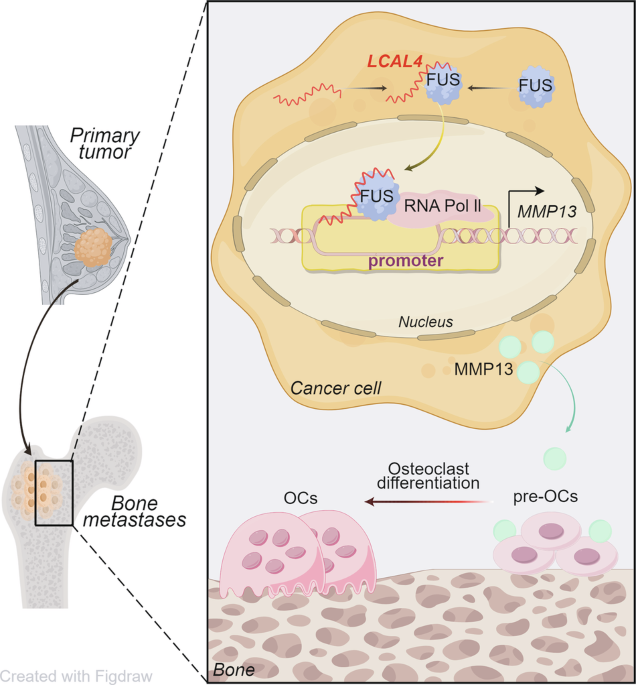
High LCAL4 expression indicates an unfavorable bone metastasis-free survival (BMFS) outcome in patients with BC
To characterize the expression profile and clinical relevance of LCAL4 in BC, FISH was conducted on formalin-fixed, paraffin-embedded tissues. FISH analysis revealed significant enrichment of LCAL4 in bone-metastatic BC (primary tumors), with the strongest signal localized within bone lesions. In contrast, LCAL4 expression was minimal in lung-metastatic tumors and lung metastases, and nearly undetectable in normal mammary epithelium or non-metastatic primary tumors (Fig. 1A). These findings were further confirmed by qPCR, which showed elevated LCAL4 levels in bone-metastatic BC and bone metastases compared to non-metastatic primary tumors, non-bone-metastatic disease, and normal breast tissue (Fig. 1B). Clinically, high LCAL4 expression was significantly correlated with advanced disease stage and bone metastasis in patients with BC (Tables S1). Notably, elevated LCAL4 levels predicted poorer BMFS and were identified as an independent prognostic factor (Fig. 1C–E). These results were validated using data from The Cancer Genome Atlas-Breast Invasive Carcinoma (TCGA-BRCA) and curated Gene Expression Omnibus (GEO) cohorts, analyzed via the BEST platform (https://rookieutopia.com/). High LCAL4 expression was linked to reduced OS (GSE20685 and TCGA-BRCA), DFS (GSE21653), relapse-free survival (RFS, GSE20711 and TCGA-BRCA), disease-specific survival (DSS, TCGA-BRCA), and progression-free survival (PFS, TCGA-BRCA) (Fig. S1A–C). Analysis of bc-GenExMiner v5.2 data further revealed that high LCAL4 expression was associated with reduced distant metastasis-free survival (DMFS) across several subtypes, including ER all/PR all/node all (P = 0.0045), ER+/PR all/node all (P = 0.0135), ER−/PR all/node all (P = 0.0152), and ER−/PR−/node+ (P = 0.046) (Fig. S1D). These results suggest that LCAL4 upregulation plays a key role in the progression of bone metastasis in BC.
Fig. 1: High LCAL4 expression indicates an unfavorable BMFS outcome in BC patients.The alternative text for this image may have been generated using AI.
A H&E staining of cellular morphology (scale bars: upper, 1 mm; lower, 100 µm) and RNA FISH analysis of LCAL4 localization and quantification (scale bar, 50 µm) in normal breast tissues (n = 10), 105 BC specimens including 63 non-metastatic, 24 bone-metastatic, and 18 other metastatic cases, as well as 27 BC metastases (15 bone metastases and 12 other metastases). B qRT-PCR analysis of LCAL4 expression in normal breast tissues and the indicated BC and metastatic samples. C Kaplan–Meier survival curves of BMFS in 105 BC patients stratified by LCAL4 expression, with P-value calculated by the log-rank test. Univariate (D) and multivariate (E) Cox regression analyses evaluating the association between LCAL4 expression and BMFS in the context of other clinical parameters (HR, hazard ratio). *P < 0.05, **P < 0.01, n.s., not significant.
LCAL4 promotes osteolytic bone metastasis and reduces survival in mice
To determine whether LCAL4 is functionally required for BC bone metastasis in vivo, stable LCAL4-overexpressing MCF7 and T47D cells (which exhibit low endogenous LCAL4 levels) were generated, and LCAL4 was silenced in the highly metastatic MDA-MB-231 line (which expresses high endogenous LCAL4) (Fig. S2A–D). A rapid bone metastasis model was established by intracardiac injection of luciferase-labeled MCF7-vector or MCF7/LCAL4 cells into estrogen-supplemented BALB/c nude mice. Longitudinal bioluminescence imaging (BLI) revealed that LCAL4 overexpression accelerated metastatic onset and significantly increased skeletal tumor burden in the hind limbs compared to vector controls (Fig. 2A, B). Micro-computed tomography (μCT) further confirmed that LCAL4 overexpression exacerbated osteolytic bone destruction (Fig. 2C). Consistent with these findings, TRAP staining and H&E of hind-limb sections demonstrated enlarged osteolytic lesions and a significant increase in TRAP-positive osteoclasts at the tumor–bone interface in the MCF7/LCAL4 group (Fig. 2D, E). By the 2-month endpoint, bone metastases developed in 83.3% of mice injected with MCF7/LCAL4 cells (verified by μCT and histology), compared to only 16.7% in the vector control group (Fig. 2F). Kaplan–Meier analysis further indicated that LCAL4 overexpression significantly reduced BMFS (Fig. 2F).
Fig. 2: LCAL4 promotes osteolytic bone metastasis and reduces survival in mice.The alternative text for this image may have been generated using AI.
A Schematic of the intracardiac injection model using MCF7 cells, comparing vector-control and LCAL4-overexpressing groups (left panel), with representative BLI images of metastases (n = 6/group) (right panel). Lower panels display BLI signals restricted to hind limbs. B Quantification of normalized hind-limb BLI and fold change from baseline to endpoint (d56/d0). C Representative μCT images of bone lesions (left panel) and quantification of osteolytic area (right panel); red boxes denote osteolytic regions. Histological images (H&E and TRAP staining) (D) and quantification of tumor area and TRAP⁺ osteoclasts along the bone–tumor interface (E). Scale bar, 50 µm. F Incidence of bone metastasis (upper panel) and Kaplan–Meier BMFS curves (lower panel), with P-values calculated by log-rank test. G Schematic of the intratibial injection model using MDA-MB-231 cells, comparing Ri-vector control and LCAL4 knockdown groups (LCAL4-Ri#1 and #2). H Representative BLI and histological sections (H&E and TRAP) of hind limbs (n = 6/group). Scale bar, 50 µm. I Representative μCT images, including 3D reconstruction and axial, coronal, and sagittal views; red arrows highlight osteolytic lesions, and red ellipses mark proximal tibiae. J Quantification of hind-limb BLI signal (fold change, d35/d0), tumor area, TRAP⁺ osteoclasts, and osteolytic area. Data are denoted as mean ± SD (n = 6 mice per group). *P < 0.05, **P < 0.01, ***P < 0.001. The schematic diagrams in A and G were created with Figdraw.
While intracardiac injection model mimics hematogenous dissemination to bone, the intratibial injection model bypasses early metastatic steps [20] and allows focused analysis of LCAL4 function in localized bone lesions and tumor-induced bone destruction. In this model, using luciferase-labeled MDA-MB-231 cells with or without stable LCAL4 knockdown, BLI revealed that LCAL4 depletion markedly reduced skeletal tumor burden in BALB/c nude mice (Fig. 2G, H, J). Corresponding μCT and H&E analyses showed significantly smaller osteolytic lesions in the hind limbs (Fig. 2H–J). TRAP staining further confirmed a significant reduction in TRAP-positive osteoclasts at the tumor–bone interface in the LCAL4-silenced group (Fig. 2H, J). To assess whether the observed phenotype is immune microenvironment-dependent, LCAL4 function was examined in an immunocompetent syngeneic model. We employed the murine BC cell line EO771 (syngeneic to C57BL/6 mice) and established luciferase-labeled cells with or without stable LCAL4 overexpression (Fig. S2E) for intratibial injection into immune-competent C57BL/6 mice. LCAL4 overexpression significantly increased skeletal tumor burden, worsened tibial osteolytic lesions, and elevated osteoclast numbers at the tumor-bone interface (Fig. S3A–D), confirming that this phenotype is not restricted to immunodeficient models.
To evaluate the therapeutic potential of targeting LCAL4, antisense oligonucleotides (ASOs), a clinically feasible nucleic acid therapeutic approach [21], were employed (Fig. S2F). In the intracardiac MDA-MB-231 xenograft model, LCAL4-ASO treatment significantly reduced the incidence of bone metastasis, skeletal tumor burden, and osteolytic lesions in the hind limbs, and TRAP-positive osteoclast numbers at the tumor-bone interface (Fig. S3E–H). These results establish LCAL4 as a critical driver of BC bone metastasis and osteolytic progression within the bone microenvironment.
Upregulation of LCAL4 in BC cells induces osteoclastogenesis
To explore the potential biological functions of LCAL4, Gene Set Enrichment Analysis (GSEA) was performed against predefined Kyoto Encyclopedia of Genes and Genomes (KEGG) pathways, Gene Ontology (GO) biological processes, and Hallmark signatures. Genes positively correlated with LCAL4 expression were significantly enriched in pathways related to extracellular matrix (ECM) remodeling, cartilage development, protein secretion, EMT, and TGF-β signaling (Fig. S4A–C), all of which are known to contribute to BC progression and metastasis [12, 19]. Given the strong pro-osteolytic phenotype induced by high LCAL4 expression in vivo, this study investigated whether LCAL4 reshapes the bone-metastatic niche by modulating osteoclast differentiation and function. Murine macrophage/pre-osteoclast RAW264.7 cells were cultured in conditioned medium (CM) derived from the corresponding BC cells. Compared to vector controls, CM from LCAL4-overexpressing cells significantly increased the number of TRAP-positive multinucleated osteoclasts (Fig. 3A, B) and TRAP enzymatic activity (Fig. 3C). In contrast, CM from LCAL4-depleted cells significantly reduced both parameters (Fig. 3A–C). Notably, ELISA quantification revealed no significant changes in PTHrP, IL-17 or TNF-α levels, which stimulate osteoblasts to secrete RANKL [22, 23], in these CM samples (Fig. S4D). Furthermore, none of the CM preparations affected the RANKL/OPG ratio in MC3T3-E1 pre-osteoblasts (Fig. S4E), indicating that LCAL4 specifically modulates the osteoclastic lineage. Additionally, several markers of osteoclast differentiation and activation, including ANPEP, PTPRE, MMP9, ACP5, and NFATC1, were significantly upregulated in RAW264.7 cells exposed to CM from LCAL4-overexpressing BC cells, whereas their expression was suppressed by CM from LCAL4-silenced cells (LCAL4-Ri#1/2) (Fig. S4F). To directly assess the functional impact of LCAL4 overexpression, RAW264.7 pre-osteoclasts were seeded on bovine cortical bone slices (Fig. 3D). The number of resorption pits per bone slice was quantified. CM from LCAL4-overexpressing BC cells significantly enhanced pit formation, while CM from LCAL4-silenced cells inhibited bone matrix resorption (Fig. 3E, F). These results suggest that LCAL4 upregulation in BC cells promotes osteoclast differentiation and enhances the bone-resorptive activity of mature osteoclasts.
Fig. 3: Upregulation of LCAL4 in BC cells induces osteoclastogenesis.The alternative text for this image may have been generated using AI.
A RAW264.7 pre-osteoclasts were differentiated for 6 days with CM derived from the indicated BC cells; osteoclast formation was visualized by TRAP staining (scale bar, 10 µm). Quantification of TRAP⁺ multinucleated osteoclasts (B) and TRAP enzymatic activity (C). D Schematic of the tumor–osteoclast “vicious cycle” driven by CM from BC cells. Pre-osteoclasts were seeded on bovine bone slices and cultured with CM from the indicated BC cells; slices were then fixed, toluidine blue–stained (E), and resorption pits quantified (F) (scale bar, 100 µm). G ELISA analysis of relative TGF-β1 levels in CM from pre-osteoclasts cultured on bone slices. H CCK-8 proliferation assays of BC cells exposed to osteoclast-derived CM. Data are denoted as mean ± SD from three independent experiments. *P < 0.05, **P < 0.01, ***P < 0.001.
Furthermore, ELISA showed that RAW264.7 pre-osteoclasts cultured on mineralized bone matrix and treated with CM from LCAL4-overexpressing BC cells released significantly more TGF-β1 than those treated with vector-control CM (Fig. 3G). This osteoclast-derived, TGF-β1-enriched CM significantly stimulated BC cell proliferation, whereas CM from LCAL4-silenced cells suppressed proliferation (Fig. 3H). These results indicate that LCAL4 upregulation in BC cells drives osteoclastogenesis and establishes a feed-forward loop that promotes tumor growth within the bone metastatic niche.
LCAL4-overexpressing BC cells secrete MMP13 to promote osteoclast differentiation and activation
To investigate the molecular mechanisms by which high LCAL4 expression promotes pre-osteoclast differentiation and maturation, three gene sets were intersected: (i) genes strongly correlated with LCAL4 expression in the TCGA-BRCA cohort, (ii) genes upregulated in bone-metastatic lesions from the GSE14017 dataset (29 distant BC metastases: 15 brain, 4 lung, 10 bone) [24], and (iii) a curated set of 20 proteases enriched at the tumor–bone interface [25]. This integrative analysis identified MMP13 and CTSK as top candidates (Fig. S5A–C). RT-PCR analysis showed that LCAL4 overexpression upregulated MMP13 in a dose-dependent manner, while CTSK expression remained unaffected in BC cells (Fig. S5D). Given MMP13’s known role in establishing bone metastatic niches [26], this gene was further examined. LCAL4 overexpression significantly increased MMP13 mRNA and protein levels in BC cells, whereas LCAL4 knockdown reduced these levels (Fig. 4A, B). Similarly, CM from LCAL4-overexpressing cells showed elevated MMP13 secretion, whereas CM from LCAL4-silenced cells had reduced MMP13 levels (Fig. 4C).
Fig. 4: LCAL4-overexpressing BC cells secrete MMP13 to promote osteoclast differentiation and activation.The alternative text for this image may have been generated using AI.
A qRT-PCR analysis of relative MMP13 mRNA levels in the indicated BC cells, normalized to GAPDH. B Western blot analysis of MMP13 protein, with GAPDH as a loading control. C ELISA quantification of secreted MMP13 in CM from the indicated BC cells. V Vector, Ri-v Ri-vector, Ri#1 LCAL4-Ri#1, Ri#2 LCAL4-Ri#2. D Representative TRAP staining of multinucleated osteoclasts induced by CM from BC cells, with MMP13 knockdown (MMP13-Ri) or recombinant MMP13 (scale bar, 10 µm); quantification shown on the right. E Immunofluorescence staining of F-actin (phalloidin) revealed disrupted podosome belts after MMP13 knockdown (scale bar, 10 µm). F Bone resorption assay on bovine slices stained with toluidine blue; pit number was quantified. Scale bar, 100 µm. Data are denoted as mean ± SD of three independent experiments. **P < 0.01, ***P < 0.001.
Notably, MMP13 knockdown in BC cells abolished the capacity of CM from LCAL4-overexpressing cells to promote RAW264.7 differentiation. However, the addition of recombinant MMP13 restored the pro-differentiation effect in LCAL4-silenced CM (Fig. 4D). Podosome formation and subsequent coalescence into circumferential, actin-rich sealing zones on mineralized surfaces are essential for effective bone resorption by osteoclasts [27]. Immunofluorescence using phalloidin staining demonstrated that CM from LCAL4-overexpressing cells strongly induced peripheral F-actin–rich podosome belts in mature osteoclasts, while MMP13 knockdown suppressed actin-ring formation and inhibited pre-osteoclast fusion (Fig. 4E). In contrast, CM from LCAL4-silenced cells resulted in fragmented actin structures, which were restored by recombinant MMP13, enhancing podosome belt formation and promoting pre-osteoclast fusion (Fig. 4E). Functionally, in vitro bone resorption assays confirmed that MMP13 knockdown abrogated the bone-resorptive activity of mature osteoclasts induced by CM from LCAL4-overexpressing cells, while recombinant MMP13 rescued osteoclast activation suppressed by LCAL4-silenced CM (Fig. 4F). These results demonstrate that tumor-secreted MMP13 is essential for LCAL4-mediated regulation of osteoclast differentiation and activation.
LCAL4 interacts with FUS and facilitates its nuclear accumulation
To elucidate the mechanism by which LCAL4 upregulates MMP13 expression in BC cells, RNA pull-down coupled with mass spectrometry (MS) was performed. This analysis identified FUS, an RNA/DNA-binding protein involved in mRNA processing and transcriptional regulation [28, 29], as a binding partner of LCAL4 (Fig. 5A). Western blotting confirmed that the LCAL4 sense probe (wild-type LCAL4), but not the antisense probe, effectively retrieved endogenous FUS from MCF7 cell lysates in RNA pull-down assays (Fig. 5B). Reciprocal RIP demonstrated significant enrichment of LCAL4 in FUS immunoprecipitates compared to the IgG control (Fig. 5C). Combined immunofluorescence and RNA-FISH revealed colocalization of LCAL4 and FUS in BC cells (Fig. 5D), with markedly enhanced colocalization in tumor cells within bone metastatic lesions compared to matched primary tumors (Fig. S6A). These results suggest that the LCAL4–FUS complex is preferentially enriched in bone-metastatic tumor cells, potentially contributing to bone tropism.
Fig. 5: LCAL4 interacts with FUS and facilitates its nuclear accumulation.The alternative text for this image may have been generated using AI.
A Silver-stained gel of proteins retrieved by LCAL4-sense (S) or antisense (AS) probes in RNA pull-down assays from MDA-MB-231 cells (left) and representative MS spectrum of FUS peptide (right). B Western blot validation of FUS retrieval by LCAL4-S but not LCAL4-AS probes, with GAPDH as a negative control. C RIP–qPCR analysis confirmed LCAL4 enrichment in anti-FUS immunoprecipitates relative to IgG control. D FISH and immunofluorescence revealed colocalization of LCAL4 (red) and FUS (green) in BC cells, with nuclei counterstained by DAPI (scale bar, 10 µm). E Schematic of full-length (FL) and truncated (F1-F4) LCAL4. F Western blot demonstrated that nucleotides 1245–1722 of LCAL4 are required for FUS binding. G Domain architecture of Flag-tagged FUS full-length (FL) and truncation mutants (N, N-terminus domain; RRM, RNA-recognition motif; Znf, zinc-finger motif; C, C-terminus domain). H RIP–qPCR showed that deletion of the RRM domain abolished LCAL4–FUS binding. I Flag immunoblot of LCAL4 pull-downs confirmed the necessity of the RRM domain for LCAL4 interaction, as deletion of this domain abolished binding. J Nuclear–cytoplasmic fractionation demonstrated that LCAL4 overexpression enhanced nuclear accumulation of FUS, whereas knockdown had the opposite effect. K Immunofluorescence further validated nuclear enrichment of FUS upon LCAL4 overexpression and redistribution upon knockdown (scale bar, 20 µm). L Co-IP showing increased FUS–TNPO1 interaction in LCAL4-overexpressing MCF7 cells. M Western blot of nuclear/cytoplasmic fractions showing LCAL4 promotes nuclear accumulation of wild-type FUS (WT), but not ΔNLS mutant, in MCF7 cells. H3 and GAPDH served as nuclear and cytoplasmic markers, respectively. Data are mean ± SD of three independent experiments. ***P < 0.001, n.s., not significant.
Secondary structure prediction of LCAL4 using UNAFold [30] divided the RNA into four structural fragments (Fig. S6B). Each fragment was truncated and subjected to RNA pull-down experiments (Fig. 5E). The results showed that the region spanning nucleotides 1245–1722 of LCAL4 was essential for FUS binding (Fig. 5F). To pinpoint the FUS domain mediating this interaction, a series of FUS truncation mutants were generated (Fig. 5G). Deletion of the RNA recognition motif (RRM) domain, but not other domains, completely abolished LCAL4 binding, indicating that the RRM domain of FUS is critical for this interaction (Fig. 5H, I). These data establish that nucleotides 1245–1722 of LCAL4 directly interact with the RRM domain of FUS.
Neither FUS mRNA nor total protein levels were significantly altered by LCAL4 overexpression or knockdown (Fig. S6C, D). However, nuclear and cytoplasmic fractionation followed by Western blotting revealed that LCAL4 overexpression increased nuclear FUS levels while reducing cytoplasmic expression. Conversely, LCAL4 knockdown resulted in the opposite pattern (Fig. 5J). Consistent with these findings, immunofluorescence assays demonstrated that LCAL4 overexpression concentrated FUS in the nucleus and diminished its cytosolic presence, whereas LCAL4 silencing reversed this distribution (Fig. 5K). These results suggest that LCAL4 binds FUS and facilitates its nuclear accumulation.
This study further explored how LCAL4 alters FUS subcellular localization. Previous reports indicate that FUS lacks a canonical nuclear export signal (NES) and that its nuclear export occurs through passive diffusion or alternative mechanisms independent of XPO1/CRM1-mediated active transport [31]. Thus, LCAL4 might promotes FUS nuclear import. FUS contains a proline-tyrosine nuclear localization signal (PY-NLS), which is recognized by the nuclear import receptor Transportin-1 (TNPO1) [32]. Co-IP assays demonstrated that LCAL4 overexpression enhanced the interaction between FUS and TNPO1 (Fig. 5L). Functionally, LCAL4 significantly increased the nuclear accumulation of wild-type FUS, an effect that was abolished in the FUS ΔNLS mutant, which lacks the PY-NLS domain (Fig. 5M). These results indicate that LCAL4 promotes FUS nuclear import via TNPO1 in a PY-NLS-dependent manner.
LCAL4 cooperates with FUS to transcriptionally upregulate MMP13
To assess whether FUS is essential for LCAL4-driven MMP13 upregulation, FUS was silenced in LCAL4-overexpressing MCF7 and T47D cells. The substantial increase in MMP13 mRNA and protein levels induced by LCAL4 overexpression was completely abrogated upon FUS depletion (Fig. 6A, B). Conversely, overexpressing FUS did not restore MMP13 expression that was suppressed by LCAL4 knockdown in MDA-MB-231 cells (Fig. 6A, B). Similar results were observed in luciferase reporter assays, where LCAL4 overexpression enhanced MMP13 promoter activity, which was attenuated by FUS knockdown, while enforced FUS expression failed to reverse the suppression of promoter activity induced by LCAL4 silencing (Fig. 6C). These results demonstrate that LCAL4 and FUS cooperate to drive MMP13 expression in BC.
Fig. 6: LCAL4 cooperates with FUS to transcriptionally upregulate MMP13.The alternative text for this image may have been generated using AI.
A qRT-PCR showed that LCAL4-induced MMP13 expression was abolished by FUS knockdown (FUS-Ri) and was not rescued by ectopic FUS in LCAL4-depleted cells. B Western blot confirmed corresponding changes at the protein level. C Luciferase activity driven by the MMP13 promoter reporter in the indicated cells. D ChIP–qPCR revealed robust FUS occupancy at a predicted promoter-binding site (−1060 to −1054 bp), enhanced by LCAL4 overexpression and attenuated by LCAL4 knockdown. E ChIP–qPCR showed that LCAL4 increased RNA Pol II recruitment and H3K4me3 deposition at the MMP13 promoter. F Schematic model of concurrent LCAL4 and FUS binding to the MMP13 promoter. G ChIRP–Western confirmed FUS association with LCAL4 complexes. H ChIRP–PCR demonstrated LCAL4 occupancy on the MMP13 promoter region (−1317 to −1307 bp). Data are denoted as mean ± SD of three independent experiments. *P < 0.05, ***P < 0.001, n.s., not significant.
Previous studies have indicated that FUS can act as either a transcriptional activator or repressor of RNA polymerase II-mediated transcription by binding to single-stranded motifs within gene promoters [28]. Guided by this model, a potential FUS-binding site was identified at −1060 to −1054 in the MMP13 promoter (Fig. 6D). ChIP–qPCR confirmed robust FUS occupancy at this locus in MCF7, T47D, and MDA-MB-231 cells, with this enrichment further enhanced by LCAL4 overexpression and diminished following LCAL4 knockdown (Fig. 6D). In parallel, LCAL4 upregulation increased RNA polymerase II recruitment and H3K4me3 deposition at the MMP13 promoter, whereas LCAL4 silencing reduced both marks (Fig. 6E). These results indicate that LCAL4 facilitates FUS binding at the MMP13 promoter, thereby promoting transcriptional activation.
To investigate whether LCAL4 directly associates with the MMP13 promoter, in-silico sequence complementarity analyses were performed using Gaemons [33] and the UCSC Genome Browser [34]. An 11-nucleotide segment (−1317 to −1307) within the MMP13 promoter was identified as the most probable LCAL4-binding site (Fig. 6F). Chromatin isolation by RNA purification (ChIRP), followed by immunoblotting and qPCR, confirmed the physical interaction between LCAL4 and FUS and corroborated LCAL4 occupancy at the predicted MMP13 promoter region (−1317 to −1307 bp) (Fig. 6G, H). These results establish LCAL4 as a molecular scaffold that anchors the MMP13 promoter and recruits FUS, thereby facilitating chromatin remodeling and transcriptional activation of MMP13.
Targeting FUS or MMP13 blocks LCAL4-mediated osteolytic metastasis
Next, the role of the FUS–MMP13 axis in LCAL4-driven osteolytic bone metastasis was evaluated. In vitro osteoclast differentiation assays showed that silencing FUS abolished the stimulatory effect of CM from LCAL4-overexpressing cells on RAW264.7 differentiation. Conversely, ectopic FUS expression in LCAL4-depleted BC cells did not significantly increase the number of TRAP-positive multinucleated osteoclasts (Fig. 7A). Similarly, bone resorption assays revealed that FUS knockdown eliminated the enhanced bone-resorbing activity of mature osteoclasts stimulated by CM from LCAL4-overexpressing cells, while enforced FUS expression did not restore osteoclast activity suppressed by LCAL4 depletion (Fig. 7B).
Fig. 7: Targeting FUS or MMP13 blocks LCAL4-mediated osteolytic metastasis.The alternative text for this image may have been generated using AI.
A TRAP staining showed that silencing FUS abolished the pro-osteoclastogenic effects of CM from LCAL4-overexpressing BC cells, while enforced FUS expression in LCAL4-depleted cells failed to rescue osteoclast differentiation (scale bar, 10 µm). B Bone resorption assays demonstrated that FUS knockdown eliminated LCAL4-induced osteoclast resorptive activity, and enforced FUS failed to restore it (scale bar, 100 µm). C In vivo experiments using MCF7/LCAL4 cells with or without FUS/MMP13 knockdown showed reduced hind-limb tumor burden and osteolytic lesions in the depletion groups, as demonstrated by BLI and histology (H&E, TRAP; scale bar, 50 µm). D Quantification of hind-limb BLI signal (fold change, d56/d0), tumor area, and TRAP⁺ osteoclasts. E μCT imaging demonstrated reduced osteolytic areas following FUS or MMP13 silencing. F Incidence of bone metastasis (upper panel) and Kaplan–Meier BMFS curves (lower panel). P-value calculated by log-rank test. Data are denoted as mean ± SD (n = 6 mice per group). *P < 0.05, **P < 0.01, n.s., not significant.
The in vivo impact of FUS or MMP13 inhibition on BC bone metastasis was then assessed. Highly bone-metastatic MCF7/LCAL4 cells, with or without concurrent FUS or MMP13 knockdown, were injected into the cardiac ventricle of nude mice. Silencing either gene significantly reduced hind-limb tumor burden and osteolytic lesions compared to scramble controls (Fig. 7C–E). TRAP staining further confirmed a marked reduction in osteoclast numbers at the tumor–bone interface in both knockdown groups (Fig. 7C, D). Moreover, depletion of FUS or MMP13 in LCAL4-overexpressing BC cells decreased the incidence of bone metastasis, delayed metastatic onset, and significantly prolonged BMFS (Fig. 7F). These results demonstrate that both MMP13 and FUS are indispensable mediators of LCAL4-driven osteolytic bone metastasis in BC.
Clinical relevance of the LCAL4–FUS–MMP13 axis in human BC
To evaluate the clinical relevance of the LCAL4–FUS–MMP13 axis identified in vitro and in vivo, FISH and IHC were conducted on archived, formalin-fixed tissue samples of non-metastatic BC (n = 63), bone-metastatic BC (n = 24), and bone metastases (n = 15). MMP13 expression showed a progressive increase across non-metastatic BC, bone-metastatic BC, and bone metastasis tissues, paralleling the trend observed for LCAL4 expression in Fig. 1A, B. In contrast, FUS exhibited a modest, non-significant increase (Fig. 8A). These results were corroborated by qRT-PCR analysis of non-bone-metastatic and bone-metastatic BC tissue samples (Fig. 8B). Correlation analysis further demonstrated LCAL4 expression was significantly correlated with MMP13 (r = 0.455, P < 0.001), and FUS expression also showed a significant correlation with MMP13 (r = 0.338, P < 0.001). However, no statistically significant correlation was found between LCAL4 and FUS (r = 0.113, P = 0.252) (Fig. 8C–E). These findings support the LCAL4–FUS–MMP13 axis as a key regulatory network promoting tumor–bone stromal interactions during metastatic progression (Fig. 8F).
Fig. 8: Clinical relevance of the LCAL4–FUS–MMP13 axis in human BC.The alternative text for this image may have been generated using AI.
A Left: Representative FISH images for LCAL4 (scale bar, 50 µm), IHC staining for FUS and MMP13 (scale bar, 100 µm), and H&E staining (scale bar, 100 µm) in the indicated tissues. Right: Violin plots showing expression levels of FUS and MMP13 (IHC H-scores) in non-metastatic BC (n = 63), bone-metastatic BC (n = 24), and bone metastasis samples (n = 15). *P < 0.05, **P < 0.01, n.s., not significant. B Expression levels of LCAL4, FUS, and MMP13 determined by qRT-PCR in non-bone-metastatic BC (n = 81) and bone-metastatic BC (n = 24), shown as box plots. Linear regression analyses revealed significant correlations between LCAL4 and MMP13 (C), as well as FUS and MMP13 (D), but not between LCAL4 and FUS (E). F Schematic model illustrating (created with Figdraw) that LCAL4 binds FUS, promotes its nuclear localization, and transcriptionally upregulates MMP13, which induces pre-osteoclast differentiation and maturation, ultimately driving osteolytic bone metastasis in BC.
