


Ethics statement
This study was conducted in compliance with all relevant ethical regulations for animal research. Mouse studies performed at the Lady Davis Institute were approved by the Animal Care Committee of the Lady Davis Institute (McGill University) (protocol #JGH-5754) and conducted in accordance with institutional guidelines. Experiments involving KM mice at The Francis Crick Institute were performed in accordance with UK Home Office regulations under project licence PP9124501 issued to G.I.E. PDX models were obtained from The Jackson Laboratory (JAX) PDX repository. All patient tumour samples were collected by contributing institutions under institutional review board-approved protocols with informed consent from participants. Samples were de-identified before receipt by JAX, and all data used in this study are fully anonymized. Access to detailed patient-level metadata is restricted to protect participant confidentiality and is managed by the originating institutions. The Leicester Archival Thoracic Tumour Investigatory Cohort—Adenocarcinoma cohort was originally constructed under REC 14/EM/1159 (East Midlands Research Ethics Committee), and the ongoing management of the resource by the National Health Service Greater Glasgow and Clyde Biorepository was approved under an amendment granted by the Leicester South REC. Ongoing use of the collection is now managed under REC 16/WS/0207.
Animal studies
All animal experiments were performed in mice. Unless otherwise indicated, experiments used male and female mice on a C57BL/6 background. Autochthonous lung tumour studies were performed in age- and sex-matched littermates, and mice were 8–12 weeks old at the time of tumour induction. Mice were randomly assigned to experimental groups. Exact sample sizes for each experiment are provided in the corresponding figure legends. Mouse strains, alleles, genetic background and source information are described below.
Transgenic mouse models and treatments
Mice on a C57BL/6 background were used in all experiments. For lung tumour induction, 2-month-old male and female mice were randomly assigned to experimental groups. Mice were maintained in ventilated cages under controlled conditions (30% humidity, 12-h light–dark cycle, lights on from 06:00 to 18:00, 23 °C).
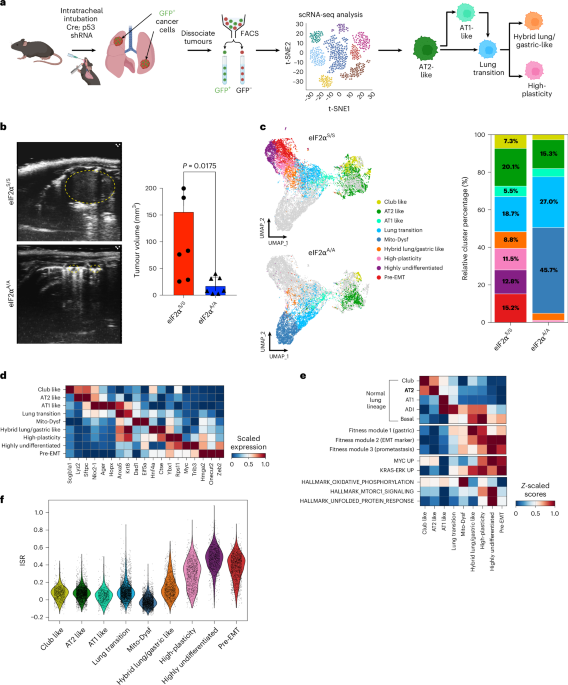
Lung tumourigenesis was induced in KRAS+/LSL-G12D;fTg/0;eIF2αS/S and KRAS+/LSL-G12D;fTg/0;eIF2αA/A mice on C57BL/6 background6 via intratracheal intubation with lentiviruses expressing Cre recombinase and TP53 shRNA under the control of U6/H1 promoter6. Lung tumour development was monitored using ultrasound imaging on a VisualSonics VEVO 3100 high-frequency ultrasound system51. ISRIB treatment was administered daily by oral gavage at a dose of 10 mg kg−1 (ref. 6) using a solution containing 0.5% hydroxypropylmethylcellulose and 0.1% Tween 80 (pH 4.0) for the indicated duration. To impair ATF4 in mouse LUAD tumours, KRAS+/LSL-G12D;fTg/0;eIF2αS/S mice were crossed with ATF4f/f mice on a C57BL/6 background43.
KM mice were maintained on regular diet in a pathogen-free facility under a 12-h light/dark cycle (lights on from 07:00 to 19:00), in individually ventilated cages at 23 °C and 61% humidity, with continuous access to food, water and cage enrichment. Krastm4Tyj (LSL-KrasG12D)52 and Gt(ROSA)26Sortm1(MYC/ERT2)Gev (LSL-Rosa26MIE/MIE)33 mice have been described previously. For all experiments, the mice were kept with a heterozygous Lsl-KrasG12D allele and homozygous LSL-Rosa26MIE/MIE alleles. Age and sex-matched littermate mice were divided equally over the treatment groups. Mouse weight, health and body condition were monitored daily during tamoxifen treatment.
For activation of MycERT2, tamoxifen (Sigma; TS648) dissolved in peanut oil (Sigma; P2144) was administered daily by intraperitoneal injection for a maximum of 2 weeks at a dose of 1 mg per 25 g body mass, or by tamoxifen diet (Harlan Laboratories UK, TAM400 diet) for a maximum of 4 weeks as previously described53. Deactivation of MycERT2 was achieved by switching mice from a tamoxifen diet back to a regular diet.
To deliver adenovirus-Cre recombinase (AdV-Cre), 8–12-week-old mice were anaesthetized with isoflurane (Covetrus, Isofane 250 ml UK, 2800025; 100% w/w inhalation vapour with 0.2% oxygen), and 5 × 10⁷ plaque-forming units of AdenoCre (Ad5CMVCre, Viral Vector Core, University of Iowa) were administered as described previously54.
PDX assay
The PDX tumour model of LUAD carrying KRAS G12C was obtained from JAX (tumour model: TM00186 LG0418F). The PDX was amplified by subcutaneous transplantations in NOD.Cg-Prkdcscid Il2rgtm1Wjl/SzJ (NSG) mice according to the provider’s specifications. Tumour growth in mice was measured with digital calipers two times per week, and the volume was calculated by the following formula: tumour volume [mm3] = [(length [mm]) × (width [mm])2]/2. ISRIB treatment was administered daily by oral gavage, following the same dosing regimen as in the autochthonous model, starting 5 weeks after tumour implantation. Tumour monitoring was terminated when tumours reached a maximum size of approximately 2.0 cm (20 mm) in any dimension. Tumour measurements remained within the limits approved by the Animal Welfare Committee of McGill University for all animal experiments.
Immunoblotting
Cells were washed twice with ice-cold phosphate-buffered saline (PBS), and proteins were extracted in ice-cold radioimmunoprecipitation assay buffer containing 10 mM Tris–HCl, pH 7.5, 50 mM KCl, 2 mM MgCl2, 1% Triton X-100, 3 μg ml−1 aprotinin, 1 μg ml−1 pepstatin, 1 μg ml−1 leupeptin, 1 mM dithiothreitol, 0.1 mM Na3VO4 and 1 mM phenylmethylsulfonyl fluoride. Cell lysates were kept on ice for 15 min, then centrifuged at 13,200g for 15 min at 4 °C, and supernatants were stored at −80 °C. Protein concentrations were measured using the Bradford assay (Bio-Rad).
Protein expression was analysed by immunoblotting after loading 50 µg of the protein extracts from the same set of samples on 10% sodium dodecyl sulfate–polyacrylamide gels. Following electrophoresis and transfer to Immobilon-P membrane (Millipore), membranes were blocked for 1 h at room temperature in 5% skimmed milk before incubation with antibodies against phospho-eIF2α (Abcam, clone E90, cat. no. Ab32157, 1:1,000), eIF2α (Cell Signaling Technology, clone L57A5, cat. no. 2103, 1:1,000), ATF4 (Cell Signaling Technologies, cat. no. 11815S, 1:1,000), CHCHD10 (Proteintech, cat. no. 25671-1-AP, 1:1,000), NKX2-1 (Abcam, clone EP1584Y, cat. no. ab76013, 1:2,000), Cytochrome c (Cell Signaling Technologies, clone D18C7, cat. no. 11940, 1:1,000), UQCRFS1/RISP (Cell Signaling Technologies, cat. no. 95231, 1:1,000), TUBULIN (Sigma-Aldrich, cat. no. T5168, 1:4,000), ACTIN (MP Biomedicals, cat. no. ICN691001, 1:4,000), DRP1 (Cell Signaling Technologies, cat. no. 8570, 1:1,000), phospho-DRP1 (Ser616) (Cell Signaling Technologies, clone D9A1, cat. no. 4494, 1:1,000), PARK2/Parkin (Proteintech, cat. no. 14060-1-AP, 1:1,000) and PINK1 (Proteintech, cat. no. 23274-1-AP, 1:1,000).
Membranes were then incubated with the corresponding secondary antibody: mouse IgG-horseradish peroxidase (HRP)-conjugated secondary antibody (KPL, cat. no. 474-1806, 1:2,000) for TUBULIN and ACTIN and rabbit IgG-HRP-conjugated secondary antibody (Cell Signaling Technologies, cat. no. 7074, 1:1,000) for all other primary antibodies. Protein signals were visualized by enhanced chemiluminescence (Thermo Fisher Scientific, cat. no. 32106) according to the manufacturer’s instructions.
TEM
Cells were plated 48 h before collection to achieve 80–90% confluency on the day of collection. Cells were detached using PBS–EDTA and centrifuged at 300g for 10 min. After removal of the supernatant, electron microscopy samples were fixed overnight at 4 °C in 2.5% glutaraldehyde in 0.2 M cacodylate buffer (pH 7.2). Following fixation, samples were washed three times in cacodylate buffer supplemented with 3% sucrose. Samples were then post-fixed for 2 h at 21 °C in 1.33% osmium tetroxide prepared in s-collidine buffer supplemented with sucrose. After post-fixation, samples were washed in distilled water and counterstained with 1% uranyl acetate for 30 min protected from light. Dehydration was performed through a graded acetone series (25%, 50%, 75%, 95%, 100% and 100%) for 15–30 min per step at room temperature. Samples were then infiltrated overnight in a 1:1 mixture of acetone and SPURR resin, followed by incubation in pure SPURR resin for 3 h and then for an additional 2 h at room temperature. Samples were transferred to BEEM capsules containing fresh SPURR resin and polymerized at 60 °C for 24–48 h. After cooling, blocks were demoulded, and ultrathin sections were prepared using an ultramicrotome. Sections were collected on Formvar-carbon 200 mesh copper grids (Sigma-Aldrich), stained with uranyl acetate and lead citrate, and examined using a Hitachi H-7100 transmission electron microscope equipped with AMT Image Capture Engine software (version 600.147) at the INRS-CAFSB platform.
Mitochondrial function assays
Mitochondrial membrane potential was assessed using tetramethylrhodamine methyl ester (TMRM; Thermo Fisher Scientific, cat. no. M20036) under non-quenching conditions by flow cytometry. Cells were incubated with TMRM at a final concentration of 20 nM for 30 min, washed with PBS and analysed on a Sony Spectral Cell Analyzer ID7000. 4′,6-Diamidino-2-phenylindole (DAPI; Roche, cat. no. 10236276001) was added immediately before acquisition to exclude dead cells. The mean fluorescence intensity was quantified using FlowJo software (v10.10.0) and normalized to vehicle control.
Mitochondrial content was assessed using MitoTracker Red CMXRos (Thermo Fisher Scientific, cat. no. M7512) for both flow cytometry and confocal microscopy. Cells were incubated with MitoTracker Red at a final concentration of 10 nM for 45 min. For flow cytometry, stained cells were analysed immediately following the addition of DAPI (Roche, cat. no. 10236276001) to exclude dead cells, and mean fluorescence intensity was used as a measure of mitochondrial content. For confocal microscopy, cells were fixed in acetone for 5 min at room temperature following staining, counterstained with DAPI (Roche, cat. no. 10236276001) to visualize nuclei, and imaged using a Zeiss LSM 800 confocal microscope to assess mitochondrial distribution and morphology. Gating strategies for mitochondrial membrane potential and mitochondrial content analyses are shown in Supplementary Figs. 3–6.
Mitochondrial respiration and glycolytic activity were assessed using a Seahorse XFe96 Analyzer (Agilent Technologies). Tumour cells were seeded in Seahorse XFe96 cell culture plates at a density of 4,000 cells per well 48 h before the assay in Seahorse XF assay medium supplemented with 2 mM L-glutamine, 25 mM glucose and 1 mM sodium pyruvate. Baseline OCR and ECAR were measured three times before sequential injection of mitochondrial inhibitors: oligomycin (1 µM, Sigma-Aldrich, cat. no. O4876), carbonyl cyanide-p-trifluoromethoxyphenylhydrazone (FCCP, 2 µM, Sigma-Aldrich, cat. no. C2920) and a combination of antimycin A (0.5 µM, Sigma-Aldrich, cat. no. A8674) and rotenone (0.5 µM, Sigma-Aldrich, cat. no. R8875). Three measurements were recorded following each injection.
Basal respiration was calculated as the final basal OCR measurement minus non-mitochondrial respiration following antimycin A/rotenone treatment. ATP-linked respiration was determined by the decrease in OCR following oligomycin injection, and spare respiratory capacity was defined as the increase in OCR after FCCP injection relative to basal respiration. All measurements were normalized to protein content using a sulforhodamine B (SRB; Sigma-Aldrich, cat. no. S1402) assay. OCR and ECAR data were analysed using Agilent Seahorse Analytics software and GraphPad Prism (v10.3.1).
Immunofluorescence and confocal microscopy
For assessment of DRP1 colocalization with mitochondria, cells were stained with MitoTracker Deep Red (Thermo Fisher Scientific, cat. no. M22426) according to the manufacturer’s instructions. Cells were then fixed in acetone for 5 min at room temperature, permeabilized with 0.2% Triton X-100 and blocked in 1% bovine serum albumin for 30 min before antibody staining. Samples were incubated with anti-DRP1 primary antibody (Cell Signaling Technology, cat. no. 8570; 1:50), followed by a donkey anti-rabbit IgG (H + L), highly cross-adsorbed Alexa Fluor 568–conjugated secondary antibody (Invitrogen, cat. no. A10042; 1:1,000). Nuclei were counterstained with DAPI (Roche, cat. no. 10236276001).
Imaging was performed on a Nikon AX/R confocal microscope equipped with the NSPARC image scanning microscopy module. Images were acquired using a 60× oil immersion objective (numerical aperture 1.42) under Nyquist sampling conditions, and z-stacks were collected for each field of view. Raw images were preprocessed using background subtraction and deconvolution in NIS-Elements before quantitative analysis.
Colocalization was quantified in NIS-Elements using Manders’ coefficients (M1 and M2). M1, representing the fraction of total DRP1 signal localized to mitochondria, was used for analysis as a measure of DRP1 recruitment. Cells were excluded from analysis if they exhibited signs of cell death or were not fully contained within the field of view.
Immunohistochemistry
Mouse lung tissues were fixed in 10% neutral-buffered formalin, paraffin-embedded and sectioned at 4 µm. Sections were mounted on TOMO slides (VWR), dried overnight at 37 °C and processed for immunohistochemistry using a Discovery XT Autostainer (Ventana Medical Systems). Unless otherwise specified, all reagents were from Ventana Medical Systems (Roche Tissue Diagnostics).
Slides underwent automated deparaffinization and heat-induced epitope retrieval using CC1 prediluted solution (standard retrieval; Roche Tissue Diagnostics, cat. no. 06414575001). Immunostaining for ONECUT2, EIF4EBP1, CHCHD10, NKX2-1 and ATF4 was performed using rabbit primary antibodies: anti-ONECUT2 (Proteintech, cat. no. 21916-1-AP; 1:100), anti-4EBP1 (Cell Signaling Technology, cat. no. 9644T; 1:8000), anti-CHCHD10 (Proteintech, cat. no. 25671-1-AP; 1:200), anti-NKX2-1 (Abcam, clone EP1584Y, cat. no. ab76013; 1:50) and anti-ATF4 (Cell Signaling Technology, cat. no. 11815S; 1:75), diluted in antibody diluent (Roche Tissue Diagnostics, cat. no. 06440002001) and applied for 32 min at 37 °C. Detection was performed using OmniMap anti-rabbit HRP (Roche Tissue Diagnostics, cat. no. 05269679001) for 8 min, followed by ChromoMap DAB (Roche Tissue Diagnostics, cat. no. 05266645001). Omission of the primary antibody served as a negative control.
Slides were counterstained with hematoxylin (Roche Tissue Diagnostics, cat. no. 05266726001) for 12 min, blued with bluing reagent (Roche Tissue Diagnostics, cat. no. 05266769001) for 4 min, removed from the autostainer, washed in tap water, dehydrated through graded alcohols, cleared in xylene and mounted with Eukitt mounting medium (Electron Microscopy Sciences, cat. no. 15320). Sections were analysed by brightfield microscopy or scanned using an Aperio AT Turbo scanner (Leica Biosystems). Quantification was performed using QuPath (v0.5.0).
For MRK mice, animals were euthanized and perfused transcardially with PBS. Lungs were collected, fixed overnight in 10% neutral-buffered formalin (Sigma-Aldrich, cat. no. 501320) and paraffin-embedded. Sections (4 µm) were deparaffinized, rehydrated and subjected to antigen retrieval by boiling in 10 mM citrate buffer (pH 6.0) for 10 min. Sections were incubated overnight at 4 °C with anti-4EBP1 antibody (Cell Signaling Technology, cat. no. 9644T; 1:5,000). Images were acquired using a Zeiss Axio Imager.M2 microscope with Zen 3.2 (blue edition) software.
Mass spectrometry-based proteomics
Frozen cell samples were transferred to 2-ml Eppendorf tubes and lysed in extraction buffer (1% n-dodecyl-β-D-maltoside in 8 M urea) supplemented with protease inhibitor cocktail. A single 7-mm stainless-steel bead was added to each tube, and samples were homogenized for 3 min at 50 oscillations s−1 using a TissueLyser LT (Qiagen). Lysates were centrifuged, and supernatants were transferred to fresh tubes.
Proteins were reduced by adding 10 µl of 0.5 M tris(2-carboxyethyl)phosphine and incubating for 1 h at 37 °C with agitation. Alkylation was performed by adding chloroacetamide to a final concentration of 55 mM, followed by an additional 1-h incubation at 37 °C. Proteins were digested with 1 µg of trypsin for 8 h at 37 °C. Peptides were dried and resuspended in 4% formic acid.
Peptides were loaded onto a PepMap Neo C18 precolumn (Thermo Fisher Scientific) and separated on a 25-cm Aurora C18 column (IonOpticks; 75 µm × 250 mm) using a 56-min linear gradient from 10% to 30% acetonitrile in 0.2% formic acid at a flow rate of 300 nl min−1 on a Vanquish Neo UHPLC system coupled to an Orbitrap Ascend Tribrid mass spectrometer (Thermo Fisher Scientific). Full MS spectra were acquired at a resolution of 120,000 with a maximum injection time of 50 ms. Data-independent acquisition was performed using 34 windows of 7 m/z across a mass range of 400–800 m/z. Fragmentation was carried out using higher-energy collisional dissociation with a normalized collision energy of 25%. Tandem mass spectrometry spectra were acquired at a resolution of 45,000 over an m/z range of 200–1,200, with an AGC target of 1,000% and a maximum injection time of 59 ms.
Raw data were processed using PEAKS Studio v12 (Bioinformatics Solutions) and searched against a concatenated UniProt mouse protein database. Precursor and fragment mass tolerances were set to 10 ppm and 0.01 Da, respectively. Carbamidomethylation of cysteine residues was set as a fixed modification, while oxidation of methionine and deamidation of asparagine and glutamine were specified as variable modifications. Quantitative proteomics data were analysed using the DEP2 package following a standard workflow55.
Isolation of mouse LUAD cells
Mice bearing LUAD tumours were euthanized 35 weeks after tumour induction. Lungs were collected and dissociated in RPMI 1640 (Wisent, cat. no. 350700CL) containing Dispase II (Gibco, cat. no. 17105041; 0.6 U ml−1), Collagenase Type IV (Gibco, cat. no. 17104019; 0.083 U ml−1) and DNase I (Thermo Fisher Scientific, cat. no. EN0521; final concentration 10 U ml−1) for 60 min at 37 °C. Dissociated cells were filtered through a 100-µm cell strainer and centrifuged at 300g for 5 min at 4 °C. Red blood cell lysis was performed using ACK Lysing Buffer (Gibco, cat. no. A1049201).
Cells were washed, pelleted at 300g for 5 min at 4 °C and resuspended in fluorescence-activated cell sorting (FACS) buffer (PBS supplemented with 2% fetal bovine serum and 2 mM EDTA). Cells were incubated for 20 min at 4 °C with the following antibodies: BUV395 rat anti-mouse CD45 (BD Biosciences, cat. no. 564279, 1:200), PE anti-mouse lineage cocktail (BioLegend, cat. no. 133303, 1:200), APC anti-mouse CD326 (EpCAM) (BioLegend, cat. no. 118214, 1:200) and APC/Cy7 anti-mouse CD49b (BioLegend, cat. no. 108920, 1:200). Cells were washed twice with ice-cold PBS, resuspended in FACS buffer and filtered through a 70-µm strainer. DAPI (Roche, cat. no. 10236276001) was added immediately before acquisition to exclude dead cells. Samples were analysed on a BD FACSAria Fusion flow cytometer. Data were acquired using FACSDiva software and analysed with FlowJo (v10.10.0). Detailed gating strategies for cell isolation are provided in Supplementary Figs. 1, 2, 7 and 8.
For KM mice, lungs were collected and processed into single-cell suspensions using a mouse tumour dissociation kit (Miltenyi Biotec) and a gentleMACS Octo Dissociator with Heaters, according to the manufacturer’s instructions. In brief, lung tissues were minced into ~1-mm2 fragments and enzymatically dissociated. Red blood cells were lysed using Red Blood Cell Lysis Solution (Miltenyi Biotec), and cell suspensions were filtered through 70-µm strainers before counting.
Cell lines
Primary KRAS G12D eIF2αS/S and eIF2αA/A lung tumour cells6 were maintained in RPMI 1640 supplemented with 10% fetal bovine serum (Gibco, cat. no. 12483020), 100 U ml−1 penicillin/streptomycin (Wisent, cat. no. 420-201-EL), 0.075% sodium bicarbonate (NaHCO3; Gibco, cat. no. 25080-094), 1× essential amino acids (Gibco, cat. no. 11130-51) and 1× non-essential amino acids (Gibco, cat. no. 11140-050).
shRNA/siRNA-mediated silencing
Stable cell pools expressing shRNAs targeting Atf4 and Chchd10 were generated by pLKO.1 lentiviral infection followed by selection with 2.5 µg ml−1 puromycin56. The shRNA sequences used were as follows: shATF4 #1, 5′-CCGGCCAGAGCATTCCTTTAGTTTACTCGAGTAAACTAAA GGAATGCTCTGGTTTTTG-3′; shATF4 #2, 5′-CCGGCGGACAAAGATACCTTCGAGTCTCGA GACTCGAAGGTATCTTTGTCCGTTTTTG-3′; shChchd10 #1, 5′-CCGGCTCAAACAGTGCAA ATACAATCTCGAGATTGTATTTGCACTGTTTGAGTTTTTTG-3′; and shChchd10 #2, 5′-CCG GCAGTGCAAATACAATCACGGTCTCGAGACCGTGATTGTATTTGCACTGTTTTTTG-3′.
Small interfering RNA (siRNA)-mediated KD of Chdchd10 was performed using four siRNAs (Horizon Discovery) with the following sequences: 5′-CCUAUGAGAUCAAGCAGUU-3′; 5′-GCAAAUACA AUCACGGUCU-3′; 5′-GCUCAGCUGUAGGGCAUGU-3′; and 5′-GCGACCUAACCCUGUGUG A-3′. A total of 2.5 × 10⁵ cells were seeded in 60-mm tissue culture plates and transfected with 200 pmol siRNA targeting Chchd10 or scrambled control siRNA (Horizon Discovery) using Lipofectamine 2000 (Invitrogen) according to the manufacturer’s instructions. Medium was replaced after 4–6 h, and cells were incubated at 37 °C for 24 h before downstream analyses.
For colony formation assays, 2 × 10³ cells were seeded and cultured for 7 days. Cells were fixed with 4% (v/v) paraformaldehyde and stained with 0.2% (w/v) crystal violet (Millipore Sigma). Colonies were quantified using an automated colony counter (GelCount; Oxford Optronix). Parallel samples were collected for validation of Chchd10 KD by immunoblotting.
Bulk RNA-seq analysis
Total RNA of KRAS G12D eIF2αS/S and eIF2αA/A cells (n = 4 per group) was extracted using the RNeasy kit (Qiagen) according to the manufacturer’s instructions. RNA-seq libraries were prepared using the TruSeq Stranded Total RNA Library Prep Kit (Illumina) and sequenced to generate 50-bp single-end reads on a HiSeq 2500 system (Illumina) in rapid mode.
Raw FASTQ files were aligned to the mouse reference genome (GRCm38/mm10) using HISAT2. Gene-level count matrices were generated using featureCounts. Differential gene expression analysis was performed using DESeq2 (v1.24.0). Genes with fewer than ten counts in at least two samples were excluded from analysis. Differentially expressed genes were defined as those with an absolute log2 fold-change > 1 and a false discovery rate < 0.05.
GSEA (v4.0.3, Broad Institute) was performed on all genes ranked by fold change (FC), using Gene Ontology gene sets v5.2 (MSigDB)57,58,59. A total of 1,000 permutations were used, and gene sets containing between 15 and 500 genes were considered.
cDNA Library Preparation
Single-cell libraries were prepared using the Chromium Next GEM Single Cell 3′ Kit v3.1 (10x Genomics) according to the manufacturer’s instructions. In brief, sorted cells were manually counted and loaded onto the Chromium Controller (10x Genomics) with a target recovery of 8,000 cells per sample. Reverse transcription, cDNA amplification, and library construction were performed following the manufacturer’s protocol. cDNA and library quality were assessed using a 2100 Bioanalyzer (Agilent Technologies). Final libraries were sequenced as paired-end 100-bp reads on a NovaSeq platform (Illumina).
scRNA-seq
FASTQ files from scRNA-seq experiments generated using the 10x Genomics Chromium platform were processed using Cell Ranger (v5.0.0). Reads were aligned to the mouse reference genome (GRCm38/mm10), and gene-cell count matrices were generated. Downstream analysis of tumour datasets was performed using the Scanpy (v1.11.0)/AnnData framework60 with custom scripts.
Cells with fewer than 500 UMIs, greater than 20% mitochondrial reads, or low gene complexity were excluded. Doublets were identified and removed using Scrublet61. Highly variable genes were selected using a variance-stabilizing approach. Data were normalized and log-transformed, followed by principal component analysis (PCA). Batch correction was performed using bbknn62. Dimensionality reduction and clustering were performed using UMAP and the Leiden algorithm.
To avoid treatment-driven bias in cell state assignment, unsupervised clustering was performed using control cells only (eIF2αS/S or vehicle-treated). A logistic regression classifier was trained on these clusters and applied to assign all cells to defined cell states. This approach ensured consistency with previously defined states in mouse KP lung tumours11.
Normalized expression values were MaxAbs-scaled before gene signature scoring using the Scanpy score genes function. Gene signatures were derived from MSigDB57,58,59, and previously defined KP tumour signatures11. Bhattacharyya distances were computed using the distances Python package (v1.5.6). Functional enrichment analysis was performed using Metascape63, incorporating Gene Ontology, Kyoto Encyclopedia of Genes and Genomes (KEGG), and Reactome pathways (P < 0.01). Detailed results are provided in Supplementary Table 1.
For KM LUAD tumours, single-cell suspensions were prepared as described above. Approximately 6,000 cells per sample were processed using the 10x Genomics Chromium Single Cell 3′ v3 kit and sequenced on a NovaSeq 6000 platform. Data were processed using Cell Ranger (v6.1.1). Downstream analysis was performed using Seurat (v5.0.0) in R (v4.3.1)64. Cells with fewer than 200 detected genes or greater than 25% mitochondrial reads were excluded. Data integration was performed using Harmony (v1.2.4)65. Dimensionality reduction was conducted using PCA (top 50 components), followed by UMAP visualization. Clustering was performed using the FindClusters function (resolution = 0.5).
Cell type annotation was performed using the decoupler Python package66 with curated marker gene sets. Differential gene expression analysis was conducted using the glmGamPoi package (v1.12.2)67. Samples with fewer than 100 tumour cells after quality control were excluded from downstream analyses.
Analysis of gene expressions along the LUAD evolution trajectory
Cell state transitions were inferred using CellRank23. Gene expression dynamics along trajectories from AT2-like to pre-EMT or Mito-Dysf states were modeled using a generalized additive model (GAM) implemented in CellRank. Imputed gene expression values were used for visualization and normalized to a range of [0,1]. Genes were ordered based on the position of their peak expression along the terminal state probability continuum. Gene expression trends were visualized using built-in CellRank plotting functions. A list of genes associated with trajectory dynamics is provided in Supplementary Table 2.
Transcription factor regulatory module (regulon) analysis
Regulatory network analysis was performed using pySCENIC workflow31 to identify transcription factor regulons with default parameters and reference databases (mm10 transcription factor targets and 500 bp upstream to 100 bp downstream gene–motif rankings). In addition to identifying condition-specific regulons, cluster-associated regulons were determined based on Pearson correlation between regulon activity scores and cluster membership.
Analysis of public datasets
Processed scRNA-seq datasets from human LUAD tumours were obtained from the CZI Cellxgene portal41. Analysis was restricted to cells annotated as malignant by the original study authors. For murine datasets, processed scRNA-seq profiles were obtained from GSE12233268, and analysis was limited to alveolar type II (AT2) and alveolar type I (AT1) cells as annotated in the original study.
Human LUAD survival analysis
TempO-seq targeted RNA-seq was performed on 706 non-mucinous LUAD cores derived from 23 FFPE tissue microarray (TMA) slides. Samples were scraped and lysed using TempO-seq 2× lysis buffer. Libraries were generated using the Human Whole Transcriptome v2.1 panel with standard attenuators and sequenced according to the manufacturer’s instructions.
Raw sequencing data were processed using the TempO-seq RTM software package. Reads passing quality control were aligned using the STAR algorithm (v2.7.2a)69 to a pseudo-transcriptome corresponding to the targeted gene panel. Gene isoforms were collapsed at the gene level, and genes detected in fewer than one-third of samples were excluded. Expression data were normalized using the upper-quartile method followed by log2 transformation.
Gene signature scores were computed using single-sample GSEA (ssGSEA) implemented in the GSVA R package (v1.51-17)70, based on genes meeting differential expression criteria (false discovery rate <0.05 and logFC >1.5). Cox proportional hazards regression was performed using the survival R package (v3.6-4) to assess associations with patient outcomes, and HRs with 95% confidence intervals were reported. Driver mutation status was available for 469 patients, including 180 with KRAS mutations. Samples were stratified into high and low p-eIF2α groups using the median H-score as a cut-off.
Statistics and reproducibility
Statistical analyses were performed using R (v4.3.0), QuPath (v0.6.0) and GraphPad Prism (v10), as specified in the relevant Methods sections. All P values were two-sided. For comparisons between two independent groups, statistical significance was assessed using either a two-tailed unpaired Student’s t-test or a two-sided Mann–Whitney U test, as indicated in the corresponding figure legends. Correlations between continuous variables were evaluated using two-sided Spearman’s rank correlation tests. Survival analyses were performed using Cox proportional hazards regression models with two-sided Wald tests, or Kaplan–Meier analysis with two-sided log-rank tests, as indicated in the corresponding figures.
No statistical methods were used to predetermine sample sizes; however, sample sizes were similar to those reported in previous studies6. Data distribution was assumed to be normal but was not formally tested. Only exclusions explicitly described in the relevant Methods sections (for example, quality-control filtering for scRNA-seq datasets) were applied; otherwise, no data were excluded. For mouse experiments, animals were randomly assigned to treatment groups using simple randomization. Unless otherwise stated, all findings were validated in at least three independent biological replicates with similar results.
Reporting summary
Further information on research design is available in the Nature Portfolio Reporting Summary linked to this article.
