


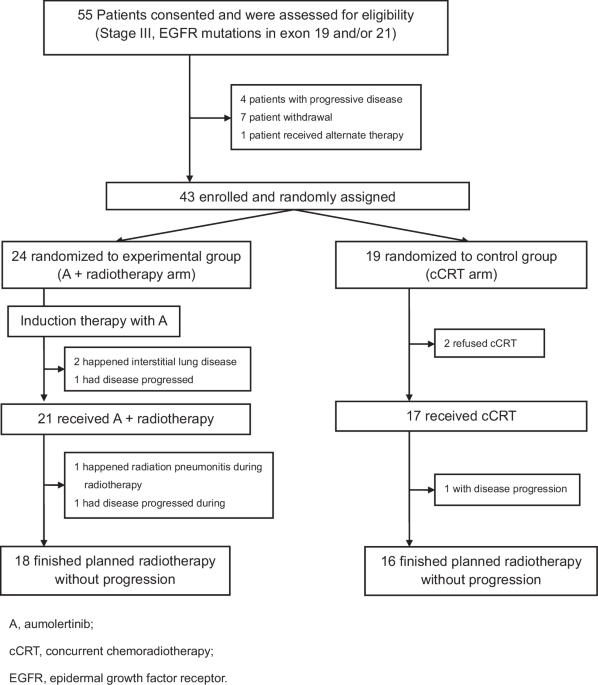
Study design and participants
The ADVANCE trial was a multicenter, open-label, phase III randomized controlled clinical trial planned from March 2021 to March 2024 at 37 centers (ChiCTR.org: ChiCTR2000040590). A protocol-specified real-world data (RWD) cohort from 7 of the 37 sites (ClinicalTrials.gov: NCT04304638) was used to validate long-term survival outcomes in patients with EGFR-mutated stage III NSCLC treated with third-generation EGFR TKI and upfront radiotherapy.
Eligible participants were patients aged 18 to 75 years with pathologically confirmed, unresectable, locally advanced non-squamous NSCLC (stage IIIA/B/C, AJCC 8th edition).33 The required workup included bronchoscopy, brain MRI, and PET-CT. Central laboratory confirmation of EGFR exon 19 deletion or L858R mutations using tissue samples was mandatory. Additional criteria included ECOG performance status 0–1 (stable over prior 2 weeks), no prior systemic or local therapy, life expectancy of at least 12 weeks, and presence of at least one measurable lesion per RECIST 1.1. Key exclusion criteria included locoregional recurrence of lung cancer, prior EGFR-TKI, chemotherapy, or radiotherapy; uncontrolled pleural/pericardial effusion; and history or evidence of active interstitial lung disease. A complete list of inclusion and exclusion criteria is provided in Table S1.
This trial adhered to Good Clinical Practice and the Declaration of Helsinki. Ethical approval was obtained from the ethics committees at the Cancer Hospital, Chinese Academy of Medical Sciences, and its Shenzhen center (ADVANCE trial: 21/115-2786 and 2020-177; RWD: NCC2247/NCC-003678). All participants provided written informed consent.
Random assignment and treatment
Patients were randomly assigned in a 1:1 ratio to receive either aumolertinib plus radiotherapy (experimental arm) or cCRT (control arm). A random permutation sequence was performed centrally by the statistician and used to generate patient random assignment numbers. Random assignment was stratified by EGFR mutation subtype (exon 19 deletion vs. L858R).
In the experimental arm, patients received oral aumolertinib (110 mg once daily) as a 9-week induction therapy, followed by concurrent aumolertinib and RT (60 Gy ± 10%, delivered in daily fractions 5 days/week). Control arm participants received platinum-based cCRT for two cycles. Patients with non-progressive disease at the 3-week post-cCRT evaluation could receive either optional consolidation chemotherapy or surveillance. Simulation, target volume definition, prescription, planning details, and concurrent chemotherapy/aumolertinib details are provided in Table S2.
The RWD cohort comprised three treatment groups: cCRT alone (cCRT group), cCRT followed by third-generation EGFR-TKIs (cCRT+TKI group), or RT combined with third-generation EGFR-TKIs (RT + TKI group).
Endpoints
The primary endpoint was PFS in the intention-to-treat (ITT) population, defined as the interval from randomization to the first occurrence of disease progression or death from any cause. Tumor assessments were performed based on RECIST v1.1 and reviewed by the investigator and a blinded independent radiologist (Table S3). Secondary endpoints included OS (time from randomization to death from any cause), objective response rate (ORR; proportion achieving complete [CR] or partial response [PR] as best response), depth of tumor response (maximum reduction in sum of target lesion longest diameters versus baseline, requiring no new lesions or non-target progression), gross/planned tumor volumes (GTV/PTV), organs-at-risk parameters (pre-/post-aumolertinib in experimental arm), and quality of life (QOL; EORTC QLQ-C30 version 3.0). Depth of response was assessed by two independent physicians (Drs. Tao Zhang and Lei Deng).
Acute adverse events (AEs) were graded according to NCI-CTCAE version 5.0, starting from randomization and continuing until three months after the completion of radiotherapy. Protocol-specified management allowed continuation/restart of aumolertinib for CTCAE grade 1 interstitial lung disease (ILD) or radiation pneumonitis. Follow-up assessment details are provided in Table S3.
For the RWD cohort, PFS and OS were defined as time from the end of RT to progression or death.
Statistical analysis
Based on prior data,10,30,34,35 median PFS was assumed to be 12 months with cCRT. The study was designed to detect a hazard ratio (HR) of 0.5 (corresponding to an improvement in median PFS to 24 months) using an exponential model under the proportional hazards assumption. With 66 disease-progression events, the study was estimated to have 80% power at a two‑sided alpha level of 0.05. After accounting for a 15% attrition rate, a sample size of 98 patients was planned. PASS 15.0 was used for sample size calculation. There was one prespecified interim analysis at 40% of PFS information for futility monitoring only. If the observed HR were >1.0 at the interim analysis—suggesting that the experimental arm was unlikely to demonstrate superiority, early stopping would be considered for futility. The interim analysis was not part of a formal efficacy stopping framework with alpha-spending boundaries.
Patient enrollment began in March 2021 across 11 sites. In September 2023, preliminary differences observed in progression risk between arms led several investigators to raise concerns about equipoise in the open-label setting. An investigator committee was formed, and a blinded, independent data analysis committee conducted a prespecified interim analysis in December 2023, including 40 randomized patients (plus 3 in screening). The results showed significantly longer PFS in the experimental arm (not reached vs. 6.2 months; HR 0.15; 95% CI, 0.04–0.58; P = 0.0002). On the other hand, the LAURA study was published, demonstrating a clear PFS benefit with consolidation targeted therapy following cCRT. This landmark trial meant that our control arm (cCRT alone) was no longer considered an optimal standard of care, and the principle of equipoise was no longer maintained. Given the magnitude of the observed benefit, the open-label design, and slow patient accrual, the trial was prematurely closed in March 2024 after approval from the ethics committees at the Cancer Hospital, Chinese Academy of Medical Sciences, and its Shenzhen center. The final data cutoff date was October 30, 2024.
Efficacy analyses were conducted on the ITT population, defined as all randomized patients. A per-protocol population (“LAURA-like set”) included patients who completed planned radiotherapy without disease progression. Safety analyses included all patients who received at least one dose of study treatment, based on the actual treatment received. Prespecified subgroup analyses of PFS included sex, age (<65 vs. ≥65), smoking history, EGFR mutation type (exon 19 deletion vs. L858R), and ECOG performance status (0 vs. 1).
Continuous variables were presented as mean (standard deviation) or median (range) and compared using Student’s t test or the Wilcoxon rank-sum test, as appropriate. Categorical variables were compared using the chi-square test or Fisher’s exact test. PFS and OS were estimated using the Kaplan–Meier method and compared using the log-rank test. Raw scores and absolute changes in functioning and symptom scores from the EORTC QLQ-C30 were compared between treatment arms at each QOL assessment visit using analysis of covariance (ANCOVA). All statistical analyses were performed using SPSS version 22.0, and two-sided P values < 0.05 were considered statistically significant.
Design of cohort from Real-World Database (RWD)
A protocol‑prespecified real‑world cohort, derived from 7 of the 37 study sites (ClinicalTrials.gov: NCT04304638), was established to provide supportive contextual evidence for the randomized trial findings. Using long‑term follow‑up data, this cohort aimed to characterize treatment patterns and real‑world outcomes, thereby validating the superiority in PFS of upfront radiotherapy or cCRT combined with third‑generation EGFR‑TKIs over cCRT alone in patients with EGFR‑mutated stage III NSCLC. Given the observational nature of these data, analyses are intended to assess consistency of associations with the randomized results rather than to provide confirmatory causal inference. This cohort comprised two parts: (1) retrospective data from patients treated for LA-NSCLC harboring EGFR mutations between March 2012 and November 2020; and (2) prospective enrollment from an observational cohort treated in the real-world setting from December 2020 until the closure of the ADVANCE trial. Patients were recruited from six centers that participated in the ADVANCE trial. The protocol received approval from the Ethics Committee of the Cancer Hospital, Chinese Academy of Medical Sciences (Reference: NCC2247/NCC-003678). Patient selection followed the key criteria of the ADVANCE trial protocol, with the exception that patients with squamous carcinoma or ILD were permitted to be included. Endpoint definitions and statistical methods aligned with those of the ADVANCE trial protocol.
