


The data confirms that our service began to struggle to achieve a waiting time of 90 days or less for SNB from 2017 onwards (96% in 2010 to 12% in 2023). Increasing disease prevalence, service funding constraints and logistical issues with tracer agents have all contributed, with the covid-19 Pandemic adding further burden. Similar trends across the UK have been anecdotally reported. Time-to-treatment has not been previously investigated using a comparably thorough approach across three critical time points in the melanoma treatment pathway. In the context of a heterogenous and insufficient evidence base, with few patients experiencing delays exceeding 90 days, this one of the first studies to address these important health concerns in the modern melanoma era.
Our analysis shows that delays translate into potential patient harm, not only in the admittedly small, but statistically significant, increased risk of disease progression on the waiting list, but also in the increased micrometastatic burden for SNB-positive patients, and disease-specific survival for patients treated in the adjuvant systemic therapy era. We attribute this significantly worse 5-year absolute survival difference (delta=6.6%; HR = 3.15; p = 0.015) to the increased risk of distant disease spread from the greater micrometastatic burden seen in the sentinel nodes. This is concerning given the availability of effective systemic therapy options [5, 9]. Our data confirms that there is a time-critical element to SNB in managing patients with occult nodal micrometastases, with potential harm for those who experience delays.
Our analysis demonstrated that the risk of progression and palpable nodal disease while on the waiting list increases after 90 days. Nodal progression is also an indication for AST, according to current UK guidelines, and more recently neoadjuvant therapy [5]. Most of these patients will undergo more extensive surgery from therapeutic lymph node dissection, with the potential for negative quality of life impact on the patient with perioperative complications and long-term lymphoedema. Thus, granted the increased rate of progression is small (0.68%), it is still nonetheless clinically relevant. Data from the MSLT-1 study [6] suggested that patients with micrometastases in sentinel nodes will develop palpable disease with a greater metastatic burden if untreated, indicating the temporal nature of this issue. Although MSLT-1 measured time in months, our significant results suggest that, for a minority, 90 days is enough for progression.
The pivotal finding of the analysis is the temporal association between SNB and micrometastatic disease burden, which corroborates previous data [17, 18]. SNB performed after 90 days led to significantly larger tumour deposits (median 2.95 mm vs 1.40 mm; p < 0.001), and a higher proportion of high-risk deposits >1 mm (55.2% vs 69.0%; OR = 1.81; p = 0.030). Our data highlights the concerning speed of progression, measured in days rather than months. The current AJCC (8th Edition) classification for melanoma, indicated that increasing deposit size is significantly associated with worse melanoma-specific survival [2]. In the DeCOG-SLT study, high risk deposits (>1 mm) acted as independent predictors of a poorer DMFS [19]. A recent multicentre study showed that patients with AJCC pT1b-pT2a primaries and low micrometastatic burden (<0.3 mm) have DSS outcomes identical to those with negative SNBs, suggesting a therapeutic benefit for SNB also observed in MSLT-1 and AJCC data [8]. Other studies confirm that, while low-risk micrometastases <0.3 mm are less common in higher-risk primaries, resecting them at SNB may still offer benefit [2, 8]. These findings support the importance of timely SNB to avoid missing a therapeutic window for a clinically significant subset of patients.
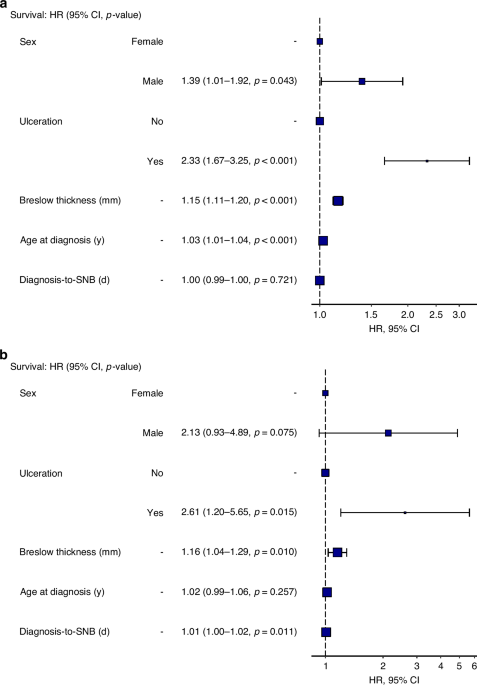
Whereas the earlier endpoints (progression on waiting list and micrometastatic burden) applied to the full cohort, the survival analysis focused on the modern treatment era to assess the effect of delay under current care standards. Whilst the treatment paradigm for palpable disease continues to evolve [20, 21], the indications for offering AST for micrometastatic disease have remained consistent since its introduction in the national guidelines [5, 9]. Multivariable analysis confirmed sex, age, primary AJCC tumour stage (Breslow thickness) as independent survival predictors, aligning with AJCC classifications and prior evidence [2]. Whilst our initial univariable and multivariable analyses stratified by the 90-day cut-point failed to indicate it as an independent predictor of survival outcome, multivariable analysis showed that time-to-SNB was a significant independent predictor of DSS outcome when assessed as a continuous variable, suggesting that the arbitrary cut point of 90 days was incorrect. This conclusion was confirmed by the subsequent sensitivity analysis, which highlighted the 68-day cut point, with significant separation of the disease-specific survival curves (HR = 3.17; p = 0.015). In the post-2016 cohort, longer waiting times were significantly associated with increased melanoma-specific mortality. Existing literature includes very few patients treated after 2016 and none beyond 2018, limiting its relevance to the post-pandemic treatment era. A high-risk micrometastatic burden greater than 1 mm was also associated with increased mortality, indicating that time-to-SNB, sentinel node burden, and DSS are closely interconnected.
We would also highlight that the sensitivity analysis has allowed for a specific definition of treatment delay (and, indeed, harm), based on relevant clinical endpoints. Our data suggest that the current 90-day target should be shortened to 68 days from diagnosis or 82 days from excision biopsy, assuming similar median reporting intervals. The latter is less dependent on variable pathology reporting times and may therefore serve as a more consistent performance measure, whilst acknowledging that prolonged pathological delays may further extend treatment intervals.
As a cautionary note, Tejera Vaquerizo et al. in 2015 [22] and 2017 [23] paradoxically noticed that melanomas which received a timely SNB (within ≤40 days) suffered a worse DSS compared to their counterparts at >40 days (HR = 2.06 (95% CI = 1.1–3.53); p = 0.08), which they attributed to the disproportionate prioritisation of primary melanomas with high-risk characteristics. Interestingly, Mandala et al. [24] also observed a 30% lower risk of recurrence and/or death was experienced in negative-SNBs with surgery performed ≥32 days after primary excision (HR = 0.70 (95% CI = 0.63–0.79); p < 0.001 for RFS and 0.69 (95% CI = 0.61–0.78); p < 0.001 for OS), but not SNB positive cases.
The results of this retrospective study at our supra-regional centre should be interpreted with caution without further external validation. The median follow-up in the post-2016 cohort, 39 months, is relatively short. Potential confounders like socioeconomic data, patient performance status, molecular subtyping and the incidence of systemic therapy were incomplete.
