


Sex as a biological variable
Pancreatic cancer affects both sexes in almost equal proportions. Our clinical cohort analysis included both male and female patients. In vivo studies used female athymic host mice. Sex in this in vivo model does not affect therapeutic response.
Cell culture
Human pancreatic cancer cell lines (MiaPaca-2, Panc-1, AsPC1) were purchased from ATCC and were cultured as previously described [25,26,27]. Human CAFs were isolated from PDAC tumour tissue by explant culture (using outgrowth method) and were utilised up to 12 passages [28, 29]. CAF purity was assessed by 100% positive immunostaining for alpha-smooth muscle actin (αSMA) and glial fibrillary acidic protein (GFAP) and negative immunostaining for cytokeratin as described [30]. IMDM media with 10% FBS, 4mM L-glutamine was used to culture all CAFs. All cells were continued in culture using humidified incubator (37 °C, 5% CO2) and tested negative for mycoplasma [MycoAlert Mycoplasma Detection kit (Lonza)] once monthly throughout study. The use of human derived CAFs were approved by UNSW Sydney human ethics committee (approvals: HC14039, HC180973, HREC13/023) and the German Technical University of Munich human ethics committee, approval:5510/12).
Western blot for HSP47
Protein lysates were prepared, quantified, and electrophoresed on a 10% SDS-PAGE gel and nitrocellulose membrane was used for transfer as described [26]. The following antibodies were used to probe the blots: HSP47 (Stressgen, Cat. SPA-470; 1:1000), GAPDH (Abcam, Cat. ab8245; 1:50,000), anti-mouse IgG-HRP secondary antibody (DAKO, Cat. P0447; 1:2000). Bands were visualised using Amersham ECL (RPN2106, GE Healthcare) and scanned using LAS4000 and quantified using ImageJ.
siRNA transfection
100 nM smartpool On-target plus human HSP47-siRNA pool (Dharmacon Cat. L-011230-00-0020; 4x siRNA sequences) or non-silencing siRNA (ns-siRNA Dharmacon Cat. D-001810-10-20) was utilised to transfect human CAFs, MiaPaCa2, AsPC1 as previously described [25,26,27].
Cell cycle microarray
48 h post-transfection with ns-siRNA pool or HSP47-siRNA, CAFs were treated with 10 ng/mL PDGF for 48 h after which RNA was extracted and processed for qPCR array. TaqMan Gene Signature plates for cell cycle were used (AB Applied Biosystem, Cat 4414116 and Cat. 4414123) according to manufacturer instructions. ABI 7900 HT instrument was used to run samples.
The production and establishment of stable human CAF cells expressing HSP47 shRNA
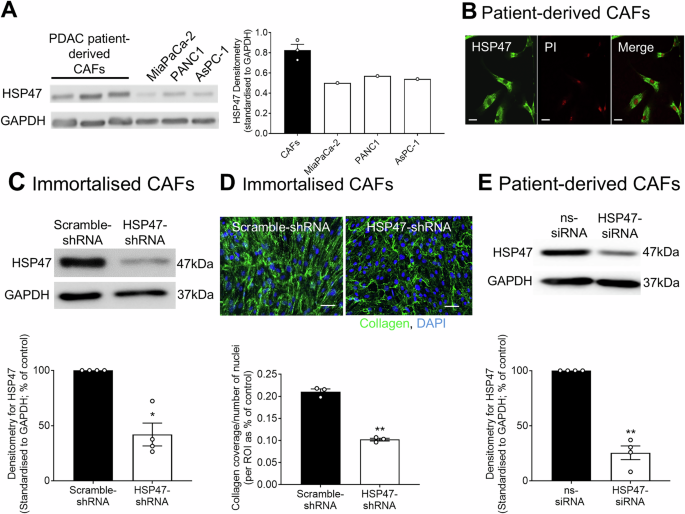
Lentiviral delivery of a human telomerase construct system (GenTarget, Cat. LVP1131-RP) was used to immortalise human patient-derived CAFs (passage 9). Immortalised cells were selected in puromycin and red fluorescent protein-positive cells sorted on a BD FACs Aria II as previously described [31]. The proliferation of the hTERT-CAFs was comparable to that of the parent cells (Supplementary Fig. 1A). hTERT-immortalised CAFs were then transduced with lentiviral scramble(control)-shRNA and HSP47-shRNA sequence (Origene, Cat. TL316478V). Transduced cells were selected with puromycin and GFP-positive cells sorted on a BD FACS Melody (Supplementary Fig. 1B). Western blot confirmed HSP47 knockdown relative to scramble-shRNA controls. All CAF shRNA cell lines were re-validated by positive immunostaining for αSMA and GFAP and negative immunostaining for cytokeratin and were used within 50 passages of immortalisation.
Immunofluorescence staining
HSP47 localisation
CAFs were seeded onto glass chamber slides and allowed to adhere for 48 h. The slides were then fixed with 4% paraformaldehyde, and permeabilised with 0.5% Triton x-100 for 10 min at room temperature. Slides were blocked in 1% BSA/PBS for 30 min at room. Primary antibody to HSP47 (Stressgen, Cat SPA-470; 1:50) was used overnight at 4 °C, followed by three 5-min washes in 0.1% Tween-20/PBS at room temperature. Slides were then incubated with goat anti-mouse AlexaFlour 488 (Invitrogen, Cat. A11001; 1:1000 dilution for 45 min at room temperature), for nuclear stain propidium iodide (Sigma, Cat. P4864; 1:1000 for 5-min at room temperature) was used. Images were captured using Leica confocal microscope.
Collagen I staining
CAFs were seeded onto glass chamber slides, 24 h post-seeding, cells were treated with 5mM L-ascorbic acid for 48 h. Cells were then fixed and stained as per HSP47 immunofluorescence procedure above except cells were not permeabilised to maintain extracellular collagen and they were blocked with 2% Goat serum/10% glycerol in PBS for 30 min at room temperature. The follow antibodies were used: Rabbit Collagen type I antibody (Rockland antibodies and assays Cat. 600-401-103-0.5; 1:100) overnight at 4 °C, goat anti-rabbit AlexaFluor 488 (Molecular Probes, Cat. A-11008; 1:1000) 45 min at room temperature. Cells were mounted using Prolong Gold Antifade (ThermoFisher Scientific, Cat. P36931) and imaged using Zeiss 900 confocal microscope.
Cell proliferation assay
CAF proliferation or viability was measured by cell counting kit-8 (CCK8) kit (Dojindo) or trypan blue as previously described [25,26,27]. Proliferation and viability measurements were performed at the following time points: i) 72 h post-transfection with siRNA; ii) 48 h post platelet-derived growth factor (PDGF; BioScientific Pty Ltd, Cat. 220-BB; 10 ng/mL), Transforming growth factor beta 1 (TGFβ1; BioScientific Pty Ltd, Cat. HZ-101; 1 ng/mL), or tert-butyl hydroperoxide (tBHP; sigma; 0–40 µM) treatment. MiaPaCa-2 and AsPC1 proliferation were measured by direct cell count (cell-by-cell detection over 16 fields of view per well; average count per field of view graphed) on an IncuCyteS3 platform.
Cell migration assay
CAF migration was studied using a Boyden Chamber assay as previously described [29] with some modifications. Briefly, 48 h post-transfection with ns-siRNA pool or HSP47-siRNA pool cells were re-seeded into inserts (In-vitro Technologies, Cat. FAL353182) with porous membrane (8.0-µm) placed into wells containing serum-reduced media (0.1% FBS IMDM) ± PDGF (10 ng/mL). Cells were cultured for a further 48 h under these conditions. The number of cell migrated through the pores was expressed as a migration index (%): (number of cells on the bottom of the membrane/total number of cells on both surfaces of the membrane) × 100.
Cell cycle and apoptosis assays
Detection of apoptosis
72 h post siRNA transfection, attached and floating cells were collected, and detection of total apoptosis was performed using an Annexin V-PE/7AAD kit (BD Bioscience, Cat 559763) according to manufacturer’s instruction. BD LSR FortessaTM was used to analyse data (gating strategy in Supplementary Fig. 1C).
Cell cycle assay
48 h post siRNA transfection, CAF cells were treated ±PDGF (10 ng/mL) for 48 h, and cell cycle measured by PI staining and flow cytometry on a BD LSR FortesaTM, as described [26, 27] (gating strategy in Supplementary Fig. 1D).
Star nanoparticle synthesis
Star nanoparticles (Star 3) were synthesised as previously described by our team [25]. The star nanoparticle was purified by several precipitation in mixture diethyl ether/ hexane to remove unreacted arms. The purified star nanoparticle was analysed by GPC, NMR and FTIR after purification to determine its composition [final composition: foligoethylene glycol methyl ether methacrylate (OEGMA)/fDimethylaminoethyl methacrylate (DMEAMA) 14.5/85.5 mol %; Mn = 155,000 g/mol ( ± 5000 g/mol)]. The nanoparticle was solubilised in methanol and dialysed with acidic water (pH = 3.0) for 24 h, and then further dialysed using water (pH = 6.5) for 48 h, then freeze-dried [Teo et al., Biomacromolecules, 2016]. Star nanoparticle was analysed by DLS [Average Size DLS = 28 (+/−5 nm), Average Zeta potential = 40 (+/−3)]. siRNA encapsulation efficiency at the ratio used (16:1 siRNA:Star 3) is ~100% by gel shift assay.
Orthotopic pancreatic cancer mouse models
Female Balb/c nude mice (8 weeks old) were used at surgeries. Star 3-siRNA therapeutic study (therapeutic knockdown): 1 × 10⁶ Luciferase-expressing MiaPaCa2 cells and 1 × 10⁶ CAF cells were co-implanted into the tail of the pancreas of mice as previously described [26, 31]. Mice were randomised 4 weeks post-surgery based on luminescence as previously described [26, 31]. Blinding was not possible during treatments due to staff availability. Mice were then treated with 3 mg/kg control-siRNA (antisense: 5’-GAACUUCAGGGUCAGCUUGCCG) or HSP47ss-siRNA single sequence (antisense: 5’-AGCCCAGCCAGGUGUUUCUUU) complexed to Star 3 intravenously daily for the first three days, followed by twice weekly for 4 weeks. Orthotopic model (stable shRNA cell lines): 1 × 10⁶ Luciferase-expressing MiaPaCa2 cells and 1 × 10⁶ immortalised CAFs stably expressing either control-shRNA or HSP47-shRNA, were co-implanted into the tail of the pancreas as previously described [26, 31]. VisualSonics Vevo 3100 ultrasound was used to measure tumour volume weekly from week 4 post-implantation. Mice with no measurable tumour at week 4 were excluded (2 exclusions). At the end of both studies, mice were humanely euthanised and organs/tumours harvested. Calliper measurement was carried out to calculate tumour volume (Length × Width × Height/2), with operator blinded to treatment. Tumours were fixed in 4% paraformaldehyde and paraffin embedded. The detection of metastases was conducted by ex vivo luminescence (>600 counts) and confirmed by H&E as previously described [26, 31].
Polarised light analysis in tumour sections
Polarised light imaging of picrosirius red-stained tissue sections was performed on an Olympus VS200 slide scanner using a 40×/0.95 objective. The percentages of low-, medium-, and high-birefringent collagen were calculated from scanned whole explant sections using the MATLAB Colour Thresholder application. The analysis was performed on HSV-converted images, where Hue (H), Saturation (S), and Value (V) range from 0 to 1. Hue represents a circular colour wheel starting at 0 (red) and progressing through yellow, green, cyan, blue, magenta, and back to red at 1. For classification, Hue-Saturation-Value thresholding was applied as follows: High birefringent (red) fibers: 0.9 ≤ H ≤ 1.066, equivalent to ~324°–23.7° on the 0–360° scale, covering raspberry to orange hues including reds. Medium birefringent (orange) fibers: 0.0661 ≤ H ≤ 1.149, corresponding to 23.7°–53.6°, which spans orange to yellow hues. Low birefringent (green) fibers: 1.1491 ≤ H ≤ 1.398, equivalent to 53.6°–143°, covering yellow-green to turquoise hues. These ranges encompass the major hues observed in Picrosirius Red polarization images. Saturation was not restricted (0–1) to avoid bias from fiber brightness variations, which can occur due to sample thickness rather than actual birefringence. A Value threshold of V > 0.113 was applied to exclude background pixels outside tissue regions.
Immunohistochemistry and histology for Alpha Smooth Muscle Actin (αSMA), Picrosirius red, and CD31 in mouse PDAC tumours
Paraformaldehyde-fixed, paraffin-embedded tumour sections (5 µm) were stained by immunohistochemistry as described [26, 27, 31]. For mouse primary antibodies Mouse on Mouse (M.O.M) immunodetection kit (Vector Laboratories, Cat. BMK-2202) was used to stain mouse PDAC tumours following manufacturer’s instructions. The following primary antibodies were used: mouse αSMA (1:5000) (Sigma Cat. A5228), and rat CD31 (1:20) (Dianova, Cat. DIA-310). Secondary antibody for CD31 was Biotinylated Rabbit anti-rat IgG (Vector Laboratories, Cat. BA-4000; 1:100). Hematoxylin was used as a counter stain and 3, 3′ diaminobenzidine tetrahydrochloride (DAB) substrate was used to visualise immunohistochemistry staining as previously described [26, 27, 31]. CD31-positive blood vessels (manual count of open vs closed) and αSMA area coverage were analysed in representative tumour regions using ImageJ with colour deconvolution module or in Qupath using positive pixel detection (excluding necrotic regions). The average tumour coverage of representative regions was 24% for αSMA analysis and 53% for CD31 analysis. For Picrosirius red histology, 5 µm paraffin-embedded tumour sections were stained with 0.1% picrosirius red and counter-stained with methyl green or hematoxylin. Representative region average tumour coverage was 55%. All tissue sections were scanned on AperioXT (Lecia Biosystems) or Vectra Polaris (PerkinElmer) slide scanner. QuPath software and ImageJ were used to quantify the amount of αSMA and CD31 positivity in the whole-tissue.
3D organoid growth assay
Co-culture organoids were established by mixing MiaPaCa-2 PDAC cells and human CAFs in a 1:1 ratio (5000 cells total), allowing spheroid formation for 24 h in a low adhesion, round bottom 96-well plate as previously described [31], then embedded in 100 μL 1:1 mix of Matrigel (ref) and complete culture medium (IMDM, 4mM L-glutamine, 10% FBS). Growth of spheroids was monitored over 4 days by bright field photos and area measurement, and standardised back to day 0 spheroid area. For organoids involving shRNA-expression CAFs, these cells were co-seeded with parent MiaPaCa-2 cells immediately from general culture. For organoids involving siRNA transfection of CAFs and MiaPaCa-2 cells, cells were transfected with ns-siRNA or HSP47-siRNA as above, then co-seeded to form spheroids 24 h post-transfection.
Contraction assay
Organotypic matrices were generated as previously described [6, 32]. Here, 3.5 × 10⁴ CAFs/matrix were embedded into acid-extracted rat tail collagen (~2 mg/ml) in the presence of 1× MEM, 8.8% FBS and neutralized with sodium hydroxide. Matrices were allowed to set at 37 °C prior to detachment and then allowed to contract for 6 days. For siRNA treatment, CAFs were transfected with ns-siRNA or HSP47-siRNA as detailed above, 24 h pre-embedding into collagen plugs. For shRNA treatment, CAFs stably expressing scramble or HSP47 shRNA were immediately embedded int collagen plugs.
HSP47 survival correlation in human PDAC cohort
Formalin-fixed, paraffin-embedded human PDAC tissue microarrays (TMAs) were received from the Australian Pancreatic Cancer Genome Initiative (APGI; International Cancer Genome Consortium Cohort and Training cohort; patient demographics in Table 1) with written informed consent from patients. Tissues were stained with HSP47 by immunohistochemistry as previously described [26, 27, 31]. Briefly, primary HSP47 antibody was used at 1:50 dilution, sections were incubated with primary antibody for 1 h at room temperature while secondary antibody used was biotinylated Goat anti-mouse (DAKO, Cat. E0433) at 1:200 dilution for 45 min at room temperature. Survival analyses were performed as previously described [31]. Staining intensity was scored by two independent scorers in tumour and stromal compartments. Scoring for stain intensity was conducted using a four-point scale (0–3), based on staining intensity in ≥75% of each compartment (normal acinar/ductal cells excluded). A consensus score was obtained for each core. The highest tumour and stroma scores were used for each set of 3 cores per patient. Scores were then dichotomised into HSP47low (scores of 0–1) and HSP47high (scores of 2–3) groups for each compartment. Kaplan–Meier Survival Curve was then used to correlate scores with overall survival. Survival for HSP47low vs HSP47high groups was compared for individual tumour and stromal compartments, and for combined tumour and stromal scores for each patient. Patients were censored if they were deceased due to other causes/still alive, in addition non-PDAC tumours were also excluded. To correlate HSP47 expression with collagen content (total picrosirius red coverage, second harmonics generation and GLCM) we used data generated by Murphy et al. [7] and Vennin et al. [33] for the APGI PDAC cohort and matched it to each patient.
Table 1 Australian Pancreatic Cancer Genome Initiative Training and International Cancer Genome Cohort (ICGC) patient cohort characteristics.
PDAC tumour explant model
PDAC patient-derived tumour explants were established and treated with Star 3+control-siRNA or Star 3+HSP47ss-siRNA every 72 h (days 0, 3, 6, and 9), as previously described [31, 34]. Day 0 and day 12 explants were fixed in 4% paraformaldehyde, paraffin embedded and sectioned as previously described [31, 34]. Histology (H&E, picrosirius red) and immunohistochemistry for HSP47 (Enzo Life Sciences, Cat. SPA-470; 1:100 dilution overnight at 4 °C), cytokeratin (DAKO, Cat. M3515; 1:100 overnight at 4 °C), αSMA (Sigma-Aldrich, Cat. A5228; 1:1000 dilution 1 h room temperature) and bromodeoxyuridine (DAKO, Cat. M0744; 1:50 dilution overnight at 4 °C) (BrdU; cells pulsed for final 24 h of assay with 10 µM BrdU) were performed on explant sections as previously described [31, 34] using the conditions described in immunohistochemistry and survival correlation methods sections above. Frequency of cytokeratin, BrdU and αSMA positive cells was quantified from whole explant sections using QuPATH. Polarised light analysis performed as per orthotopic model analysis.
Statistics
Two-tailed Student’s t test (2 groups) or one-way/two-way ANOVA (≥3 groups; post-hoc test: Dunn’s, Sidak’s or Bonferroni multiple comparison) were performed for statistical comparison using GraphPad Prism (version 10.4.1). For survival curves, the multivariate associations between variables and time event were created from the Cox proportional hazards (PH) regression and survival curves calculated using the method of Kaplan–Meier (KM). Survival analyses were performed using Analysis of Censored and Correlated Data (ACCoRD) V6.4 Boffin. A p-value of ≤0.05 was considered statistically significant. Sample size was selected based on similar prior studies that demonstrated minimum number required to obtain statistical significance for in vitro and in vivo studies. Patient number for the cohort analysis were based on the maximum number of patients provided in the cohort. All specific replicate numbers and individual replicate data points are provided in figures and figure legends. All in vitro experiments utilizing PDAC cells and/or immortalised CAFs were technical replicates. All explants experiments, in vivo experiments and in vitro experiments involving CAFs are biological replicates (Independent patient-derived CAFs).
Study approval
In vivo models: All mouse work was approved by the UNSW Sydney animal care and ethics committee (approval: ACEC 16/25B, ACEC 19/3A). Survival correlations: All studies involving the use of human specimens were approved by the UNSW Sydney human ethics committee (approvals: HC14039, HC180973). All patients provided written informed consent through the APGI. Explant model: Human PDAC tumour specimens were obtained from patients undergoing pancreaticoduodenectomy at Prince of Wales Hospital or Prince of Wales Private Hospital, Randwick, NSW, Australia. All patients provided written informed consent through the Health Science Alliance Biobank, all work was approved by UNSW human ethics (HC180973), and all experiments were performed in accordance with the relevant regulations.
